
Sea Ship and Air Ship Drop Test Difference: A 2026 Shipper’s Guide
Navigating the complex landscape of international shipping regulations presents a significant challenge for UK businesses. A single packaging miscalculation can lead to costly cargo damage, substantial financial losses, and complex insurance disputes. For many shippers, a critical point of confusion is the fundamental sea ship and air ship drop test difference. This distinction, governed by conflicting IATA and IMDG standards, dictates everything from packaging design to material strength, directly impacting your operational efficiency and bottom line.
As we approach 2026 and the implementation of updated safety protocols, achieving clarity on these standards is essential for compliance. This guide provides a definitive breakdown of the critical technical and regulatory differences between air and sea transit tests. You will gain a clear understanding of mode-specific drop heights, enabling you to optimise your packaging strategy, reduce damage rates, and ensure your shipments are both safe and fully compliant with international requirements.
Key Takeaways
- Understand the distinct regulatory frameworks, comparing IATA’s Dangerous Goods Regulations (DGR) for air freight with the IMDG Code for sea transit.
- Grasp the critical sea ship and air ship drop test difference by examining the specific variations in required drop heights and package orientations for different Packing Groups.
- Learn how to conduct a “Mode Risk Assessment” to select the optimal packaging materials and design for the unique physical stresses of either air or sea transport.
- Optimise your packaging strategy to ensure full compliance, reduce the risk of cargo damage, and enhance the overall integrity of your supply chain.
The Physics of Global Transit: Why Air and Sea Freight Demand Different Drop Tests
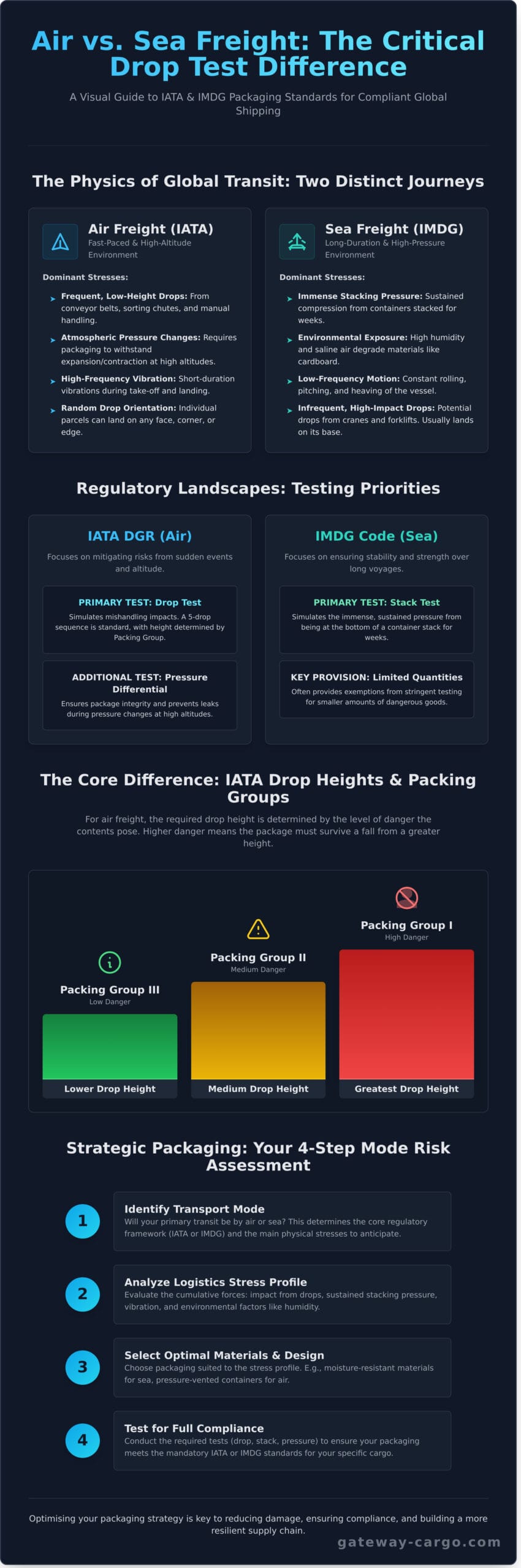
To optimise packaging for global transit, one must first understand the distinct physical journey a package undertakes via air versus sea. The forces, impacts, and environmental conditions are fundamentally different, which directly explains the sea ship and air ship drop test difference. From high-speed airport conveyor systems to the heavy, methodical movements at a maritime port, each stage presents unique risks that demand tailored packaging solutions and testing protocols.
Handling Environments and Kinetic Energy
The core of any drop test is managing kinetic energy. The force of an impact is critically influenced by drop height, which dictates the velocity at the moment of collision. Air freight, often comprising smaller, individually handled parcels, faces a higher frequency of low-height drops from conveyor belts, sorting chutes, or manual handling. In contrast, palletised ocean freight is moved by cranes and forklifts, where potential drops are less frequent but can be from much greater heights, resulting in significantly higher impact energy. A clear understanding of these variables is foundational to all package testing principles and ensures packaging is engineered for its specific supply chain.
The Impact of Port Automation on Cargo Stress
The increasing automation at UK ports introduces new variables. While AI-driven cranes can reduce human error and major drops, they create a consistent profile of mechanical stress and vibration. An aircraft subjects its cargo to short-duration, high-frequency vibrations, primarily during take-off and landing. A container ship, however, exposes goods to low-frequency but constant motion, including rolling and pitching, for weeks at a time. This is compounded by environmental stressors unique to sea freight, such as high humidity and saline air, which can degrade the structural integrity of materials like cardboard, making them more vulnerable to damage upon impact. The cumulative physical force exerted on a package during transit is defined as its Logistics Stress Profile. This profile, along with the likely drop orientation-air parcels on any face, sea crates on their base-dictates the necessary protective measures.
Regulatory Landscapes: Comparing IATA (Air) and IMDG (Sea) Testing Standards
Navigating the complex world of freight regulation is fundamental to ensuring supply chain integrity and safety. For hazardous or sensitive goods, the primary distinction between air and ocean transit lies in the mandatory testing protocols established by their respective governing bodies. The International Air Transport Association (IATA) and the International Maritime Dangerous Goods (IMDG) Code dictate distinct standards that reflect the unique physical stresses of each transport mode. Understanding these differences is critical for compliance and risk mitigation.
IATA Standards for Air Shipments
Air freight safety protocols prioritise a package’s ability to withstand sudden impacts and atmospheric changes. The IATA Dangerous Goods Regulations (DGR) mandate rigorous drop testing to simulate potential mishandling during loading and turbulence in flight. The severity is determined by the “Packing Group” system:
- Packing Group I: High danger (e.g., highly corrosive acids)
- Packing Group II: Medium danger
- Packing Group III: Low danger
A package in Packing Group I must endure a drop from a greater height than one in Group III. The standard test involves a 5-drop sequence onto a rigid surface. Crucially, alongside drop tests, air cargo packaging must also pass a pressure differential test to ensure it can withstand pressure changes at altitude without leaking. Adherence to these IATA testing standards is non-negotiable for air transit.
IMDG and Maritime Safety Requirements
The core sea ship and air ship drop test difference stems from the primary risks involved. While impacts occur, the IMDG Code’s main concern is the immense, sustained pressure within a cargo hold. Packages at the bottom of a container stack must support the weight of everything above them for weeks at sea. Consequently, the IMDG code often places greater emphasis on stack testing over drop testing. Furthermore, the code includes “Limited Quantity” exemptions, which may waive stringent testing for smaller amounts of certain dangerous goods, a provision less common in air freight. For shippers seeking a unified testing solution, bodies like the International Safe Transit Association (ISTA) provide protocols that can help bridge regulatory gaps for multimodal journeys.
The critical crossover point for shippers is the use of UN Specification packaging. This packaging is performance-tested to meet stringent global standards, often satisfying the requirements for both air and sea transport and simplifying logistics. As regulations evolve, such as the 2026 standards increasing the focus on “Combination Packaging” durability, relying on certified, robust packaging solutions becomes an essential strategy for optimising global supply chains.
The Technical Breakdown: Key Drop Test Metric Differences
While both air and ocean freight demand robust packaging, the specific testing protocols they mandate are distinct. These standards, governed by bodies like the IATA (International Air Transport Association) and IMO (International Maritime Organization), are not interchangeable. The core sea ship and air ship drop test difference lies in the simulation of different handling environments, from automated airport sorting hubs to the prolonged vibrational stress of a container vessel.
Drop Height Disparities
Air freight protocols typically mandate higher drop tests to account for the greater potential for manual handling and shocks within fast-paced airport logistics. The required drop height is determined by the UN Packing Group (PG) of the goods:
- Packing Group I (High Danger): Requires a drop from 1.8 metres for air transport, compared to 1.2 metres for sea.
- Packing Group II (Medium Danger): Standardised at a 1.2-metre drop for both modes.
- Packing Group III (Low Danger): Requires a 1.2-metre drop for air, but only 0.8 metres for sea.
Furthermore, specialised air cargo, such as UN 2814 Infectious Substances, must withstand a severe 9-metre drop test. Industry projections for 2026 suggest that increased automation in sorting facilities will raise average impact forces, making adherence to these higher standards essential for risk mitigation.
Orientation and Sequence
A crucial part of understanding the sea ship and air ship drop test difference is the sequence of impacts. Air freight certification often follows a stringent 5-drop sequence onto a rigid, non-resilient surface like steel or concrete. This sequence methodically tests the package’s integrity from every angle:
- Flat on the bottom
- Flat on the top
- Flat on the long side
- Flat on the short side
- On a corner
In contrast, testing for sea freight may incorporate more prolonged stress simulations, like vibration and compression tests, to mimic stacking and movement at sea. The corner drop is statistically the most frequent point of failure in these tests, as it concentrates the entire impact force onto a small, vulnerable area. A “pass” is documented only when the package shows no leakage or structural compromise that would allow its contents to escape. Any breach constitutes an immediate failure.
Strategic Packaging: How to Optimize for Mode-Specific Risks
Effective packaging is not a one-size-fits-all solution; it is a strategic component of your logistics plan. Before designing any outer packaging, conducting a “Mode Risk Assessment” is critical. This assessment analyses the unique stresses your cargo will face, from handling procedures to environmental conditions. Understanding the fundamental sea ship and air ship drop test difference is central to this process, ensuring your packaging is engineered for the specific journey ahead.
Material selection is a direct outcome of this assessment. While lightweight corrugated cardboard is often sufficient for air freight, heavier, more durable materials like treated wood or high-density plastic are frequently required to withstand the stacking pressures and prolonged transit of ocean freight. Internally, customised cushioning and dunnage-such as foam inserts or air pillows-are essential for both modes to absorb impact energy and prevent product movement, a primary cause of damage.
Designing for the Air Cargo Environment
For air cargo, the primary objective is to optimise the strength-to-weight ratio. Packaging must be lightweight to manage costs, yet robust enough to protect against drops and impacts during rapid manual handling. High-impact corner strength is paramount. Forward-thinking shippers now leverage AI-driven simulations to predict drop outcomes and refine designs digitally before committing to physical testing, saving both time and resources. As a sustainability tip, consider using moulded recycled pulp inserts, which offer excellent cushioning performance with minimal environmental impact.
Designing for Sea Freight Resilience
Packaging for ocean transit demands a focus on long-term resilience. The primary challenge is moisture resistance, as humidity within a container can soften and compromise standard corrugated materials over a multi-week voyage. Furthermore, edge protection is significantly more critical for palletized sea loads, which face constant vibration and pressure from stacked containers. Bespoke packaging, validated through certified testing protocols to address these specific risks, has been shown to reduce damage-related insurance premiums by an average of 15-20%. This proactive approach underscores the key sea ship and air ship drop test difference: air freight prioritises acute impact resistance, while sea freight demands endurance against chronic environmental and mechanical stress.
To develop an optimised packaging solution for your cargo, consult with our logistics specialists.
Beyond Compliance: Building a Smarter Supply Chain with Gateway Cargo
Understanding the technical standards for freight packaging is only the beginning. At Gateway Cargo, we transform compliance data into a strategic advantage, creating a more resilient, intelligent, and sustainable supply chain. The information gleaned from understanding the sea ship and air ship drop test difference is not just a box to be ticked; it is a critical data point that fuels our AI-driven digital platform, enabling predictive risk analysis and proactive logistics planning for every shipment.
By verifying that your packaging meets the appropriate standards, we directly contribute to our shared sustainability goals. Properly secured cargo significantly reduces the risk of damage, which in turn minimises product loss, avoids the carbon cost of returns and replacements, and cuts down on material waste. This is how we move from simple testing to building a genuinely smarter, more responsible global distribution network.
Gateway Cargo’s Specialist Approach
For high-value, fragile, or mission-critical shipments, we employ a deeply consultative process. Our specialists work as an extension of your team, analysing product specifications and transit requirements to devise a bespoke packaging and transport strategy. We build robust intermodal solutions that account for the unique stresses of each leg of the journey, bridging the gap between air, sea, and road transport protocols. This ensures your goods are protected from the first mile to the last, where our commitment to sustainability continues with the use of EV vehicles and designated green corridors for final-leg delivery in the UK.
Optimizing Your Global Reach
Moving from testing to seamless global distribution requires expertise beyond packaging. We empower our clients with ongoing education through our “Insights” hub, featuring market updates and whitepapers that help you navigate the complexities of international trade. This expertise is particularly vital during customs inspections. Our deep knowledge of UK and international customs clearance procedures ensures that your properly packaged and documented goods move through checkpoints without costly delays, preserving your delivery timelines and protecting your budget. Let us show you how a proactive, data-led approach can transform your logistics from a cost centre into a competitive advantage.
Contact our logistics specialists to optimize your freight strategy today.
From Compliance to Competitive Edge: Mastering Global Transit Risks
As we have explored, the physical forces inherent in air and sea transit are vastly different, mandating distinct testing protocols under IATA and IMDG regulations. Understanding the sea ship and air ship drop test difference is more than a matter of compliance; it is the foundation of a resilient packaging strategy that protects your assets, reduces waste, and safeguards your brand’s reputation across global supply chains.
Navigating these complexities requires a strategic partner. At Gateway Cargo, our specialists leverage an AI-Driven Digital Strategy to analyse mode-specific risks, delivering Bespoke Freight Solutions that ensure your packaging is optimised for its specific journey. Our commitment to Sustainability-First Logistics means we help you achieve compliance and efficiency while minimising your environmental impact, preparing your business for the demands of 2026 and beyond.
Ready to transform your packaging strategy from a cost centre into a competitive advantage? Optimize Your Supply Chain with Gateway Cargo today and build a smarter, more resilient future for your freight.
Frequently Asked Questions
What is the standard drop height for air freight in 2026?
While regulations are subject to review by bodies like IATA, major changes to standard test protocols are not anticipated for 2026. Currently, drop heights are determined by package weight. For instance, under ISTA procedures commonly used for air freight, a package weighing up to 10 kg may be tested from a height of 76 cm. Shippers should always consult the latest IATA and carrier-specific guidelines to ensure ongoing compliance for their consignments.
Do I need different packaging if I switch from sea to air shipping?
Yes, switching from sea to air freight requires a comprehensive packaging review. The primary sea ship and air ship drop test difference lies in the handling environment. Air freight packaging must withstand pressure and temperature changes in-flight and more frequent manual handling. In contrast, ocean freight packaging must be optimised for extreme stacking pressure, high humidity, and potential moisture damage over a much longer transit duration, demanding different material strengths and protective measures.
What is the difference between ISTA 3A and ASTM D4169 for drop testing?
ISTA 3A is a test procedure designed specifically for individual packaged products shipped through a parcel delivery system, simulating the journey of a single package. ASTM D4169 is a broader standard practice that provides a framework for evaluating the performance of complete shipping units, like a palletised load. It offers various “Distribution Cycles” that can be selected to simulate different supply chains, including air, sea, or road, making it more customisable than ISTA 3A.
How does the IMDG code regulate drop testing for sea shipments?
The International Maritime Dangerous Goods (IMDG) Code mandates stringent performance testing for all packaging intended for hazardous materials. For drop testing, the height is determined by the material’s Packing Group (PG). PG I (high danger) requires the most severe drop test, typically from 1.8 metres. This ensures the packaging can withstand significant impacts during handling and transit without releasing its dangerous contents, protecting both crew and the marine environment.
Can I use the same drop test for hazardous and non-hazardous goods?
No, the testing requirements are fundamentally different. Hazardous goods must use UN-certified packaging that has passed the rigorous tests defined by regulations like the IMDG Code or IATA DGR. These tests are standardised and mandatory. Non-hazardous goods do not require UN certification; shippers typically use performance tests like those from ISTA or ASTM to validate package integrity and minimise damage, but these standards are voluntary and less severe.
What happens if my package fails a drop test during a customs inspection?
UK customs officers (HMRC) do not perform drop tests, but they will inspect for non-compliant or damaged packaging, especially for regulated goods. If a package is deemed unfit for transport, it can be detained, refused entry, or seized. The shipper is then liable for all associated costs, which may include storage fees, repackaging charges to meet compliance standards, fines, or the cost of returning the entire shipment to its origin.
How does temperature and humidity affect drop test results for sea cargo?
Temperature and humidity, prevalent in ocean transport, critically affect packaging integrity, particularly for materials like corrugated fibreboard. High humidity can cause cardboard to absorb moisture, significantly reducing its stacking strength and resistance to impact. Therefore, a package that passes a drop test in a controlled, dry lab may fail in real-world sea freight conditions. Robust testing protocols often include pre-conditioning samples to simulate these challenging atmospheric environments.
Is computer-simulated drop testing acceptable for UN certification?
No, computer-aided simulation is not a substitute for physical testing for UN certification. While advanced simulation software is a valuable tool for package design and development, helping to optimise material use and predict performance, regulations are unequivocal. To achieve UN certification for transporting dangerous goods, a physical prototype of the packaging must be produced and subjected to the required physical tests, including drop, stacking, and pressure tests, at an authorised facility.
How do cargo shipping regulations relate to passenger travel, like cruises?
While the regulations are distinct, both commercial cargo and passenger voyages require meticulous planning and adherence to international standards. The logistics of ensuring a safe journey for goods via sea or air share a similar complexity with planning personal travel. For those organizing complex trips, it can be helpful to learn more about Crestwell Travel Services, a specialized agency that handles the intricate details of cruise and all-inclusive vacations.