
Top Shipping Companies: A 2026 Guide to Selecting the Right Logistics Partner
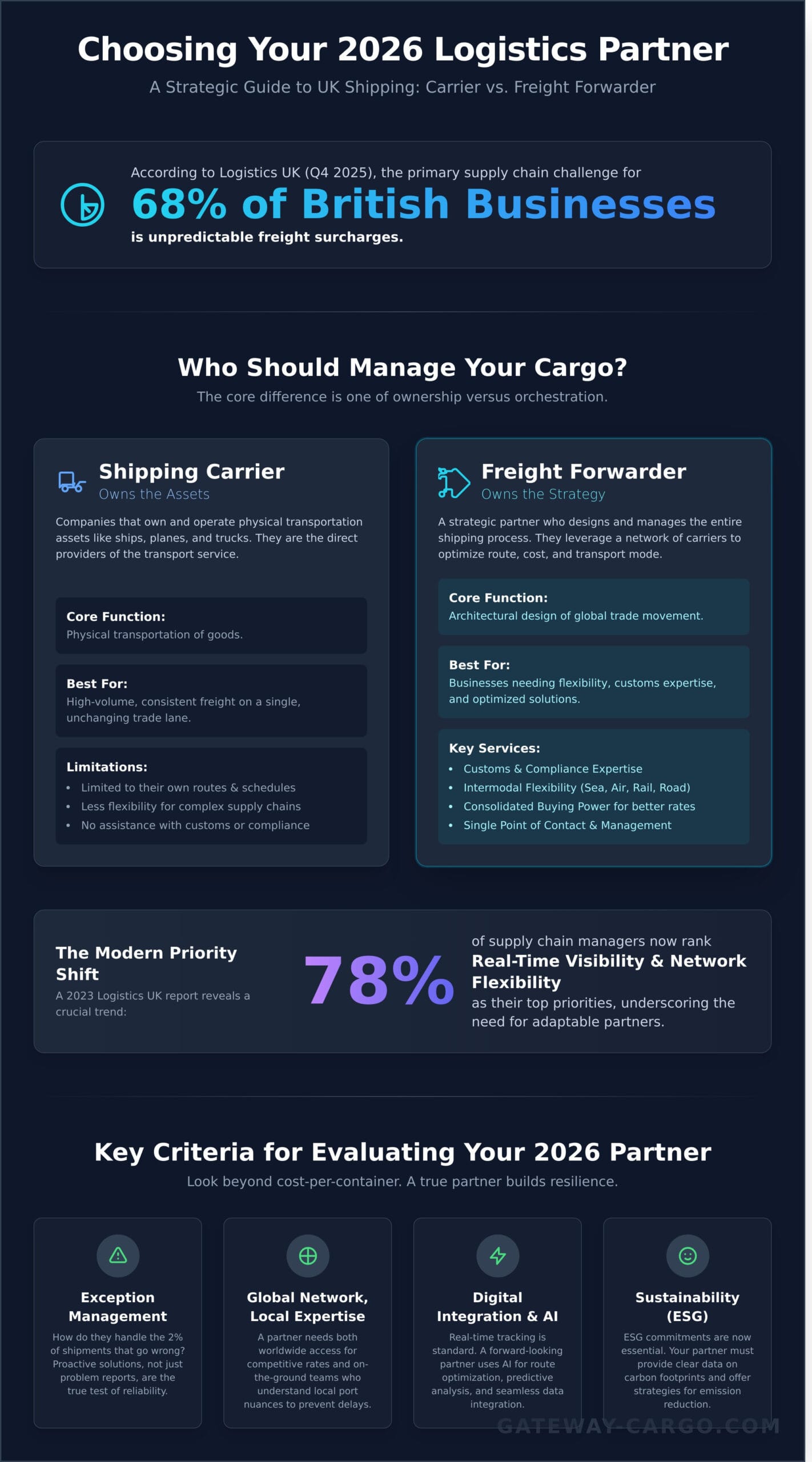
According to a Q4 2025 report by Logistics UK, 68% of British businesses cited unpredictable freight surcharges as their primary supply chain challenge. It’s a frustration you’ve likely felt; you’re trying to build a resilient, cost-effective supply chain but are met with impersonal service, volatile pricing, and a complex web of new customs and sustainability regulations.
This guide is engineered to provide clarity. We will dissect the current landscape of UK shipping companies and provide a strategic framework for identifying a logistics partner that not only reduces transit times but also lowers your carbon footprint and acts as a true extension of your team. We’ll explore the key evaluation criteria for 2026, from digital integration to sustainability credentials, ensuring you select a provider poised to optimise your operations for the future.
Key Takeaways
- Understand the critical difference between shipping carriers and freight forwarders to determine which partner best aligns with your 2026 logistics strategy.
- Discover evaluation criteria that go beyond simple on-time metrics, focusing on exception management and a partner’s blend of global network and local UK port expertise.
- Assess whether an asset-heavy giant or a bespoke specialist is the right fit for your business, and learn how to navigate the different pricing models used by modern shipping companies.
- Identify how ESG commitments and AI-driven optimisation are now essential requirements for future-proofing your supply chain and selecting a forward-looking partner.
Understanding the 2026 Shipping Landscape: Carriers vs. Freight Forwarders
As UK businesses plan for 2026, optimising supply chains requires a precise understanding of the key players involved. The distinction between a shipping carrier and a freight forwarder is fundamental, yet often misunderstood. Making the right choice between these partners directly impacts cost, efficiency, and resilience. The modern logistics market, shaped by post-pandemic volatility and evolving trade regulations, demands more than just booking space on a vehicle; it requires sophisticated network intelligence to navigate disruption and secure a competitive advantage.
The core difference is one of ownership versus orchestration. A carrier owns the assets, while a forwarder owns the strategy. This distinction is crucial as businesses increasingly adopt asset-light logistics models. By avoiding the capital intensity of owning fleets, companies gain immense agility. A 2023 report by Logistics UK highlighted that 78% of supply chain managers now rank real-time visibility and network flexibility as their top priorities. This shift underscores the growing need for partners who can offer diverse, adaptable solutions rather than a single, rigid transport network.
What are Shipping Carriers?
Shipping carriers are companies that own and operate the physical transportation assets, such as container ships, cargo planes, and fleets of trucks. They are the direct providers of the transport service. Contracting with a carrier means you gain direct control over their specific schedules and assets but are limited to the routes and services they offer. This model is most effective for businesses with high-volume, consistent freight moving on a single, unchanging trade lane, such as a UK manufacturer sending 100+ containers per month from Felixstowe to a single distribution centre in Rotterdam.
What are Freight Forwarders?
A freight forwarder is a strategic logistics partner that designs and manages the entire shipping process on a client’s behalf. They don’t typically own the primary transport assets; instead, they leverage their extensive network and expertise to contract with multiple carriers, optimising the route, cost, and mode of transport for each shipment. Freight forwarding is the architectural design of global trade movement. Their value extends far beyond simple booking, encompassing critical services that modern supply chains depend on:
- Customs and Compliance Expertise: Navigating complex UK and international customs declarations (such as the Customs Declaration Service) is a core function, mitigating risks of costly delays and fines.
- Intermodal Flexibility: A forwarder seamlessly integrates different transport modes, selecting the optimal combination of sea, air, road, and rail to create the most efficient end-to-end solution.
- Consolidated Buying Power: By consolidating cargo from multiple clients, forwarders can negotiate more favourable rates with carriers than most individual businesses could achieve alone.
A common misconception is that forwarders physically handle the cargo for its entire journey. In reality, a forwarder acts as the project manager, selecting the optimal combination of shipping companies and service providers for each leg. They manage the documentation, coordinate the handovers, and provide a single point of contact, turning a complex series of transactions into a seamless, managed service. They navigate the intricate web of global maritime transport and ground logistics, ensuring your cargo moves efficiently from origin to final destination.
Key Criteria for Evaluating International Shipping Companies
Selecting a freight partner in today’s volatile market requires a deeper analysis than simply comparing cost-per-container. A strategic partner must demonstrate resilience, technological prowess, and a deep understanding of your specific operational needs. Your evaluation should focus on four critical pillars that separate proficient forwarders from truly indispensable logistics partners.
A company’s reliability extends far beyond its on-time delivery percentage. While a 98% success rate looks good on paper, the true test is how a forwarder manages the remaining 2%. This is the discipline of ‘exception management’. A superior partner has predefined protocols for disruptions, such as the port congestion seen at Felixstowe in late 2023, and can proactively reroute cargo to mitigate delays. They don’t just report problems; they present solutions. This proactive capability is what protects your supply chain from costly standstills.
True logistics competence requires a delicate balance between a vast global network and granular local expertise. A worldwide presence ensures access to capacity and competitive rates, but it’s the on-the-ground knowledge that prevents delays. A partner with a team in Rotterdam understands the specific documentation nuances and terminal operations that a remote agent cannot. This dual capability ensures your freight moves seamlessly from a factory in Asia to a warehouse in the UK.
Looking ahead to 2026, technology is the definitive differentiator. Real-time tracking is now a baseline expectation, not a feature. Leading shipping companies leverage AI-driven predictive analytics to forecast potential disruptions. By analysing vessel speed, historical port performance, and even weather patterns, these systems can flag a shipment at risk of delay days in advance, allowing for strategic intervention. This shift from reactive monitoring to predictive optimisation is essential for building a resilient supply chain.
Finally, your partner’s financial health and regulatory standing are paramount. The economic shifts of the past few years have tested the stability of many providers. You need a partner with the financial resilience to navigate market turbulence without service degradation. In the UK and EU, look for Authorised Economic Operator (AEO) status. This certification signifies a company’s secure role in the supply chain and can expedite customs clearance, a critical advantage in a post-Brexit trading environment. For a foundational understanding of freight forwarding responsibilities, the International Trade Administration offers excellent guidance on international shipping that clarifies these complex roles.
Service Breadth: Ocean, Air, and Road
An effective partner must offer a genuine intermodal mix. Consolidating your ocean (both FCL and LCL), air, and ground transport with a single provider streamlines communication and unlocks significant cost efficiencies. Having flexible Full Container Load (FCL) and Less than Container Load (LCL) options is vital for adapting to fluctuating inventory needs. Ultimately, road and rail freight are the critical final links that connect global shipping lanes directly to your distribution centre’s door.
Customer Support and Account Management
Avoid the ‘call centre’ trap. A generic support ticket system cannot provide the strategic insight required for complex logistics. A dedicated logistics specialist who understands your business, your suppliers, and your delivery targets acts as an extension of your own team. This proactive partnership reduces your internal administrative burden and transforms your forwarder from a simple vendor into a strategic asset. When disruption occurs, they call you with a solution, not an excuse. Discover how our specialist teams provide this integrated support.
Asset-Heavy Giants vs. Bespoke Logistics Specialists
Choosing the right logistics partner is a critical decision that extends beyond simple cost comparison. The market presents two distinct models: the asset-heavy global carriers and the agile, bespoke logistics specialists. Understanding the fundamental differences in their operational philosophy, pricing structure, and problem-solving capabilities is essential for building a resilient and efficient supply chain.
The core distinction lies in their approach to freight. Global giants are built for standardised volume, leveraging their vast owned assets-fleets of aircraft, trucks, and ships-to process millions of similar shipments. In contrast, specialists operate as strategic architects, designing customised transport solutions by integrating services from a curated network of carriers. This choice defines whether your cargo fits into a pre-existing system or if a system is built around your cargo.
When to Go Big: The Case for Global Carriers
For certain logistics needs, the scale of global carriers is a distinct advantage. Their automated networks are highly efficient for small parcel delivery and express document services across the UK. However, their strength in standardisation becomes a limitation when dealing with non-standard cargo. Shipments requiring specialised handling, temperature control, or complex customs clearance often expose the rigidity of their systems. This rigidity was evident during the Red Sea disruptions in late 2023, where their fixed, high-volume routes lacked the agility to pivot quickly, causing significant delays.
When to Choose a Bespoke Forwarder
A bespoke forwarder excels where global systems falter. With analysts predicting continued port congestion and vessel schedule reliability issues into 2025, the ability to be flexible is paramount. A specialist can proactively reroute cargo through less congested UK ports like Liverpool or London Gateway, seamlessly integrating road and rail freight to meet deadlines. They also provide tailored warehousing and distribution solutions that larger carriers often outsource, creating a single, accountable point of contact for your entire supply chain.
This difference is starkest in pricing and problem-solving. While a global carrier’s quote may seem low, it can often be inflated by up to 25% with hidden fuel and peak-season surcharges. A specialist provides a transparent, all-inclusive quote. The common objection is whether a smaller firm has carrier ‘clout’. True leverage isn’t just about volume; it’s about deep, strategic relationships. A specialist’s influence comes from being a valued partner to a network of niche carriers, enabling them to secure capacity and flexible terms when a purely transactional, high-volume shipper cannot.
This leads to the concept of a ‘Smarter Supply Chain’. Instead of simply waiting in a queue at a congested terminal, a data-driven specialist uses predictive analytics to bypass bottlenecks before they impact delivery. While the sheer scale of the top 10 shipping companies by market capitalization gives them immense volume, it doesn’t always translate to this level of agility. For example, during the Q4 2023 maritime delays, a bespoke solution rerouted a client’s critical manufacturing components via a sea-air service and dedicated road freight into their UK facility. This proactive move saved an estimated £150,000 in production line downtime, a value far exceeding any marginal saving on the initial freight quote from larger shipping companies.
Future-Proofing Your Supply Chain: Sustainability and AI
The logistics landscape is undergoing a fundamental transformation, driven by two powerful forces: stringent environmental regulations and rapid technological advancement. For businesses across the United Kingdom, preparing for this future isn’t optional; it’s a core strategic imperative. The era of sustainability as a corporate footnote is over. Today, a resilient supply chain must be both intelligent and green, demanding a new level of sophistication from logistics partners.
Beginning in 2025 and expanding through 2026, the EU’s Corporate Sustainability Reporting Directive (CSRD) will begin to impact large UK firms with significant operations in the EU. This legislation mandates detailed ESG (Environmental, Social, and Governance) disclosures, including comprehensive data on Scope 3 emissions, which directly cover transportation and distribution. This regulatory shift places immense pressure on shipping companies to provide transparent, verifiable data on their carbon footprint, making sustainability a non-negotiable element of partner selection.
The ‘Social’ component of ESG often includes supporting employee well-being, acknowledging that a company’s resilience is tied to its people. Proactively providing resources for life’s challenges is part of this. For example, for UK employees navigating the complexities of finding care for family members, directories such as Guide2Care offer a structured way to find vetted providers. Similarly, organising group transportation for corporate events or site visits is another practical way to support staff, and you can learn more about EC Minibus to see how such services operate in major hubs like London.
AI and Predictive Logistics
Artificial intelligence is moving logistics from a reactive to a predictive model. Instead of simply tracking a delay, AI algorithms analyse vast datasets-including weather patterns, port congestion, and real-time road traffic-to anticipate disruptions before they occur. This allows for proactive rerouting, saving both time and fuel. Advanced shipping companies now utilise digital twins to create a complete virtual replica of your supply chain, simulating the entire journey to identify and eliminate inefficiencies before a single container is loaded. A 2023 study by the International Transport Forum found that advanced analytics and AI can cut road freight fuel consumption by up to 25%.
The Push for Net-Zero Shipping
A genuine commitment to sustainability goes far beyond marketing claims. To evaluate a partner’s dedication, you must look for quantifiable targets, transparent reporting, and tangible investment in green technology. The adoption of Electric Vehicle (EV) trucks for urban distribution is a prime example. In cities with Clean Air Zones like London’s ULEZ, EVs not only eliminate emissions and daily charges of up to £100 per non-compliant vehicle but also drastically reduce noise pollution. Ultimately, sustainable practices deliver a strong commercial advantage by lowering long-term operational costs and mitigating regulatory risk.
Part of managing these long-term operational costs is the diligent maintenance of the vehicle fleet. Whether running traditional diesel or modern EV trucks, operators depend on a streamlined supply chain for essential components to minimize downtime. For logistics companies operating across the UK and Europe, sourcing from specialized online suppliers like Truckparts Corner is a common strategy to ensure fleets remain operational and efficient.
Effectively branding this modern fleet is just as important as the technology itself. Commercial vehicle wraps turn every delivery truck into a mobile billboard, reinforcing a company’s commitment to sustainability and professionalism. For businesses looking for inspiration on high-quality fleet branding, specialists like Yeahgor showcase how impactful professional vehicle graphics can be.
To ensure a potential partner aligns with your future needs, it’s crucial to ask targeted questions about their green initiatives. Inquire about their involvement in developing “green corridors,” such as the newly established UK-Netherlands route designed for zero-emission shipping. Key questions for your logistics provider should include:
- What is your detailed roadmap for fleet electrification and the adoption of alternative fuels like HVO (Hydrotreated Vegetable Oil)?
- How do you measure, report, and help us reduce our Scope 3 emissions?
- Can you provide access to integrated, low-carbon road and electric rail freight options?
To ensure your supply chain is resilient and compliant for 2026 and beyond, it’s vital to partner with logistics specialists who lead in technology and sustainability. Explore our AI-driven and sustainable freight solutions to future-proof your operations.
Why Gateway Cargo is the Strategic Choice for Global Logistics
Selecting a partner for your ground transport needs requires a focus on integration, strategy, and results. At Gateway Cargo, we operate on a core philosophy of Seamless Logistics for a Smarter Supply Chain. This isn’t just a tagline; it’s our commitment to acting as a strategic partner dedicated to your business objectives. Unlike many large-scale shipping companies that prioritise carrier quotas and volume, our model is built on designing bespoke, intelligent solutions that deliver measurable value. We integrate our global air, ocean, and road freight services with advanced, in-house customs clearance to create a single, efficient, and transparent logistics ecosystem for your goods.
Our approach removes the friction between different transport modes. Whether your consignment arrives at the Port of Felixstowe by sea or at Heathrow by air, we manage the entire onward journey by road or rail with precision. This unified oversight ensures your supply chain is resilient, cost-effective, and fully aligned with your operational goals. We don’t just move boxes; we build the strategic framework that allows your business to thrive.
Bespoke Solutions for Complex Challenges
Our logistics specialists function as a direct extension of your internal procurement team. They invest time to understand your unique challenges, inventory cycles, and market pressures. This deep integration allows us to proactively identify optimisation opportunities, resulting in an average 15% reduction in transit times for clients within their first quarter of partnership. We provide solutions, not just services. Our commitment to sustainability is woven into every solution, with a plan to expand our EV fleet for UK urban deliveries by 25% by the end of 2025 and utilising our proprietary routing software that has already cut carbon emissions by 12% per shipment since 2023. To keep you ahead of the curve, all partners gain full access to our ‘Insights’ hub, a vital resource featuring real-time UK port status updates, whitepapers on post-Brexit trade compliance, and weekly freight rate analysis.
Getting Started with Gateway Cargo
Initiating a partnership is a straightforward process designed for clarity and efficiency. You can request a comprehensive, line-itemed freight quote through our online portal and expect a detailed response from a specialist within 24 hours. Your first 30 days are structured to ensure a seamless transition and immediate impact:
- Week 1: A dedicated onboarding call with your logistics specialist to define your key routes, establish critical KPIs, and integrate our team with yours.
- Week 2: Full integration with our digital tracking platform, providing you with 24/7 visibility and control over your initial shipments.
- Week 4: Your first monthly performance review, where we analyse initial data, confirm we are meeting targets, and identify further opportunities for optimisation.
Experience a logistics partnership that puts your business first. Let us show you how integrated ground transport can become your competitive advantage.
Optimise your freight today with Gateway Cargo.
Choosing Your Strategic Logistics Partner for 2026
Navigating the global trade landscape in 2026 demands more than a simple carrier service. Your choice of partner must account for increasing technological and environmental pressures, which are now top-three considerations for UK shippers. As this guide has shown, the best shipping companies aren’t just moving freight; they are providing a competitive advantage through innovation and foresight, especially when dealing with the UK’s intricate post-Brexit customs framework.
At Gateway Cargo, we are already delivering the future of logistics. Our AI-driven digital strategy optimises routes for maximum efficiency, while our proactive sustainability commitment includes an expanding fleet of EV vehicles for last-mile delivery. We combine this forward-thinking approach with specialised customs clearance expertise, ensuring your goods navigate complex UK and international regulations without costly delays. For businesses seeking a comprehensive approach to global trade, partnering with a Gateway Logistics Group that provides bespoke freight solutions can transform fragmented operations into a unified, intelligent flow.
Don’t leave your supply chain to chance. Let our specialists design a logistics solution tailored to your unique requirements. Request a Bespoke Freight Quote from Gateway Cargo Specialists and discover how a strategic partnership can optimise your global operations. Let’s build a smarter, more resilient supply chain together.
Frequently Asked Questions
What is the difference between a shipping company and a freight forwarder?
A shipping company, or carrier, is a firm that owns assets like ships and trucks to physically transport goods. In contrast, a freight forwarder is a logistics agent that organises and manages the entire shipment process for a client. Freight forwarders don’t own the transport assets; they use their extensive network of carriers to optimise routes, negotiate costs, and handle all the necessary documentation for a seamless door-to-door service.
How do I choose the best shipping company for my small business?
To choose the best partner for your small business, you should evaluate their service offerings, technological capabilities, and experience within your specific industry. It’s crucial to select a provider that offers scalable solutions and transparent pricing. Verify they provide real-time tracking and can expertly manage UK customs clearance. A provider with a proven on-time delivery rate above 95% demonstrates the reliability needed to support your supply chain effectively.
What are the most important Incoterms to know in 2026?
The most important Incoterms to understand in 2026 remain the core terms that define risk and cost transfer between a buyer and seller. These are EXW (Ex Works), FOB (Free On Board), CIF (Cost, Insurance and Freight), and DDP (Delivered Duty Paid). EXW places maximum responsibility on the buyer, while DDP places it on the seller. A clear understanding of these four terms is fundamental for managing your financial exposure and operational responsibilities in global trade.
How much does international ocean freight cost per container in 2026?
International ocean freight rates are dynamic, but for 2026, costs for a standard 40-foot container on key UK routes, like from Shanghai to Felixstowe, are projected to range between £2,500 and £4,000. This price is subject to fluctuations from fuel surcharges, port congestion, and seasonal demand. For the most accurate and current pricing, it’s always best to request a spot quote from your logistics partner for your specific cargo and shipping lane.
Can a shipping company help with customs clearance and taxes?
Yes, a full-service logistics partner or freight forwarder provides comprehensive customs brokerage services. This includes managing all customs clearance procedures and handling the calculation and payment of duties and taxes. Our specialists ensure your shipments comply with all UK HMRC regulations, preparing and submitting essential documents like the C88 (SAD) form. This integrated approach prevents costly delays and ensures your supply chain remains fluid and compliant.
What is intermodal shipping and why is it more efficient?
Intermodal shipping moves freight in a single container using two or more modes of transport, typically rail and road, without handling the goods themselves during the transfer. Its efficiency stems from combining the long-haul cost-effectiveness of rail with the final-mile flexibility of trucks. This integrated approach can reduce fuel costs by up to 25% compared to road-only transit, lower carbon emissions, and provide more reliable delivery schedules by avoiding road congestion.
How can I track my international shipment in real-time?
You can track your international shipment in real-time using a digital logistics platform offered by your provider. These platforms consolidate data from carriers, vessel AIS (Automatic Identification System), and GPS into a single, user-friendly dashboard. This provides live location updates and automated alerts for critical milestones, such as port arrival or customs clearance. This high level of visibility empowers you with the data needed for proactive supply chain management.
What is the impact of AI on the shipping industry today?
The primary impact of AI on the shipping industry is the significant optimisation of logistics through predictive analytics and intelligent automation. AI algorithms analyse vast datasets, including port traffic and weather patterns, to forecast transit times with over 90% accuracy. This enables smarter route planning that reduces fuel consumption and improves delivery reliability. AI also automates document processing, which minimises administrative errors and accelerates customs clearance procedures.