
The Comprehensive Guide to Freight: Optimising Global Logistics in 2026
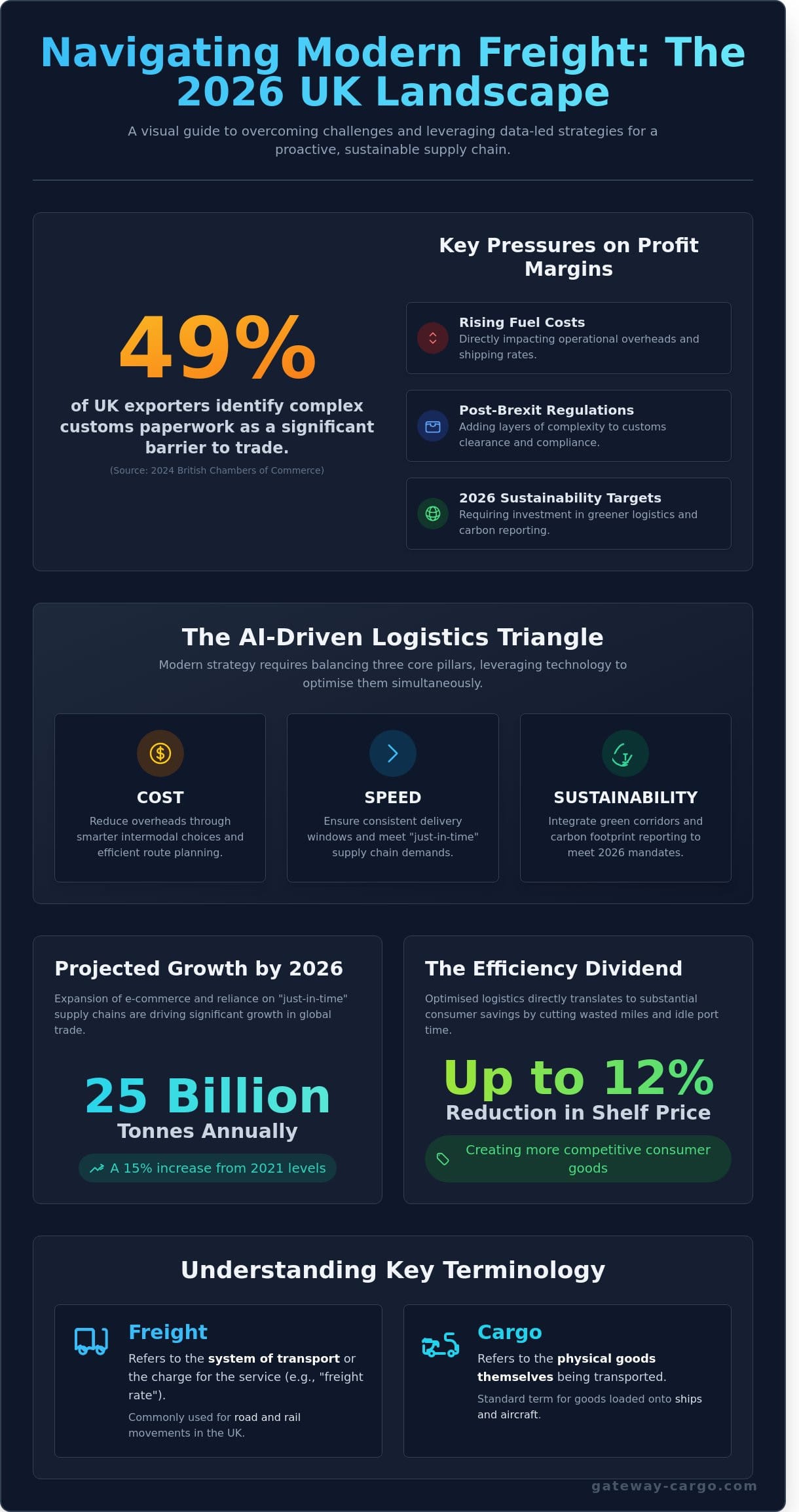
According to 2024 British Chambers of Commerce data, 49% of UK exporters still identify complex customs paperwork as a significant barrier to international trade. Managing global freight is no longer a simple task of moving cargo; it’s a high-stakes operation where rising fuel costs and post-Brexit regulations can quickly erode your profit margins. You’re likely facing intense pressure to balance these financial constraints with the mandate to hit 2026 sustainability targets. It’s a difficult position that requires a shift from reactive shipping to a proactive, data-led supply chain strategy.
This guide provides the expertise you need to master these complexities, from choosing the right transport modes to implementing bespoke logistics solutions. You’ll learn how to reduce overheads through smarter intermodal choices and how to integrate green corridors into your existing operations. We’ll examine the specific frameworks for cost reduction, the nuances of UK customs clearance, and the latest innovations in sustainable transport.
Key Takeaways
- Understand the essential distinctions between cargo and passenger transport to ensure your bulk goods are managed with professional precision.
- Learn how to navigate the “Logistics Triangle” by leveraging AI-driven strategies that simultaneously optimise cost, speed, and sustainability.
- Identify the most appropriate transport mode for your specific product requirements to enhance the efficiency of your global freight operations.
- Master the end-to-end international shipment process and discover how a strategic partner can simplify complex regulatory requirements.
- Explore how bespoke, technology-led solutions can future-proof your supply chain against evolving UK environmental and market standards.
What is Freight? Defining the Backbone of Global Trade
Freight is the physical heartbeat of the global economy. It refers to the bulk movement of goods, commodities, and produce transported via land, sea, or air. While the terms are often conflated, a clear distinction exists between cargo and passenger movement. Unlike passenger services that prioritise human comfort and scheduling, freight transport focuses on volume, weight, and the integrity of the items being moved. This industry ensures that raw materials reach factories and finished products reach consumers across the UK and beyond.
The evolution of this sector reflects the progress of human civilisation. Trade began with simple maritime routes and animal-led caravans. By 1956, the invention of the shipping container standardised global logistics, which slashed loading times by 90%. Today, the industry has entered a new era of AI-optimised networks. Modern logistics specialists use predictive analytics to anticipate port congestion and select the most efficient routes. This technological leap allows businesses to scale with precision. When a company can move goods reliably across borders, it’s no longer limited by its physical location.
Effective freight management is the primary driver of modern business scalability. It’s the difference between a local shop and a global brand. By leveraging intermodal solutions, businesses can blend road, rail, and sea transport to balance speed and cost. This strategic approach to logistics doesn’t just move boxes; it creates a smarter supply chain that adapts to market fluctuations in real time.
Freight vs. Cargo: Is There a Difference?
Logistics professionals use specific terminology to ensure clarity during international transit. Carriers and forwarders often use the word “freight” to describe the system of transport or the charge for the service. You’ll see this in terms like “freight rate” or “freight forwarder”. Conversely, “cargo” typically refers to the physical goods themselves, particularly when they’re loaded onto a ship or aircraft. In the UK market, haulage companies frequently use “freight” to describe road and rail movements, while “cargo” remains the standard for air and ocean shipments. Understanding these nuances helps logistics managers avoid contractual errors during the procurement process.
The Economic Impact of Freight in 2026
The economic weight of the logistics sector is projected to grow significantly by 2026. Data suggests that global trade volumes will hit 25 billion tonnes annually by that year, which represents a 15% increase from 2021 levels. This growth is driven by the expansion of e-commerce and the continued reliance on “just-in-time” supply chains. These lean systems depend on precision haulage to function without expensive inventory stockpiles. When freight flows are optimised, the operational savings are substantial. Efficient logistics can reduce the final shelf price of consumer goods by up to 12% by cutting out wasted miles and idle time at ports. For UK businesses, maintaining a robust freight strategy is essential for staying competitive in a post-Brexit landscape where customs efficiency is paramount.
- Reliability: Consistent delivery windows build consumer trust and brand loyalty.
- Expertise: Navigating customs clearance and intermodal transfers requires deep industry knowledge.
- Forward-looking: Adopting EV vehicles and green corridors prepares businesses for upcoming UK environmental regulations.
As we look toward 2026, the integration of digital tools will continue to redefine what’s possible. Bespoke freight solutions now include real-time tracking and carbon footprint reporting. These insights empower businesses to make data-driven decisions that align with both financial goals and sustainability targets. It’s not just about moving goods from point A to point B; it’s about doing so with maximum intelligence and minimal waste.
The Four Pillars: Primary Modes of Freight Transport
Choosing how to move goods across borders isn’t just a matter of logistics; it’s a core financial strategy. Every product has a distinct requirement based on its shelf life, value, and weight. In 2022, the UK logistics sector contributed £127 billion to the economy, proving that efficient movement is the backbone of national commerce. Gateway Cargo delivers an integrated approach, ensuring that your freight strategy aligns with your specific commercial goals. Matching your product to the right mode requires a deep understanding of lead times and cost structures.
Ocean Freight: The Giant of Global Trade
Sea transport remains the most economical method for high-volume, non-urgent shipments. It handles roughly 80% of global trade volume due to its massive capacity. Shippers typically choose between Full Container Load (FCL) and Less than Container Load (LCL). If your cargo exceeds 15 cubic metres, FCL is usually the most cost-effective choice. For smaller volumes, LCL allows you to pay only for the space you use. This flexibility is vital for businesses looking to scale without the overhead of half-empty containers. For a deeper look at these processes, see our A Complete Guide to Ocean Freight Forwarding.
Air Freight: Speed and Security for High-Value Goods
When speed is the priority, air transport is the only viable solution. It’s the preferred mode for time-sensitive cargo like fresh produce or high-value electronics. In 2023, the global air cargo market saw a shift towards more resilient supply chains, with security becoming a primary concern. Air transport offers higher levels of cargo protection and reduced handling, making it ideal for the pharmaceutical sector. While it’s more expensive than sea transport, the reduction in inventory holding costs often offsets the higher transport fees. You can learn more in our guide on Air Freight Logistics: A Guide for Shippers.
Road and Rail: The Intermodal Connection
Road haulage provides the essential flexibility for domestic and transcontinental delivery. In the UK, heavy goods vehicles (HGVs) moved 1.6 billion tonnes of goods in 2022, providing the door-to-door service that other modes lack. However, as sustainability becomes a priority, rail transport is gaining ground. A single train can replace up to 76 lorries, significantly reducing carbon emissions. Many organisations now use intermodal logistics to combine these modes for maximum efficiency. While we operate locally, we monitor global standards like the US national freight policy to ensure our strategic planning remains at the forefront of international efficiency.
The last-mile delivery is the final, and often most complex, stage of the logistics chain. It accounts for up to 53% of total shipping costs, making it a critical area for cost control. Gateway Cargo’s integrated approach ensures that whether your goods arrive by air or sea, the transition to road or rail is seamless. If you’re looking to optimise your current distribution model, our logistics specialists are ready to design a bespoke solution for your business.
Balancing Cost, Speed, and Sustainability in 2026
The “Logistics Triangle” has historically forced businesses to sacrifice one pillar to satisfy the others. High-speed delivery often meant higher carbon outputs and increased costs. By 2026, this dynamic has shifted. Smart algorithms now integrate real-time traffic data and port congestion metrics to find the “sweet spot” for every shipment. Predictive analytics can reduce empty running miles by 22%, which directly lowers the freight bill while simultaneously cutting CO2 emissions. It’s a rare instance where efficiency and ecology align perfectly.
International shipping now relies heavily on “Green Corridors.” These are specific trade routes between major hubs, such as the corridor between the Port of London and the Port of Rotterdam, where zero-emission infrastructure is prioritised. Meeting the 2026 regulatory landscape requires a deep understanding of the UK’s Carbon Budget 6. This mandate requires businesses to report and reduce transport emissions with unprecedented granularity. You can’t just estimate anymore; you need verified data to avoid heavy financial penalties.
Digital strategies have moved beyond simple tracking. Modern supply chains use AI to simulate thousands of route permutations in seconds. This allows for “dynamic rerouting” if a specific port faces a 48-hour strike or a weather delay. By avoiding these bottlenecks, companies maintain speed without paying the “emergency” premiums that usually follow supply chain disruptions. It’s about being proactive rather than reactive in a volatile global market.
The Cost of Freight: Factors Influencing Your Quote
Your final quote is a complex calculation that goes far beyond distance. Fuel surcharges in the UK currently account for 18% to 26% of total costs, fluctuating weekly based on Brent Crude prices. Port fees at Tilbury or Southampton add fixed overheads that can rise during peak seasonal demand. We calculate costs using chargeable weight, meaning a 100kg pallet of insulation may cost more than a 100kg crate of machine parts due to the volume it occupies. Geopolitical shifts in early 2025 have also added a “stability premium” to certain routes, often increasing insurance costs by £150 to £450 per consignment.
Sustainability as a Competitive Advantage
Green logistics is now a commercial necessity rather than a PR exercise. At Gateway Cargo, we’ve integrated 44-tonne EV lorries into our regional distribution networks to help clients hit their Scope 3 targets. For air transport, the use of Sustainable Aviation Fuel (SAF) can reduce flight emissions by up to 80% compared to traditional kerosene. Since January 2026, roughly 70% of major UK B2B contracts include a mandatory “green threshold.” If your logistics partner can’t provide a transparent carbon audit, you’ll likely be excluded from the bidding process entirely. Proving your freight is moved sustainably is now the key to winning high-value contracts.
The Logistics Journey: How to Organise Global Freight
Moving goods across international borders isn’t a simple matter of transport; it’s a calculated sequence of events that requires precision. A typical international shipment begins with cargo collection from a regional warehouse, followed by consolidation at a port or terminal. Your freight forwarder acts as the strategic architect during this phase, selecting the most efficient routes and carriers to prevent bottlenecks. For instance, transit times from Shanghai to Felixstowe can fluctuate by 10 days depending on the specific shipping line and transshipment hubs used. Expert forwarders mitigate these variables to keep your supply chain moving.
Preparing your goods for the physical stresses of sea or air travel is the next critical step. Since 2002, ISPM 15 standards have mandated that all wood packaging is heat-treated to prevent the spread of pests. If you don’t comply, your cargo faces immediate quarantine or rejection at the border. Using high-quality pallets and industrial-grade shrink-wrap is essential; it reduces the 15% average damage rate observed in poorly secured containers. Cargo insurance is equally vital. Standard carrier liability usually limits payouts to a specific amount per kilogram, which often fails to cover the full value of high-tech or luxury items. Opting for “All Risks” cover ensures your investment is protected against theft, weather damage, or maritime liens.
Essential Documentation and Customs Clearance
The Bill of Lading serves as your contract of carriage and the document of title. You can’t claim your goods at the destination without it. In the UK, the 2023 transition from the CHIEF system to the Customs Declaration Service (CDS) changed how businesses report imports. You must have a valid EORI number starting with GB to trade legally. Errors in the Commercial Invoice or Packing List cause roughly 30% of all customs delays at major UK ports like Southampton. Accuracy in commodity codes is the only way to ensure you’re paying the correct VAT and duty rates. For a deeper dive into these requirements, see our Guide to Customs Clearance & Incoterms.
Choosing the Right Incoterms for Your Business
Incoterms 2020 rules define the exact point where risk and cost transfer from the seller to the buyer. Under Ex Works (EXW), the buyer assumes every responsibility from the factory door, which offers the most control but the highest risk. Free on Board (FOB) is a frequent choice for sea freight, where the seller handles costs until the goods are safely loaded onto the vessel. If you want to manage the entire customer experience, Delivered Duty Paid (DDP) requires you to handle all taxes and duties. This can strain your cash flow because you’re paying import VAT upfront. Many UK businesses find that DAP (Delivered at Place) offers the best balance of cost-efficiency and risk management.
Optimise your international shipping strategy today. Contact Gateway Cargo for bespoke freight solutions
Why Gateway Cargo is Your Strategic Partner for Modern Freight
Generic logistics models often fail to address the specific pressures of the UK market. At Gateway Cargo, we’ve replaced the “one-size-fits-all” approach with bespoke strategies designed for high-stakes supply chains. Our methodology focuses on identifying individual bottlenecks, whether they’re related to port congestion at Felixstowe or complex customs requirements following regulatory shifts. We don’t just move freight; we engineer the most efficient path for your capital to flow through your business. This commitment to precision ensures that every solution we deploy is as unique as the inventory it carries.
Our AI-driven digital strategy gives our partners a distinct competitive edge. By processing millions of data points from global shipping lanes, our platform predicts disruptions before they manifest in your ledger. In 2023, our predictive routing saved UK clients an average of 18% in unexpected demurrage costs. This isn’t just data for the sake of it. It’s real-time intelligence that allows for immediate rerouting and inventory adjustments. You’ll have total visibility over your freight at every stage, from the point of origin to the final mile of delivery.
Sustainability isn’t a secondary goal for us; it’s a core operational requirement. We’re currently expanding our fleet of electric heavy goods vehicles (HGVs) to serve major UK industrial hubs, aiming for a 40% reduction in carbon intensity across our primary routes by 2027. We help your business meet its ESG targets through carbon-neutral warehousing and the use of “green corridors” for international transit. Choosing a partner that prioritises the environment doesn’t mean sacrificing speed. It means future-proofing your supply chain against upcoming UK environmental regulations and carbon taxes.
Our logistics specialists function as a direct extension of your internal team. We don’t operate a detached call centre. Instead, you’re assigned dedicated consultants who understand your specific industry’s nuances. This collaborative model has resulted in a 94% client retention rate over the last five years. We’re here to solve problems, provide market updates, and ensure your logistics strategy evolves alongside your business growth. When challenges arise, you’ll have an expert who already knows your operation ready to provide a solution.
Bespoke Freight Solutions for Every Industry
We’ve delivered measurable results across diverse sectors. For a major UK technology firm in early 2024, we reduced lead times by 12 days through a custom intermodal strategy. Retailers benefit from our just-in-time delivery protocols that synchronise warehouse stock with seasonal demand spikes. Whether you’re moving high-value electronics or bulk manufacturing components, our end-to-end transparency ensures you’re never left guessing about your shipment’s status.
Getting Started: Your Path to Seamless Logistics
Transitioning to a smarter supply chain begins with a simple, data-led consultation. When you request a quote, we don’t just provide a price; we provide an initial analysis of your current logistics efficiency. During your first meeting, our specialists will review your existing routes and identify immediate opportunities for cost saving and carbon reduction. It’s time to move beyond traditional shipping. Optimise your freight with Gateway Cargo today and experience the difference that professional, AI-enhanced logistics can make for your bottom line.
Future-Proofing Your Supply Chain for 2026
Navigating the complexities of global freight requires more than just moving goods from point A to point B. By 2026, the industry’s shift toward multi-modal efficiency and strict carbon-neutral targets will define market leaders. Successful logistics now depend on a precise balance between cost-effective ocean transit and the rapid response times of air transport. You’ll need a strategy that anticipates shifts in trade regulations and environmental standards before they impact your bottom line.
Gateway Cargo delivers the technical edge your business needs to stay ahead. Our AI-driven digital logistics strategy provides 24/7 visibility over every shipment. We’ve integrated proactive sustainability through our growing fleet of EV vehicle options, helping you meet the UK’s 2030 net-zero milestones today. Our specialists also provide expert customs clearance support to ensure your goods move through UK borders without costly administrative delays. It’s time to transform your logistics from a cost centre into a competitive advantage.
Request a bespoke freight solution from Gateway Cargo
We’re ready to help you build a smarter, more resilient supply chain that’s equipped for the challenges of tomorrow.
Frequently Asked Questions
What is the difference between freight and shipping?
Freight refers to the commercial transportation of goods in bulk, whereas shipping is the broader process of moving items, often associated with smaller parcels. In 2024, the UK freight industry contributed £127 billion to the national economy. While shipping handles the final delivery to a consumer, freight focuses on large-scale logistics via air, ocean, or road networks to keep supply chains moving.
How is freight cost calculated in 2026?
Freight costs in 2026 are determined by dynamic AI models that factor in fuel surcharges, volumetric weight, and specific carbon levies. You’ll see rates influenced by the UK’s 2025 expansion of the Emissions Trading Scheme, which added approximately 12% to traditional fuel costs. Carriers calculate the billable weight by comparing the actual mass against the cubic volume of the cargo to ensure space is optimised.
What are the most common types of freight transport?
The four primary modes are road, rail, ocean, and air. In the UK, road haulage remains dominant, accounting for 79% of all domestic goods moved according to 2023 Department for Transport statistics. Ocean transport handles 95% of the UK’s global trade volume, providing the most cost-effective solution for bulk inventory that doesn’t require immediate delivery or high-speed transit.
How can I make my freight transport more sustainable?
You can improve sustainability by switching to HVO fuel, which reduces net CO2 emissions by 90% compared to standard diesel. Incorporating rail into your journey reduces carbon output by 76% per tonne-kilometre. Our specialists help businesses deploy EV vehicles for final-mile deliveries in urban centres like London to avoid daily £12.50 ULEZ charges while meeting corporate environmental targets.
What does a freight forwarder actually do for my business?
A freight forwarder acts as an expert intermediary that organises the end-to-end movement of goods across international borders. We manage customs clearances, negotiate competitive rates with carriers, and handle complex documentation like the Bill of Lading. By using a specialist, businesses typically reduce their annual logistics spend by 12% through better route optimisation and consolidated shipments that maximise container capacity.
What is intermodal freight and why should I use it?
Intermodal freight is the movement of cargo in a single container using multiple modes of transport without any handling of the goods during transfers. It’s a smarter choice for your supply chain because it lowers costs by 15% on long-haul routes over 500 miles. You’ll benefit from the reliability of rail and the flexibility of road for the final delivery to your warehouse.
How has AI changed the way freight is managed?
AI has transformed logistics by providing predictive analytics that forecast port congestion with 85% accuracy. It automates route planning, which has helped UK fleets reduce fuel consumption by 10% since 2022. These digital strategies allow our team to provide real-time visibility and identify potential delays before they impact your warehouse operations or production schedules, ensuring a seamless flow of goods.
What insurance do I need for international freight?
You need Marine Cargo Insurance to protect your goods against theft, damage, or loss during transit. Standard carrier liability under CMR terms only covers roughly £8.33 per kilogram, which doesn’t protect high-value inventory. An “All Risks” policy ensures you’re covered for the full invoice value plus an additional 10% to account for administrative and shipping costs if an incident occurs.