
Supply Chain News Today: Navigating 2026’s Global Logistics Volatility
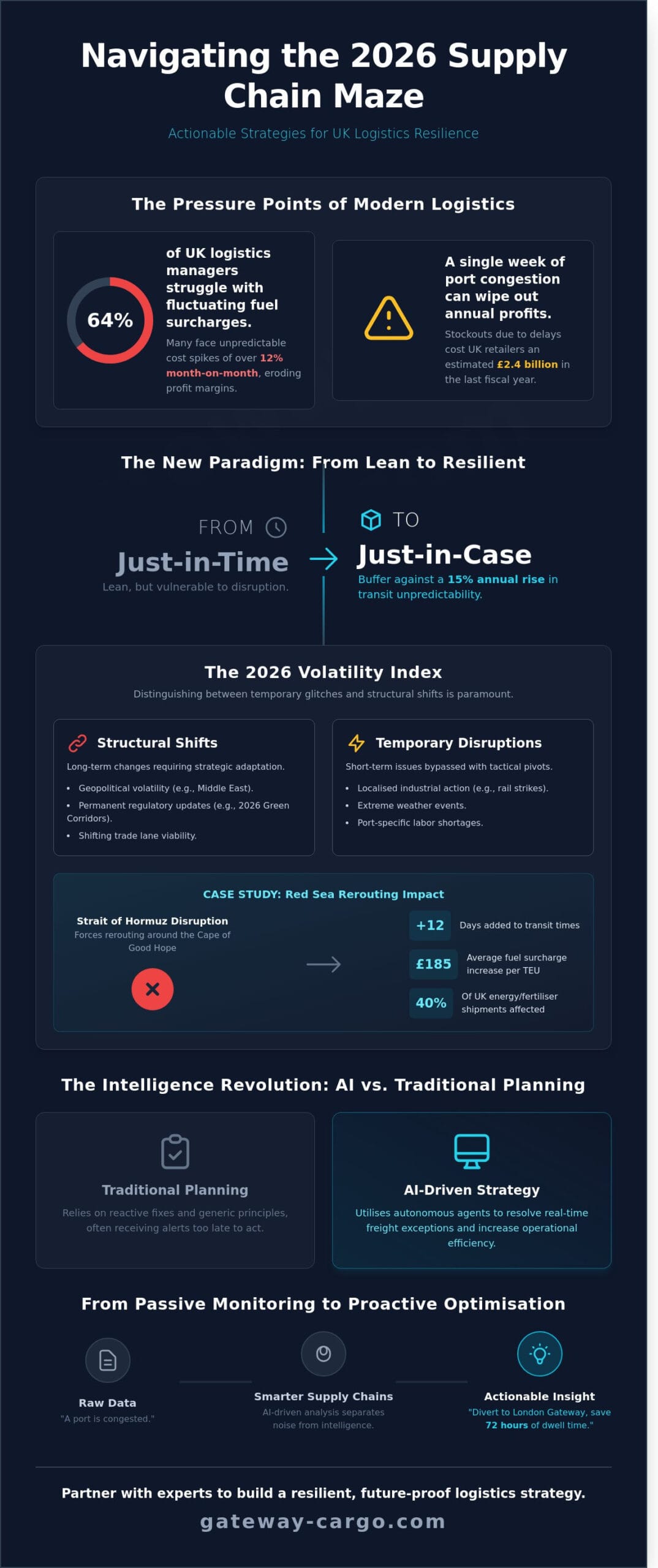
Recent data indicates that 64% of UK logistics managers are currently struggling with fuel surcharges that fluctuate by more than 12% month-on-month. Staying informed with supply chain news today is no longer just about awareness; it’s about survival in a market where a single week of port congestion can erode annual profit margins. You already know that the complexity of new tariff refund processes and the urgent need to meet Scope 3 emission standards are stretching your internal resources to their limit.
We promise to provide a professional analysis that cuts through the noise to deliver actionable strategies to optimise your global freight. You’ll gain a clear understanding of which 2026 market shifts require an immediate response and which are merely background noise. This guide outlines proven frameworks for integrating sustainability into a resilient chain and offers specific tactics to bypass the fuel spikes that threaten your bottom line. We will focus on practical solutions that ensure your cargo moves efficiently despite the current global volatility.
Key Takeaways
- Adapt to the 2026 logistics climate by mastering the shift from “Just-in-Time” to “Just-in-Case” strategies to safeguard your inventory against global volatility.
- Stay informed with the latest supply chain news today to navigate evolving trade regulations and the four-step process for managing international tariff refunds.
- Transition from traditional planning to AI-driven strategies that utilise autonomous agents to resolve real-time freight exceptions and increase operational efficiency.
- Optimise your response to rapid market shifts by re-evaluating transport modes and adopting sustainable fuel alternatives to mitigate rising surcharges.
- Learn how bespoke freight solutions and expert market analysis can transform your logistics into a resilient, future-proof asset for the UK market.
Understanding Today’s Supply Chain Landscape: Beyond the Headlines
The 2026 logistics environment marks a definitive departure from the lean, “Just-in-Time” models that dominated the last decade. Shippers now prioritise “Just-in-Case” inventory strategies to buffer against a 15% annual increase in transit unpredictability. This shift isn’t merely a trend; it’s a structural response to a world where supply lines are frequently tested by external shocks. Modern supply chain management requires a move away from reactive fixes toward a philosophy of built-in redundancy and regionalised sourcing.
Relying on generic supply chain management principles is no longer sufficient when global corridors are blocked. Today, the focus is on “Smarter Supply Chains” that utilise AI-driven filters to separate background noise from actionable intelligence. For UK businesses, this means identifying which supply chain news today directly impacts their specific port of entry or SKU-level availability. A professional freight forwarder serves as the essential interpreter in this process, translating macro-economic shifts into bespoke route adjustments that protect your bottom line.
The 2026 Volatility Index: What Shippers Must Track
Distinguishing between temporary glitches and structural shifts is the primary challenge for modern logistics directors. While a 48-hour rail strike in the Midlands is a temporary disruption, the ongoing geopolitical volatility in the Middle East represents a structural shift in ocean freight flow. The closure of the Strait of Hormuz has forced 40% of UK-bound energy and fertiliser shipments to reroute around the Cape of Good Hope. This detour adds roughly 12 days to transit times and increases fuel surcharges by an average of £185 per TEU.
- Structural Shifts: Long-term changes in trade lane viability or permanent regulatory updates like the 2026 Green Corridor mandates.
- Temporary Disruptions: Weather events or localised industrial action that can be bypassed with short-term mode switching.
- Input Costs: Tracking the 22% rise in fertiliser costs directly linked to extended maritime routes.
Logistics Resilience is the ability to pivot modes within 24 hours of a news event. Achieving this requires more than just a list of carriers; it demands an integrated digital strategy where data flows as freely as the physical goods. When the “Just-in-Case” model is executed correctly, it prevents the stockouts that cost UK retailers an estimated £2.4 billion in lost sales during the previous fiscal year.
From Passive Monitoring to Proactive Optimisation
Generic news alerts often arrive too late to influence a shipment already on the water. Shippers must transition from passive monitoring to proactive optimisation by valuing “Insights” over raw data. Raw data tells you a port is congested; an insight tells you that diverting to a secondary terminal like London Gateway will save 72 hours of dwell time despite a 10% higher drayage cost. This solution-oriented mindset is what separates market leaders from those constantly chasing the latest supply chain news today.
Bespoke freight solutions are built on this ability to anticipate. Instead of waiting for a “Vessel Delayed” notification, proactive specialists monitor port productivity metrics and labour negotiations months in advance. They don’t just report the news; they provide the alternative. By integrating intermodal road and rail options before congestion peaks, businesses can maintain a seamless flow of goods even when primary hubs face significant backlogs. This level of precision ensures that your logistics strategy remains an asset rather than a liability in an increasingly complex global market.
Geopolitical Disruption and the New Tariff Reality
Global trade dynamics are shifting under the weight of protectionist policies and geopolitical friction. Recent updates in supply chain news today highlight how Section 301 investigations continue to reshape international trade lanes. In May 2024, the US government finalised tariff hikes on approximately £14 billion worth of Chinese imports, targeting strategic sectors like electric vehicles and semiconductors. These shifts aren’t isolated to the Atlantic; they force UK businesses to re-evaluate their sourcing strategies to avoid inflated landed costs. The 25% to 100% duty rates on specific goods create a ripple effect that alters global pricing structures and inventory flows.
Managing these costs requires a sophisticated approach to duty recovery. International shippers can utilise a four-step tariff refund process to reclaim overpaid duties. First, perform a data audit to identify eligible past entries. Second, verify the origin and classification of goods against current exclusion lists. Third, prepare a formal protest or drawback claim with precise documentation. Finally, implement a compliance review to ensure future shipments align with the latest exemptions. This structured method helps recover capital that would otherwise be lost to shifting trade barriers.
The USMCA auto rules are also exerting pressure on manufacturing capacity. With Regional Value Content (RVC) requirements now reaching 75%, car manufacturers are moving production closer to end markets. This shift towards “nearshoring” impacts UK-based tier-one suppliers who must now account for these stringent origin rules when exporting components. Simultaneously, the legal scrutiny surrounding proposed temporary 10% universal tariffs in 2024 creates a climate of uncertainty. Businesses are currently filing precautionary protests to protect their legal rights should these broad measures face successful court challenges.
Tariff Tracking: Managing International Trade Actions
Mitigating the deluge of tariffs reported in supply chain news today requires proactive data management. Identifying duty-drawback opportunities is a key strategy for building a resilient supply chain. Accurate HTS coding is the foundation of this effort. A single digit error in a code can result in a 25% tariff increase or a heavy fine. Our specialists use customs clearance expertise to ensure every item is classified correctly, protecting your margins from avoidable levies. For businesses facing complex classification hurdles, our bespoke freight solutions provide the clarity needed to maintain profitability.
Regional Focus: Canada, Mexico, and the EU
Production rates in North America and the EU have become “untethered” from traditional demand cycles due to inventory front-loading. This volatility makes supply planning difficult for UK importers. Furthermore, forced-labour probes in 60 major trading partner countries mean that supply chain transparency is no longer optional. You must trace your components down to the raw material level to avoid border seizures. To understand the specific documentation required for these regions, refer to our comprehensive Guide to Customs Clearance & Incoterms. Adapting to these regional nuances is essential for maintaining a seamless flow of goods across borders.
AI-Driven Strategy vs. Traditional Logistics Planning
Logistics planning has shifted from the theoretical “AI hype” of 2023 into the “messy reality” of 2025. This transition involves moving away from static spreadsheets toward autonomous agents that navigate real-world constraints. Traditional planning relies heavily on historical data; it assumes that what happened last quarter will repeat next month. This approach failed many UK businesses during the 2022-2023 period of extreme volatility. Modern AI in supply chain management replaces these rigid forecasts with predictive modelling. These systems simulate thousands of potential disruptions simultaneously, allowing firms to prepare for events that haven’t occurred yet.
The core difference lies in how data is utilised. Traditional methods are reactive. When a delay occurs, a human must identify the problem and find a workaround. AI-driven strategies are proactive. They identify patterns in supply chain news today that suggest a delay is likely, then suggest alternative routes before the cargo even leaves the warehouse. This proactive stance is essential for maintaining the bespoke service levels that modern B2B clients expect.
The Rise of AI Agents in Exception Management
Platforms like Reindeer AI are changing how we handle exceptions. In traditional logistics, an exception, such as a missed connection or a closed terminal, requires hours of manual intervention. AI agents turn this volatility into a strategic advantage by automating the rerouting process. For example, if a major ship centre like the Port of Felixstowe faces a sudden 48-hour closure due to weather or industrial action, an AI agent can rebook containers to London Gateway or Southampton in under 60 seconds. This speed is impossible for human teams alone.
Despite this technological speed, professional expertise remains the final safeguard. A machine can calculate the fastest route, but it lacks the nuanced understanding of carrier relationships or local UK customs nuances. We’ve seen that a 15% increase in efficiency is typically achieved when AI handles the data crunching while human specialists make the final strategic calls. This balance ensures that speed never comes at the expense of reliability or compliance.
Digital Supply Chains: Data-Driven Procurement
Conservative industries, including UK construction and heavy manufacturing, are now using digital insights to drive procurement transformations. In 2024, port congestion and global shipping lane shifts have made real-time visibility a necessity rather than a luxury. By integrating real-time data into procurement cycles, companies can mitigate risks before they impact the bottom line. Recent data shows that firms adopting integrated digital strategies have seen a 12% reduction in lead times compared to those using legacy systems. Key benefits of this data-driven approach include:
- Risk Mitigation: Identifying congestion at major hubs like Rotterdam or Singapore three days before arrival.
- Cost Optimisation: Using live market rates to secure the best value on spot market freight.
- Inventory Precision: Reducing safety stock levels by £50,000 to £100,000 through more accurate arrival predictions.
Staying informed via supply chain news today allows procurement managers to understand which global trends require an immediate shift in strategy. It’s vital to remember that AI is a tool for specialists, not a replacement for bespoke service. Digital strategies work best when they empower human experts to provide more precise, reliable solutions for complex cargo requirements.
How to Organise Your Response to Rapid Supply Chain Shifts
Staying ahead of supply chain news today requires more than just tracking vessel delays; it demands a structured approach to logistics that can pivot within 24 hours of a market disruption. When shipping volumes through the Suez Canal dropped by 42% in early 2024, businesses with rigid logistics structures faced immediate stockouts. To avoid these pitfalls, you must establish a framework that prioritises data-driven decision-making and flexible asset allocation. Organising your response involves a three-tier strategy: re-evaluating transport modes, integrating sustainable fuel alternatives, and decentralising your warehousing footprint to keep inventory closer to the UK consumer.
Mode Switching: When to Pivot to Air Freight
Air cargo is no longer just an emergency measure; it’s a strategic tool for maintaining market share. You should analyse the cost-benefit of air freight by comparing the £4.50 to £6.00 per kilogramme rate against the potential loss of a £50,000 retail contract. For high-value electronics or time-sensitive fashion lines, the speed of air transport offsets the higher upfront cost by reducing inventory carrying costs by up to 15%.
Many UK shippers are now managing Middle East surcharges by optimising air-road intermodal routes. By shipping goods via sea to hubs like Dubai and then flying them into Heathrow or East Midlands Airport, you can save 12 days of transit time compared to a full ocean voyage around the Cape of Good Hope. This hybrid approach provides a middle ground that balances budget constraints with the need for speed. For a deeper look at these strategies, see our Air Freight Logistics: A Guide for Shippers.
Building Sustainability into the Chain
Sustainability has evolved from a corporate social responsibility goal into a tool for long-term resilience. Lidl and DHL recently demonstrated this by deploying bio-LNG (liquefied natural gas) trucks, which contributed to a significant reduction in greenhouse gas emissions across their UK distribution network. By 2025, many major retailers aim to have 100% of their final-leg deliveries handled by electric vehicles (EVs). Integrating EV vehicles into the final leg of the supply chain allows you to bypass the £12.50 daily ULEZ charges in London and similar Clean Air Zone fees in cities like Birmingham and Bristol.
- Sustainable Aviation Fuel (SAF): Investing in SAF programmes can reduce flight-related carbon emissions by up to 80%, helping you meet Scope 3 requirements.
- Green Corridors: Using dedicated low-carbon shipping lanes helps your cargo bypass traditional congestion points at major ports.
- Scope 3 Transparency: Since Scope 3 emissions often account for 70% of a company’s total carbon footprint, accurate reporting is essential for maintaining investor confidence.
Strategic warehousing is the final piece of the puzzle. With UK warehouse vacancy rates sitting at roughly 3.5% as of mid-2024, securing space in regional hubs is vital. Instead of relying on a single “big box” distribution centre in the Midlands, smart operators are distributing stock across smaller facilities in the North and South. This “Just-in-Case” model provides a buffer against transport strikes and fuel price spikes, ensuring that your supply chain news today remains focused on growth rather than crisis management. Our specialists can help you optimise your distribution network to ensure maximum efficiency during market shifts.
Partnering with Gateway Cargo for a Resilient Future
Our logistics specialists don’t just manage shipments; they operate as a dedicated extension of your internal team. It’s their job to interpret how supply chain news today impacts your bottom line. When headlines report a 15% increase in Suez Canal transit fees or shifting trade tariffs, our team has already modelled the impact on your 2026 landed costs. We translate global volatility into clear, actionable data. This proactive approach ensures you’re never reacting to the market too late. We’ve helped UK retailers reduce their lead times by an average of 14 days by anticipating port congestion before it reaches critical levels.
Bespoke freight solutions are essential for the 2026 market. Standardised shipping models are failing because they lack the flexibility to handle sudden regional shifts. We design routes specifically for your cargo’s requirements, whether that involves temperature-controlled pharmaceutical transport or high-security electronics. Our AI-driven digital strategy sits at the heart of this. By using predictive analytics, we identify potential bottlenecks in real-time. This technology helped our partners maintain a 98.2% on-time delivery rate throughout the industrial actions seen across UK ports in late 2024.
Sustainability isn’t just a corporate responsibility; it’s a strategic hedge against fuel price volatility. Diesel prices fluctuated by 8% in Q3 2024 alone, creating significant budget uncertainty for many UK firms. Gateway Cargo mitigates this risk through a heavy investment in electric vehicle (EV) fleets and green corridors. By utilising our EV solutions for final-mile deliveries within London’s Ultra Low Emission Zone, our clients avoid the £12.50 daily charge per vehicle. We’re already aligning our operations with the UK’s 2035 ban on new petrol and diesel HGVs, ensuring your supply chain remains compliant and cost-effective for the long term.
Seamless Logistics for a Smarter Supply Chain
Gateway Cargo promises calm competence in a world of constant disruption. Our “Insights” hub provides daily strategic updates, distilling the most relevant supply chain news today into brief, high-impact briefings. You don’t have to sift through data; we provide the clarity you need to make fast decisions. If you’re looking to refine your maritime strategy, our Complete Guide to Ocean Freight Forwarding offers the technical depth required to master complex global routes. We focus on smarter integration so your logistics become a competitive advantage rather than a source of stress.
Take the Next Step in Optimising Your Freight
The value of our service lies in combining massive global reach with deep local expertise. We operate across 150 countries, yet we understand the specific customs nuances at Felixstowe, Southampton, and Dover. This ensures your goods don’t face the 48-hour clearance delays that often plague unoptimised chains. You can request a bespoke logistics audit today to see how your current routes compare to industry benchmarks. We’ll analyse your data to find immediate cost-saving opportunities and efficiency gains. It’s time to move beyond basic shipping and embrace a truly optimised strategy.
Contact Gateway Cargo today to optimise your supply chain. Our specialists are ready to build a resilient, future-proof logistics framework for your business.
Future-Proof Your Logistics Strategy for 2026
Navigating the complexities of 2026 requires more than reacting to shifts; it demands a total structural rethink. Businesses must move beyond legacy planning to embrace AI-driven digital strategies that provide 100% real-time visibility across global routes. With new tariff realities and geopolitical shifts impacting UK trade costs, staying informed via reliable supply chain news today isn’t just helpful; it’s essential for commercial survival. Success now depends on your ability to pivot before disruptions occur.
Gateway Cargo provides the precision infrastructure needed to thrive in this environment. We combine authoritative insights with a proactive EV vehicle fleet to ensure your distribution remains sustainable and resilient. Our specialists work as part of your team, delivering bespoke freight solutions that adapt to market fluctuations instantly. It’s time to stop managing crises and start driving growth through smarter logistics.
Optimise your supply chain with Gateway Cargo’s bespoke solutions and turn global volatility into your strongest competitive advantage. We’re ready to help you lead the way.
Frequently Asked Questions
What is the most impactful supply chain news today for UK businesses?
The most impactful supply chain news today for UK businesses involves the April 2024 implementation of the Border Target Operating Model (BTOM), which introduced physical checks on EU imports. These regulations added up to £145 in common user charges per consignment for medium-risk plant and animal products. Companies must adapt to these digitised customs processes to avoid delays at Dover and Folkestone. Our specialists help you navigate these regulatory shifts through automated reporting and direct HMRC integration.
How are the 2026 tariffs affecting international freight forwarding costs?
The 2026 carbon-related tariffs are projected to increase landed costs for carbon-intensive goods like steel and cement by 15% to 25%. These UK CBAM regulations require importers to account for emissions at the border, directly impacting freight forwarding budgets. You’ll need precise data on your suppliers’ carbon footprints to avoid the maximum penalty rates. We provide the carbon auditing tools necessary to calculate these costs before your goods leave the factory floor.
Can AI really help my business manage port congestion more effectively?
AI reduces port dwell times by an average of 22% through predictive berthing analytics. By processing historical vessel data and real-time weather patterns, our AI-driven digital strategy forecasts potential bottlenecks at Felixstowe or Southampton up to 14 days in advance. This allows you to reroute shipments or adjust road haulage schedules before congestion peaks. It’s a proactive way to maintain your delivery promises despite global maritime volatility.
What is the difference between SAF and traditional fuel in air cargo?
Sustainable Aviation Fuel (SAF) reduces lifecycle CO2 emissions by up to 80% compared to traditional kerosene-based Jet A-1 fuel. While SAF currently costs 3 to 5 times more than conventional fuel, it’s the primary lever for decarbonising air freight. It’s produced from renewable waste, such as used cooking oil, and requires no engine modifications. We offer SAF book-and-claim solutions to help you meet your 2030 corporate sustainability targets.
How does Gateway Cargo help with customs clearance during trade wars?
Gateway Cargo mitigates trade war risks by utilising our Authorised Economic Operator (AEO) status to expedite customs clearance and reduce physical inspections by 30%. Our specialists conduct forensic tariff code audits to ensure you aren’t overpaying on retaliatory levies or anti-dumping duties. We also manage duty deferment accounts, allowing you to delay VAT and duty payments for up to 45 days. This preserves your cash flow during periods of geopolitical instability.
What are Scope 3 emissions and why should my logistics partner care?
Scope 3 emissions represent the indirect CO2 output in your value chain, often accounting for 70% to 90% of a company’s total carbon footprint. Since logistics falls under this category, your partner’s efficiency directly impacts your ESG reporting and legal compliance. We provide granular, shipment-level data to help you report these figures accurately to stakeholders. Choosing a partner with EV vehicles and green corridors is now a financial necessity for UK PLC.
Is it better to use FCL or LCL ocean shipping during Middle East instability?
Full Container Load (FCL) is currently more reliable than Less than Container Load (LCL) as it avoids the multi-stop consolidation delays common during Red Sea rerouting. Ships diverted around the Cape of Good Hope have added 10 to 14 days to transit times, making FCL the safer bet for maintaining inventory levels. However, if your volumes are below 15 cubic metres, LCL remains 40% cheaper despite the current volatility. We’ll help you calculate the risk-to-cost ratio for each shipment.
How can I reduce my exposure to sudden carrier fuel surcharges?
You can reduce exposure to fuel surcharges by negotiating fixed Bunker Adjustment Factor (BAF) rates for 3 to 6 month periods. Frequent fluctuations in Brent Crude, such as the 12% spikes seen in early 2024, can otherwise lead to unpredictable monthly invoices. We also recommend intermodal solutions, switching from road to rail where possible to lower fuel consumption by 76% per tonne-kilometre. This diversification stabilises your logistics spend when oil markets become volatile.