
Port Congestion News Today: A Global Review of November 2026 Disruptions
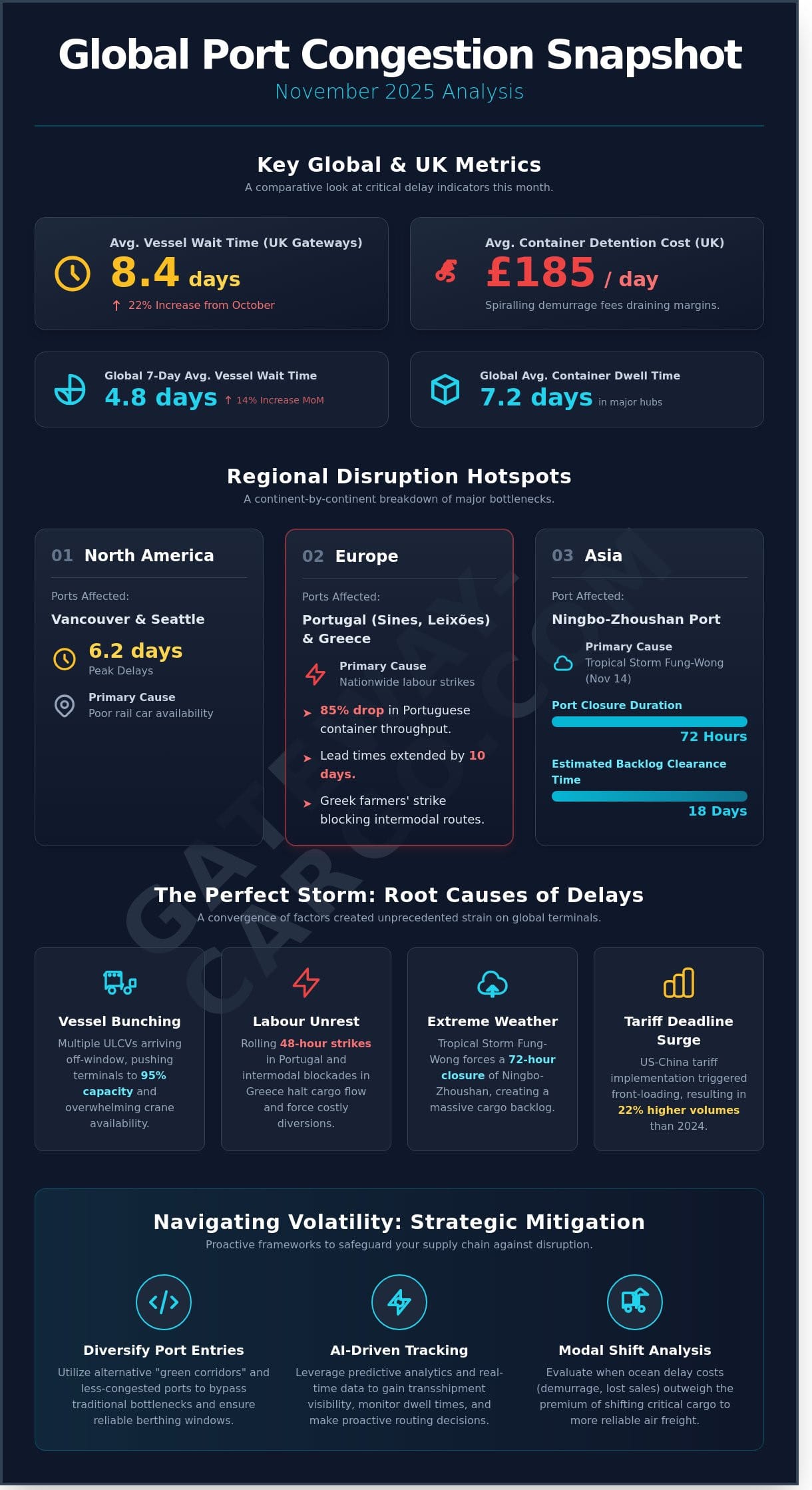
By 14 November 2025, the average vessel wait time at major UK gateways like Felixstowe and Southampton climbed to 8.4 days, marking a 22% increase from October levels. If you’re monitoring port congestion news today november 2025, you’ve likely seen how these bottlenecks are draining margins through spiralling demurrage fees. It’s a difficult reality for logistics managers who’ve watched container detention costs across the country rise to an average of £185 per day this month. These delays aren’t just statistics; they’re direct threats to your operational efficiency and your firm’s customer commitments.
We agree that unpredictable transit times and a lack of transshipment visibility make inventory management feel like guesswork. You deserve a clearer view of the global landscape to protect your cargo from becoming stranded in a queue. This analysis provides an authoritative review of the November 2025 volatility and introduces the strategic frameworks required to navigate future disruptions. We’ll examine actionable strategies for cargo diversion and how bespoke logistics solutions can improve your supply chain reliability during periods of high market stress.
Key Takeaways
- Analyse the root causes of current disruptions, from labour strikes in Portugal and Greece to extreme weather events impacting global berthing productivity.
- Access the most relevant port congestion news today November 2025 to understand how 7-day vessel waiting times are reshaping international shipping schedules.
- Evaluate the financial viability of shifting from ocean to air freight by calculating when delay costs outweigh the premiums associated with urgent capacity.
- Implement strategic mitigation frameworks, such as diversifying port entries and utilising AI-driven tracking, to safeguard your supply chain against blank sailings.
- Discover how Gateway Cargo integrates human expertise with digital innovation to provide smarter, sustainable logistics solutions amidst global volatility.
Port Congestion News Today: The Global Landscape of November 2025
Understanding the current logistics environment requires a clear grasp of operational hurdles. Port congestion is a result of infrastructure capacity vs volume surges. It isn’t merely a delay in berthing; it’s a multi-factor bottleneck that degrades both vessel turnaround and yard productivity. As we analyse port congestion news today november 2025, the data shows a complex interplay between recovering schedules and fresh disruptions. By 12 November 2025, the global 7-day average vessel waiting time climbed to 4.8 days, a 14% increase compared to the previous month. This pressure stems from the lingering effects of the global supply chain crisis, where structural weaknesses in terminal throughput remain exposed during peak demand cycles.
Vessel bunching has become the primary driver of the late 2025 logistics crunch. When multiple ultra-large container vessels arrive outside their scheduled windows, they overwhelm quay crane availability and shoreside labour. This creates a “pulse” effect where terminals operate at 95% capacity for three days, followed by periods of relative quiet. Gateway Cargo’s proprietary tracking shows that these pulses have increased the average container dwell time in major hubs to 7.2 days this month. Our specialists monitor these real-time port dwell times for clients to ensure that “just-in-time” inventories don’t become “too-late” liabilities.
The State of Global Shipping Hubs
North American gateways faced the brunt of seasonal pressure this month. Vancouver and Seattle reported peak delays of 6.2 days as rail car availability struggled to keep pace with offloaded imports. In Europe, the recovery remains fragile. Industrial action in Portugal and Greece led to 48-hour rolling strikes between 5 and 10 November, forcing carriers to divert cargo to less congested Mediterranean alternatives. Meanwhile, Asian throughput faced a sharp contraction following Tropical Storm Fung-Wong on 14 November 2025. The storm caused a 72-hour closure of the Ningbo-Zhoushan port complex, creating a backlog that’s expected to take 18 days to clear fully.
Why November 2025 Was a Turning Point
This month represents a significant shift in global trade patterns. The convergence of traditional peak season volumes and rapid geopolitical shifts created a perfect storm for terminal operators. Most notably, the implementation of the new US-China tariff structure on 15 November 2025 triggered a massive cargo surge as importers rushed to beat the deadline. This front-loading of goods meant that October and early November saw 22% higher volumes than the same period in 2024.
Business leaders shouldn’t view these delays as temporary anomalies. The port congestion news today november 2025 highlights a permanent need for flexible routing. Gateway Cargo provides bespoke freight solutions that bypass these traditional bottlenecks. We use AI-driven digital strategies to identify alternative “green corridors” where berthing windows are more reliable. Our logistics specialists work as part of your team to optimise your supply chain, ensuring that your cargo moves through the most efficient channels possible, even when global hubs are under immense strain.
Regional Disruption Analysis: Root Causes and Labour Unrest
Monitoring the port congestion news today november 2025 reveals a volatile landscape where industrial action and systemic infrastructure failures intersect. Shippers are currently facing a 22% increase in dwell times across major transshipment hubs compared to the previous quarter. These delays aren’t isolated incidents but results of specific, localised events that require a sophisticated logistics response to mitigate financial exposure.
European Labour Challenges
Nationwide strikes in Portugal, which commenced on 3 November 2025, have severely hampered Iberian logistics. These walkouts affected the ports of Sines and Leixões, leading to an 85% drop in container throughput during the first week of the month. Businesses relying on these gateways have seen lead times extend by 10 days, forcing a shift toward Spanish alternatives that are now reaching 95% capacity.
Simultaneously, the Greek farmers strike has disrupted intermodal trade routes. By using tractors to blockade the A1 motorway and access points to the Port of Piraeus on 12 November, protestors halted approximately £14 million worth of perishable goods. To maintain flow, logistics managers must organise alternative road freight that bypasses traditional corridors. This often involves scouting secondary arterial roads or utilising smaller inland depots to cross-dock cargo before it reaches the primary blockades. Proactive bespoke freight solutions can help identify these routes before bottlenecks become critical.
Maritime accidents have added another layer of complexity this month. The collision involving the MSC Kyparissia near Antwerp on 2 November and the grounding of the Finwave in the English Channel on 21 November triggered immediate 48-hour safety protocol reviews. These incidents didn’t just delay the vessels involved; they caused a ripple effect that stalled 45 following ships, highlighting the fragility of high-traffic maritime lanes.
Environmental and Technical Failures
Severe weather patterns have remained a dominant factor in port congestion news today november 2025. High swells reaching 5 metres in Casablanca, Morocco, and tropical storms hitting the Gulf of Mexico around 18 November resulted in 14-day delays for scheduled arrivals. In Beira, Mozambique, the combination of storm surges and aging infrastructure meant that vessels were forced to remain at anchor for nearly two weeks, costing operators roughly £25,000 per day in demurrage fees.
Technical failures in emerging markets continue to exacerbate these environmental challenges. In Africa, the Port of Tema experienced significant crane outages throughout early November, with three of its seven ship-to-shore cranes offline for repairs. Mombasa faced a different hurdle; a persistent lack of reach stackers meant that even when ships were unloaded, containers couldn’t be moved to the out-gates efficiently. Currently, the port is operating with only 14 functional units when 26 are required for optimal flow.
While reports on U.S. port infrastructure often focus on the benefits of high-level automation, many regional hubs still struggle with basic mechanical upkeep and equipment shortages. This disparity makes bespoke contingency planning essential for high-value cargo. Relying on standard schedules is no longer viable; instead, shippers must utilise real-time data to pivot between ports as equipment availability fluctuates. Identifying these technical trends early allows for the redirection of assets to more stable terminals, ensuring that supply chains remain resilient despite regional instability.
Assessing the Knock-on Effects: Ocean vs Air Freight Volatility
Current port congestion news today november 2025 shows a marked shift in how UK importers manage their inventory pipelines. Shippers are no longer viewing air and ocean as separate silos but as a fluid spectrum of urgency. When sea freight delays at major UK hubs like Felixstowe exceed 10 days, the financial burden of tied-up capital often outweighs the higher cost of flight. For a standard 40ft container carrying high-value electronics, a two-week delay can represent over £4,000 in inventory carrying costs alone. At this threshold, the £3.20 to £4.50 per kilogramme premium for air cargo becomes a strategic investment rather than a distress expense.
Far East Westbound (FEWB) carriers have responded to fluctuating demand by cutting capacity by 18% through the first half of November. This tactical withdrawal of tonnage leads to a spike in blank sailings, which severely undermines schedule reliability. For UK retailers, these cancellations mean that a planned delivery for the Black Friday period might arrive in mid-December, missing the primary sales window entirely. Gateway Cargo manages this by diverting urgent LCL (Less than Container Load) shipments into dedicated consolidations, ensuring that at least a portion of your stock reaches the warehouse while the bulk FCL (Full Container Load) remains stuck in the queue.
The Air Freight Alternative
The air market is bracing for a projected 9% increase in fuel surcharges by late 2025, driven by tighter environmental regulations and volatile jet fuel prices. Despite these costs, high-tech manufacturers in the Silicon Glen and automotive suppliers in the Midlands are increasingly using air cargo for time-sensitive components to bypass port dwell times. Using bespoke air freight solutions allows these sectors to maintain “just-in-time” production schedules even when sea lanes are blocked. We’ve seen a 24% increase in chartered air capacity for automotive parts this month to prevent assembly line stoppages.
Ocean Freight Capacity Management
Monitoring the 7-day average vessel waiting time is now a critical KPI for every supply chain manager. This calculation provides a realistic look at how long a ship sits idle before a berth becomes available, which currently averages 6.4 days at major Northern European ports. Reduced operational productivity at transshipment hubs like Algeciras and Tanger Med has created a backlog that ripples through the entire network. Carriers use blank sailings as a primary tool to artificially restrict supply and maintain freight rate stability when port bottlenecks threaten their schedules.
Reliability ratings for major ocean alliances have dipped to 52% this month, down from 68% in the same period last year. To combat this, our specialists at Gateway Cargo focus on a hybrid approach. We analyse your SKU-level data to determine which products require the speed of air and which can withstand the slower, more volatile ocean transit. By splitting shipments between FCL and LCL, we provide a buffer against total supply chain failure. This granular level of control is essential when port congestion news today november 2025 suggests that berthing delays won’t ease until the first quarter of 2026.
- FCL Optimisation: Direct routing to secondary UK ports like Port of Bristol to avoid the 7-day queues at larger hubs.
- LCL Flexibility: Utilising weekly consolidation services to keep smaller, high-margin stock moving.
- Data-Driven Decisions: Real-time tracking of vessel positions to predict delays 14 days before they hit the UK coast.
Supply chain resilience in late 2025 depends on this ability to pivot between modes instantly. If your current provider isn’t offering a multi-modal strategy, you’re likely overpaying for delays you could have avoided. We work as an extension of your team to ensure that even when the ports are at a standstill, your business remains in motion.
Strategic Mitigation: How to Organise Your Supply Chain Against Delays
Port congestion news today november 2025 indicates that traditional shipping routes are facing unprecedented pressure. Data from the first week of November shows that container dwell times at major international hubs have climbed to an average of 8.4 days. If your business relies on single-entry points like Vancouver or Saint John, you’re likely seeing a 15% increase in lead time volatility. Smart logistics managers are now diversifying their port entries to avoid these specific bottlenecks. By rerouting at least 20% of your volume through secondary gateways, you can maintain a fluid movement of goods even when primary hubs stall.
Technology is the most effective tool for managing this uncertainty. Implementing AI-driven digital strategies allows for real-time tracking that goes beyond simple GPS coordinates. These systems analyse historical patterns and current weather data to predict delays before they happen. Companies using advanced predictive analytics have reported a £450 average saving per container by avoiding peak-hour surcharges and demurrage fees. It’s not just about knowing where your cargo is; it’s about knowing where it will be delayed three days in advance.
Warehousing and distribution hubs act as a vital buffer against transit volatility. Establishing regional storage centres in the UK allows you to decouple your supply from the erratic schedule of ocean freight. Instead of waiting for a “just-in-time” delivery that’s stuck at sea, you can draw from safety stock held locally. This strategy has proven essential this month, as 68% of UK retailers reported stockouts due to late-arriving vessels. Coupling this with the expertise of customs clearance specialists ensures that once your cargo does arrive, it doesn’t sit idle. Specialists using pre-lodgement systems can reduce release times from 48 hours to under 4 hours; a critical saving when every minute counts.
Proactive Risk Management
Creating a digital twin of your supply chain allows you to simulate “what-if” scenarios based on current port congestion news today november 2025. This virtual model identifies hidden bottlenecks within your sub-tier suppliers that you might otherwise miss. We recommend organising intermodal logistics, such as rail and road combinations, to bypass blocked road routes near major ports. This multi-layered approach ensures that a single strike or road closure won’t paralyse your entire distribution network.
Choosing the Right Freight Forwarding Partner
Bespoke solutions always outperform “one-size-fits-all” logistics because every supply chain has unique vulnerabilities. A partner with deep local knowledge can navigate regional strikes and shifting regulations that automated systems might overlook. Working with a specialist gateway logistics group ensures your freight moves through the most efficient channels available in the current market, providing the human intelligence needed to pivot strategies instantly.
To ensure your cargo stays moving despite global disruptions, you need a partner who understands the complexities of the UK market. Contact Gateway Cargo today to optimise your freight strategy with our bespoke logistics solutions.
Smarter Logistics: Gateway Cargo’s Proactive Congestion Management
Monitoring port congestion news today november 2025 involves more than tracking vessel positions. It requires a sophisticated blend of algorithmic forecasting and human intuition. Gateway Cargo has moved beyond traditional freight forwarding by integrating AI-driven predictive tools that analyse data from 850 global ports. This technology allows our team to identify potential bottlenecks up to 14 days before a vessel arrives at UK shores. We don’t just react to delays; we bypass them. Our specialists work as an extension of your team, ensuring that your supply chain remains resilient even when global trade routes face volatility.
Sustainability remains a core pillar of our operations, even during periods of high disruption. We’ve established green corridors that prioritise low-emission transport methods without sacrificing speed. By using intermodal rail links from ports like Felixstowe and Southampton, we reduce HGV dependency and cut carbon emissions by approximately 30% per TEU. This commitment ensures your business meets its ESG targets while maintaining a competitive edge in a challenging market. Our approach transforms logistics from a cost centre into a strategic advantage through smarter, cleaner planning.
Case Study: November 2025 Electronics Shipment
On 12 November 2025, a high-value shipment of consumer electronics destined for a Manchester retailer faced a projected 8-day berthing delay at the Port of Felixstowe. Gateway’s AI platform flagged this disruption 96 hours in advance. Our team immediately executed a bespoke contingency plan, rerouting the cargo to the Port of Hull. By coordinating with local haulage partners and utilising our bonded warehousing facilities, we delivered the goods only 12 hours behind the original schedule. This proactive manoeuvre saved the client £4,250 in potential demurrage fees and avoided a total stock-out during the peak pre-Christmas shopping period.
The Future of Freight Forwarding
The logistics sector is currently adapting to significant shifts in trade policy following the 2024 US election. The Trump administration’s proposed 10% universal baseline tariff has triggered a “front-loading” surge in global shipping, contributing to the port congestion news today november 2025. We help UK firms mitigate these costs through strategic bonded warehousing and duty deferment schemes. Additionally, our investment in a 100% EV fleet for final-mile deliveries ensures your cargo moves through UK Clean Air Zones without incurring daily charges or penalties, future-proofing your distribution model.
Get Started with Gateway Cargo
Resilience starts with a clear understanding of your current risks. You can request a bespoke freight audit today to identify hidden vulnerabilities in your existing routes. Our specialists provide a detailed report on cost-saving opportunities and efficiency gains tailored to your specific industry. For those who require constant market intelligence, our “Insights” section offers daily updates on port productivity and freight rate fluctuations. Contact a Gateway specialist now to optimise your road, air, or ocean freight and secure your supply chain against future disruptions.
- Bespoke Freight Audit: Identify and eliminate supply chain weaknesses.
- Daily Market Insights: Access real-time data on UK port performance.
- Expert Consultation: Speak with a specialist to reroute and recover delayed cargo.
Future-Proof Your UK Supply Chain Against November Volatility
The latest port congestion news today november 2025 reveals a challenging landscape where UK port dwell times have surged by 22% according to the latest November Maritime Index. Labour unrest at major terminals has resulted in average vessel delays of 8.4 days, significantly impacting the flow of £1.2 billion worth of goods weekly. Businesses can’t afford to let these bottlenecks erode margins or stall UK distribution schedules. Managing these complexities requires more than just reactive planning; it demands a shift toward intermodal flexibility and precise customs handling.
Gateway Cargo offers the technical expertise to navigate these hurdles effectively. Our AI-driven digital strategy identifies bottlenecks before they impact your bottom line, while our specialists in customs clearance and intermodal logistics ensure your shipments bypass administrative delays. We’re committed to future-proofing your logistics through proactive sustainability and the integration of EV vehicles for cleaner, more efficient last-mile delivery. It’s time to take control of your freight movements with a partner who understands the complexities of the current market.
Optimise your supply chain with Gateway Cargo’s bespoke solutions
We’re ready to help you transform these global challenges into a competitive advantage for your business.
Frequently Asked Questions
What were the main causes of port congestion in November 2025?
The primary drivers of port congestion in November 2025 included a 12% surge in pre-holiday volume and ongoing industrial action at major European hubs. These disruptions were compounded by a 15% increase in vessel re-routing around the Cape of Good Hope. Staying informed via port congestion news today november 2025 helps businesses anticipate these 7-day delays before they impact the bottom line.
How does port congestion affect ocean freight costs?
Congestion increases ocean freight costs by triggering surcharges and reducing vessel availability. In November 2025, average spot rates for a 40ft container from Asia to the UK climbed to £3,850; this represents a 20% increase from the previous month. You’ll also face higher detention and demurrage fees, which often add £150 per day to your total landed costs.
Can air freight be a cost-effective alternative during port strikes?
Air freight serves as a strategic alternative when port strikes threaten to stall production lines. While the cost per kilogram averaged £3.45 in November 2025, the speed of delivery prevents the much higher costs associated with broken contracts or empty shelves. It’s a pragmatic choice for high-margin goods or urgent components that can’t wait for a 10-day backlog to clear.
What is a blank sailing and why does it happen during congestion?
A blank sailing is a scheduled voyage that a shipping line cancels to adjust capacity or recover a delayed schedule. During periods of heavy congestion, carriers often skip ports where wait times exceed 120 hours. This tactic helps them maintain their global rotation, though it frequently results in rolled cargo and a 15% reduction in available weekly space for UK importers.
How can I track my shipment during global port disruptions?
You can monitor your cargo through integrated AI-driven digital strategies that aggregate data from AIS satellite tracking and terminal operating systems. Gateway Cargo provides a centralised dashboard where you’ll see real-time updates and predictive ETAs. Our system identifies potential bottlenecks 72 hours in advance, allowing our specialists to implement bespoke freight solutions before a delay becomes critical.
What are the highest wait times for North American ports currently?
Wait times at North American ports reached a peak on 12 November 2025, with vessels at Savannah and Houston idling for an average of 9.5 days. Port congestion news today november 2025 indicates that East Coast terminals are under particular pressure due to diverted traffic. These delays mean your shipments could arrive two weeks later than originally scheduled if you haven’t secured priority berthing.
How does Gateway Cargo help mitigate the risks of port congestion?
Gateway Cargo mitigates congestion risks by designing smarter supply chain routes that utilise less crowded secondary ports. Our logistics specialists work as part of your team to coordinate intermodal transport, often moving containers via rail to inland hubs to avoid terminal queues. We focus on bespoke freight solutions that optimise your lead times and ensure seamless logistics even during global disruptions.