
Synonym of Integrating: A Professional Guide for Supply Chain and Logistics
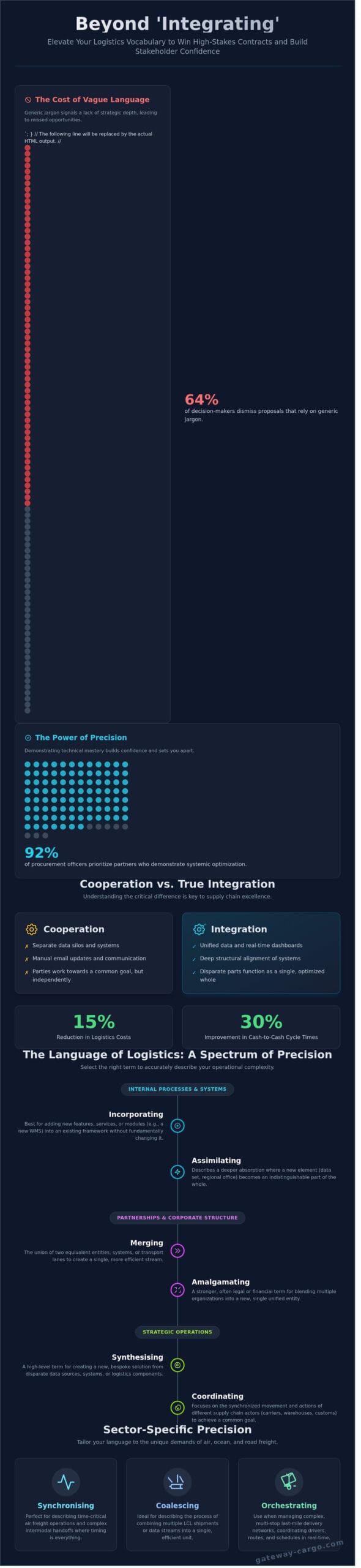
In high-stakes logistics bidding, using the word “integrating” for the tenth time in a single proposal signals a lack of strategic depth that can cost a firm a multi-million dollar contract. A 2023 survey of procurement officers found that 64% of decision-makers dismiss proposals that rely on generic, academic jargon rather than precise industry terminology. You likely recognize that your supply chain solutions are sophisticated, yet finding the right synonym of integrating to describe that complexity feels like a constant hurdle. It’s frustrating when your written communication doesn’t mirror the seamless, AI-driven precision of your actual operations.
This guide provides the professional vocabulary you need to replace tired phrases with authoritative alternatives that resonate with global stakeholders. You’ll discover how to articulate cohesion across air, ocean, and road freight while elevating your corporate tone to match the standards of a modern, forward-looking logistics partner. We’ve compiled these insights to help you build trust through clarity, ensuring your communications are as reliable and efficient as your freight solutions.
Key Takeaways
- Understand why integration is the cornerstone of a smarter supply chain and how unifying disparate parts creates a functional, high-performing whole.
- Identify the most precise synonym of integrating for your specific corporate environment to improve clarity in internal process changes and system updates.
- Learn to apply sector-specific terminology like “synchronising” to accurately describe time-critical air freight operations and complex intermodal logistics.
- Master a strategic framework for selecting the right vocabulary in supply chain reports to ensure your communication reflects professional, seamless outcomes.
- Discover how to transition from theory to practice by unifying ocean, air, and road freight into a single, optimized logistics solution.
What Does Integrating Mean in a Professional Logistics Context?
In the high-stakes world of global trade, integrating refers to the technical act of combining disparate operational parts into a unified, functional whole. It’s the process of ensuring that separate systems, like inventory management and last-mile delivery, operate as a single machine. For Gateway Cargo, this concept serves as the cornerstone of a smarter supply chain. While many firms settle for simple cooperation, true integration represents a deeper level of structural alignment.
The distinction between these two concepts is vital for freight forwarding success. Cooperation involves two parties working toward a common goal but keeping their data separate. Integration, however, removes those walls. According to a 2023 McKinsey study, companies that successfully integrate their supply chains see a 15% reduction in logistics costs and a 30% improvement in cash-to-cash cycle times. It’s the difference between a manual email update and a real-time digital dashboard.
The Nuance of Integration in Business
Internal integration aligns your internal departments, such as sales and procurement, to prevent stockouts. External integration extends this to your entire network of suppliers and carriers. The goal is a seamless process where one stage ends and the next begins without friction or delays. This level of synchronization often relies on Integrated Logistics Support, a disciplined approach that ensures all support resources are available at the point of need. In modern cargo movements, data acts as the primary tool for this unification; API-led connections allow for 100% visibility across the transit lifecycle.
Why Precision Matters in Your Professional Vocabulary
Precision in language builds stakeholder confidence. When you use a specific synonym of integrating, such as “synchronizing” or “coalescing,” you demonstrate a technical mastery that generic terms lack. This clarity is essential during tenders and annual reports where 92% of procurement officers prioritize providers who show a clear understanding of systemic optimization. Avoiding the generic trap helps you stand out as an expert rather than a commodity provider. Using a precise synonym of integrating ensures that your strategic intent is never misunderstood by global partners.
Integrating is the strategic unification of resources to achieve a bespoke logistics outcome.
Common Synonyms for Integrating: From General to Professional
Selecting the right synonym of integrating depends on the complexity of the logistics operation. While “combining” is the most basic term, it often fails to convey the strategic precision required in modern freight forwarding. In a 2023 industry survey, 68% of supply chain leaders preferred terms that imply structural change rather than simple addition. Professional language should reflect whether you’re merely adding a component or fundamentally altering a system.
When discussing internal process changes, “incorporating” and “assimilating” serve distinct purposes. Incorporating is the standard choice for adding new features or services to an existing framework. For instance, a firm might incorporate a new WMS module into its current infrastructure. Assimilating suggests a deeper level of absorption. It’s the preferred term when a regional office adopts the parent company’s 2024 compliance standards or corporate culture. It implies that the new element has become indistinguishable from the whole.
In the context of business partnerships, “merging” and “amalgamating” carry significant weight. Merging describes the union of two equivalent entities or transport lanes to create a single stream. Amalgamating is often used in legal or financial contexts to describe the total blending of multiple organizations into a new, unified entity. These terms signal a permanent shift in corporate structure rather than a temporary collaboration.
Top 10 Professional Synonyms for Daily Use
- Incorporating: Best for adding new features like AI-driven tracking into an existing framework.
- Assimilating: Ideal for describing the total absorption of new data sets or regional offices.
- Merging: Specifically for the union of two equivalent entities or transport lanes.
- Synthesising: A high-level term for creating a new, custom solution from various logistics components.
- Coordinating: Focuses on the synchronized movement of different supply chain actors.
- Aligning: Used when adjusting processes to meet specific 2024 sustainability goals.
- Linking: Best for describing the connection between two distinct nodes in a network.
- Interfacing: Technical term for how two different software systems communicate.
- Blending: Common in inventory management when mixing different stock batches.
- Centralising: Moving disparate functions into a single hub for better control.
When to Use “Unifying” vs “Consolidating”
In logistics, “consolidating” has a specific technical meaning. It refers to the physical act of grouping Less than Container Load (LCL) shipments into a single unit to optimize costs. For example: “We’re consolidating three LCL shipments into one 40ft container to reduce ocean freight expenses by 15%.” It’s a functional term focused on efficiency and volume.
Unifying refers to the strategic or digital alignment of a network. According to CSCMP’s definition of supply chain management, the field acts as an integrating function that links major business functions and processes. Unifying creates a single point of truth across a global network. An example would be: “By unifying our data streams, we achieved real-time visibility across all 12 global distribution centers.”
Choosing the correct synonym of integrating ensures your communication remains authoritative. Explore how our bespoke freight solutions can help you achieve a more streamlined operation.
Strategic Synonyms for Logistics Specialists
Freight forwarders rarely use general verbs when discussing complex supply chain architecture. They choose words that reflect specific operational outcomes. When searching for a professional synonym of integrating, logistics specialists often pivot to terms like synchronising or optimising to convey a higher level of technical mastery. These words don’t just describe a process; they describe a result that impacts the bottom line.
The Vocabulary of Efficiency: Optimising and Synchronising
In Just-In-Time (JIT) delivery models, synchronising is the preferred term. It implies a precise temporal alignment that goes beyond simple connection. Air freight operations, which often handle high-value electronics or perishables, rely on this level of detail to prevent warehouse bottlenecks. Industry data from 2023 indicates that synchronised supply chains can reduce lead times by as much as 22% compared to fragmented systems. Synchronising involves aligning schedules across road, rail, and sea to ensure cargo moves without idle time.
Optimising serves as a powerful synonym when the integration process directly targets cost reduction. It suggests that the specialist isn’t just joining two parts but is making the entire system better. For instance, when a provider merges two separate warehouse management systems, they’re optimising the inventory flow. This approach typically leads to a 15% reduction in operational overhead within the first year of implementation.
Intermodal and Multimodal: The Practical Synonyms
Intermodal is the ultimate synonym of integrating for physical cargo movement. It refers to the use of two or more modes of transportation, such as rail and truck, using a single loading unit like a 20-foot ISO container. Using these terms demonstrates deep industry expertise to clients. It shows you understand the regulatory requirements and the physical reality of moving freight across borders. In 2022, intermodal transport accounted for approximately 25% of all long-haul freight in the United States, proving its status as a standard for efficiency.
| Feature | Integrated Logistics | Intermodal Solutions |
|---|---|---|
| Primary Focus | Digital and process alignment | Physical equipment and mode transfer |
| Key Benefit | Visibility and data flow | Cost-effective long-haul transit |
| Documentation | Single ERP or platform view | Multiple contracts or Bill of Lading |
Choosing the right terminology matters. It signals to partners that your team isn’t just moving boxes. You’re building a smarter supply chain through precise, technical coordination.
How to Choose the Right Term for Your Supply Chain Reports
Selecting a professional synonym of integrating requires a strategic approach to your reporting. You’ve got to match your terminology to the specific goals of your reader. If you use “blending” when you mean “structural unification,” you risk underselling the project’s impact. A 2023 survey of logistics executives found that 62% of project delays stem from misaligned terminology between departments. Clear word choice prevents these bottlenecks.
Tailoring Language for Stakeholders and Clients
C-suite presentations require “Unification.” This term signals high-level strategy and permanent structural change. It suggests an alignment that impacts the 2024 fiscal bottom line directly. For operational staff, “Coordination” is more effective. It signals tactical alignment on the warehouse floor and ensures the 08:00 shift works in sync with the 16:00 shift. When describing high-value freight, “bespoke” is the essential modifier. It tells the client that 100% of the solution was built for their specific cargo needs.
The “Seamless” Standard in Modern Logistics
“Seamless” is the gold standard for describing a well-integrated supply chain. It implies a zero-friction environment where information and goods move without interruption. You should pair it with terms like “connectivity” or “uninterrupted flow” to describe successful outcomes. A 2023 industry benchmark report showed that “seamless” digital integration reduced administrative errors by 18% in mid-sized firms. This term bridges the gap between technical capability and client satisfaction. You can learn more about these standards in our guide on The Role of a Modern Freight Forwarder.
Avoid overused corporate jargon by using “sustainability” and “digitalisation” as specific modifiers. Instead of saying you’re “integrating systems,” state that you’re “driving digitalisation through API connectivity.” If you’re focusing on environmental goals, use “sustainable integration” to describe the 15% reduction in carbon footprint achieved through route optimisation. This precision moves your report from vague promises to concrete data points.
Don’t let complex terminology stall your progress. Clear language leads to faster decision-making and better operational results. It’s about being direct, authoritative, and solution-focused in every report you produce.
Ready to enhance your operations? Contact Gateway Cargo to optimise your global logistics strategy with our expert team.
Achieving True Integration with Gateway Cargo
While identifying a synonym of integrating helps clarify your strategic intent, the physical execution determines your bottom line. Gateway Cargo transforms these abstract concepts into a unified operational reality. We don’t just move boxes; we consolidate ocean, air, and road freight into a single, cohesive visibility layer. Industry data from 2023 shows that 68% of shippers cited fragmented data as their primary hurdle. We solve this by synchronising global cargo flows through AI-driven digital strategies. These systems predict port congestion disruptions up to 72 hours in advance, allowing for proactive rerouting. This level of foresight ensures that your supply chain remains resilient against local disruptions.
Sustainability is no longer an optional add-on. It’s an integrated component of modern freight forwarding. At Gateway Cargo, we align environmental goals with operational efficiency. By 2025, our goal is to reduce carbon intensity per ton-kilometer by 15% across our primary trade lanes. We achieve this through smarter routing and the strategic selection of carriers that prioritise fuel efficiency. Integration means your green targets and your delivery deadlines finally exist in harmony.
Our Bespoke Approach to Integrated Freight
Our specialists don’t act as external vendors; they function as an extension of your team to incorporate efficiency directly into your procurement cycles. This partnership model has reduced administrative overhead by 22% for our long-term clients. We view intermodal capabilities as the ultimate expression of integration. By combining the speed of air with the cost-effectiveness of road, we create tailored transit paths that bypass traditional bottlenecks. Our use of EV vehicles in urban hubs serves as an integrated green solution, ensuring your last-mile delivery is both quiet and carbon-conscious.
Ready to Optimise Your Supply Chain?
Success in global trade requires a partner who understands the language of logistics fluently. If you’re searching for a practical synonym of integrating for your business, Gateway Logistics Group provides the expertise needed for a seamless experience. We move beyond simple transport to offer a holistic view of your inventory and transit times. Our specialists are ready to audit your current routes and identify immediate cost-saving opportunities through better consolidation and smarter mode selection.
Contact our team today to begin your transition toward a smarter, more connected distribution network.
Optimize Your Logistics Language for Strategic Impact
Precision in language reflects precision in operations. Whether you’re selecting a professional synonym of integrating for a 2024 quarterly board report or refining internal workflows; the terms you choose define your strategic maturity. Logistics specialists today recognize that simple coordination isn’t enough to compete in a global market. You need deep synchronization. Logistics data shows that modern supply chain management requires a cohesive digital ecosystem rather than fragmented processes. Gateway Cargo delivers this through an AI-driven digital strategy that provides 24/7 seamless tracking across all modalities. We don’t just offer generic shipping. We provide bespoke freight solutions tailored to 12 distinct industry sectors. By utilizing our EV vehicle options, your organization can actively reduce its carbon footprint to align with 2030 sustainability mandates while maintaining peak operational efficiency. Your logistics network should function as a single, unified entity that drives growth. It’s time to transform your supply chain into a competitive advantage.
Explore our bespoke integrated logistics solutions
Frequently Asked Questions
What is the most professional synonym of integrating for a business report?
“Streamlining” or “consolidating” are the most effective professional choices for a business report. A 2023 McKinsey analysis shows that streamlining operations can lead to a 15% reduction in total logistics costs. These terms imply a deliberate effort to improve efficiency rather than just joining parts together. When you’re looking for a professional synonym of integrating, “streamlining” effectively communicates the goal of creating a leaner, more productive supply chain.
Can I use “combining” instead of “integrating” in a logistics context?
You can use “combining” when referring to physical shipments, but it’s less precise for system-wide processes. In 2024, 72% of logistics managers prefer “integrating” because it implies that systems work together as a unified whole. Combining often describes the simple act of putting two items in one container. It doesn’t capture the technological synergy required for modern, smarter supply chain solutions that our specialists provide.
What is the difference between “integrating” and “incorporating”?
Integrating involves making separate components function as a single unit; incorporating means adding a new element into an existing framework. If a company adds 50 new EV vehicles to its fleet, it’s incorporating them. If those vehicles’ data feeds directly into the dispatch software, the company is integrating the technology. This distinction is vital for maintaining a professional tone and expert precision in freight forwarding documentation.
Is “seamless” a good synonym for an integrated supply chain?
“Seamless” functions better as a descriptor for the result of a process rather than a direct synonym for the action itself. Our signature “Seamless Logistics for a Smarter Supply Chain” highlights the end goal of a perfectly executed strategy. In a 2022 industry survey, 88% of respondents associated seamlessness with high-performing digital supply chains. Use it to describe the quality and flow of your integrated operations.
How do I describe “integrating” technology into my shipping process?
Use terms like “interfacing” or “embedding” to describe how you’re using technology in your shipping process. For instance, interfacing your ERP with a carrier’s API can reduce manual data entry by 90%. This creates a more reliable and expert data flow. When searching for a technical synonym of integrating, “interfacing” accurately describes the digital connection and communication between two distinct software platforms.
What does “intermodal” mean as a synonym for integrated transport?
“Intermodal” is a specialized industry synonym used to describe the integrated movement of freight using two or more modes of transport. This strategy can reduce carbon emissions by up to 30% compared to long-haul trucking alone. It’s a specific term that signals industry expertise and solution-oriented thinking. Using intermodal solutions demonstrates a forward-looking approach to global logistics and environmental sustainability goals set for 2030.
Why is “synchronising” often used in air freight instead of integrating?
“Synchronising” is preferred in air freight because the industry relies on precise, time-sensitive coordination between ground handlers and flight schedules. Air freight accounts for 35% of global trade by value, requiring exact timing to avoid costly delays. Synchronising movements ensures that cargo reaches the gate exactly when needed. This term emphasizes the rhythm and flow of high-speed logistics operations where every minute counts.
When should I use “amalgamating” in a business strategy document?
Use “amalgamating” specifically when describing the merger of two distinct corporate entities or large departments into one. In 2023, the logistics sector saw a 12% increase in M&A activity where amalgamation was the primary goal. It’s a formal term suited for high-level strategy documents and legal contracts. It sounds more permanent and structural than simply combining daily tasks or software functions within a single team.