
What is DDP (Delivered Duty Paid) Shipping? A Complete Guide
Navigating the complexities of international shipping presents a significant challenge for UK businesses. Unexpected customs duties, border delays, and confusing terminology can disrupt your supply chain and inflate your total landed cost. Among the various Incoterms designed to clarify global trade, Delivered Duty Paid, or DDP, stands out as an agreement that places maximum responsibility on the seller, yet it is often misunderstood.
This comprehensive guide provides the clarity your business requires to operate with confidence. We will dissect the DDP Incoterm, outlining the precise allocation of costs, risks, and responsibilities for both buyers and sellers. By understanding its advantages and potential drawbacks, you will gain the expert knowledge needed to negotiate with suppliers, accurately forecast your landed costs in GBP, and ensure your shipments clear UK customs smoothly and predictably. This insight is crucial for optimising your supply chain and protecting your bottom line.
Key Takeaways
- Sellers assume maximum responsibility under DDP, covering all costs and risks until the goods are delivered to the buyer’s destination, including UK import clearance and taxes.
- For buyers, the primary advantage is price transparency and minimal logistical burden, as the final price includes all shipping, customs, and duty expenses.
- Choosing the DDP Incoterm requires a seller to have expert knowledge of the destination country’s import regulations to avoid unexpected costs and delays.
- Determining if DDP is the optimal solution for your shipment involves a careful assessment of risks, costs, and the level of control each party desires over the logistics process.
Table of Contents
- Defining DDP: The Core Principles of Delivered Duty Paid
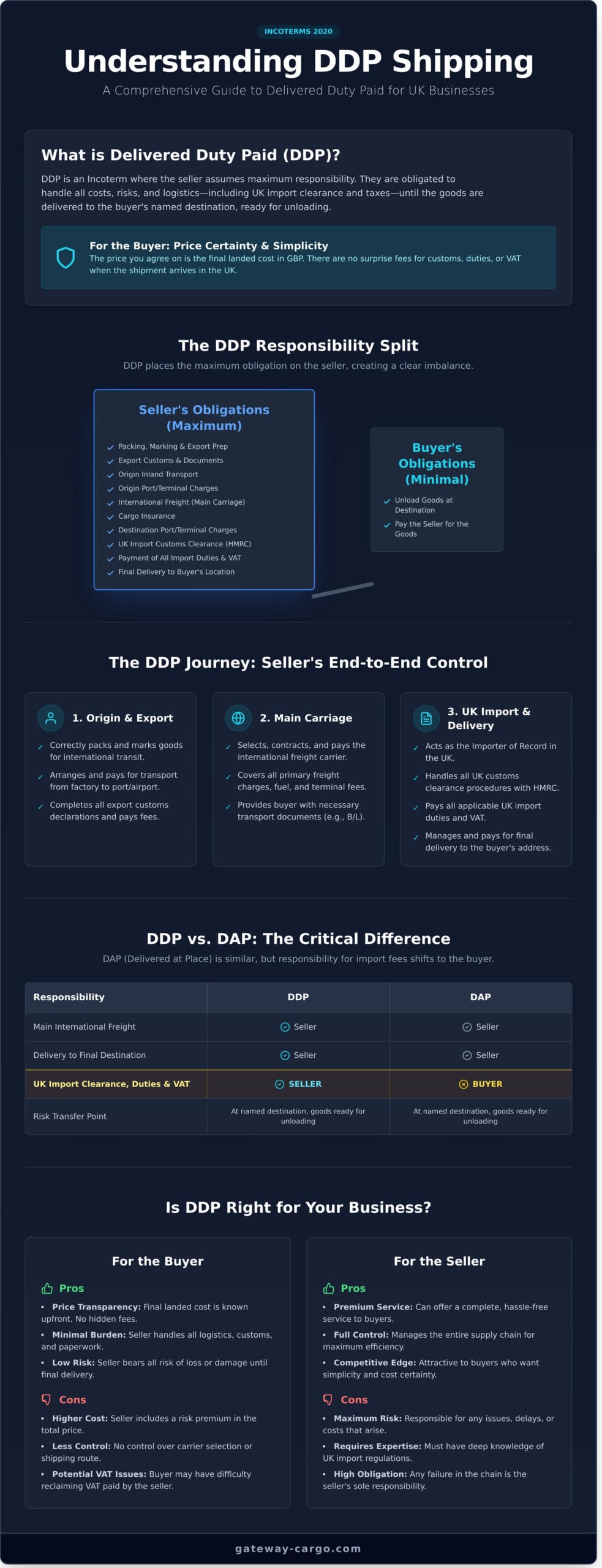
- The Seller's Obligations Under DDP: A Detailed Checklist
- The Buyer's Responsibilities Under DDP: Simplicity and Clarity
- Pros and Cons of DDP Shipping for Buyers and Sellers
- When to Use (and When to Avoid) DDP Incoterms
Defining DDP: The Core Principles of Delivered Duty Paid
In global trade, clarity and precision are paramount. One of the most significant terms governing international shipping agreements is DDP, which stands for ‘Delivered Duty Paid’. It is one of the official Incoterms established by the International Chamber of Commerce (ICC) to standardise shipping practices worldwide. The core principle of a DDP arrangement is straightforward: the seller assumes maximum responsibility and financial obligation. The risk for the goods only transfers from the seller to the buyer when the shipment arrives at the named destination, is cleared for import, and is ready for unloading. This provides the buyer with a clear, all-inclusive price, eliminating unexpected costs upon arrival.
What DDP Means in Practice
For a UK-based buyer, a DDP agreement offers unparalleled convenience. The seller is contractually obligated to manage and pay for the entire logistics process from origin to destination. This comprehensive responsibility includes:
- Handling all transportation from the origin warehouse to the buyer’s specified final destination in the United Kingdom.
- Managing and paying for both export customs clearance in the country of origin and import customs clearance with HMRC in the UK.
- Covering all associated costs, including freight charges, insurance, import duties, and any applicable Value Added Tax (VAT).
Key Elements of a DDP Agreement
A successful DDP shipment relies on precise contractual details. The most critical element is the ‘named place of destination,’ which must be specified with complete accuracy (e.g., ‘Unit 5, Industrial Park, Manchester, UK’). This location marks the exact point where the seller’s responsibility ends. The transfer of risk occurs precisely when the goods are available for unloading from the arriving transport. All costs incurred up to this moment-from freight and insurance to customs duties and taxes-are the seller’s liability, providing the buyer with a fixed final cost in Pounds Sterling (£).
DDP vs. Other Common Incoterms: A Quick Overview
Understanding DDP is clearer when contrasted with other terms. It represents the opposite end of the spectrum from EXW (Ex Works), where the buyer assumes nearly all responsibility from the moment goods leave the seller’s premises. A closer comparison is DAP (Delivered at Place), which is very similar, but with one crucial difference: under DAP, the buyer is responsible for import customs clearance and paying duties and taxes. Therefore, a ddp agreement is the most comprehensive and secure option for a buyer, offering the highest level of service and cost certainty in international freight.
The Seller’s Obligations Under DDP: A Detailed Checklist
Under Delivered Duty Paid (DDP) Incoterms, the seller assumes the maximum level of obligation, risk, and cost. This arrangement requires the seller to possess comprehensive knowledge of the destination country’s import regulations, tax structures, and logistics networks. Any unexpected costs, customs delays, or transport issues that arise during the entire shipping journey are the seller’s sole responsibility. This end-to-end control demands meticulous planning and execution.
To provide clarity, we have broken down the seller’s extensive responsibilities into a stage-by-stage checklist.
Pre-Carriage and Export Formalities
The journey begins at the seller’s own premises. Before the goods can start their international transit, the seller must manage all origin-country logistics and legal requirements. This includes:
- Packaging and Marking: Correctly preparing, packing, and marking the goods for export to withstand the rigours of transit and meet international standards.
- Inland Transportation: Arranging and paying for the transportation of goods from their warehouse or factory to the designated port or airport of origin (e.g., the Port of Felixstowe or London Heathrow).
- Export Customs Clearance: Completing and submitting all necessary export declarations, obtaining licenses or permits, and paying all fees required to clear the goods for departure from the UK.
Main Carriage and Transportation
Once the goods are cleared for export, the seller is responsible for the principal international leg of the journey. The seller’s obligations at this stage are to:
- Contract Freight: Select, contract, and pay for the main international freight carrier, whether by ocean, air, or road.
- Cover All Transit Costs: Pay for all primary freight charges, fuel surcharges, and any terminal handling charges (THC) at both the origin and destination ports.
- Provide Documentation: Furnish the buyer with the necessary transport documents (e.g., Bill of Lading) required for them to take possession of the goods at the final destination.
Import Formalities and Final Delivery
This final stage is where the highest risk for the seller lies under ddp terms, as it involves navigating another country’s regulations. The seller must:
- Act as Importer of Record (IOR): Legally act as the importer in the destination country or arrange for an agent to do so. This is a significant legal and financial commitment.
- Manage Import Customs: Handle the entire import customs clearance process, including documentation, liaising with customs brokers, and managing any inspections.
- Pay All Duties and Taxes: Pay all applicable import duties, tariffs, and local taxes, such as Value Added Tax (VAT). This responsibility for taxes is a crucial point of distinction in the DDP vs. DAP Incoterms comparison, as under DAP, the buyer handles these payments.
- Arrange Final Delivery: Organise and pay for the final leg of transportation from the port of arrival to the buyer’s named destination, such as their warehouse or office.
The Buyer’s Responsibilities Under DDP: Simplicity and Clarity
For importers in the United Kingdom, the primary appeal of a Delivered Duty Paid (DDP) agreement is the profound simplicity it offers. The buyer’s obligations are intentionally minimal, designed to reduce administrative burdens and transfer the majority of the risk to the seller. While the seller manages nearly the entire logistics chain, the buyer’s role is clear, concise, and focused primarily on the final stage of delivery. This structure provides unparalleled clarity and predictability for procurement teams, allowing them to focus on their core business operations.
Primary Obligation: Unloading the Goods
Once the carrier arrives at the agreed-upon destination-typically the buyer’s premises or a designated warehouse-the buyer’s core responsibility begins. The seller is responsible for getting the goods to this destination, but the buyer is responsible for unloading them from the transport vehicle. This includes providing the necessary labour and equipment, such as a forklift and pallet jacks, to safely and efficiently remove the cargo. It is at this precise moment, once the goods are made available for unloading, that the risk officially transfers from the seller to the buyer.
Assisting the Seller (If Required)
While a ddp agreement places maximum responsibility on the seller, it does not completely eliminate the need for the buyer’s cooperation. The buyer must, upon the seller’s request, provide reasonable assistance in obtaining any documents or information required for import clearance in the UK. This is performed at the seller’s risk and expense. For example, if a specific import licence can only be obtained by the UK-based consignee, the buyer must assist in the application process, with the seller reimbursing any associated costs.
Post-Delivery Responsibilities
After the goods are successfully unloaded, all subsequent responsibilities and costs fall to the buyer. The seller’s obligations are fully discharged at this point. The buyer assumes full control over the inventory and is accountable for all further logistics and handling. This typically includes:
- Moving the goods into a warehouse or storage facility.
- Managing inventory and internal stock control.
- Arranging any onward distribution to final customers or other locations.
- Bearing all risks of loss or damage from the point of unloading onwards.
Pros and Cons of DDP Shipping for Buyers and Sellers
Delivered Duty Paid (DDP) is not a one-size-fits-all solution for international trade. It presents a distinct set of advantages and disadvantages that vary significantly depending on your role in the transaction. The optimal choice hinges on your company’s risk tolerance, logistical capabilities, and customer service strategy. For sellers, the decision involves weighing the premium service they can offer against substantial financial and regulatory risks. For buyers, it is a trade-off between ultimate convenience and potentially higher, less transparent costs.
Advantages for the Buyer
For the importer, a ddp arrangement offers a streamlined and predictable procurement process. The key benefits include:
- Complete Price Transparency: The price quoted by the seller is the final, total landed cost. This eliminates the risk of unexpected charges for customs duties, taxes, or clearance fees, allowing for precise and confident budgeting.
- Minimal Risk and Responsibility: The seller bears all risk of loss or damage to the goods until they are delivered to the buyer’s specified location. The buyer has no liability during transit.
- Operational Simplicity: The buyer is freed from the complexities of international logistics. There is no need to engage with carriers, freight forwarders, or customs brokers, making it an ideal solution for businesses with limited import experience.
Disadvantages for the Buyer
While simple, the convenience of DDP shipping comes at a cost and a loss of oversight. Buyers should be aware of these potential drawbacks:
- Potentially Higher Overall Cost: To cover their risks and administrative efforts, sellers typically include a significant markup in the DDP price. A buyer might pay £1,200 for goods that would have cost £1,000 plus manageable import fees if handled separately.
- Lack of Control: The buyer has no influence over the choice of carrier, shipping route, or transit times. This can be a critical issue if speed or specific handling requirements are a priority for their supply chain.
- VAT Reclamation Issues: In the UK, if the seller (as the importer of record) does not handle the import VAT documentation correctly, a VAT-registered buyer may face challenges reclaiming it as input tax, directly impacting their cash flow.
Advantages and Risks for the Seller
For the seller, offering DDP terms can be a powerful competitive differentiator, creating a seamless, “white-glove” experience that attracts and retains customers. However, this high level of service is accompanied by the highest level of risk and obligation under Incoterms.
The primary risks include:
- High Financial Exposure: The seller is liable for all costs until final delivery. This includes transport, insurance, customs duties, and any unexpected fees from delays, inspections, or storage, which can quickly erode profit margins.
- Complex Regulatory Navigation: The seller must act as the importer in the buyer’s country, requiring expert knowledge of UK customs regulations, tariffs, and compliance standards. Mistakes can lead to costly penalties or shipment seizure.
Successfully managing these complexities is crucial. Partnering with an experienced logistics provider can help sellers mitigate these risks, ensuring that their DDP offerings remain both profitable and reliable.
When to Use (and When to Avoid) DDP Incoterms
Choosing the right Incoterm is a critical strategic decision that directly impacts cost, risk, and customer satisfaction. While Delivered Duty Paid (DDP) offers a seamless experience for the buyer, it places maximum responsibility on the seller. Understanding the specific business context is essential to determine if the benefits of this arrangement outweigh the potential drawbacks.
Ideal Scenarios for DDP
In certain situations, the convenience and predictability of DDP shipping provide significant value for both the seller and the buyer. It is most effective when the seller has a high degree of control and knowledge of the end-to-end logistics process. Consider DDP for:
- E-commerce shipments to consumers (B2C): DDP provides a superior customer experience by presenting a single, all-inclusive price at checkout, eliminating surprise customs fees or taxes upon delivery in the UK.
- Buyers new to international trade: For a buyer unfamiliar with import procedures, a fixed, landed cost simplifies budgeting and removes the burden of navigating customs and logistics.
- Samples or replacement parts: When speed and convenience are more important than cost optimisation, DDP ensures the goods arrive with minimal administrative effort for the recipient.
- Sellers with established logistics in the UK: If your business already has a robust network, including relationships with UK customs brokers and carriers, you can manage DDP obligations efficiently.
When to Consider Alternatives to DDP
The high level of seller responsibility inherent in DDP makes it unsuitable for every transaction. The risks can quickly escalate into unforeseen costs and delays if not managed correctly. Alternatives should be strongly considered in these circumstances:
- Unfamiliarity with UK import laws: If the seller does not have a comprehensive understanding of UK customs regulations, VAT, and duty calculations, the risk of non-compliance and financial penalties is high.
- Buyers with trusted partners: An experienced UK buyer may have their own preferred customs brokers and freight carriers, allowing them to secure better rates and exercise more control.
- Complex or frequently changing regulations: In markets where import rules are volatile, the seller assumes significant risk. A different Incoterm can shift this responsibility to the buyer, who is better positioned to manage local complexities.
- The buyer requires supply chain control: If the buyer needs to manage inland transport or wants full visibility and control over costs post-arrival, terms like DAP (Delivered at Place) may be more appropriate.
Expert Guidance on Choosing Incoterms
The right Incoterm aligns with your business strategy, risk tolerance, and the nature of your relationship with your trade partner. There is no single correct answer for every shipment. A knowledgeable freight forwarder provides invaluable insight, helping you analyse the trade-offs between cost, control, and convenience.
At Gateway Cargo, our specialists help you navigate these decisions to optimise your supply chain. We can manage the complexities of customs clearance and final delivery, even if you decide against using DDP terms. Ensuring your shipment is structured for success is our priority. Need help with your shipment? Talk to a Gateway Cargo expert.
Mastering DDP: Your Strategic Next Steps
Delivered Duty Paid shipping offers a streamlined experience for the buyer by placing maximum responsibility on the seller. While this Incoterm provides clarity and cost predictability for the recipient, it demands significant logistical expertise from the sender to manage all transport, customs, and duties effectively. The key to success with ddp is understanding when this powerful shipping term aligns with your business strategy and when an alternative may be more suitable.
Navigating these complexities requires a partner with proven expertise. At Gateway Cargo, our specialists leverage authoritative insights and bespoke freight solutions for air, ocean, and road to build a smarter supply chain for your business. With deep expertise in global customs clearance, we ensure your shipments are handled with precision from origin to final destination, giving you complete peace of mind.
Ready to optimise your international freight? Request a quote from our experts to simplify your DDP shipments.
Frequently Asked Questions About DDP Shipping
Is VAT included in DDP shipping?
Yes, under DDP Incoterms, the seller is responsible for all costs required to deliver the goods to the destination, which includes import duties and applicable taxes. In the United Kingdom, this explicitly includes Value Added Tax (VAT). The seller must handle customs clearance and pay the VAT before the goods can be delivered to the buyer. This arrangement represents the maximum obligation for the seller, ensuring a seamless, all-inclusive price for the buyer.
Who is the Importer of Record (IOR) in a DDP shipment?
In a DDP shipment, the responsibility for acting as the Importer of Record (IOR) falls upon the seller. The seller, or an agent they appoint, must ensure the goods comply with all UK import regulations, file the necessary customs declarations, and pay all associated duties and taxes. This is a significant responsibility, as the seller must be legally established or have a representative in the destination country to act as the IOR for customs purposes.
What is the main difference between DDP and DAP (Delivered at Place)?
The primary distinction between DDP (Delivered Duty Paid) and DAP (Delivered at Place) lies in the responsibility for customs clearance and payment of import duties and taxes. With DDP, the seller handles and pays for everything, including UK import duties and VAT. Under DAP terms, the seller is only responsible for delivering the goods to the named destination; the buyer must then manage and pay for all costs and risks associated with import customs clearance.
Can DDP be used for any mode of transport?
Yes, DDP is a flexible Incoterm that can be utilised for any mode of transport, including combinations of different modes. This makes it a versatile solution for global supply chains, whether your goods are moving via sea freight, air freight, road, or rail. Its multimodal nature allows for a single, consistent term to be applied throughout the entire transit from the seller’s origin to the buyer’s final named destination, simplifying contractual arrangements for complex shipments.
What are the biggest risks for a seller using DDP terms?
The most significant risks for a seller using DDP terms involve unforeseen costs and regulatory complexities in the destination country. The seller is liable for any unexpected customs delays, storage fees, or changes in UK tax rates, which could be valued at hundreds of pounds. A lack of local knowledge can lead to compliance issues and significant financial exposure. Mitigating these risks requires meticulous planning and a reliable logistics partner with expertise in the destination market.
As a buyer, how do I know if the DDP price is fair?
To assess if a DDP price is fair, request a detailed cost breakdown from the seller. This should itemise the cost of goods, freight, insurance, and all anticipated UK import duties and taxes. You can then compare this all-inclusive price against quotes from other suppliers or by obtaining an independent freight quote. For instance, you could request a DAP quote and then ask a freight forwarder to estimate the import costs for a direct comparison.