
FCL vs. LCL: How to Choose the Right Ocean Freight Strategy in 2026
In the dynamic landscape of global logistics, selecting the right ocean freight strategy is a critical financial decision. Many businesses grapple with the concern of paying for unused space in a Full Container Load (FCL) shipment, while others fear that the seemingly lower initial cost of a Less than Container Load (LCL) option will be undermined by hidden fees and potential delays. The classic FCL vs. LCL dilemma is more than a question of shipment volume; it is a strategic choice that directly impacts your total landed cost and supply chain efficiency.
This definitive 2026 guide provides the strategic framework necessary to make an informed decision. We move beyond basic CBM calculations to analyse the true costs, including terminal handling charges and potential customs inspection fees in the UK. You will gain a clear understanding of how to balance cost against security and transit time, equipping you with the confidence and a practical checklist to optimise every future shipment for a smarter, more resilient supply chain.
Key Takeaways
- Discover how to calculate the true landed cost, as the initial LCL quote often excludes significant UK destination charges.
- Move beyond a simple volume calculation in the fcl vs lcl debate by weighing critical factors like transit time, cargo security, and supply chain flexibility.
- Understand the specific scenarios where paying more for an exclusive FCL container provides a better return on investment through reduced risk and faster delivery.
- Utilise an actionable checklist to assess your shipment’s unique requirements, ensuring you select the most optimal and cost-effective freight strategy.
FCL vs. LCL: Defining the Core Ocean Freight Options
Ocean freight serves as the backbone of global trade, facilitating the movement of vast quantities of goods across continents. As a critical component of the wider Intermodal freight transport network, it offers two primary methods for shipping cargo: Full Container Load (FCL) and Less than Container Load (LCL). Understanding the fundamental difference in the fcl vs lcl framework is the first step toward optimising your supply chain for both cost and efficiency. At its simplest, the choice is analogous to ground transport: FCL is like chartering a private bus for your exclusive use, while LCL is akin to buying a single ticket on a public bus, sharing the journey with others.
What is FCL (Full Container Load)?
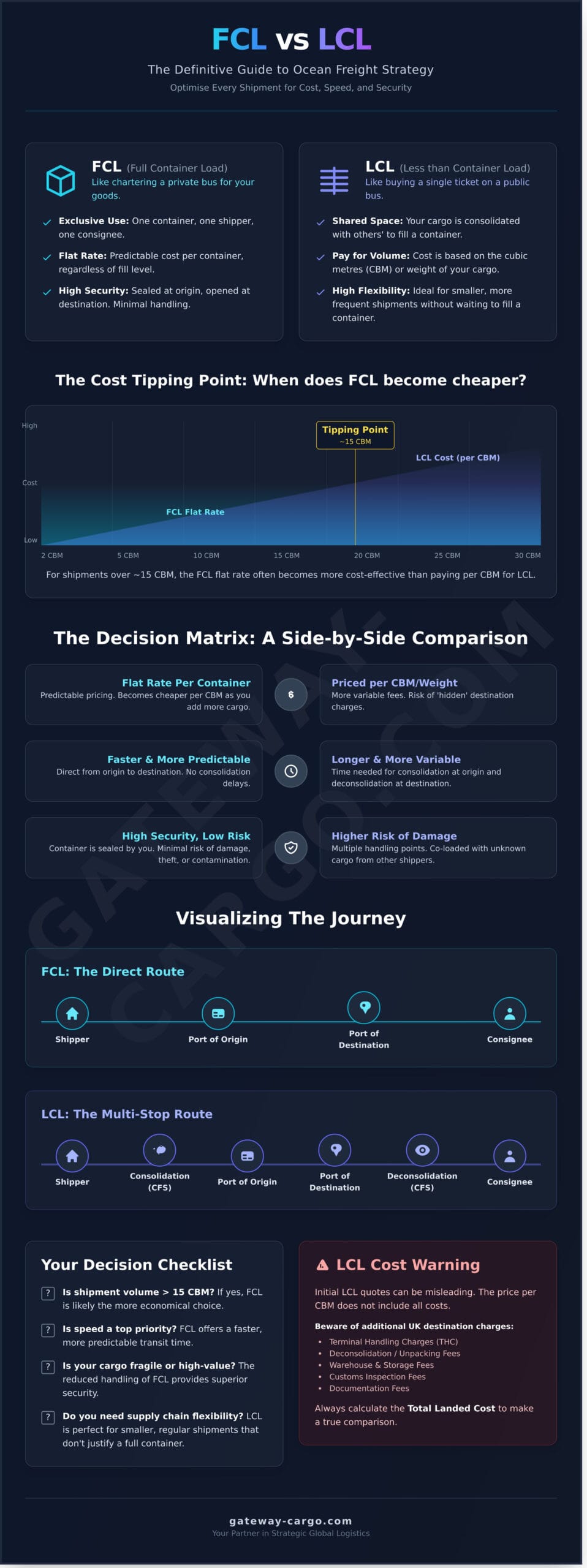
FCL shipping means you book the exclusive use of a standard shipping container (typically 20ft or 40ft). The container is dedicated solely to your cargo, moving from a single shipper to a single consignee. A key feature of FCL is its pricing structure; you pay a flat rate for the entire container, regardless of whether you fill it completely. This makes it the most cost-effective solution for larger shipments, generally those exceeding 15 cubic metres (CBM). The container is sealed at origin and remains sealed until it reaches its destination, offering enhanced security for your goods. For a deeper analysis, explore our comprehensive guide to FCL Shipping: A Guide to Full Container Loads.
What is LCL (Less than Container Load)?
LCL shipping is the ideal solution when your cargo volume is not large enough to warrant a full container. With LCL, your shipment is consolidated with cargo from other shippers to fill a shared container. This consolidation process occurs at a logistics provider’s warehouse or a Container Freight Station (CFS). The primary advantage is cost efficiency for smaller consignments, as you only pay for the specific volume (measured in CBM) or weight that your goods occupy within the container. This flexible approach provides an accessible entry point to global ocean freight for businesses of all sizes. To learn more about this method, please read our article, What is LCL Shipping?
The Decision Matrix: A Side-by-Side Comparison
Selecting the optimal freight solution requires a clear understanding of the trade-offs between Full Container Load (FCL) and Less than Container Load (LCL). The best choice is not universal; it depends entirely on which operational factor-cost, speed, security, or flexibility-is most critical for your specific shipment. The central question in the fcl vs lcl debate is about aligning the shipping method with your business priorities.
To provide a clear framework for this decision, we have developed a direct comparison matrix. This detailed FCL vs LCL comparison highlights the key differences across the most important business metrics, establishing a foundation for the deeper analysis that follows.
- Factor
- FCL (Full Container Load)
- LCL (Less than Container Load)
- Cost Structure
- Flat rate per container. Cost-effective for larger volumes.
- Priced per cubic metre (CBM) or weight. More variable fees.
- Transit Time
- Faster and more predictable. Direct from origin to destination.
- Longer due to consolidation/deconsolidation at ports.
- Security & Risk
- High security. Sealed at origin, opened by consignee. Low risk.
- Higher risk due to multiple handling points and co-loading.
- Flexibility
- Less flexible for small shipments; requires near-full container for value.
- Highly flexible for small volumes and frequent shipments.
Cost Structure and Pricing
With FCL, you pay a single flat rate for the exclusive use of a container. This model is highly predictable and becomes increasingly cost-effective per cubic metre as you fill the space. In contrast, LCL is priced based on the volume (CBM) or weight of your cargo, whichever is greater. While this seems economical for smaller shipments, the pricing is more variable and includes multiple handling and documentation fees. These ancillary charges, often termed ‘hidden costs’, will be explored in our next section.
Transit Time and Speed
FCL shipments are generally faster. Once loaded and sealed, the container moves directly from the port of origin to the port of destination without intermediate handling. LCL, by its nature, involves a longer logistics chain. Your cargo must be consolidated with other shipments at the origin warehouse and then deconsolidated at the destination. This process not only adds time but also exposes your shipment to potential delays caused by other shippers’ documentation or customs issues.
Cargo Security and Risk of Damage
Security is a significant advantage of FCL. Your goods are the only items in the container, which is sealed by the shipper and ideally not opened until it reaches the final consignee. This minimises handling and dramatically reduces the risk of damage or loss. LCL shipments face a higher risk profile. Your cargo is handled multiple times during consolidation and deconsolidation and is co-loaded with unknown goods from other shippers, increasing the potential for cross-contamination or damage from improperly secured freight.
Calculating the True Landed Cost: FCL vs. LCL
For any business optimising its supply chain, the primary concern is not the initial quote but the final landed cost. A superficial comparison of shipping rates can be deceptive, which is why a detailed analysis of the cost structures in the fcl vs lcl debate is essential for accurate budgeting. A complete financial picture requires understanding the differences between FCL and LCL pricing models, as the most affordable option is not always the one with the lowest initial per-CBM rate.
The All-Inclusive Nature of FCL Pricing
Full Container Load (FCL) shipping is defined by its pricing transparency. You are typically quoted a single, lump-sum rate for the exclusive use of a container. This all-inclusive cost is primarily composed of three elements:
- Ocean Freight Rate: The base cost for moving the container from the port of origin to the port of destination.
- Terminal Handling Charges (THC): Fees levied by the port authorities at both ends for handling the container.
- Chassis or Haulage Fees: The cost associated with the inland transport of the container to and from the port.
With fewer line items, FCL offers predictable, transparent pricing. As you fill the container, your cost per unit shipped decreases, making it a highly efficient solution for larger volume shipments. A flat rate of £2,800 for a 40ft container is straightforward to budget for, regardless of whether it is half-full or packed to capacity.
Unpacking the Hidden Costs of LCL
Less than Container Load (LCL) shipping presents a more complex cost structure. The initial low per-CBM quote for LCL can be misleading once all origin and destination fees are applied. While the ocean freight portion may seem economical (e.g., £60 per CBM), the total cost is inflated by numerous handling fees required to manage shared container space.
Common LCL charges that accrue throughout the journey include:
- Container Freight Station (CFS) Fees: Charges at both origin and destination for the labour and facilities used to consolidate your goods with others and later deconsolidate them.
- Consolidation/Deconsolidation Fees: Specific administrative and handling fees for the grouping and separating of cargo.
- Destination Port Charges: These are often significantly higher per CBM for LCL shipments compared to FCL, as the terminal must perform more complex handling to sort individual consignments.
A comprehensive, all-in quote is therefore critical when evaluating your fcl vs lcl options to prevent unforeseen expenses from eroding your profit margins.
Making the Final Call: A Practical Decision Checklist
Understanding the theoretical differences between shipping methods is the first step. The next is applying that knowledge to your specific business needs. This practical checklist is designed to move from education to application, empowering you to make the optimal, most cost-effective decision for your cargo.
Your 5-Point Shipment Evaluation Checklist
To determine the right solution in the fcl vs lcl debate, evaluate your consignment against these five critical questions. Your answers will provide a clear direction for your logistics strategy.
- What is your shipment volume? Calculate your total volume in cubic metres (CBM). Is this figure approaching the economic breakpoint where a dedicated container becomes more viable?
- How urgent is your delivery? FCL shipments typically have shorter transit times due to direct routing and less handling. Can your supply chain accommodate the potential for delays inherent in LCL consolidation and deconsolidation processes?
- How fragile or valuable is your cargo? LCL shipments are handled multiple times at various stages. If your goods are high-value, delicate, or susceptible to damage from movement, the minimal handling of an FCL shipment offers superior security.
- What is your total budget? While LCL offers a lower entry price for small volumes, consider all associated costs, including destination charges. FCL provides a single, all-in cost that can simplify budgeting and may prove more economical for larger shipments.
- Do you have consistent shipping needs? If you have a regular flow of smaller shipments, could they be consolidated into a single, periodic FCL shipment? This strategy can significantly optimise long-term freight expenditure.
Breakpoint Analysis: When FCL Beats LCL on Price
In logistics, the ‘breakpoint’ is the volume at which the cumulative cost of an LCL shipment surpasses the flat-rate cost of an FCL container. While market rates fluctuate, this tipping point typically occurs around 13-15 CBM for a standard 20ft container.
At this volume, the per-CBM rate combined with various LCL-specific fees can exceed the cost of securing your own container. For any business with a borderline shipment size, it is imperative to request quotes for both FCL and LCL options to conduct a precise cost-benefit analysis. A comprehensive comparison is the only way to ensure you are not overpaying for your freight. For a detailed, no-obligation quote based on current market rates, let our experts run a breakpoint analysis for your shipment.
Optimising Your Strategy with a Freight Forwarding Partner
Choosing between Full Container Load (FCL) and Less than Container Load (LCL) is more than a simple volume calculation; it is a strategic decision that impacts your entire supply chain. A basic freight quote rarely captures the full picture. At Gateway Cargo, we operate as an extension of your team, providing the strategic insight needed to transform a simple shipping choice into a competitive advantage. Our role is not just to provide a price, but to engineer a solution.
The complexities of the fcl vs lcl decision require a level of expertise that goes beyond online calculators. Our specialists analyse your shipping patterns, inventory needs, and market demands to recommend the most efficient and cost-effective method for your specific circumstances.
Beyond Booking: The Value of Expert Consultation
Our logistics specialists provide proactive guidance to optimise your freight operations. We focus on delivering value and clarity at every stage:
- True Landed Cost Analysis: We help you understand the total cost of your shipment in Pounds Sterling, factoring in UK customs duties, VAT, port fees, and potential demurrage charges to prevent unforeseen expenses upon arrival.
- LCL Network Optimisation: For LCL shipments, we leverage our extensive global network and direct consolidation services to major UK ports. This minimises handling, reduces the risk of damage, and shortens transit times.
- Bespoke Shipping Solutions: We offer flexible strategies like buyer’s consolidation, allowing you to combine orders from multiple suppliers in one origin country into a single FCL shipment, delivering significant cost savings.
Seamless Logistics for Your Ocean Freight Needs
Whether your cargo requires the dedicated space of FCL or the flexibility of LCL, Gateway Cargo provides robust, end-to-end management. Our global infrastructure ensures your goods are handled with precision from origin to final destination. We integrate ocean freight with critical services, including HMRC customs clearance, warehousing, and final-mile distribution across the United Kingdom, creating a truly seamless logistics experience.
Let us provide the clarity and strategic support your business deserves. Move beyond quotes and build a smarter, more resilient supply chain with a trusted partner.
Making the Strategic Choice for Your Ocean Freight
Choosing the right ocean freight strategy for 2026 hinges on a clear understanding of your specific needs. The decision between fcl vs lcl is not merely about shipment volume; it requires a comprehensive analysis of the true landed cost, transit time sensitivity, and cargo security. By looking beyond the initial quote and considering all factors from warehousing fees to customs duties, you can significantly optimise your supply chain efficiency and control your costs within the dynamic UK market.
Navigating these complexities alone can be challenging. The true key to success lies in partnership. At Gateway Cargo, our dedicated specialists provide bespoke freight solutions tailored to your unique requirements. With a global network for seamless FCL and LCL shipments and deep expertise in UK customs clearance, we manage your end-to-end logistics with precision.
Ready to build a smarter, more resilient supply chain? Request a complimentary consultation with our ocean freight specialists today and let us optimise your logistics strategy for the future.
Frequently Asked Questions: FCL vs LCL
What is the main difference between FCL and LCL?
The primary distinction lies in container exclusivity. With FCL (Full Container Load), you lease an entire container for your exclusive use, regardless of whether you fill it. In contrast, LCL (Less than Container Load) involves sharing container space with cargo from other shippers. FCL offers greater security and typically faster transit times, while LCL provides a cost-effective solution for smaller shipments that do not warrant a full container.
Is LCL always cheaper than FCL for small shipments?
While LCL is designed for smaller volumes, it is not invariably the most economical choice. LCL pricing is calculated at a higher rate per cubic metre than FCL. When a shipment’s volume reaches a certain threshold, typically around 13-15 cubic metres, the total cost of LCL can surpass the flat rate for a 20ft FCL container. Therefore, a careful cost analysis is essential to determine the optimal shipping method for your cargo.
How is LCL shipping cost calculated?
The cost of an LCL shipment is determined by its chargeable weight, which is the greater of its actual weight (in tonnes) or its volumetric weight (in cubic metres, CBM). This is known as the Weight/Measurement (W/M) standard. The applicable rate is multiplied by this chargeable weight to calculate the base freight cost. Additional charges for origin/destination handling, customs, and documentation are then applied to establish the final price.
What is the minimum volume for an LCL shipment?
Most freight forwarders and consolidators impose a minimum chargeable volume for LCL shipments, which is universally set at one cubic metre (1 CBM). This means that even if your cargo occupies less space, for instance 0.6 CBM, you will be billed for the 1 CBM minimum. This policy covers the fixed administrative and physical handling costs incurred for every individual shipment processed through the LCL consolidation network.
How long does LCL shipping take compared to FCL?
LCL shipments consistently have longer overall transit times than FCL shipments. This delay is attributed to the essential consolidation and deconsolidation processes. Cargo must be collected, sorted, and loaded with other goods at the origin port, and then unloaded and segregated at the destination. These additional handling stages can add several days to a week or more to the total journey compared to a direct FCL transit.
What are the standard container sizes for FCL shipping?
The most frequently utilised standard containers for FCL shipping are the 20-foot and 40-foot dry van containers. A 20ft container provides approximately 33 CBM of cargo capacity, while a 40ft container offers around 67 CBM. A 40-foot High Cube (HC) container, providing extra vertical space for a total of about 76 CBM, is also a common option. Specialised equipment like refrigerated or open-top containers are available for non-standard cargo.
Can you ship hazardous materials via LCL?
Shipping hazardous materials (HAZMAT) or dangerous goods (DG) via LCL is highly restricted and often not permitted. The complexity of ensuring that incompatible dangerous goods are not co-loaded in the same container presents significant safety and regulatory challenges for consolidators. While some providers may accept certain classes of DG, FCL is the standard, safer, and often mandatory method for shipping such materials, ensuring proper segregation and compliance.
What is ‘Buyer’s Consolidation’ and how does it relate to FCL?
Buyer’s Consolidation is a logistics strategy where a single importer combines multiple LCL-sized orders from different suppliers at the origin into a single FCL container shipment. This service allows the buyer to leverage the cost-efficiency, enhanced security, and faster transit times of FCL shipping. It is a highly effective method to optimise supply chain costs when debating FCL vs LCL for sourcing from multiple vendors within the same geographical region.