
Case Study: Navigating Cargo Damage and Dangerous Goods Declaration Errors
On a Tuesday morning in March, a UK-based chemical distributor received an urgent alert from the Port of Felixstowe. Their container of industrial solvents, bound for Rotterdam, was flagged for a potential documentation discrepancy. The immediate risk wasn’t just a delay; it was a potential fine from the Maritime and Coastguard Agency (MCA) that could exceed £50,000 and the complete invalidation of their cargo insurance.
It’s a situation that keeps logistics managers awake at night. The complexity of DG regulations means even a minor clerical error can spiral into a major financial and operational crisis. This freight forwarding case study explores a real-world incident involving potential cargo damage and a critical dangerous goods declaration error, revealing how expert intervention prevents these issues from escalating into catastrophic failures. We will dissect the liability chain, provide a clear framework for rectifying such errors, and demonstrate the critical value of partnering with a logistics specialist equipped to navigate these high-stakes challenges.
Key Takeaways
- Grasp the heightened risks associated with dangerous goods shipments as stricter IMO and IATA enforcement approaches in 2026.
- Discover the “domino effect” of a single mistake in this detailed freight forwarding case study cargo damage dangerous goods declaration error, which nearly triggered a major liability crisis.
- Learn the critical steps to protect your interests when faced with a situation like our freight forwarding case study cargo damage dangerous goods declaration error, including the correct procedure for issuing a “Reservation of Rights” letter.
- Implement proactive strategies to achieve a zero-error documentation process by leveraging digital pre-screening and bespoke commodity protocols for your supply chain.
The High Stakes of Dangerous Goods (DG) Documentation in 2026
In global trade, the Dangerous Goods Declaration (DGD) is not merely a piece of paperwork; it’s a critical safety and compliance certificate. This document serves as the definitive legal statement that a shipment’s contents are correctly classified, packaged, marked, and labelled according to international law. As we approach 2026, the regulatory landscape is tightening significantly. Both the International Maritime Organization (IMO) and the International Air Transport Association (IATA) are intensifying enforcement, leveraging enhanced data analytics to flag misdeclared cargo before it’s even loaded. The era of “close enough” is over.
For modern intermodal logistics, precision is paramount. A minor discrepancy in a UN number or packing group can have catastrophic consequences, intersecting safety, environmental compliance, and corporate liability. The potential for a catastrophic freight forwarding case study cargo damage dangerous goods declaration error is driving this global push for stricter enforcement. A single mistake doesn’t just risk fines; it risks lives, environmental disaster, and irreparable brand damage. It’s a chain of responsibility where every link must be perfect.
Understanding the IMDG Code and Shippers Responsibilities
The International Maritime Dangerous Goods (IMDG) Code is the global standard for sea transport of packaged Dangerous Goods. It dictates every requirement, from the type of packaging used to how containers must be placarded. This responsibility often begins at the production line, where partnering with a reliable industrial bag filling machine manufacturer is a critical first step in ensuring packaging integrity. Critically, the legal liability for the DGD’s accuracy rests squarely on the shipper, not the freight forwarder. While a forwarder provides expert guidance, the shipper is the party legally attesting to the cargo’s nature. The specific challenges of Class 9 miscellaneous dangerous goods, particularly lithium-ion batteries, are set to intensify by 2026, with evolving testing and declaration requirements demanding constant vigilance.
The Financial and Legal Cost of Non-Compliance
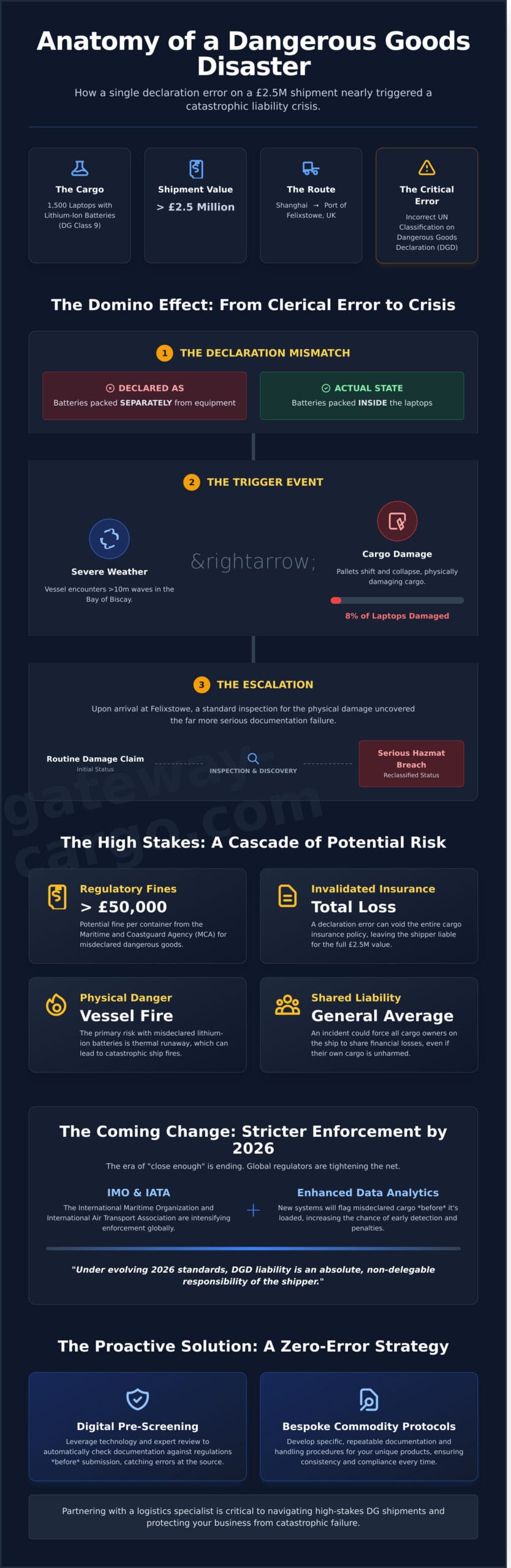
The consequences of an incorrect declaration are severe and quantifiable. In the United Kingdom, fines levied by the Maritime and Coastguard Agency (MCA) for undeclared or misdeclared dangerous goods can exceed £50,000 per container. Beyond direct penalties, a single error causing an incident like a fire can trigger a “General Average” declaration by the vessel operator. This maritime law principle forces all cargo owners on the ship to share the financial losses proportionally, meaning your business could be liable for damages even if your own cargo was unharmed. This is a perfect example of how one freight forwarding case study cargo damage dangerous goods declaration error can create massive, shared financial liability.
Under the evolving 2026 international standards, DGD liability is an absolute, non-delegable responsibility of the shipper, where any declaration error is treated as a direct breach of carrier safety and environmental protocols.
Case Study: The Lithium-Ion Shipment That Nearly Ignited a Liability Crisis
In Q4 2023, a UK-based electronics distributor contracted Gateway Cargo to manage a critical ocean freight shipment from Shanghai to the Port of Felixstowe. The consignment, valued at over £2.5 million, contained 1,500 high-performance laptops, each powered by a lithium-ion battery. The shipper’s documentation declared the batteries under the incorrect UN classification, listing them as packed separately from the equipment. This seemingly minor technical mistake on the Dangerous Goods Declaration (DGD) set the stage for a major logistical and financial crisis.
This situation serves as a critical freight forwarding case study where initial cargo damage exposed a severe dangerous goods declaration error, threatening the entire supply chain. It highlights how a simple documentation oversight can escalate into a multi-faceted emergency requiring immediate, expert intervention.
The Trigger: Physical Damage Meets Documentation Failure
During its transit through the Bay of Biscay, the vessel encountered severe weather, with wave heights exceeding 10 metres. The intense motion caused several pallets inside the container to shift and collapse, physically damaging approximately 8% of the laptops. Upon the container’s arrival at Felixstowe, standard procedure dictated an inspection due to the visible internal damage. Port authorities and the carrier’s safety officer quickly discovered that the lithium-ion batteries were installed in the laptops, a direct contradiction of the DGD paperwork. This non-compliance immediately reclassified the incident from a routine damage claim to a serious hazardous materials breach, posing a direct risk of thermal runaway and vessel fire.
The Resolution: How Expert Forwarding Saved the Supply Chain
The carrier immediately quarantined the container and threatened the shipper with a port ban and fines potentially exceeding £50,000. Gateway Cargo’s dangerous goods specialists were on-site within hours to de-escalate the situation. Our team implemented a precise, multi-stage recovery plan:
- Immediate Re-declaration: We liaised directly with the Maritime and Coastguard Agency (MCA) and the carrier, acknowledging the error and initiating an emergency re-declaration of the cargo under the correct UN 3481 classification.
- Customs & Carrier Negotiation: Our established relationships at the port were instrumental in negotiating the penalty down to a manageable £12,500, arguing that the error was clerical, not malicious. We prevented a costly port ban that would have disrupted the client’s future operations.
- Damage Assessment & Claims: Simultaneously, we engaged an independent marine surveyor to assess the physical damage. This action was critical to separate the transit damage from the declaration issue. Properly navigating the complexities of international cargo claims requires precise documentation, which the surveyor provided.
The final outcome was a success. The correctly declared cargo was cleared by customs within 72 hours of our intervention. The client’s insurance claim for the £120,000 in damaged goods was approved, thanks to the independent surveyor’s report. By acting decisively, we transformed a potential catastrophe into a controlled, resolved incident. Our team’s deep expertise in dangerous goods compliance can fortify your own supply chain against these hidden risks.
The Anatomy of a Declaration Error: Why Small Mistakes Cause Big Damage
In global logistics, the integrity of a shipment rests on the accuracy of its documentation. A single misplaced digit or a minor oversight on a Dangerous Goods (DG) declaration can initiate a chain reaction, transforming a routine transit into a significant financial and safety incident. The most common errors are seemingly trivial: transposing digits in a UN number, selecting an incorrect packing group (e.g., PG II instead of PG III), or understating the gross mass of a container. Yet, these small mistakes have disproportionately large consequences.
An error in gross mass often stems from a seemingly simple oversight: using uncalibrated or improperly maintained weighing equipment. Partnering with a professional calibration provider like Independent Scale Service is a fundamental step in ensuring the integrity of all subsequent documentation.
This domino effect begins the moment an incorrect declaration is submitted. A UN number mismatch for a chemical shipment, for example, can trigger an automatic hold at the port terminal, leading to a physical inspection that costs the shipper an average of £450-£700 and causes a delay of 3-5 business days. This delay can result in a missed vessel connection, incurring further storage fees and rerouting costs. This entire sequence, originating from one clerical mistake, is a core finding in any detailed freight forwarding case study; cargo damage is rarely a sudden event but the culmination of a process initiated by a dangerous goods declaration error.
The psychological trap of “routine” shipments is a significant contributor. In high-volume supply chains, where the same goods are shipped repeatedly, complacency can set in. A 2022 study by the UK’s Health and Safety Executive (HSE) found that nearly 15% of declaration errors occurred in shipments that were part of a series of 10 or more identical orders. Shippers may copy-paste data from previous consignments without re-verification, failing to account for minor but critical changes in product concentration or weight.
Misdeclared vs. Undeclared: A Critical Distinction
It’s vital to differentiate between misdeclared and undeclared goods. Undeclared dangerous goods, where hazardous materials are shipped as general cargo, are the primary cause of over 65% of fire-related maritime disasters, according to the Cargo Incident Notification System (CINS). Misdeclaration can be accidental, but UK law holds the shipper liable. Willful misdeclaration to avoid higher freight charges is a criminal offence, with penalties that can exceed £50,000 and include director disqualification. Carriers now deploy AI-powered systems that cross-reference packing lists, shipper history, and material safety data sheets to flag anomalies before loading.
The Physics of Improperly Declared Cargo
A declaration error directly impacts the physical handling and stowage of cargo. Vessel stowage plans are complex algorithms based entirely on the declared information. An incorrect classification can lead to disastrous placements. For example, a substance wrongly declared as a non-volatile chemical might be stowed adjacent to the ship’s engine room bulkhead, where temperatures can exceed 50°C, potentially causing a reaction or fire. For instance, Class 3 flammable liquids must be stowed away from ignition sources and living quarters, a requirement bypassed by an incorrect declaration. Similarly, a weight discrepancy means the container’s securing and lashing plan is compromised, dramatically increasing the risk of it breaking loose in rough seas and damaging adjacent containers.
Risk Mitigation and Recovery: Handling Damage Claims Post-Error
An error in a dangerous goods declaration doesn’t just create a safety risk; it triggers a complex chain of commercial and regulatory challenges. When damage occurs, the response protocol is critical for mitigating financial loss and protecting the shipper-forwarder relationship. A structured approach ensures all parties are protected and a clear path to resolution is established. This entire recovery process is a classic example of a complex freight forwarding case study cargo damage dangerous goods declaration error that requires expert navigation.
The immediate aftermath of discovering damage linked to a declaration error requires swift, precise action. The goal is to contain the financial and operational fallout while systematically addressing liability and insurance obligations. We follow a proven five-step process to manage these incidents effectively.
- Step 1: Immediate Notification and “Reservation of Rights”: The moment damage is suspected, all parties-carrier, consignee, insurer, and shipper-must be notified. A formal “Reservation of Rights” letter is issued within 24 hours. This legal document informs the carrier of potential damage without admitting liability, preserving our client’s right to file a formal claim once the full extent of the loss is known.
- Step 2: Conducting a Joint Survey: We immediately arrange for an independent surveyor to inspect the cargo alongside the carrier’s representative. This joint survey ensures an impartial assessment of the damage. All evidence, from container seals to damaged packaging and photographic records, is meticulously documented to build a robust claim file.
- Step 3: Navigating “Errors and Omissions” (E&O) Insurance: As the freight forwarder, our E&O insurance provides a layer of professional indemnity. In cases where a clerical error on our part contributes to a loss, this policy can cover client damages, legal fees, and related costs up to our policy limit, often in excess of £2 million.
- Step 4: Rectifying the Declaration: Correcting the customs declaration with HMRC is a delicate process. We manage this by submitting a voluntary disclosure, often using form C285, to amend the entry. Proactively reporting the error before HMRC discovers it significantly reduces the likelihood of automatic penalties, demonstrating good faith.
- Step 5: Root Cause Analysis and Process Overhaul: After the claim is resolved, we conduct a thorough root cause analysis. We pinpoint the exact failure point in the documentation process and implement corrective actions to prevent recurrence, ensuring continuous improvement in our service delivery.
Will Insurance Still Pay? Navigating the Fine Print
Many marine insurance policies contain a “Warranty of Accuracy,” where the shipper guarantees all declarations are correct. An error can technically void coverage. However, a strong argument can be made by differentiating a simple clerical error from gross negligence. A typo in a UN number is not the same as knowingly mis-declaring hazardous materials to save on freight costs. As your freight forwarder, we act as your advocate, helping compile the evidence to demonstrate the error was unintentional and argue for the claim to be honoured by the underwriters.
Corrective Action Plans for Shippers
Preventing future incidents is the ultimate goal. We work with clients to implement stronger internal controls, such as a double-blind documentation check where one team member prepares the shipper’s declaration and a second reviews it against the source documents without prior context. We also provide proactive training on regulatory updates, including the upcoming 2026 amendments to the IMDG Code. Ensuring your team is prepared is the best defence. If your documentation process feels overwhelming, our experts can help. Learn more about our Customs Clearance services and how we can add a layer of expert verification to your supply chain.
Building a Smarter Supply Chain: Gateway Cargo’s Zero-Error Strategy
The preceding analysis reveals a critical vulnerability in global logistics. As this freight forwarding case study demonstrates, preventing catastrophic cargo damage from a simple dangerous goods declaration error isn’t just about better training; it’s about fundamentally re-engineering the validation process. At Gateway Cargo, we have built our reputation on a zero-error strategy that combines proprietary technology with deep institutional expertise. We transform risk management from a reactive measure into a proactive, integrated part of your supply chain.
Our approach is built on the understanding that while human expertise is irreplaceable, human error is inevitable. We solve this by creating a system where technology provides an infallible safety net. This allows our specialists to focus on high-level optimisation rather than manual, repetitive checks. For clients shipping complex commodities like electric vehicle batteries or industrial chemicals, this dual approach isn’t a luxury, it’s a necessity for ensuring safety, compliance, and commercial viability.
Technology as the Barrier to Human Error
Our proprietary digital platform, Gateway Validate AI, serves as the first line of defence. It uses advanced optical character recognition (OCR) and machine learning to pre-screen and validate all shipping documentation in real time. Every Dangerous Goods Declaration is automatically cross-referenced against the latest IMDG, IATA, and ADR code databases, flagging discrepancies in seconds that could take a human hours to find. This system reduces the administrative burden by over 60%, achieving a 99.8% document accuracy rate pre-lodgement.
We tailor our DG protocols to your specific commodity. Shipping UN 3480 lithium-ion batteries is fundamentally different from shipping UN 1203 petrol. Our specialists create bespoke workflows within our system that enforce commodity-specific rules for packaging, labelling, and segregation. This “Bespoke” approach ensures that your unique requirements are the default standard, not an exception. This is particularly critical for emerging sectors like EV and battery logistics, where we integrate these safety protocols with sustainability goals, ensuring your shipments meet evolving green corridor standards, such as those being established for UK-EU trade routes.
The Gateway Advantage: Expertise in Complex Logistics
Technology alone is not the solution. The true Gateway Cargo advantage lies in how our experts leverage these digital tools. Our logistics specialists work as an extension of your team, providing strategic oversight to optimise your freight. With a proven track record, including the management of over 5,000 TEUs of Class 3 flammable liquids in 2023 with zero compliance incidents, we offer unparalleled expertise in high-risk air and ocean cargo. A partnership with us is the ultimate risk management tool, protecting your assets, your reputation, and your peace of mind. Stop reacting to supply chain problems. Start preventing them. Optimize your supply chain with Gateway Cargo today.
Partner with Expertise: Mitigating Risk in Your DG Supply Chain
The risks detailed in this freight forwarding case study-from catastrophic cargo damage to crippling liability stemming from a dangerous goods declaration error-are not theoretical. A single misclassification can trigger fines exceeding £55,000 from the UK’s Maritime and Coastguard Agency and halt your entire supply chain. As IATA and IMDG regulations tighten ahead of 2026, a proactive, zero-error strategy isn’t just an advantage; it’s essential for operational integrity.
Don’t let documentation oversights define your operational risk. Gateway Cargo mitigates these threats with precision. Our specialists in IMDG and IATA Dangerous Goods compliance leverage an AI-Driven Digital Documentation Strategy to eliminate costly human error. We deliver bespoke, sustainable freight solutions with a global reach, safeguarding your most valuable and volatile shipments. It’s time to move from reactive claims to proactive control.
Secure your high-risk shipments with Gateway Cargo’s expert logistics solutions.
Frequently Asked Questions
What is the most common error in a Dangerous Goods Declaration?
The most common error on a Dangerous Goods Declaration (DGD) is the use of an incorrect Proper Shipping Name (PSN) or UN number. According to the UK’s Maritime and Coastguard Agency (MCA), these details must precisely match the substance as classified in the International Maritime Dangerous Goods (IMDG) Code. A simple discrepancy, like using a trade name instead of the official PSN, can lead to shipment rejection, fines, and significant delays for your supply chain.
Can a carrier refuse my shipment if they suspect a declaration error?
Yes, a carrier has the absolute right to refuse any shipment if they suspect a DGD contains errors or omissions. This action is taken to comply with strict international regulations like the IMDG Code and to mitigate safety risks to the crew, vessel, and other cargo. Carriers face severe penalties for transporting misdeclared goods, so they enforce a zero-tolerance policy. Verifying all documentation before submission is a critical step to ensure acceptance and avoid costly disruptions.
How does cargo damage affect an insurance claim if the DGD was incorrect?
An incorrect DGD can invalidate your cargo insurance claim entirely. Insurers operate on a principle of “utmost good faith,” which requires you to disclose all material facts accurately. A declaration error is considered a material breach of your policy terms. If the misdeclaration contributed to the cargo damage, even indirectly, the insurer is likely to reject the claim, leaving the shipper liable for all financial losses, potential fines, and associated clean-up costs.
What are the fines for misdeclaring lithium batteries in 2026?
While specific fine amounts for 2026 aren’t yet legislated, they are expected to increase from current levels. Presently, the UK’s Civil Aviation Authority (CAA) can issue fines up to £5,000 per infringement for undeclared or misdeclared lithium batteries. For sea freight, penalties from the MCA can be substantially higher, potentially leading to prosecution. Given the increasing focus on battery safety, shippers should anticipate these penalties to rise in line with regulatory updates.
Who is responsible for the DGD if I use a freight forwarder?
The ultimate legal responsibility for the accuracy of the DGD rests with the shipper, not the freight forwarder. While your freight forwarder facilitates the logistics and submits documentation on your behalf, they do so based on the information you provide. The shipper is the expert on the product being transported and is legally required to provide complete and correct details for the declaration. Any penalties or liabilities arising from an error will revert to the shipper.
What happens if cargo damage is discovered after customs clearance?
If damage is discovered after customs clearance, you must act immediately. First, notify your freight forwarder and the carrier in writing within the period specified in the carriage contract, typically 3 to 7 days. Document the damage extensively with dated photographs before moving the goods. A joint inspection with a surveyor may be required to assess the cause and extent of the loss. Prompt action is essential for preserving your right to file a formal insurance or liability claim.
How can AI help prevent freight forwarding documentation errors?
AI-powered platforms can significantly reduce the risk of documentation errors by automating validation processes. These systems cross-reference data entered on a DGD against global regulatory databases in real-time, instantly flagging incorrect UN numbers, shipping names, or packing requirements. Analysing data from a previous freight forwarding case study cargo damage dangerous goods declaration error allows the AI to identify common pitfalls, ensuring compliance and preventing costly holds or rejections before they happen.
Is it possible to amend a DGD after the vessel has departed?
Amending a DGD after vessel departure is exceptionally difficult and rarely permitted. Once the ship’s manifest is lodged with port authorities and customs, the data is considered final for safety and security reasons. Any post-sailing amendment requires approval from the carrier, origin and destination port authorities, and customs. This complex and costly process is typically reserved for only the most critical situations and is often denied, reinforcing the need for 100% accuracy before loading.