
International Freight Forwarding Services: A Strategic Guide for 2026
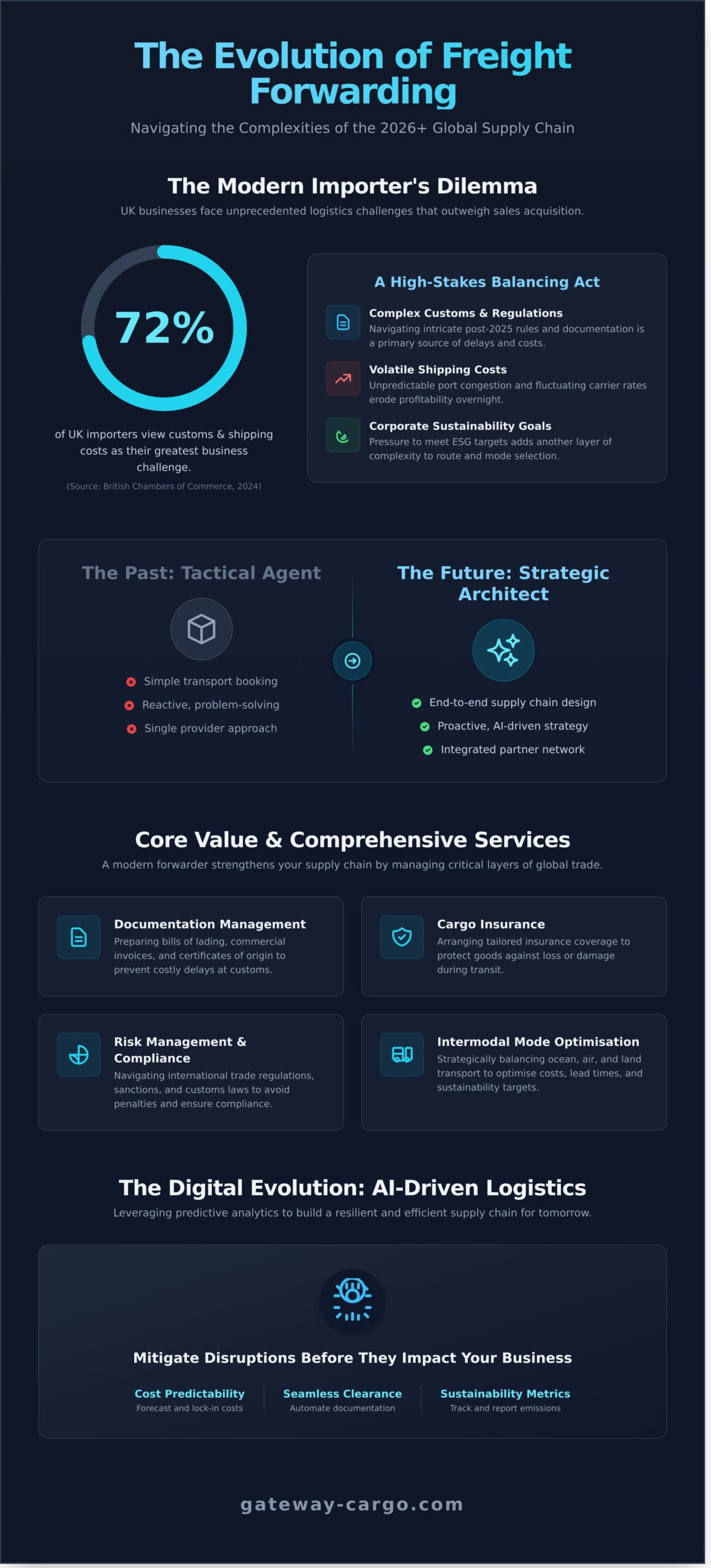
A 2024 report from the British Chambers of Commerce revealed a startling fact: 72% of UK importers now view navigating customs and volatile shipping costs as a greater challenge than acquiring new customers. It’s a reality that defines the current market. The pressure to meet corporate sustainability goals while preparing for complex post-2025 regulations has turned supply chain management into a high-stakes balancing act, where unpredictable port congestion and rising costs can erode profitability overnight.
This strategic guide is designed to provide a clear pathway forward. You will discover how modern international freight forwarding services are evolving to deliver the cost predictability, seamless customs clearance, and visible sustainability metrics your business needs to thrive. We will explore how AI-driven logistics, bespoke intermodal solutions, and proactive sustainability strategies are not just future concepts, but practical tools for building a resilient and efficient supply chain for 2026 and beyond.
Key Takeaways
- Understand how AI-driven predictive analytics are used to mitigate supply chain disruptions before they impact your business.
- Develop a weighted scorecard to evaluate partners, learning why the lowest initial quote often results in higher total costs in the UK market.
- Learn to strategically balance ocean, air, and intermodal transport to optimise lead times against both budgetary constraints and sustainability targets.
- Discover why modern international freight forwarding services have evolved from simple transport arrangement to the strategic optimisation of your entire global supply chain.
What Are International Freight Forwarding Services in the Modern Era?
The traditional definition of a freight forwarder as a simple transport agent is now obsolete. In today’s interconnected global economy, a modern provider of international freight forwarding services operates as a strategic architect for your entire supply chain. They are no longer just booking space on a vessel; they are designing, managing, and optimising the complex journey of your goods from origin to final destination. This evolution addresses a fundamental question for any business involved in global trade: what is a freight forwarder in an age of constant disruption? The answer is a multi-faceted partner who integrates logistics, technology, and regulatory expertise.
This shift from tactical transport booking to end-to-end supply chain optimisation is why a growing number of UK businesses are moving away from direct carrier engagement. A 2024 report from the Chartered Institute of Logistics and Transport (CILT) UK found that 75% of SMEs experienced significant shipping delays when booking directly with carriers. By 2026, we project this trend will accelerate, as volatile shipping rates and complex post-Brexit customs procedures make a single-provider approach inefficient and risky. A forwarder provides access to a network of carriers, modes of transport, and real-time market intelligence that a single carrier simply cannot offer.
The Forwarder as an Extension of Your Team
Effective logistics partners provide bespoke solutions, not “off-the-shelf” packages. This means having dedicated specialists who understand the unique challenges of your industry and complex trade routes, such as navigating new customs requirements for EU trade or securing capacity on high-demand Asia-Europe lanes. Bespoke logistics in 2026 is the practice of dynamically engineering supply chains in real-time to mitigate geopolitical disruptions and fluctuating carrier capacities. It’s a proactive strategy, not a reactive service.
Core Responsibilities and Value-Add Services
Beyond coordinating shipments, a forwarder’s core value lies in managing the critical administrative and regulatory layers of global trade. They act as your legal and regulatory intermediary, ensuring every shipment is compliant and protected. This comprehensive management includes:
- Documentation Management: Preparing and processing all necessary paperwork, including bills of lading, commercial invoices, and certificates of origin to prevent costly delays at customs.
- Cargo Insurance: Arranging appropriate insurance coverage to protect your goods against loss or damage during transit, with policies tailored to the value and risk profile of your cargo.
- Risk Management and Compliance: Navigating the intricate web of international trade regulations, sanctions, and customs laws to ensure full compliance and avoid penalties. This is especially critical for specialised cargo.
- Mode Optimisation: Selecting the most efficient and cost-effective transport methods, from sea and air to road and rail. For a detailed look at marine logistics, see our Complete Guide to Ocean Freight Forwarding.
The intersection of logistics and customs compliance is where professional international freight forwarding services deliver immense value. By handling these complex responsibilities, a forwarder doesn’t just move your freight; they secure its journey, protect your investment, and strengthen your supply chain’s resilience.
The Pillars of Global Logistics: Ocean, Air, and Intermodal Solutions
Effective global logistics rests on three core pillars: ocean, air, and land transport. As we look towards the 2026 landscape, the challenge for UK businesses isn’t just choosing a mode, but strategically blending them. Shippers must constantly balance faster lead times against rising fuel costs, budgetary constraints, and environmental targets set by regulations like the IMO 2023 framework. This complex equation has elevated the importance of intermodal logistics, which offers a flexible, optimised middle ground.
A successful strategy hinges on a deep understanding of how each transport mode functions within a unified supply chain. The value of expert international freight forwarding services lies in their ability to analyse these variables and construct the most efficient and cost-effective route for your specific cargo. Optimising this mix requires deep expertise, aligning with established freight forwarder best practices to ensure compliance and reliability at every stage of the journey.
Ocean Freight: FCL and LCL Strategies
For large-volume, non-urgent goods, ocean freight remains the most cost-effective solution. The primary decision for shippers is choosing between a Full Container Load (FCL) or Less Than Container Load (LCL). FCL is typically the optimal choice for shipments exceeding 15 cubic metres, providing an exclusive container for your goods. LCL allows you to share container space and costs with other shippers, ideal for smaller consignments. Deciding which is right for you involves more than just volume; it requires analysing cost, security, and handling requirements. You can learn more in our detailed guide: FCL vs LCL: Which Container Load is Right for You?
An expert forwarder also provides crucial strategies for mitigating risks like port congestion, which impacted UK hubs like Felixstowe throughout late 2022, and “blanked sailings,” where carriers cancel scheduled vessel stops. By leveraging relationships with multiple carriers, we can re-route cargo and secure alternative bookings, maintaining the momentum of your supply chain.
Air Freight: Speed vs. Sustainability
Air freight is the premier solution for high-value and time-sensitive supply chains, from pharmaceuticals to consumer electronics. While the cost is higher, it can be justified through key business metrics. For a £100,000 shipment of electronics, paying an extra £4,000 for air cargo that arrives 25 days sooner than sea freight can drastically improve inventory turnover and get products to market ahead of competitors. The focus is shifting, however, towards sustainability. The industry is seeing a significant rise in the use of Sustainable Aviation Fuel (SAF), with carriers like IAG Cargo committing to using 10% SAF by 2030, offering a greener, albeit more premium, air freight option.
Road and Rail: The Critical Final Mile
The journey doesn’t end at the port or airport. Road and rail networks are the arteries that perform the critical final-mile delivery, connecting global transit hubs to your warehouse floor. For transcontinental movements, particularly across Europe and Asia, rail freight presents a compelling alternative. The “New Silk Road” rail link from China to the UK, for example, can be up to 50% faster than sea freight and 60% more cost-effective than air freight. Gateway Cargo’s specialists leverage this integrated network to connect ports to your distribution centres with maximum efficiency. You can find out more in our Guide to Road and Rail Freight Transport.
The Digital Evolution: Why AI and Data Define Freight Forwarding in 2026
The era of managing global logistics with spreadsheets and manual tracking is over. By 2026, the competitive advantage in supply chain management won’t be found in the lowest price, but in the smartest data. The landscape of international freight forwarding services is undergoing a seismic shift, moving from reactive problem-solving to proactive, AI-driven strategy. Real-time visibility is no longer a luxury; it’s the fundamental baseline for modern inventory management and operational resilience. At Gateway Cargo, our investment in a “Smarter Supply Chain” isn’t just about technology. It’s about providing our clients with the predictive intelligence required to navigate an increasingly complex global market with confidence and precision.
Predictive Logistics and Risk Mitigation
Artificial intelligence is transforming risk management from a guessing game into a data science. Our systems analyse millions of data points to forecast potential disruptions with remarkable accuracy. This includes predicting port congestion at Felixstowe based on vessel arrival schedules and historical turnaround times, or flagging a high probability of weather-related air freight delays at Heathrow a week in advance. By creating a ‘digital twin’ of a client’s supply chain, we can simulate the impact of tariff changes or rerouting cargo, calculating cost and time implications with over 95% accuracy before a single pallet is moved. Our analysis indicates that AI-driven logistics visibility provides a return on investment of up to 15% through reduced demurrage fees, optimised inventory levels, and proactive risk mitigation.
The Paperless Supply Chain
The push for digitalisation extends to the very documents that underpin global trade. By 2026, the adoption of secure, blockchain-verified electronic Bills of Lading (eBLs) will be standard practice, reducing document transmission times from days to minutes and cutting fraud risk by an estimated 25%. This digital transformation is critical at the border. Digitising customs documentation and submitting it directly to HMRC’s Customs Declaration Service (CDS) dramatically reduces clearance delays. Navigating the complex web of International logistics rules and regulations becomes far more efficient with automated systems that pre-validate data. This automation also plays a crucial role in corporate responsibility. Our platforms generate precise, shipment-level carbon footprint reports, providing the verifiable data UK businesses need to comply with mandatory ESG (Environmental, Social, and Governance) disclosure requirements established in April 2022.
Ultimately, the benefit of these advanced international freight forwarding services is a supply chain that is not only more efficient but also more resilient and intelligent. Gateway Cargo’s commitment to a “Smarter Supply Chain” means leveraging these technologies to turn your logistics function from a cost centre into a strategic asset that drives growth and mitigates risk.
Key Criteria for Evaluating International Freight Forwarders
Selecting the right logistics partner is a strategic business decision, not a simple procurement task. A methodical evaluation ensures you partner with a forwarder that enhances your supply chain’s resilience and efficiency. The most effective approach is to develop a weighted scorecard, moving beyond a simple price comparison to a holistic assessment of capabilities. This framework allows you to assign importance to what truly matters for your operations, such as industry expertise (25%), network coverage (20%), and technology platforms (15%).
A critical error many businesses make is equating the cheapest quote with the best value. This perspective ignores the Total Cost of Ownership (TCO). A forwarder quoting £2,000 for a shipment may seem preferable to one quoting £2,300, but if the cheaper option results in a 48-hour customs delay at the Port of Felixstowe, the resulting demurrage fees and production downtime can cost upwards of £5,000. True value is found in reliability and risk mitigation, which are hallmarks of premier international freight forwarding services.
Your evaluation must also scrutinise a forwarder’s industry-specific expertise. A partner managing pharmaceutical shipments needs demonstrable experience with Good Distribution Practice (GDP) and cold chain integrity. Conversely, an automotive supplier requires a forwarder proficient in Just-in-Time (JIT) logistics and handling non-standard cargo. Finally, assess the balance between a forwarder’s global network and their local presence. A vast network provides carrier options and competitive routing, but on-the-ground teams in key markets provide the invaluable local knowledge needed to resolve issues swiftly.
Sustainability and Green Logistics
A forward-looking partner must have a credible sustainability strategy. Ask for data on their use of EV vehicles for last-mile delivery and their investment in alternative fuel fleets for long-haul routes. Enquire about their participation in “Green Corridors,” such as those being developed between the UK and the Netherlands, which prioritise low-emission shipping. A serious provider will offer transparent carbon reporting, often validated against the GLEC Framework, ensuring data accuracy for your own ESG initiatives.
Accreditations and Compliance Standards
Certifications are a clear indicator of a forwarder’s commitment to quality and security. For UK businesses, membership in BIFA (British International Freight Association) is fundamental, confirming adherence to industry best practices. IATA accreditation is non-negotiable for air freight, while C-TPAT compliance is vital for expediting shipments to the United States. In a market still feeling the effects of the 2023-2024 Red Sea disruptions, financial stability is paramount. A quick check of a potential partner’s credit score or latest accounts at Companies House can prevent your cargo from being stranded by an insolvent provider.
Your supply chain deserves a partner that excels across every metric. Schedule a consultation with our logistics specialists to see how our capabilities align with your strategic goals.
Gateway Cargo: Seamless Logistics for a Smarter Supply Chain
Choosing the right partner is the final, most critical step in optimising your global logistics. At Gateway Cargo, we combine the global scale necessary for competitive shipping rates with the bespoke service of a dedicated logistics partner. We don’t just move freight; we engineer smarter supply chains that deliver tangible value, providing comprehensive international freight forwarding services designed for the complexities of modern commerce.
The Gateway advantage lies in our unique fusion of technology and talent. Our proprietary AI platform, ‘Logi-Q’, analyses over 50 real-time data points, from weather patterns to port congestion, to predict disruptions and dynamically optimise routes. This technology is paired with the deep industry knowledge of our specialists, experts who have an average of over a decade of experience navigating complex customs documentation and UK trade agreements. This combination ensures your shipments are not only efficient but also fully compliant.
Our commitment to a smarter supply chain is intrinsically linked to sustainability. We are actively reducing our carbon footprint and helping our clients achieve their own ESG targets. Key initiatives include:
- EV Fleet Integration: A strategic plan to transition 35% of our UK last-mile delivery fleet to electric vehicles by the end of 2025.
- Optimised Routing: Our routing algorithms have already reduced fuel consumption by an average of 14% across our European road freight network since their implementation in Q3 2022.
- Green Corridors: We prioritise carriers and routes that demonstrate a verified commitment to lower emissions, offering clients a clear path to greener logistics.
This forward-looking approach delivers measurable results. For a FTSE 250-listed fashion retail partner, we recently re-engineered their Asia-to-UK supply chain. By optimising container consolidation at the point of origin and leveraging our priority port access, we reduced their average ocean freight transit time from 41 days to just 34 days, a 17% improvement that significantly accelerated their speed-to-market.
Our Bespoke Process
Our partnership begins with a comprehensive audit of your existing logistics network to identify inefficiencies and opportunities. From there, our specialists design a customised solution and work as a seamless extension of your team to manage execution, from customs clearance to final delivery. Getting started is straightforward. A simple enquiry provides you with a detailed, no-obligation quote and a clear roadmap for optimising your freight operations with our team of experts.
The Future of Your Supply Chain
In a volatile global market, partnering with a forward-looking provider of international freight forwarding services is a decisive competitive advantage. It transforms your supply chain from a cost centre into a strategic asset that drives growth, enhances resilience, and builds customer trust. Our “Smarter Supply Chain” promise is a commitment to providing you with the visibility, efficiency, and sustainable solutions needed to thrive. Don’t let logistics be a bottleneck for your business.
Optimize your supply chain with Gateway Cargo and build a foundation for future success.
Navigate the Future of Global Logistics
The path to a resilient supply chain in 2026 is defined by two strategic imperatives: embracing digital evolution and selecting an expert partner. Success is no longer just about moving goods; it’s about leveraging AI-driven data for total visibility and optimising every shipment. The right international freight forwarding services have transformed from a simple transport function into a critical, technology-integrated partnership that drives business growth.
At Gateway Cargo, we’ve built our solutions around these future-focused principles. Our AI-driven digital strategy delivers the real-time visibility your business demands, while our commitment to sustainability is demonstrated by the active integration of EV vehicles into our UK-based ground fleet. Our logistics specialists don’t just work for you; they become a dedicated extension of your team, providing expert guidance through every complexity.
Take control of your logistics strategy for 2026. Request a bespoke freight solution quote today and discover how a smarter partnership can optimise your global trade operations.
Frequently Asked Questions About International Freight Forwarding
What is the difference between a freight forwarder and a carrier?
A freight forwarder is a logistics specialist that organises and manages your shipment, while a carrier is the company that physically transports it. Think of a forwarder as the architect of your cargo’s journey; we select the optimal carriers, negotiate rates, and handle all documentation. A carrier, like an airline or shipping line, simply owns the vessels and performs the transportation from point A to B under the forwarder’s direction.
How much do international freight forwarding services typically cost?
The cost of international freight forwarding services varies based on shipment complexity, mode, and distance. A forwarder’s management fee typically ranges from £150 to £500 for standard UK-based shipments. For more complex or high-value consignments, the fee may be calculated as a percentage, often between 2-5% of the total shipping cost. This fee covers expert coordination, documentation management, and securing competitive carrier rates on your behalf.
Can a freight forwarder help with customs clearance and taxes?
Yes, comprehensive customs brokerage is a core component of a freight forwarder’s service. Our specialists manage all customs formalities, ensuring your shipment complies with HMRC regulations in the UK and international trade laws. We handle the accurate classification of goods, calculate applicable VAT and duties, and submit all necessary declarations electronically. This expertise prevents costly delays and ensures a seamless customs clearance process for your cargo.
How long does international ocean freight take compared to air freight?
Ocean freight is significantly slower but more cost-effective than air freight. For example, a typical container shipment from a major port in China to the Port of Felixstowe in the UK takes approximately 30-40 days. In contrast, the same route via air freight can be completed in just 3-5 days, including ground handling. The optimal choice depends on your specific balance of budget constraints and inventory deadlines.
Is cargo insurance included in freight forwarding services?
No, comprehensive cargo insurance is not automatically included and must be arranged separately. While carriers have limited liability, it often covers only a fraction of your cargo’s value, as defined by international conventions. We strongly recommend “All-Risk” cargo insurance, which can be secured for a premium of around 0.3% to 0.5% of the goods’ commercial value. This provides complete financial protection against loss or damage during transit.
What documents are required for international freight shipping in 2026?
By 2026, core documents like the Commercial Invoice, Packing List, and Bill of Lading (or Air Waybill) will remain essential. However, expect a greater emphasis on digital submission through the UK’s Single Trade Window. Full digital customs declarations will be standard, and certificates of origin may require electronic verification. For certain goods, proof of compliance with sustainability regulations, like carbon footprint data, will also become a mandatory requirement for entry into the UK.
How does AI improve freight forwarding efficiency?
AI optimises freight forwarding by delivering predictive insights and automating complex tasks. AI algorithms analyse historical data and real-time variables to forecast transit times with over 95% accuracy, allowing for smarter route planning. It also automates document processing, reducing data entry errors by more than 90%. This integration of AI allows us to proactively manage exceptions and provide more reliable, efficient, and cost-effective logistics solutions for our clients.
What are Incoterms and why do they matter for my shipment?
Incoterms are a set of 11 globally recognised rules that define the responsibilities of sellers and buyers in international trade. They clarify precisely when the risk, costs, and obligations for a shipment transfer from one party to the other. For instance, under EXW (Ex Works), the buyer assumes all risk from the seller’s doorstep. Under DDP (Delivered Duty Paid), the seller is responsible for everything until the goods arrive at the buyer’s destination, cleared and with all duties paid.