
The Ultimate Guide to Air Cargo Logistics: Optimizing Your Global Supply Chain in 2026
By 2026, UK businesses that fail to meet new environmental reporting standards for logistics could face significant financial penalties. It’s a risk many supply chain managers aren’t yet prepared for, adding another layer of complexity to an already challenging role. We understand the pressure. You’re tasked with accelerating international shipments while simultaneously navigating volatile freight costs, opaque transit processes, and complex customs regulations.
This guide provides a clear, actionable roadmap for optimising your global supply chain. You will discover how partnering with a forward-thinking air cargo logistics company allows you to leverage bespoke solutions and AI-driven strategies to not only meet but exceed these challenges, delivering a clear return on your logistics investment. We will explore how to achieve seamless door-to-door integration, gain real-time visibility, and build a resilient, green supply chain fit for the future.
Key Takeaways
- Discover how AI is transforming air cargo from a reactive transport service into a predictive, strategic asset for your global supply chain.
- Learn to analyse the critical cost-to-speed ratio to determine when air freight is the most profitable choice for high-value and time-critical goods.
- Uncover key strategies for navigating complex international customs and air cargo pricing to prevent costly delays and protect your budget.
- Understand how a specialist air cargo logistics company leverages bespoke solutions and digital strategies to optimise your specific shipping requirements for greater efficiency.
The State of Air Cargo Logistics in 2026: Speed Meets Intelligence
The global supply chain disruptions of 2020-2022 served as a critical inflection point for global enterprises. The fundamental role of air cargo has evolved from a simple transport function into a sophisticated, tech-enabled strategic asset. By 2026, the industry is no longer defined by reactive shipping; it’s characterised by predictive, AI-driven supply chain management. This is the year of ‘Seamless Logistics’, where speed is augmented by intelligence to create resilient, agile, and transparent global trade networks. For UK businesses competing on a global scale, leveraging air freight is now a cornerstone of a resilience-focused economic strategy, ensuring continuity and competitive advantage.
What Defines a Modern Air Cargo Logistics Company?
A modern logistics partner moves far beyond simply transporting boxes from point A to B. It operates as an extension of your team, providing strategic insights to optimise inventory, mitigate geopolitical risks, and reduce landed costs. This requires a dual capability: the expansive global network to connect UK businesses with markets in North America and Asia, combined with the bespoke, local expertise needed to navigate complex post-Brexit customs clearance at hubs like Heathrow and East Midlands Airport. The era of ‘black box’ shipping, with its opaque tracking and vague timelines, has been replaced by radical digital transparency, offering clients a single source of truth through real-time dashboards and predictive analytics.
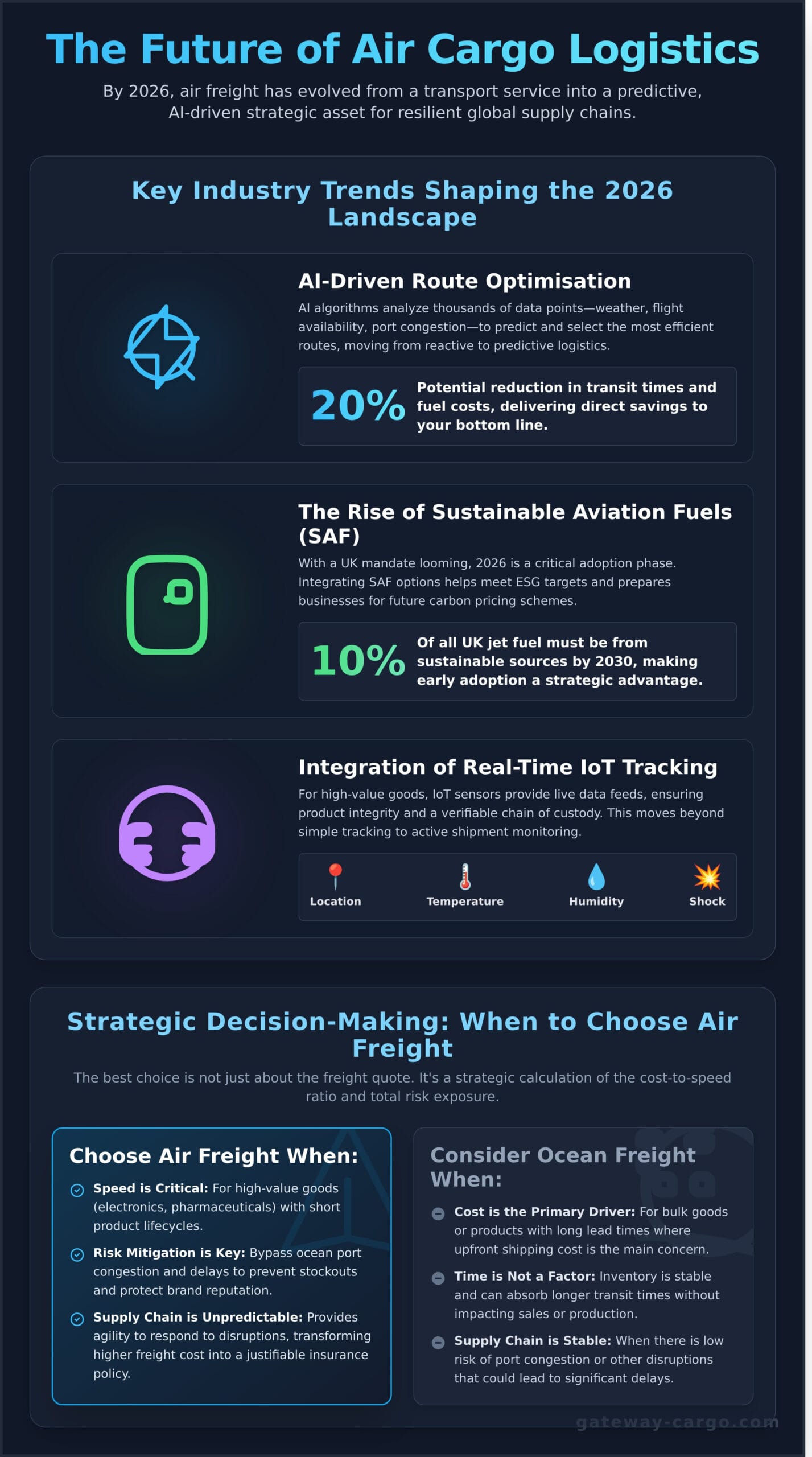
Key Industry Trends Shaping the 2026 Landscape
Three core developments are defining the operational reality for every leading air cargo logistics company. These are not future concepts; they are the current standards for optimising global supply chains.
- The Rise of Sustainable Aviation Fuels (SAF): With the UK government mandating that 10% of all jet fuel must be from sustainable sources by 2030, 2026 represents a critical adoption phase. Forward-looking logistics partners are already integrating SAF options into their quotes, helping clients meet their ESG (Environmental, Social, and Governance) targets and prepare for future carbon pricing schemes.
- AI-Driven Route Optimisation: Artificial intelligence is now essential for efficiency. AI algorithms analyse thousands of data points, from real-time weather patterns and flight availability to historic port congestion data, to predict and select the most efficient routes. This proactive approach can reduce transit times by up to 20% and cut fuel costs, delivering direct savings to your bottom line.
- Integration of Real-Time IoT Tracking: For high-value goods like pharmaceuticals, electronics, and aerospace components, standard tracking is insufficient. Internet of Things (IoT) sensors now provide live data feeds on a shipment’s precise location, temperature, humidity, and shock exposure. This active monitoring doesn’t just provide visibility; it ensures product integrity, reduces spoilage, and can lower insurance premiums by demonstrating a secure, verifiable chain of custody.
As we move through 2026, the most effective air cargo logistics company is one that has mastered the synthesis of these technologies. It provides not just transportation, but a smarter, more resilient, and sustainable supply chain solution tailored to the precise needs of your business.
Strategic Decision-Making: When to Choose Air Freight
Selecting the right transport mode is a critical financial decision that extends far beyond the initial freight quote. While ocean freight often presents a lower upfront cost, a comprehensive analysis reveals scenarios where air freight delivers a superior return on investment. The decision hinges on a strategic calculation of the cost-to-speed ratio, risk exposure, and the total cost of ownership for your goods. For UK businesses navigating volatile global supply chains, air freight is not merely a faster option; it’s a powerful tool for maintaining market position and operational continuity. This approach aligns with key air cargo industry priorities, which focus on delivering secure, reliable, and efficient logistics solutions.
Air cargo provides an essential solution for mitigating significant supply chain risks. For example, during the widespread port congestion seen at Felixstowe and Southampton in 2021 and 2022, companies using air freight bypassed weeks of delays, preventing stockouts and honouring commitments to customers. This agility transforms the higher freight cost into a justifiable insurance policy against costly disruptions, protecting revenue and brand reputation.
High-Value and Time-Sensitive Cargo Profiles
Certain industries depend on the velocity that only an expert air cargo logistics company can provide. For electronics with product lifecycles as short as six months, speed-to-market is paramount. Air freight ensures new technology reaches consumers at peak demand. In pharmaceuticals, where the UK exports over £25 billion in products annually, the temperature-controlled environment and priority handling of air cargo are non-negotiable for maintaining cold chain integrity and meeting strict MHRA regulations.
For the automotive sector and AOG (Aircraft on Ground) situations, the cost of inaction is immense. A single grounded aircraft or a halted production line can cost a company tens of thousands of pounds per hour. In these cases, the expense of flying in a critical component is insignificant compared to the catastrophic cost of the downtime it prevents. Air freight becomes the default solution for just-in-time manufacturing and emergency parts logistics.
The Total Cost of Ownership (TCO) Calculation
A true comparison between air and ocean freight requires looking at the Total Cost of Ownership (TCO). This calculation moves beyond the carrier’s invoice to encompass all associated supply chain expenses. A faster transit time directly reduces these hidden costs and improves financial performance.
- Reduced Inventory Carrying Costs: If your capital is tied up in £500,000 of inventory for 40 days at sea versus 5 days in the air, you free up that capital 35 days sooner. This significantly improves cash flow.
- Warehouse and Storage Savings: Less time in transit means less inventory held in reserve, potentially reducing the need for expensive warehousing space and associated labour costs.
- Enhanced Market Responsiveness: Air freight allows you to react instantly to market demand, replenish stock quickly, and avoid lost sales due to stockouts, directly protecting your revenue streams.
Understanding these variables is key, and our specialists can help you model your total cost of ownership for any given shipment. By 2026, Total Cost of Ownership in logistics will be defined as the comprehensive, data-driven calculation of all direct and indirect costs from procurement to final delivery, heavily weighted by the financial impact of supply chain resilience and carbon emissions.
The Intermodal Advantage: Connecting Air, Road, and Rail
Air freight doesn’t operate in a vacuum. Its true value is unlocked only when seamlessly integrated with ground transport. A smarter supply chain isn’t just about the speed of a flight; it’s about the total transit time from your factory door to the customer’s warehouse. At Gateway Cargo, we engineer this integration, transforming isolated transport legs into a single, optimised journey. The critical first and last miles, handled by our road and rail freight networks, are meticulously planned to eliminate delays and maximise the efficiency of every air shipment.
This holistic approach ensures your high-value or time-sensitive goods don’t lose their competitive edge sitting in a terminal. As a dedicated air cargo logistics company, our expertise lies in orchestrating the precise handovers between modes. We manage the transition from a long-haul flight to a regional delivery truck with the same level of precision as the air transit itself, creating a truly end-to-end logistics solution.
Creating a Seamless Door-to-Door Journey
An effective door-to-door strategy relies on infrastructure and intelligence. Our distribution hubs are strategically positioned within minutes of major UK airports, including London Heathrow (LHR) and East Midlands (EMA), to act as rapid consolidation and deconsolidation points. We synchronise ground transport schedules directly with flight arrival and departure times, a complex process that demands adherence to stringent air cargo handling best practices. This eliminates the costly delays that often occur during inter-modal transfers.
- Case Study Highlight: For a UK-based medical device manufacturer shipping to North America, we recently optimised their supply chain. By synchronising their nightly production output from their Coventry facility with a dedicated ground service to a 05:30 cargo flight from LHR, we cut their total door-to-distributor transit time by 14 hours, effectively bypassing a full day of warehousing stateside.
Sustainability and Green Corridors
We recognise the environmental responsibilities inherent in air freight. Our intermodal strategy is a key component of our commitment to sustainability and meeting future emissions standards, such as those outlined in the UK’s Jet Zero strategy. By optimising ground routes and integrating cleaner technologies, we actively reduce the total carbon footprint of each shipment. This isn’t just about compliance; it’s about building resilient and responsible supply chains for the future.
Our commitment is demonstrated through tangible actions. We are progressively integrating EV trucks into our fleet for last-mile deliveries in urban centres like London and Manchester, cutting ground-level emissions by over 95% for those journey legs. Our new warehousing facilities are built to BREEAM ‘Excellent’ standards, incorporating solar arrays and intelligent energy management systems. Choosing an air cargo logistics company is also a choice about your brand’s environmental commitment. Partnering with Gateway Cargo ensures your logistics are not only efficient but also aligned with long-term corporate responsibility goals.
Optimizing Costs and Compliance in Global Air Shipping
Achieving efficiency in air freight requires a delicate balance between speed, cost, and regulatory adherence. The final price on your invoice often extends far beyond a simple per-kilogram rate, encompassing a complex web of surcharges, duties, and potential penalties for non-compliance. A strategic approach is not just beneficial; it’s essential for protecting your margins and ensuring your supply chain remains resilient.
Understanding air cargo pricing begins with deconstructing the quote. Beyond the base freight rate, you must account for fluctuating surcharges. For example, the fuel surcharge, often indexed to market rates published by IATA, can change monthly and add 15-25% to your base cost. Similarly, security surcharges, a standard since 2001, add a fixed cost per kilogram. A shipment from London Heathrow (LHR) to Dubai (DXB) with a base rate of £2.10/kg could easily reach over £2.80/kg once these mandatory fees are applied.
The allocation of these costs and risks is formally defined by Incoterms. Your choice has significant financial implications:
- FCA (Free Carrier): You take control of the main freight leg and destination charges. This offers greater control but requires more logistical management on your part.
- DAP (Delivered at Place): The seller covers transport to your named UK destination, but you remain responsible for customs clearance, import duties, and VAT. Any delays at customs become your financial liability.
- DDP (Delivered Duty Paid): The seller manages the entire process, including paying UK import duties. While offering maximum convenience, the seller often includes a significant risk premium in their price.
Mastering Customs and Regulatory Requirements
Precise documentation is the foundation of smooth customs clearance. A single error on a Commercial Invoice or an incorrect commodity code on the UK’s C88/SAD declaration form can trigger an inspection, leading to delays and storage fees that can exceed £150 per day at major UK airports. As an Authorised Economic Operator (AEO), we leverage our trusted status with HMRC to minimise inspections and accelerate clearance, a benefit that can reduce customs processing times by up to 50%.
An expert air cargo logistics company manages this administrative burden seamlessly. Looking ahead, with the UK’s Single Trade Window set for full implementation by 2026, we are already leveraging digital customs filing to pre-clear shipments. This proactive approach reduces average cargo dwell times from hours to minutes, ensuring your goods keep moving.
Strategies for Reducing Air Freight Spend
Consolidating your cargo is one of the most effective cost-reduction tools. We offer two distinct service levels to match your needs. Our ‘Prioritise’ service ensures direct, express transit for time-critical shipments. For less urgent goods, our ‘Perform’ consolidation service can lower your freight costs by 20-40% by combining your shipment with others on the same route, adding a predictable 24-48 hours to the total transit time.
Packaging directly impacts your final invoice through volumetric weight. Air carriers charge based on the greater of actual weight or volumetric weight, calculated as (L x W x H in cm) / 6000. A 15kg shipment of lightweight components in a 60x50x50cm box has a volumetric weight of 25kg, meaning you pay for an extra 10kg of “air”. We help clients optimise packaging to reduce this chargeable weight, delivering immediate savings.
Finally, we help you move beyond the volatile spot market. While useful for ad-hoc shipments, spot rates can increase by over 30% during peak seasons like Q4. For businesses with consistent volume, securing long-term capacity through a Blocked Space Agreement (BSA) provides rate stability and guarantees your cargo a spot on the plane, even when capacity is tight. Contact our specialists to analyse your shipping patterns and secure a predictable, cost-effective air freight solution.
Gateway Cargo: Bespoke Solutions for a Smarter Supply Chain
In a global market defined by volatility, a one-size-fits-all logistics strategy is no longer a viable option. Standardised solutions often create inefficiencies, introduce unforeseen costs, and lack the agility to respond to market shifts. At Gateway Cargo, we reject this outdated model. Our bespoke approach is engineered to integrate seamlessly with your operations, transforming your supply chain from a cost centre into a strategic asset that drives growth and resilience.
We believe that superior logistics is a collaborative effort. Our logistics specialists work as a direct extension of your team, bringing an average of 12 years of industry-specific experience to your operations. They don’t just execute shipments; they provide proactive counsel, identify optimisation opportunities, and manage complexities from customs brokerage to final-mile delivery. This deep integration is what elevates us beyond a typical air cargo logistics company and into the role of a trusted partner invested in your success.
The Gateway promise is built on three core pillars:
- Reliability: We deliver on our commitments. Our data-driven approach and operational excellence have resulted in a 98.7% on-time delivery rate for air freight shipments into major UK hubs like Heathrow (LHR) and Manchester (MAN) over the last fiscal year.
- Transparency: You gain complete, real-time visibility through our digital platform. From the moment a shipment is booked to its final proof of delivery, every milestone is tracked and accessible 24/7.
- Innovation: We continuously invest in technology and processes that create a smarter supply chain. Our AI-driven strategy and commitment to sustainable solutions ensure your logistics are fit for the future.
Our Technology: Real-Time Insights and AI
Our proprietary digital platform provides more than just tracking; it delivers actionable intelligence. We use predictive analytics to anticipate potential disruptions, such as airport congestion or labour disputes, allowing us to re-route cargo proactively. For our clients, this has reduced delay-related costs by an average of 15% in 2023. This commitment to technology ensures absolute transparency at every touchpoint, from the factory floor to the final destination.
Getting Started with Gateway Cargo
Our partnership begins with a comprehensive, no-obligation audit of your current supply chain. We analyse your existing freight routes, cost structures, and transit times to identify specific areas for improvement. From there, our onboarding process is meticulously tailored to your industry’s unique requirements, whether it’s for time-sensitive pharmaceuticals or high-value aerospace components. Let our expert team build a more efficient and resilient network for your business. Optimise your freight with a bespoke Gateway solution.
Your Partner for Smarter Air Cargo in 2026 and Beyond
The air cargo landscape of 2026 demands more than just speed; it requires strategic intelligence and seamless intermodal integration. As highlighted by the 2025 IATA World Cargo Symposium, optimising routes and navigating complex UK customs regulations are essential for competitive advantage. The future belongs to businesses that can harness technology and expertise to build a resilient, efficient, and sustainable supply chain.
This is where choosing the right partner becomes critical. As a forward-looking air cargo logistics company, Gateway Cargo leverages an AI-driven digital strategy to provide predictive insights, helping clients reduce transit times by up to 15% on key routes. Our proactive sustainability solutions, including EV vehicle integration, and our bespoke freight solutions are engineered for your specific industry needs. Don’t let your supply chain fall behind the curve.
Ready to optimise your logistics for the future? Request a Bespoke Air Cargo Quote from Gateway Cargo and discover how our tailored solutions can elevate your business. Let’s build a smarter supply chain together.
Frequently Asked Questions
What are the primary factors that determine air cargo logistics costs in 2026?
In 2026, air cargo costs will be primarily driven by chargeable weight, fuel price volatility, and escalating sustainability mandates. New regulations, such as the UK’s Emissions Trading Scheme and EU requirements for Sustainable Aviation Fuel (SAF) usage, are projected to add an estimated £0.15 to £0.25 per kilogram on key routes. Our specialists work to optimise routes and consolidate shipments to mitigate these new costs for our clients, providing transparent quotes that reflect these market realities.
How does an air cargo logistics company handle dangerous goods (IMDG/IATA)?
An expert air cargo logistics company handles dangerous goods by adhering strictly to IATA’s Dangerous Goods Regulations (DGR). Our certified specialists manage the entire process, including correct classification, UN-specification packaging, and accurate completion of the Shipper’s Declaration for Dangerous Goods. This meticulous approach ensures compliance and safety, preventing costly delays and fines. We have over 20 years of experience shipping everything from lithium batteries to industrial chemicals safely and efficiently.
What is the difference between air freight and air courier services for businesses?
Air freight is designed for larger commercial shipments, typically over 100kg, offering cost-effective transport for bulk goods on a per-kilogram basis. In contrast, air courier services are optimised for smaller, time-critical parcels and documents, usually under 30kg. Couriers provide an all-inclusive, door-to-door service with simplified pricing, making them ideal for urgent deliveries, while air freight provides a more bespoke solution for complex supply chain requirements.
How can I track my air cargo shipment in real-time?
You can track your shipment 24/7 through our secure client portal using your unique Air Waybill (AWB) number. The portal provides live updates from departure and transit to customs clearance and final delivery confirmation. For high-value or temperature-sensitive cargo, we offer enhanced GPS tracking solutions that provide precise location and condition monitoring every 15 minutes, ensuring complete visibility and peace of mind throughout the entire journey.
What sustainability options are available for air freight to reduce carbon emissions?
We offer clients two primary solutions to reduce their carbon footprint: Sustainable Aviation Fuel (SAF) and certified carbon offsetting. Opting for SAF can reduce lifecycle emissions by up to 80% compared to conventional jet fuel. Additionally, our carbon offsetting programmes allow you to invest in verified projects, such as UK-based reforestation initiatives, to neutralise the remaining emissions from your shipment. Our team can integrate these options directly into your logistics quote.
How do customs clearance and Incoterms like DDP affect air cargo delivery times?
Proper customs documentation is critical; errors can easily delay a shipment by 48 hours or more at UK airports like Heathrow. Using Incoterms such as DDP (Delivered Duty Paid), where we manage all customs formalities and duties as the sender’s representative, significantly streamlines the process. This proactive approach prevents clearance issues and ensures your cargo moves from the aircraft to its final destination without interruption, providing predictable delivery timelines.
Why should I choose a freight forwarder over booking directly with an airline?
Choosing a freight forwarder provides a complete, end-to-end logistics solution that airlines don’t offer. We manage everything from ground transport and customs brokerage to final-mile delivery. Because we negotiate rates based on high cargo volumes, our clients often see cost savings of 10-15% compared to direct airline pricing. A freight forwarder acts as your single point of contact, simplifying a complex process and optimising your entire supply chain.
Can Gateway Cargo handle intermodal shipments involving air, ocean, and road?
Yes, we specialise in designing and executing seamless intermodal transport solutions. Our logistics experts optimise your supply chain by combining modes of transport to balance speed and cost. For example, a popular “sea-air” service from Asia to the UK can cut transit time by 40% compared to pure ocean freight while costing significantly less than a direct air freight solution. We manage every handover point to ensure a smooth, integrated journey for your goods.