
The Ultimate Guide to Less Than Container Load (LCL) Shipping in 2026
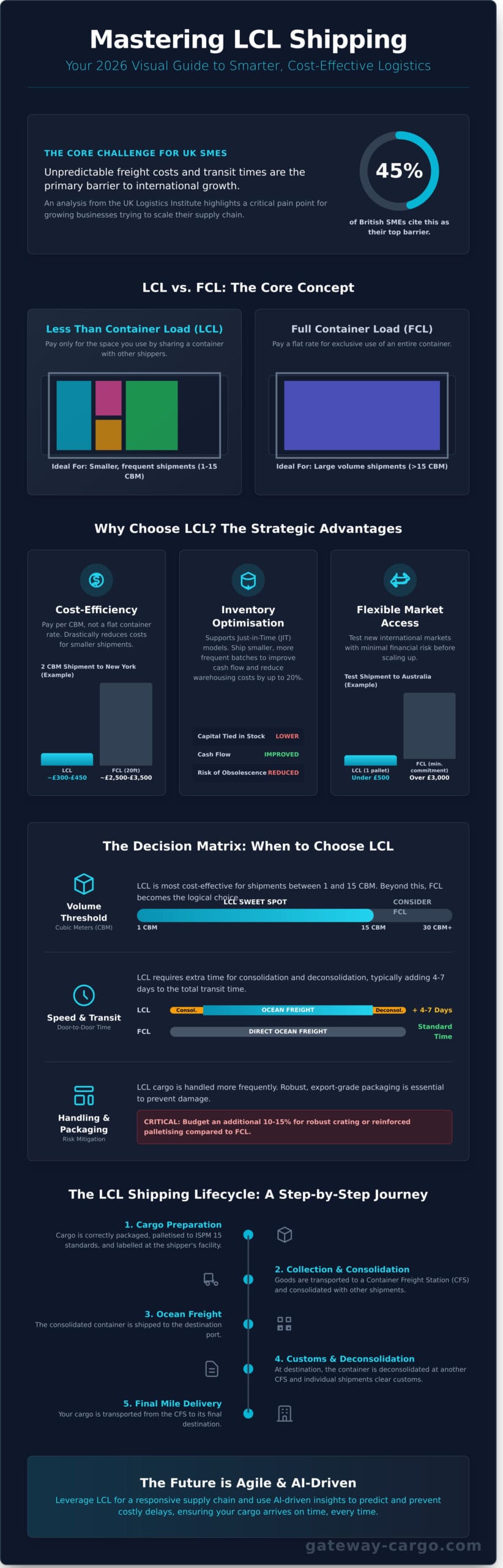
According to a Q4 2025 analysis from the UK Logistics Institute, nearly 45% of British SMEs cite unpredictable freight costs and transit times as their primary barrier to scaling international trade. It’s a familiar challenge for any growing business. You’re constantly trying to balance inventory costs against transport efficiency, grappling with complex pricing based on CBM or weight, and worrying about potential delays at consolidation hubs from Felixstowe to Southampton. The fear of cargo damage in a shared container only adds to the pressure.
This guide is engineered to provide clarity and control. We will provide you with a definitive framework to master less than container load shipping in 2026, empowering you to optimise your supply chain costs, improve operational agility, and make informed decisions on sustainable logistics solutions. You’ll gain a clear strategy for achieving predictable shipping schedules, significantly lowering your inventory carrying costs, and knowing precisely when your volume justifies the switch to a full container load.
Key Takeaways
- Identify the critical volume threshold where choosing LCL over FCL shipping provides significant cost savings for your UK-based business.
- Master the step-by-step LCL lifecycle, from correct documentation at your facility to consolidation at the Container Freight Station (CFS), to ensure smooth transit.
- Accurately forecast your freight costs by mastering the “Weight or Measure” (W/M) rule and correctly calculating the Cubic Meters (CBM) for your less than container load shipments.
- Discover modern strategies to mitigate the risks of cargo damage in shared logistics and learn how AI-driven insights can predict and prevent costly delays.
What is Less Than Container Load (LCL) and Why It Matters in 2026
In global logistics, efficiency is paramount. For businesses whose shipping volumes don’t justify the cost of a full container, less than container load shipping provides a flexible and economical solution. At its core, LCL is a method of ocean freight where multiple shippers’ consignments are consolidated into a single, shared container. The foundational principle of what is Less Than Container Load (LCL) is based on this concept of shared space, which stands in direct contrast to Full Container Load (FCL), where one shipper utilises an entire container exclusively. With LCL, you pay only for the volume your cargo occupies, typically measured in Cubic Metres (CBM), not for the entire unit.
Looking ahead to 2026, the global supply chain is rapidly evolving towards a model of “Agile Logistics.” This paradigm shift prioritises smaller, more frequent shipments to minimise inventory holding costs and enhance responsiveness to market demand. Projections from the Chartered Institute of Logistics and Transport (CILT-UK) suggest that UK businesses adopting this agile model can reduce warehousing overheads by up to 20%. LCL is the primary enabler of this strategy, empowering companies to dispatch goods as they are produced without the delay or capital outlay of waiting to fill a full container.
The intricate process of consolidating cargo from multiple shippers requires precise coordination. The freight forwarder serves as the architect of the LCL journey. Our logistics specialists meticulously manage every stage, from cargo collection and consolidation at a Container Freight Station (CFS) to customs clearance and final-mile delivery. This expert oversight ensures that the shared LCL model operates seamlessly and reliably for all parties involved.
The Strategic Advantages of LCL for Modern Shippers
For UK businesses navigating competitive global markets, LCL shipping offers distinct operational and financial benefits that drive a smarter supply chain:
- Cost-Efficiency: Instead of committing to a flat rate of £2,500-£3,500 for a 20ft FCL container, you pay only for your specific volume. A 2 CBM shipment to New York, for example, might cost just £300-£450, making LCL a highly economical choice for smaller consignments.
- Inventory Optimisation: LCL supports lean, Just-in-Time (JIT) inventory models. By shipping smaller batches more frequently, businesses can reduce the capital tied up in static stock and lower the risk of product obsolescence, directly improving cash flow.
- Market Access: A UK-based SME can test a new international market, such as exporting craft beer to Australia, with a single pallet via LCL. This approach minimises the initial financial risk from over £3,000 to under £500 before confirming market viability.
LCL vs. FCL: A Quick Comparison for Decision Makers
Selecting the correct shipping mode requires a clear understanding of the operational trade-offs. Here is a direct comparison to guide your decision:
- Volume Thresholds: LCL is the most cost-effective solution for shipments between 1 and 15 CBM. Once a consignment exceeds 15 CBM, the cumulative cost per cubic metre often approaches the flat rate of a dedicated 20ft FCL container, making FCL the more logical financial choice.
- Speed and Transit Times: The “consolidation lag” is an inherent part of the LCL process. Consolidating goods at the port of origin and de-consolidating them at the destination typically adds 4-7 days to the total door-to-door transit time compared to a direct FCL shipment.
- Handling Requirements: LCL cargo is handled more frequently than FCL freight as it’s moved through consolidation centres. Consequently, robust, export-grade packaging like crating or reinforced palletising is essential to prevent damage. Shippers should budget an additional 10-15% for packaging costs compared to an FCL shipment.
The LCL Shipping Process: A Step-by-Step Lifecycle
Understanding the journey of a less than container load shipment reveals a highly coordinated system designed for maximum efficiency. Unlike a direct Full Container Load (FCL) shipment, the LCL process involves several critical stages of consolidation and deconsolidation. Each step is precisely managed to ensure cargo from multiple shippers travels securely and arrives on schedule. The lifecycle begins long before the vessel leaves port and extends beyond its arrival at the destination.
The process commences at the shipper’s facility. Here, cargo must be correctly packaged, palletised to international standards like ISPM 15, and labelled with all necessary shipping marks. From there, it’s transported to a consolidation warehouse, officially known as a Container Freight Station (CFS), which acts as the operational heart of the LCL journey.
Once the container is loaded onto a vessel at a major UK port like Felixstowe, its ocean voyage begins. Modern logistics networks no longer rely on guesswork. Advanced IoT sensors integrated within containers now provide real-time data on GPS location, temperature, humidity, and shock events, offering unprecedented visibility. Upon arrival at the destination port, the container is transferred to another CFS for the final, critical phase: deconsolidation. Here, the container is carefully opened, and individual shipments are sorted, cleared through customs, and prepared for their final delivery.
The Role of the Container Freight Station (CFS)
The CFS is the central hub in the LCL world. It’s where individual shipments are received, verified, and consolidated into a single container. At the origin CFS, your cargo is professionally measured (for Cubic Metre or CBM calculation) and weighed. These verified dimensions are recorded for the Master Bill of Lading. The meticulous process of loading the container, known as “stuffing,” is a specialised skill crucial for preventing the in-transit damage that, according to the UK P&I Club, accounts for over 65% of cargo claims.
Documentation and Compliance: The Paper Trail
The documentation for a less than container load shipment is more complex than for FCL. Two key documents govern its movement: the House Bill of Lading (HBL), issued by the freight forwarder to the individual shipper, and the Master Bill of Lading (MBL), issued by the ocean carrier to the forwarder (the consolidator). This dual-document system is essential for managing multiple consignments within one container.
Customs clearance presents another layer of complexity. Every individual shipment within the container must be cleared by HMRC before any of the cargo can be released from the destination CFS. A documentation error or delay from one shipper can impact every other business sharing the container. This underscores the need for expert handling and precise paperwork.
Finally, the assigned Incoterms dictate responsibility for costs, risk, and insurance. Terms like Delivered at Place (DAP) or Delivered Duty Paid (DDP) define exactly where the seller’s responsibility ends and the buyer’s begins. Clarifying these terms is a key part of our service; our logistics specialists can advise on the optimal Incoterms for your specific shipment, ensuring a seamless and predictable supply chain.
Calculating LCL Costs: Understanding CBM and the Tipping Point
Optimising your freight spend requires a precise understanding of how charges are calculated. Unlike the fixed price of a Full Container Load (FCL), the cost of a less than container load shipment is variable, based on the volume or weight of your cargo. Mastering these calculations is the first step toward building a more intelligent and cost-effective supply chain.
The foundational principle for LCL pricing is the “Weight or Measure” (W/M) rule. Freight forwarders will calculate the cost based on both the cargo’s actual gross weight in tonnes and its volumetric weight in cubic metres (CBM). The greater of the two figures becomes the “chargeable weight” used to determine your final freight rate. As a general industry standard, 1 CBM is considered equivalent to 1,000 kg. Therefore, if your 1 CBM pallet weighs 1,200 kg, you will be billed for 1.2 “tonnes” of weight; if it weighs 400 kg, you will be billed for 1 CBM of volume.
The Math of CBM: A Practical Example
The cubic metre (CBM) is the standard unit of measurement for volume in global LCL pricing. To calculate the CBM for a single piece of cargo, you simply multiply its length, width, and height in metres. For example, a shipment of 5 standard UK pallets, each measuring 1.2m long, 1.0m wide, and 1.5m high, would be calculated as follows:
- Volume per pallet: 1.2m x 1.0m x 1.5m = 1.8 CBM
- Total Volume: 1.8 CBM x 5 pallets = 9.0 CBM
Your freight quote would be based on 9.0 CBM, assuming the total weight is less than 9,000 kg. It’s also critical to account for “dead space.” If your pallets are non-stackable due to fragile contents or irregular shape, you are still occupying the vertical space above them inside the container. Consolidators must account for this lost capacity and may bill you for a larger volumetric footprint than your goods physically occupy.
Beyond the Freight Rate: Ancillary Charges and the Crossover Point
A competitive rate per CBM is only one part of the equation. A comprehensive LCL quote will include several other essential charges that contribute to the total cost. Shippers must be aware of:
- CFS Charges: Fees at the origin and destination Container Freight Station (CFS) for the labour and equipment required to consolidate and deconsolidate your cargo.
- Documentation Fees: Administrative costs for issuing the Bill of Lading and processing customs declarations, typically a fixed fee per shipment.
- Destination Port Handling: Includes Terminal Handling Charges (THC) and other local fees levied by the port authority and the deconsolidation agent.
Understanding these costs is crucial for identifying the FCL/LCL crossover point. For many UK trade lanes, this “danger zone” occurs around 15 CBM. If your total LCL costs for a 15 CBM shipment approach the flat-rate cost of a 20ft FCL container (which holds approximately 33 CBM), it’s often more economical to book the entire container. For instance, if a 20ft container costs £1,500 and your all-in LCL rate is £110 per CBM, the break-even point is 13.6 CBM. Any less than container load shipment larger than this becomes a candidate for an FCL booking to optimise costs.
This calculation, however, doesn’t capture the full picture. A Total Cost of Ownership (TCO) approach reveals that LCL’s slightly higher per-unit rate can be offset by significant savings in other areas. By enabling smaller, more frequent shipments, LCL reduces the need for extensive warehousing space and lowers inventory holding costs. Furthermore, during periods of high congestion at UK ports like Felixstowe, an FCL container can accrue substantial demurrage fees. LCL shipments, managed through an efficient CFS, can often bypass these specific bottlenecks, providing a strategic advantage beyond the initial freight quote.
Risk Mitigation and Sustainability in Shared Logistics
While the cost-effectiveness of less than container load shipping is clear, shippers often express concerns about two key areas: cargo security and environmental impact. The concept of sharing a container can seem to introduce variables. However, modern logistics has transformed these variables into strengths through rigorous protocols and forward-thinking technology, making LCL a secure and sustainable choice for a smarter supply chain.
Addressing the risk of damage or loss in a shared environment starts long before the container is loaded. It begins with a robust strategy built on preparation and prevention. A shipment’s integrity is directly tied to its packaging, labelling, and handling throughout its journey from origin to the final deconsolidation point.
Packaging Best Practices for LCL Shipments
Proper preparation is the most effective form of insurance. To protect goods against the movements and weight of other cargo during transit, we advocate for a defence-in-depth approach:
- Export Crating: This is the gold standard for LCL. Unlike standard cardboard boxes, custom-built wooden crates create a rigid, self-contained shell for your goods. A properly constructed crate can reduce the risk of compression and impact damage by over 90%, effectively isolating your shipment from its neighbours.
- Clear Labelling: At the destination Container Freight Station (CFS), dozens of shipments are deconsolidated simultaneously. Vague or missing labels are a primary cause of misrouting. Every pallet or crate must be clearly marked on multiple sides with the consignee’s name, final destination, and unique booking number to ensure a seamless transition.
- ISPM 15 Compliant Palletizing: For all international trade, including shipments entering the UK, any wood packaging material (WPM) must meet ISPM 15 standards. This means pallets and crates must be heat-treated to eliminate pests and stamped with an official mark. Non-compliance can lead to the entire container being rejected by customs authorities, causing severe delays for every shipper involved.
The Future of LCL: AI and Sustainability
Beyond physical protection, Gateway Cargo leverages technology to mitigate temporal and environmental risks. Our AI-driven digital strategy redefines reliability in the LCL sector. By analysing real-time data on port congestion at hubs like the Port of Felixstowe, vessel speed, and weather patterns, our predictive analytics engine improves Estimated Time of Arrival (ETA) accuracy by up to 30% compared to standard carrier schedules. This proactive insight allows you to manage inventory and expectations with far greater precision.
This forward-looking approach extends to our environmental commitments. The core model of less than container load shipping is inherently sustainable; it maximises container utilisation to over 95%, drastically cutting the carbon footprint per cubic metre shipped. We build on this natural advantage through our “Green Corridors” initiative, prioritising routes and carriers that demonstrate superior carbon efficiency. For the final stage of the journey, we are integrating Electric Vehicles (EVs) into our fleet for last-mile pallet deliveries from UK deconsolidation centres, directly supporting your company’s ESG (Environmental, Social, and Governance) goals. Discover how our sustainable LCL solutions can secure your supply chain.
Optimizing Your Supply Chain with Gateway Cargo’s LCL Solutions
Choosing to ship via Less Than Container Load (LCL) is a strategic decision for cost-efficiency and flexibility. However, unlocking its full potential requires a partner with the expertise to manage its complexities. At Gateway Cargo, we don’t just move your freight; we integrate our LCL solutions directly into your supply chain to create a smarter, more resilient logistics network.
Our approach is built on four pillars of excellence. We begin by designing bespoke LCL strategies tailored to your specific industry and shipment volume. For a UK-based electronics retailer importing from multiple suppliers in Southeast Asia, this could mean creating a multi-country consolidation programme that feeds into a single weekly sailing, reducing transit costs by up to 25% compared to multiple individual shipments. This strategic planning ensures your cargo moves on your terms, not just when a container happens to be available.
True efficiency is achieved through seamless integration. Our LCL ocean freight services are directly connected to our global air and road freight networks. Imagine your critical components arrive at the Port of Felixstowe; our system automatically triggers a priority transfer to our road haulage fleet, guaranteeing next-day delivery to your manufacturing facility in Coventry. This eliminates handover delays and provides a single point of accountability from origin to final destination.
You gain complete control through our AI-powered tracking platform. This isn’t just a map with a pin. It provides end-to-end visibility of every pallet, offering real-time status updates from the moment your goods are collected to the final proof of delivery. Our predictive analytics engine identifies potential port congestion or customs delays 48 hours in advance, giving your team the critical time needed to adjust plans. Finally, our in-house customs specialists provide expert clearance for multi-shipper containers. With an average of 10-15 different importers’ goods in a single LCL box, the risk of one party’s incorrect paperwork delaying everyone is high. Our team’s 99.8% first-pass success rate with HMRC ensures your goods are cleared swiftly, avoiding costly demurrage and storage fees.
Why Partner with a Specialist Freight Forwarder?
Unlike “Carrier-Direct” LCL options which limit you to one network, a “Forwarder-Managed” solution from Gateway Cargo provides access to a portfolio of premier carriers. This gives you superior flexibility in sailing schedules and routing. Our logistics specialists work as an extension of your team, analysing your freight spend to identify optimisation opportunities. We provide exclusive access to our global “Insights” reports, offering market updates that keep you ahead of disruptions like fluctuating freight rates or new UK import regulations.
Getting Started: Your Path to Smarter Logistics
Transitioning to a more efficient less than container load strategy is straightforward. The first step is to request a bespoke, no-obligation quote from our team. Once you’re ready, our onboarding specialists will configure your personalised digital logistics dashboard, giving you immediate visibility and control over your shipments. Stop managing freight and start optimising it. Optimize your ocean freight with Gateway Cargo’s LCL solutions today.
Navigate the Future of LCL Shipping with Confidence
As we look towards 2026, it’s clear that mastering LCL shipping offers a significant competitive advantage. For businesses with shipments typically under 15 CBM, leveraging less than container load provides unparalleled flexibility and cost-efficiency, allowing you to build a more resilient and agile supply chain. Understanding the key dynamics, from precise CBM calculations to proactive risk mitigation, is the first step towards optimisation.
Gateway Cargo transforms this process into a strategic asset. Our AI-driven digital strategy provides real-time tracking across a global network covering all major ports and inland points. We integrate proactive sustainability solutions, including options for EV final-mile delivery, to align your logistics with modern environmental standards. You don’t just ship with us; you gain a forward-looking partner dedicated to enhancing your operational efficiency.
Ready to optimise your freight strategy for 2026? Request a Bespoke LCL Quote from Our Specialists and let’s build a smarter supply chain, together.
Frequently Asked Questions About Less Than Container Load Shipping
What is the minimum volume for an LCL shipment?
The minimum chargeable volume for an LCL shipment is typically 1 cubic metre (CBM). Even if your cargo is smaller, such as 0.5 CBM, freight forwarders will usually charge for the 1 CBM minimum. This base charge covers the essential costs of handling, documentation, and consolidation at both origin and destination warehouses. It’s a standard practice in the UK logistics sector to ensure operational viability for small consignments.
How long does LCL shipping take compared to FCL?
LCL shipping generally takes 7 to 10 days longer than a comparable Full Container Load (FCL) shipment. This additional transit time is required for the consolidation and deconsolidation processes at the origin and destination ports. Your cargo must be loaded with other shipments and then carefully sorted upon arrival. For a standard UK-China route, this can extend a 30-day FCL journey to a 37-40 day LCL transit time.
Is LCL shipping safe for fragile or high-value goods?
LCL shipping can be a secure option for fragile goods, provided they are professionally packed and crated for transit. Because your goods are handled multiple times during consolidation, robust packaging is critical to prevent damage. For high-value items, we always recommend securing comprehensive cargo insurance. This protects your investment against the slightly higher risk of damage or loss associated with co-loading in a shared container.
What are the most common Incoterms used in LCL shipping?
The most common Incoterms for LCL shipments are Ex Works (EXW), Free on Board (FOB), and Delivered at Place (DAP). EXW places most responsibility on the buyer, who arranges collection from the seller’s premises. FOB is also popular, with the seller handling transport to the port of origin. DAP is frequently used for door-to-door services, where the seller manages transport to the buyer’s location, excluding UK import duties and taxes.
How are LCL shipping rates calculated in 2026?
LCL shipping rates in 2026 are calculated based on the greater of a shipment’s actual weight or its volumetric weight, a rule known as Weight/Measurement (W/M). Freight is charged per cubic metre (CBM) or per 1,000 kg, whichever yields a higher cost. For instance, a 1 CBM pallet weighing 300 kg would be charged by volume. Current projections for 2026 place average UK-Asia rates around £120-£150 per W/M.
What happens if another shipper’s goods in the same container are flagged by customs?
If another shipment within your shared container is flagged by UK Customs, the entire container will be held for inspection. This means your goods will be delayed until HM Revenue and Customs (HMRC) completes its examination, a process that can take from a few days to several weeks. You aren’t liable for the other shipper’s issue, but you will experience a delay. Working with a reputable forwarder helps mitigate this risk.
Can I track my LCL shipment at the pallet level?
Yes, modern LCL logistics services provide tracking at the individual pallet or consignment level. Through our advanced digital platform, you receive a unique tracking number for your specific shipment, not just the container. This offers granular visibility on key milestones like warehouse arrival, vessel loading, discharge, and customs clearance. This precision gives you superior control over your supply chain planning and inventory management.
Does LCL shipping include door-to-door delivery?
Yes, LCL shipping can be structured as a comprehensive door-to-door service. This is a common solution for businesses seeking to optimise their logistics with a single partner. The service covers cargo collection from the origin address, consolidation, ocean freight, customs clearance in the UK, and final delivery to your facility. This end-to-end management simplifies the entire journey of your less than container load shipment.