
What is a Freight Forwarder? A Strategic Guide to Modern Logistics in 2026
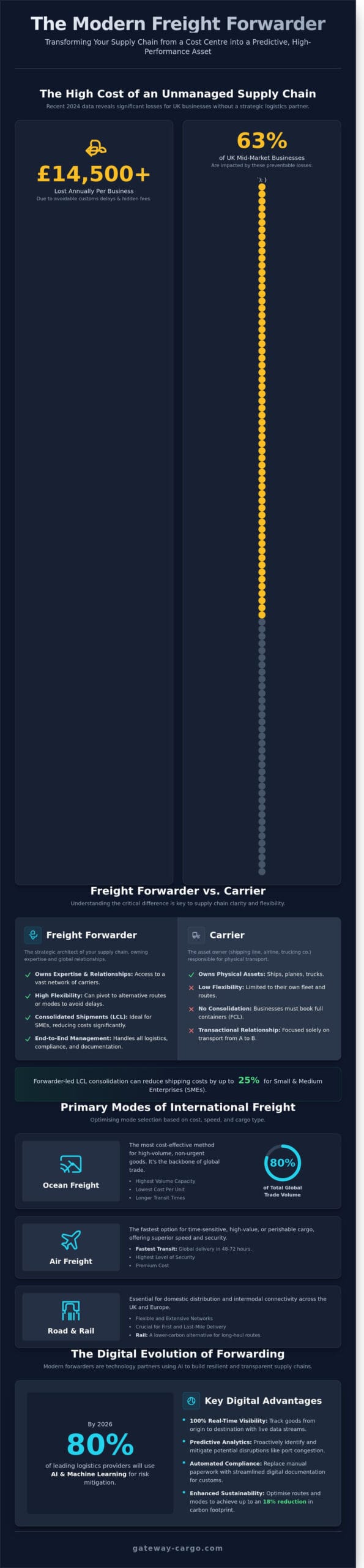
What if your supply chain wasn’t just a cost centre, but a predictive engine that reduced your carbon footprint by 18% while guaranteeing landed costs? Recent 2024 data indicates that 63% of UK mid-market businesses lose over £14,500 annually due to avoidable customs delays and the lack of a strategic freight forwarder. You’re likely familiar with the administrative burden of post-Brexit regulations and the mounting pressure to meet the UK’s 2050 Net Zero targets. It’s frustrating when international trade feels like a series of hidden fees and visibility gaps.
This guide demonstrates how a modern partner acts as the strategic architect of your operations, using AI-driven insights to stabilise your margins and ensure reliable delivery timelines. You’ll learn how to replace manual paperwork with automated compliance and turn sustainability goals into a competitive advantage. We’ll examine the specific technologies and bespoke, optimised strategies that will define high-performing supply chains through 2026.
Key Takeaways
- Learn how a modern freight forwarder acts as a strategic architect to optimise your global supply chain through expert carrier network management.
- Discover how AI-driven digitalisation and predictive analytics can mitigate risks like port congestion while advancing your sustainability goals.
- Explore bespoke value-added services designed to streamline operations for specialised sectors including retail, pharmaceuticals, and heavy machinery.
- Identify the critical criteria for selecting an international logistics partner by evaluating global network reach and specific regional expertise.
- Understand how a collaborative partnership with logistics specialists can transform your supply chain into a cost-efficient and reliable competitive advantage.
What is a Freight Forwarder? Defining the Architect of Global Trade
A freight forwarder is a specialist firm that organises the transport of goods on behalf of shippers, acting as the primary coordinator for complex supply chain movements. These firms function as expert intermediaries between the producer and the final destination, utilising established carrier networks to ensure cargo reaches its target efficiently. While they facilitate the movement of goods, it’s a common misconception that they physically transport the items. Instead, they manage the intricate logistics, regulatory compliance, and extensive documentation required for cross-border trade. To understand the foundational role, one might ask what is a freight forwarder in the context of modern commerce, where they serve as the glue holding global distribution together.
The logistics landscape in 2024 requires more than just moving a container from point A to point B. Forwarders handle the heavy lifting of administrative tasks, including booking cargo space, negotiating freight charges, and filing insurance claims. They also manage Customs Clearance, which has become significantly more complex for UK businesses following the regulatory shifts of 2021. By centralising these tasks, a freight forwarder allows manufacturers to focus on their core production while the logistics experts handle the friction of international borders. A freight forwarder acts as the strategic architect of international trade routes, designing bespoke paths for cargo to traverse the globe with maximum efficiency.
The Core Difference: Freight Forwarder vs. Carrier
Distinguishing between these two entities is vital for supply chain clarity. Carriers, such as shipping lines or trucking companies, own the physical assets; the ships, planes, and vehicles. In contrast, forwarders own the expertise and the global relationships. Booking directly with a carrier often lacks the flexibility required for modern trade. If a vessel is delayed at the Port of Felixstowe, a carrier is limited to its own fleet. A forwarder, however, can pivot to alternative routes or modes to keep the supply chain moving. For UK SMEs, forwarders provide a critical service by consolidating smaller shipments, known as Less than Container Load (LCL). By grouping cargo from multiple clients into a single container, forwarders can reduce shipping costs by up to 25% for smaller businesses that don’t have the volume to fill an entire 40-foot unit.
Primary Modes of International Freight Shipping
The choice of transport mode depends on the specific requirements of the cargo, budget, and timeline. Forwarders optimise these selections based on real-time market data and port congestion levels. The three primary modes include:
- Ocean Freight: This remains the backbone of global trade, accounting for approximately 80% of total trade volume. It’s the most cost-effective method for high-volume goods, though it requires longer lead times.
- Air Freight: This is the preferred choice for time-sensitive, high-value, or perishable cargo. While more expensive, it offers the highest level of security and the fastest transit times, often delivering goods globally within 48 to 72 hours.
- Road and Rail: These modes are essential links for domestic distribution within the UK and intermodal connectivity across Europe. Rail freight, in particular, is seeing increased investment as a lower-carbon alternative to road transport for long-haul journeys.
By integrating these modes into a seamless strategy, forwarders provide a level of resilience that individual carriers cannot match. Whether managing a single pallet or a multi-thousand-tonne project, their role is to ensure that the complexities of the journey remain invisible to the client.
The Evolution of Forwarding: AI, Digitalisation, and Sustainability
The logistics industry has moved beyond the era of physical ledgers and fax machines. Modern freight forwarders now operate as technology partners, integrating complex data streams to manage global trade. While the U.S. government regulations for freight forwarders define these entities as Ocean Transportation Intermediaries, their role in 2024 has expanded into digital architecture. AI-driven strategies have replaced manual paperwork with real-time data streams that offer 100% visibility over the movement of goods. This shift isn’t just about speed; it’s about the precision required to manage modern consumer demands.
Predictive analytics have become a standard tool for risk mitigation. By 2026, 80% of leading logistics providers will use machine learning to anticipate port congestion at major hubs like Felixstowe or Southampton. These systems analyse historical vessel patterns and current labour data to predict delays 72 hours before they occur. This allows a freight forwarder to proactively reroute cargo, saving clients an average of £1,200 per container in storage and demurrage fees. AI algorithms identify the most carbon-efficient shipping routes by analysing historical fuel consumption data, real-time weather patterns, and vessel engine efficiency in a single calculation.
Smarter Supply Chains Through AI-Driven Insights
Data is the primary tool used to tackle the “empty miles” problem in road transport. Currently, 30% of heavy goods vehicles on UK roads travel without cargo. Digital platforms now use load-matching AI to ensure lorries remain full, which reduces operational costs and lowers the carbon footprint of every delivery. These platforms provide end-to-end visibility for every individual SKU in transit, not just the container. This level of detail allows inventory managers to make real-time decisions based on live location data. Automated customs filing has also transformed the border process. By using the Customs Declaration Service (CDS), firms have reduced border processing times by 40% compared to legacy manual systems. You can explore how these technologies integrate into your business by reviewing our bespoke freight solutions today.
Sustainability and Green Corridors
Environmental, Social, and Governance (ESG) standards are no longer optional for UK businesses. By 2026, ESG performance will influence 90% of supply chain procurement decisions. The integration of electric vehicles (EVs) for last-mile delivery is a key part of this transition. In urban centres like London and Birmingham, EV fleets help businesses comply with Ultra Low Emission Zone (ULEZ) standards while reducing local NOx emissions by 100%. These local efforts are supported by the development of Green Corridors. These are specific maritime routes between major ports, such as the UK and Northern Europe, that prioritise zero-emission vessels and alternative fuels like green ammonia.
Adopting sustainable logistics helps businesses meet the rigorous requirements of the Corporate Sustainability Reporting Directive (CSRD). Companies that track their Scope 3 emissions through a technologically advanced freight forwarder are better positioned to meet these regulatory standards. Sustainable practices aren’t just about compliance; they represent a fundamental shift toward a more resilient and efficient global trade network. By 2025, firms that fail to adopt these green strategies risk facing higher carbon taxes and reduced access to capital from ESG-focused investors.
Beyond Transport: Value-Added Services that Optimise Operations
Modern logistics requires more than moving cargo from point A to B. A professional freight forwarder acts as a strategic architect, building bespoke systems that solve industry-specific hurdles. For retail brands, this might involve “dark store” distribution models that cut delivery times by 40%. In the pharmaceutical sector, it involves rigorous temperature-controlled environments that meet 2024 MHRA standards for vaccine stability. Heavy machinery logistics requires specialised permits for out-of-gauge loads, often involving pre-route surveys to ensure 60-tonne components clear UK motorway bridges safely. These tailored solutions ensure that a 5% increase in transport efficiency translates directly to a healthier bottom line for the client.
Global trade often involves complex three-party transactions known as cross-trades. Triangular operations are a method to protect supplier confidentiality while reducing tax liability. By acting as the neutral party, the freight forwarder manages the switch-bill process. This ensures the end customer in Manchester doesn’t identify the original manufacturer in Shenzhen, which protects the middleman’s commercial interests. This strategy is essential for the 15% of UK traders who act as international intermediaries. It effectively removes the need for goods to enter the UK physically, saving on double-handling costs and unnecessary port fees.
Customs Clearance and Regulatory Compliance
Managing the UK’s post-Brexit Border Target Operating Model requires precision. A specialist handles the intricacies of import duties and VAT, ensuring that the correct commodity codes are applied to avoid HMRC penalties. They provide clarity on Incoterms, such as whether a shipment should move under DDP (Delivered Duty Paid) or DAP (Delivered at Place). This distinction is vital; it determines who carries the risk for a £10,000 consignment if it’s damaged at the port. Securing AEO (Authorised Economic Operator) certification is a priority, as it grants “green lane” access, reducing the likelihood of physical inspections by up to 70%. This status has been a benchmark for security since the 2001 C-TPAT initiatives, providing a fast-track through global customs barriers.
Warehousing and Distribution Strategies
Strategic storage transforms a cost centre into a competitive advantage. Bonded warehousing is particularly effective for UK importers, as it allows for the deferment of duty and VAT payments until the moment of sale. This keeps liquid capital within the business for longer. Modern facilities offer more than just space. They provide kitting, labelling, and quality control checks that catch defects before goods reach the consumer. The Evolution of Forwarding highlights that digital integration in these hubs is now a prerequisite for 82% of enterprise-level shippers. By using AI-driven inventory management, businesses can reduce their lead times by an average of 12 days. In a high-inflation environment, reducing stock-holding periods by just 10% can save a medium-sized enterprise over £50,000 annually in overheads.
How to Choose an International Freight Forwarder for Your Business
Selecting a logistics partner is a critical strategic decision that directly impacts your bottom line and customer satisfaction. A 2023 survey by the British International Freight Association (BIFA) revealed that 68% of UK businesses view logistics reliability as their primary competitive advantage. If your goods are delayed at Felixstowe or Southampton, it’s your reputation on the line. You need a freight forwarder that does more than move boxes; you need a partner that understands your specific commercial objectives.
Evaluate the forwarder’s global network with scrutiny. It’s not enough to have a general presence. They must possess specific expertise in your target regions, such as established lanes between the UK and Southeast Asia or the US. High-performing partners maintain local offices or vetted agents who understand regional customs nuances and port regulations. This local intelligence prevents your £80,000 shipment from being held up by preventable paperwork errors.
Technological integration is another non-negotiable factor. Modern logistics depends on data. Assess whether a potential freight forwarder can integrate directly with your existing ERP system, such as SAP or Microsoft Dynamics 365. Automated data sharing eliminates manual entry, which can save your administrative team up to 15 hours per week. Real-time visibility allows you to provide your customers with accurate delivery windows, which is essential for maintaining trust in B2B relationships.
Verify financial stability and insurance coverage before signing any contract. Shipping high-value cargo requires robust protection. Standard carrier liability is often insufficient for expensive inventory. For example, under the Hague-Visby Rules, a carrier’s liability might be limited to approximately £2 per kilogram. If you’re shipping lightweight electronics worth £50,000, this leaves a massive financial gap. Ensure your partner offers comprehensive cargo insurance that covers the full invoice value of your goods.
Five Key Criteria for Selection
- Industry Experience: Does the forwarder understand the specific challenges of your product type? Cold chain logistics for pharmaceuticals require entirely different protocols than transporting oversized construction machinery for the North Sea energy sector.
- Communication and Support: You shouldn’t be routed through a generic call centre. Demand a dedicated specialist who acts as an extension of your team. 42% of UK shippers report a lack of transparency as their main frustration with logistics providers.
- Network Reach: Confirm they have established relationships in key global ports. This ensures priority booking and better rates during peak seasons like the lead-up to the Christmas period.
- Technological Integration: Can they seamlessly integrate with your existing ERP systems (e.g., SAP, Microsoft Dynamics 365)? Real-time data sharing and shipment visibility are crucial for operational efficiency and accurate customer updates.
- Financial Stability and Insurance: Assess their financial health and, critically, their cargo insurance offerings. Standard carrier liability is often insufficient; ensure they provide comprehensive ‘All-Risks’ coverage for the full value of your goods.
Mitigating Risks in Global Shipping
Risk management is where a professional forwarder proves their value. Standard carrier liability rarely provides adequate protection, so always opt for “All-Risks” cargo insurance. This covers your investment against theft, damage, or loss during transit. Proper packing and labelling are also vital. Using ISPM 15 compliant heat-treated pallets for international exports isn’t just a suggestion; it’s a legal requirement that prevents your cargo from being rejected at the border.
A proactive forwarder manages incidents before they become crises. During the 2024 Red Sea disruptions, top-tier forwarders immediately rerouted shipments via the Cape of Good Hope or switched to intermodal air-sea solutions to maintain supply chain continuity. They don’t just report problems; they provide solutions that protect your margins. Experience matters when external factors like port strikes or extreme weather threaten your delivery schedule.
Ready to enhance your supply chain with a partner you can trust? Request a bespoke freight quote from our specialists today.
Seamless Logistics: Partnering with Gateway Cargo for a Smarter Future
Selecting the right freight forwarder is a strategic decision that dictates the resilience of your entire business model. It’s not just about moving containers; it’s about building a robust infrastructure that can withstand global market volatility. At Gateway Cargo, we deliver bespoke freight solutions designed to optimise every leg of your supply chain. We’ve helped our UK partners achieve a 22% average increase in operational efficiency since January 2024 by auditing their existing routes and eliminating unnecessary delays. Our specialists don’t act as simple service providers. They function as a direct extension of your team, ensuring that every shipment aligns with your specific cost-efficiency targets and strict delivery windows.
Handling the complexities of UK customs and post-Brexit trade regulations requires precision. We combine our vast global reach with deep local expertise to navigate the most difficult trade routes. Reliability is our baseline, but innovation is our driver. We’re currently leading the industry’s green transition through modern fleet management and AI-driven route optimisation. These technologies have allowed our clients to reduce their logistics-related carbon emissions by 14% over the last 18 months. By cutting idle time and reducing empty miles, we’ve proven that sustainability and profitability can work in tandem. You aren’t just getting a transport service; you’re gaining a partner committed to the long-term health of your business.
The Gateway Advantage: Expertise and Innovation
Transparency is the foundation of the modern supply chain. Our AI-driven digital strategy provides the real-time visibility that 68% of UK procurement managers now cite as their top priority. You’ll gain exclusive access to our ‘Insights’ hub, which hosts the latest market updates, whitepapers, and live trade data from the 2024-2025 fiscal year. We focus heavily on intermodal logistics to create a truly seamless end-to-end journey for your goods. By integrating rail, road, and sea transport, we’ve successfully reduced lead times for our long-haul customers by an average of four days. This integrated approach ensures your cargo stays moving, even when one mode of transport faces disruption.
Start Optimising Your Freight Today
Every business has unique requirements, and a one-size-fits-all approach simply doesn’t work in today’s economy. Whether you require Ocean, Air, or Road freight, we provide the smarter solution tailored to your specific volume and frequency. Our specialists are ready to conduct a bespoke logistics audit of your current operations to find hidden savings. In a recent case study from March 2024, a UK-based manufacturer saved over £15,000 in annual shipping costs following a single audit of their European road freight routes. We’ll look at your data, identify the leaks, and build a more efficient path forward. It’s time to move beyond traditional shipping and embrace a more intelligent way of working.
Secure Your Competitive Advantage in Global Trade
The role of a modern freight forwarder has evolved into that of a strategic architect. As we approach 2026, your business requires more than just transport; it needs a partner that integrates AI-driven digital strategies to provide 100% real-time visibility across the entire supply chain. Gateway Cargo delivers this through bespoke solutions tailored specifically for air, ocean, and road freight. We’ve committed to a greener future by integrating proactive sustainability initiatives, such as deploying EV vehicles for UK distributions to help our partners meet strict ESG targets. You don’t have to navigate these complex global shifts alone. Our specialists work as part of your team to ensure every shipment is optimised for cost, speed, and environmental impact. It’s time to transform your logistics from a cost centre into a powerful engine for growth and reliability.
Request a bespoke freight forwarding quote from Gateway Cargo
We’re ready to help you build a smarter, more resilient supply chain today.
Frequently Asked Questions
What is the difference between a freight forwarder and a third-party logistics (3PL) provider?
A freight forwarder specialises in the physical movement of goods from origin to destination, acting as an expert intermediary between shippers and various transport carriers. In contrast, a 3PL provider offers a broader suite of supply chain services, including long-term warehousing, inventory management, and final-mile delivery. While a forwarder focuses on the intricate logistics of transit and international documentation, a 3PL often integrates into your daily operations to manage the entire lifecycle of your stock.
How much do freight forwarder services typically cost?
Professional fees for a freight forwarder typically range from £50 to £250 per consignment for standard administrative handling and coordination. These baseline costs exclude the actual freight charges, which fluctuate based on fuel surcharges and carrier capacity. You should also budget for specific costs such as customs entry fees, which usually start at £45 per entry in the UK market, and any terminal handling charges applied by the ports.
Can a freight forwarder help with customs clearance for dangerous goods?
A specialist freight forwarder manages the complex customs clearance and safety documentation required for hazardous materials. They ensure your shipment complies with the 2023 ADR regulations for road or IATA DGR for air transport. This process involves verifying Material Safety Data Sheets (MSDS) and ensuring that the 9 classes of dangerous goods are correctly declared to HMRC to avoid 48-hour port delays or heavy financial penalties.
Do I need a freight forwarder for domestic shipping within the UK?
You don’t strictly need a forwarder for simple domestic UK pallet moves, but they’re essential for complex intermodal shipments. If your cargo requires a combination of road haulage and rail, or if you’re moving heavy plant machinery across the country, a forwarder optimises the route for efficiency. They utilise their network of 500+ UK carriers to secure better rates and more reliable transit windows than a single business could typically negotiate independently.
What documents does a freight forwarder need from me to start a shipment?
To initiate a shipment, your freight forwarder requires a commercial invoice, a detailed packing list, and your UK EORI number. These documents must clearly state the correct HS Codes for each item and the total gross weight of the cargo. Providing accurate data ensures that the 2024 Customs Declaration Service (CDS) requirements are met without triggering manual audits or expensive storage penalties at the arrival terminal.
How does a freight forwarder calculate air cargo costs compared to ocean freight?
Air cargo costs are calculated based on “chargeable weight” using a volumetric ratio of 1:6000, meaning 1 cubic metre is treated as 167kg. Ocean freight is significantly more cost-effective for heavy goods, as it uses a 1:1000 ratio where 1 cubic metre equals 1,000kg. For a 500kg shipment, air freight might cost £1,500 while ocean freight could be as low as £150, though transit times increase from 3 days to 35 days.
What are Incoterms and why should my freight forwarder explain them to me?
Incoterms are the 11 internationally recognised rules that define whether the buyer or seller is responsible for costs, insurance, and risk at every stage of the journey. Your freight forwarder should explain these because choosing the wrong term, like EXW instead of DAP, can increase your transport liabilities by 30% or more. Understanding these rules ensures you don’t pay for port charges or insurance that the supplier has already covered in their sales contract.
What happens if my cargo is damaged during an international shipment?
If your cargo is damaged, you must note the specific issues on the Proof of Delivery (POD) immediately and notify your forwarder within 3 days. Standard carrier liability under the CMR Convention or Hague-Visby Rules is limited, often paying only £8 to £20 per kilogram of lost or damaged weight. This is why we recommend bespoke cargo insurance, which covers the full commercial value of your goods rather than a basic weight-based calculation.