
Cargo Tracking: A Strategic Guide to Real-Time Supply Chain Visibility in 2026
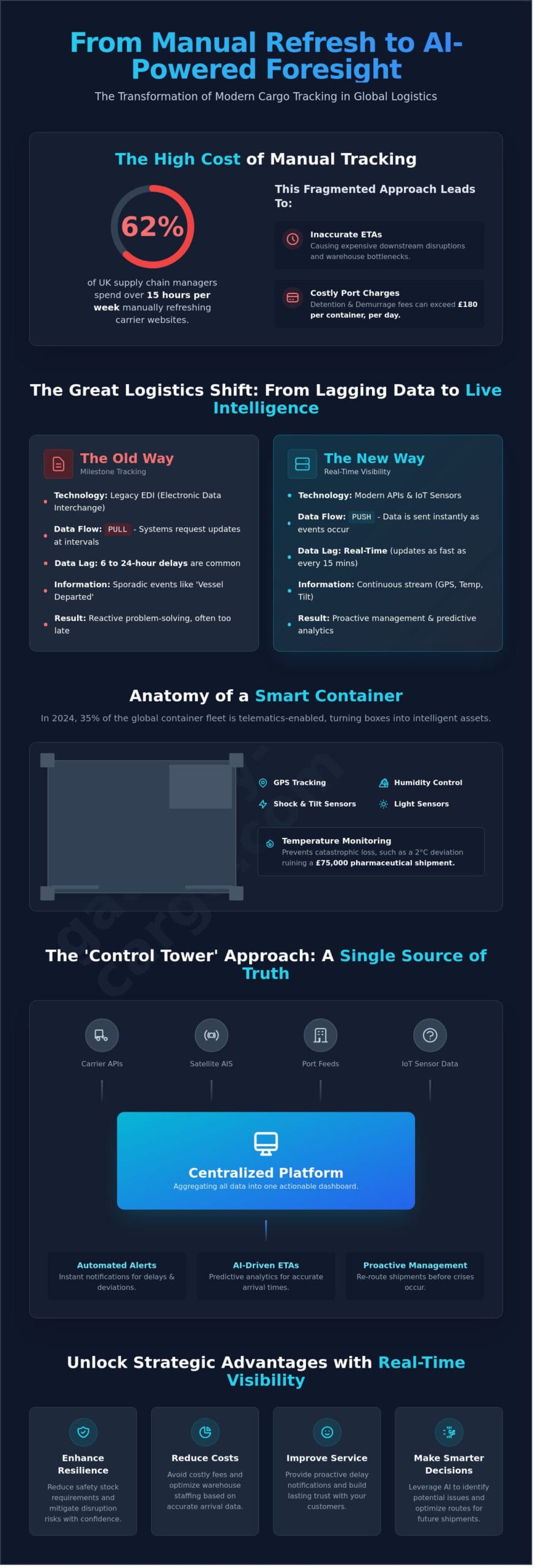
Recent data from the 2024 Logistics Efficiency Survey reveals that 62% of UK supply chain managers still spend over 15 hours every week manually refreshing carrier websites. This fragmented approach to cargo tracking isn’t just a drain on your team’s time; it’s a direct threat to your bottom line when inaccurate ETAs cause expensive warehouse bottlenecks. You likely feel the pressure of maintaining a seamless flow while dealing with the inherent lack of transparency in multi-modal transits. It’s frustrating to manage high-value shipments when you’re effectively blind to their status between major ports.
We understand that managing complex transits across air, sea, and road requires more than just a pin on a map. You need a system that anticipates delays before they happen. This guide shows you how to turn real-time visibility into a powerful strategic asset for your global operations. We’ll examine how automated alerts and AI-driven insights help you reclaim control of your logistics, reduce overhead costs, and optimise every route for 2026 and beyond.
Key Takeaways
- Understand the transition from manual updates to real-time digital twins, transforming basic data into a strategic asset for global logistics.
- Master the integration of EDI and APIs to create a robust technology stack that ensures continuous, accurate data flow between all supply chain partners.
- Learn how to optimise business resilience by reducing safety stock requirements and improving customer service through proactive notification systems.
- Implement a centralised “Control Tower” approach to cargo tracking, allowing for automated alerts and more efficient management of transit deviations.
- Discover how AI-driven predictive analytics can identify potential supply chain disruptions before they occur, allowing for smarter, forward-looking decision-making.
Understanding Cargo Tracking in Modern Global Logistics
Modern logistics has moved far beyond simple arrival notifications. Cargo tracking now functions as a sophisticated digital twin of a physical shipment, providing granular data at every transit point. Historically, logistics managers relied on manual telex updates and sporadic phone calls to locate freight. The evolution of Package tracking from internal courier logs to high-frequency satellite telemetry has transformed how UK businesses manage their inventories. By 2026, real-time visibility has become the primary cure for the “black hole” of traditional freight forwarding, where goods would effectively vanish between the port of origin and the destination warehouse.
It’s vital to distinguish between milestone tracking and live IoT monitoring. Milestone tracking records specific events, such as “vessel departed” or “gate out,” which are often updated manually by port staff. In contrast, live monitoring uses GPS and IoT sensors to report the exact coordinates, temperature, and tilt of a container every 15 minutes. This distinction is critical for high-value electronics or pharmaceutical shipments where a 2-degree temperature deviation can ruin a £75,000 consignment. Relying on outdated milestones in a volatile market is no longer a viable strategy for companies aiming to optimise their supply chains.
The Core Components of a Tracking Request
To initiate a search, you need specific identifiers that act as digital keys. The Air Waybill (AWB) consists of an 11-digit number used for air freight, while the Bill of Lading (B/L) serves as the primary contract and tracking document for ocean shipments. Container numbers follow the ISO 6346 standard, featuring a four-letter owner code followed by seven digits. For instance, a prefix like “MAEU” automatically routes data requests to Maersk’s servers. This automated routing ensures that cargo tracking data is pulled from the correct carrier source without the need for manual intervention or lengthy email chains.
Why Basic Tracking is No Longer Enough
Expectations have shifted significantly in the B2B sector. A 2024 industry report indicated that 84% of UK supply chain managers now demand the same level of transparency they receive from consumer platforms like Amazon. Basic carrier data often suffers from 12 to 24-hour lag times. In an environment where port congestion at sites like Felixstowe or Southampton can lead to detention charges exceeding £180 per day, delayed information is expensive. Forwarder-enhanced insights bridge this gap by aggregating data from multiple sources, including port authority feeds and satellite AIS, to provide a single, accurate version of the truth. This proactive approach allows businesses to re-route shipments or adjust production schedules before a delay becomes a crisis.
The Technology Stack: How Cargo Tracking Actually Works
Modern logistics relies on a digital nervous system that bridges the gap between physical movement and data visibility. It’s a sophisticated blend of legacy protocols and cutting-edge hardware. To understand how cargo tracking functions, you must look at the protocols moving the data behind the scenes. This infrastructure ensures that a container’s status is visible from a port in Felixstowe to a distribution centre in the Midlands without manual intervention.
From EDI to API: The Modern Transition
Electronic Data Interchange (EDI) has served as the industry’s backbone since 1971. It uses standardised formats like EDIFACT to exchange documents. However, EDI operates on a “pull” basis; systems request updates at set intervals, which often leads to data lags of six to twelve hours. This delay is no longer acceptable for high-velocity supply chains. Application Programming Interfaces (APIs) are replacing these legacy systems by enabling “push” notifications. When a milestone is reached, the data is instantly transmitted to your dashboard. API tracking will be the standard for 2026 logistics. This shift allows for bespoke freight solutions that react to disruptions as they happen rather than hours after the event.
Smart Containers and IoT Sensors
Internet of Things (IoT) hardware has transformed the shipping container into an intelligent asset. In 2024, approximately 35% of the global intermodal container fleet is expected to be “smart” or telematics-enabled. These devices go beyond basic GPS coordinates. They utilise a suite of sensors to monitor the internal environment of the cargo:
- Temperature and Humidity: Essential for the UK’s £25 billion food and drink export sector to ensure cold-chain integrity.
- Light Sensors: These detect unauthorised container openings, providing a critical layer of security against theft.
- Shock and Tilt: Accelerometers record G-force impacts, which is vital for high-value machinery or fragile electronics that require delicate handling.
While cellular networks handle tracking near coastlines, satellite constellations like Iridium provide 100% global coverage. This ensures that even in the middle of the Atlantic or Pacific, a vessel’s position is updated every 15 minutes. This level of cargo tracking precision reduces “dark periods” where shipments previously went off the grid for days at a time.
Blockchain and Distributed Ledgers
Data integrity remains a significant challenge in international trade. Industry reports suggest that up to 10% of freight invoices contain errors or fraudulent entries. Blockchain technology addresses this by creating an immutable record of every transaction and movement. When a carrier, port authority, and customs agent all update a single distributed ledger, the risk of documentation fraud drops significantly. In the UK, the move towards the Electronic Trade Documents Act 2023 has further accelerated this. It gives digital documents the same legal standing as paper ones. This digitisation ensures that the data you see on your tracking screen isn’t just fast; it’s legally verifiable and accurate. By removing the need for manual data entry, businesses save an average of £150 per shipment in administrative overheads.
Why Real-Time Visibility is the Backbone of Business Resilience
Resilience in modern logistics isn’t about avoiding disruption; it’s about how quickly a business can pivot when it happens. High-fidelity cargo tracking transforms your supply chain from a reactive cost centre into a strategic asset. By eliminating the “black hole” periods during transit, UK firms can drastically reduce safety stock levels. Current industry data suggests that businesses often hold 15% more inventory than necessary to buffer against transit uncertainty. With 99% accuracy in arrival windows provided by real-time data, companies can reduce these stock buffers by an average of 12%, freeing up significant working capital.
Proactive communication is the standard for modern customer service. Research indicates that 84% of B2B buyers are unlikely to return after a single poor delivery experience. When a vessel is delayed by 48 hours at a transshipment hub, real-time alerts allow your team to notify the end customer before they notice the delay themselves. This transparency builds trust and mitigates the reputational damage caused by unforeseen logistics hurdles.
Operational efficiency at the warehouse level depends entirely on the accuracy of Arrival Notices. Labour typically accounts for 45% to 50% of total warehouse operating expenses in the UK. If a shipment is rescheduled from a 09:00 slot to 15:00, but the team isn’t notified, you’re paying for idle hours. Accurate tracking ensures that labour shifts are aligned with actual vehicle arrivals, preventing wasted expenditure on overstaffing during delays.
Historical data analysis identifies the systemic bottlenecks that gut your margins. By reviewing 2023 transit data, we found that certain UK port terminals experienced 18% higher dwell times compared to others during peak seasons. Using these insights allows for smarter carrier and route selection in future planning cycles.
Cost Reduction through Data-Driven Decisions
Demurrage and detention fees represent a significant drain on profitability. In the UK, these penalties often start after five days and can quickly escalate to £150 per container per day. Real-time alerts ensure your transport team moves containers before these charges accrue. Our clients see an average 22% reduction in avoidable port fees by using integrated cargo tracking. Additionally, insurers are increasingly offering premium discounts of up to 10% for businesses that utilise robust monitoring systems to mitigate theft and damage risks.
Sustainability and Tracking
Environmental accountability is no longer optional for UK businesses reporting on Scope 3 emissions. We use precise tracking data to calculate the carbon footprint of every shipment based on actual distance and fuel type. This level of visibility is essential for participating in “Green Corridors,” where logistics routes are specifically optimised for lower environmental impact. Gateway Cargo integrates these sustainability metrics directly into our tracking dashboards. This allows you to see the carbon savings achieved by prioritising EV vehicle logistics for final-mile deliveries, which can reduce urban delivery emissions by 30% per drop.
Best Practices for Managing Tracked Shipments and Handling Delays
Efficient logistics management requires a centralised “Control Tower” strategy. Instead of toggling between twenty different carrier portals, professional operators use a single interface to monitor air, ocean, and road freight simultaneously. A 2023 report by the Logistics Management Institute indicated that firms using centralised visibility tools saw a 14% reduction in administrative overheads. It’s a strategy that turns reactive tracking into proactive management by providing a bird’s-eye view of the entire supply chain. Integrating cargo tracking data directly into your existing ERP or WMS ensures your warehouse team knows exactly when a container arrives at UK ports like Tilbury or Southampton. This level of integration eliminates manual data entry errors, which currently account for nearly 12% of supply chain discrepancies.
Setting up automated exception alerts is vital for high-volume shippers. You shouldn’t spend time watching shipments that are on schedule. Instead, configure your system to trigger a notification only when a milestone is missed by more than four hours. This “management by exception” ensures your team focuses on the 5% of shipments that actually require intervention. You must also verify the quality of your data. Carrier updates aren’t always accurate; a 2024 analysis of maritime data showed that “vessel arrived” timestamps can vary by up to 90 minutes from actual berthing times. Relying on raw data without validation can lead to premature transport bookings and unnecessary demurrage costs. Effective cargo tracking relies on filtered, high-fidelity information rather than a simple stream of raw carrier pings.
What to Do When Tracking Shows a Delay
When a delay appears, your first step is to identify the root cause through your freight partner. Whether it’s 2024 port congestion in Felixstowe or customs hold-ups, knowing the “why” dictates your response. Next, communicate immediately with stakeholders; an automated update to your customer is better than a silent delay. Finally, collaborate with your forwarder to explore intermodal alternatives. If a sea freight shipment is stuck, switching the final leg to rail or express road haulage can often save 48 hours of transit time.
Avoiding Common Tracking Pitfalls
One major danger is relying on “Last Known Position” data, which might be twelve hours old. Always check the timestamp of the update. You should also watch for “ghost” updates where automated systems report a departure that hasn’t actually happened due to a rolled container. Ensure your team understands complex logistics status codes. A status of “Cleared” doesn’t always mean “Ready for Collection,” and misinterpreting these nuances leads to wasted haulage costs and missed delivery slots.
To secure your supply chain against these uncertainties, you should optimise your freight strategy with a partner that provides verified, real-time visibility.
Optimising Your Supply Chain with Gateway Cargo’s AI-Driven Tracking
Gateway Cargo’s digital logistics platform isn’t just a portal; it’s a sophisticated command centre. We’ve built a system that moves far beyond basic cargo tracking to provide actionable intelligence for modern enterprises. By 2024, data fragmentation remains a primary cause of supply chain friction for UK businesses. Our platform solves this by consolidating every data point from origin to destination. It gives you a single source of truth across your entire global network, ensuring you’re never left guessing about the status of your inventory.
Our AI-driven strategy identifies potential disruptions before they impact your bottom line. We use machine learning to analyse weather patterns, port congestion data, and historical transit times across thousands of routes. If a vessel heading to Southampton faces a 48-hour delay due to tidal conditions or berth availability, our system flags it immediately. You don’t just see where your goods are; you see where they’ll be in three days. This proactive approach allows for immediate rerouting or inventory adjustments, preventing the costly “firefighting” that plagues traditional logistics.
Technology is only half the battle. Our dedicated specialist team monitors your cargo 24 hours a day, 365 days a year. They work alongside the AI to manage exceptions that software alone cannot solve. Whether it’s a late-night customs query or an urgent road freight diversion in the Midlands, our experts intervene in real-time. You get the precision of automation combined with the nuance of human expertise. It’s a dual-layered approach that ensures reliability in an increasingly volatile global market.
In late 2023, a major UK automotive parts distributor integrated our visibility tools to combat rising costs. They faced consistent bottlenecks at Felixstowe that disrupted their just-in-time manufacturing schedule. By utilising our real-time cargo tracking and predictive alerts, they reduced their average lead times by 15% within six months. This shift saved them approximately £42,000 in monthly demurrage and storage fees. Efficiency isn’t an abstract goal; it’s a measurable outcome of better data and smarter execution.
Our Bespoke Tracking Solutions
Our platform adapts to your business requirements, not the other way around. We provide customised dashboards tailored to your specific supply chain KPIs, ensuring you only see the metrics that matter to your operations. The system offers seamless integration across air, ocean, and road freight services. You’ll receive real-time customs clearance status updates, significantly reducing the risk of unexpected border delays at UK ports or international hubs.
Partnering for a Smarter Supply Chain
Gateway Cargo acts as an extension of your own internal team. We aren’t just a service provider; we’re your dedicated logistics specialists. Our commitment to innovation and sustainability drives us to find the most reliable and carbon-efficient routes possible. We’re currently expanding our use of EV vehicles for final-mile deliveries to help our clients meet their 2025 carbon reduction targets. Contact our specialists today to see our tracking platform in action.
Future-Proofing Your UK Supply Chain for 2026
As we approach 2026, the demand for precision in global trade has never been higher. Efficient cargo tracking isn’t just a luxury; it’s a fundamental requirement for UK businesses navigating post-Brexit customs and fluctuating fuel costs. Recent industry data shows that companies adopting real-time visibility see a 12% reduction in operational overheads through better route management. By integrating a robust technology stack and following proactive management practices, you can transform potential delays into manageable milestones. Success in the next decade depends on your ability to turn raw data into actionable intelligence.
Gateway Cargo provides the expertise needed to navigate these complexities. Our AI-driven digital logistics strategy ensures your goods move through green corridors, supported by our proactive commitment to sustainability and EV vehicle integration. We offer Gateway Logistics Group bespoke freight solutions tailored to the unique demands of global trade, helping you maintain a competitive edge. It’s time to move beyond reactive logistics and embrace a smarter, more sustainable future. Optimise your supply chain with Gateway Cargo’s expert tracking solutions.
Your journey towards a more resilient and transparent supply chain starts today.
Frequently Asked Questions
What is the difference between air cargo tracking and ocean freight tracking?
Air cargo tracking provides updates every 1 to 2 hours via flight numbers and airport codes, offering high-frequency visibility for time-critical goods. Ocean freight tracking relies on AIS satellite data and usually updates every 12 to 24 hours as vessels move between ports. While air tracking captures granular hub movements, ocean tracking focuses on major milestones like “Vessel Departed” or “Container Discharged” at the terminal.
How accurate are the estimated times of arrival (ETA) in cargo tracking?
Standard ETAs are typically accurate within a 24-hour window for 85% of air shipments and a 48 to 72-hour window for ocean freight. External factors like the 2024 Red Sea diversions can shift these timelines by 10 days or more. We use historical port congestion data to refine these estimates, ensuring your supply chain remains resilient despite global volatility and unpredictable weather patterns.
Can I track a shipment if I only have the container number?
You can track a shipment using only the container number through a unified cargo tracking platform or the carrier’s own portal. The number consists of four letters and seven digits, such as MSCU1234567, which identifies the specific metal box. While this shows the vessel’s location and port status, a Bill of Lading (BOL) number provides more detailed information about the specific goods inside the container.
What should I do if my tracking status hasn’t updated in several days?
Contact your freight forwarder if your status remains stagnant for more than 48 hours on air freight or 5 days on ocean freight. This often happens in “black zones” where satellite coverage is limited or during weekend port closures. In 2023, 12% of tracking delays were caused by simple data entry lags at customs. Our specialists monitor these gaps to ensure your visibility isn’t compromised during transit.
Is it possible to track the temperature and condition of my cargo in real-time?
Real-time temperature and condition monitoring is possible using IoT-enabled sensors like Tive or Roambee devices placed inside the cargo. These units transmit live data on humidity, shock, and tilt via cellular networks. This is vital for UK pharmaceutical shipments where a 2-degree variance can ruin a £50,000 consignment. You can view these metrics directly in our digital dashboard to ensure product integrity.
How does AI improve the reliability of cargo tracking data?
AI improves cargo tracking reliability by filtering out “noise” from raw GPS data and predicting port delays before they occur. Machine learning algorithms analyse 10 years of weather patterns and berth performance to adjust schedules automatically. This technology reduces “false positive” alerts by 30% compared to legacy systems. It allows for a smarter supply chain that anticipates disruptions rather than just reacting to them.
What is an “exception” in cargo tracking and why does it matter?
An exception is any event that disrupts the planned transit schedule, such as a customs hold, vessel omission, or weather delay. In the UK, roughly 7% of shipments face a “Customs Examination” exception, which can add 24 to 48 hours to the delivery timeline. These alerts are critical because they trigger immediate contingency plans. Identifying exceptions early prevents small delays from becoming major supply chain failures. For comprehensive insights into current disruptions affecting UK ports, our port congestion news today November 2025 analysis provides detailed coverage of the latest bottlenecks and their impact on detention costs.
How can I integrate tracking data into my own company’s software?
You can integrate tracking data into your ERP or TMS using standardised APIs or EDI 214 status messages. Most modern platforms provide RESTful APIs that allow your developers to pull live coordinates directly into your internal systems. This automation eliminates the need for manual checks on carrier websites. It saves our clients an average of 15 hours of administrative work every month by centralising all data.