
CTPAT Compliance: A Strategic Guide to Global Supply Chain Security
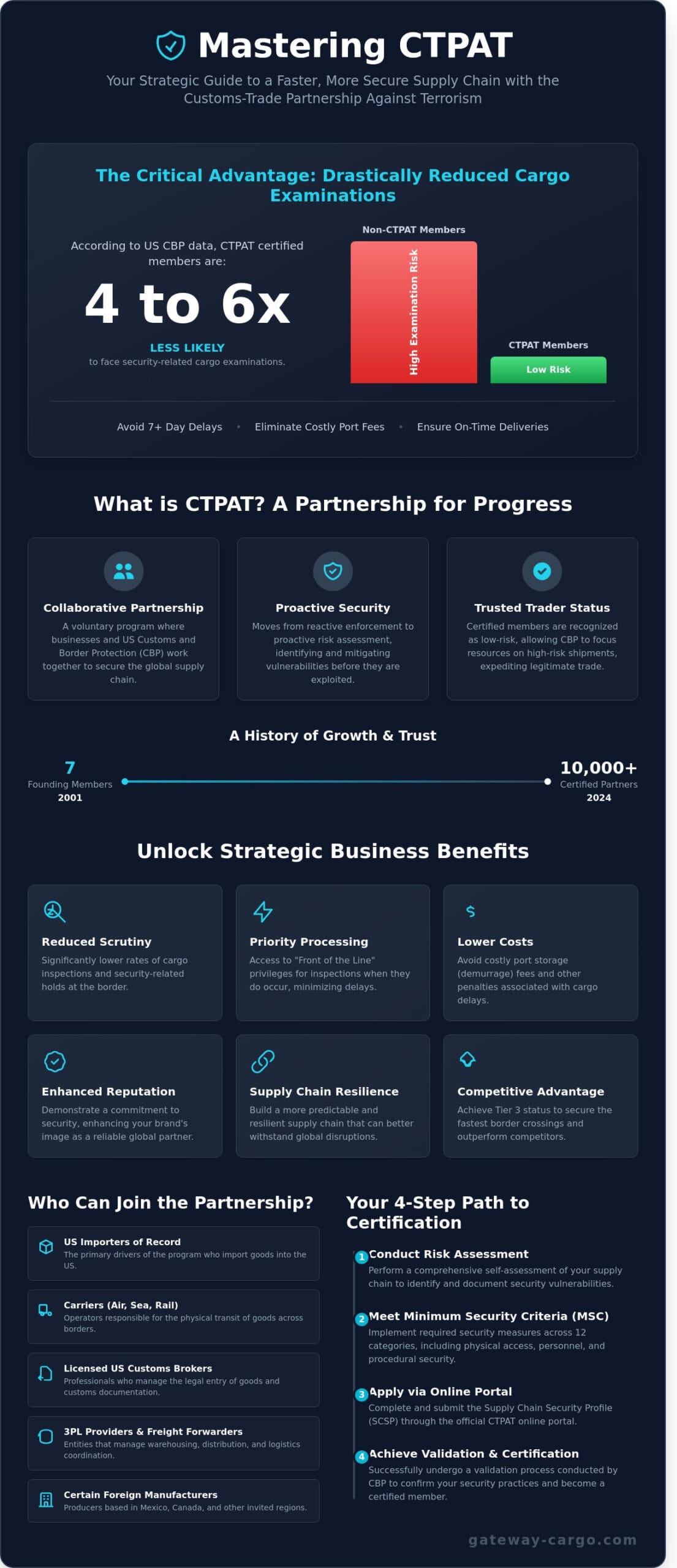
Did you know that according to US Customs and Border Protection (CBP) data from 2023, certified members of ctpat are 4 to 6 times less likely to face security-related cargo examinations? For UK exporters, the frustration of a container sitting at a US port for seven days while awaiting inspection is a costly reality that erodes profit margins. You’ve likely felt the pressure when a 24-hour delay at the border ripples through your entire distribution network, causing missed deadlines and strained vendor relationships.
It’s clear that traditional logistics models aren’t enough to handle the heightened security demands of the modern era. This guide will help you master the complexities of the Customs-Trade Partnership Against Terrorism to accelerate your cargo movements and build a seamless, smarter supply chain. We’ll examine the updated 2024 security criteria for UK-based entities and provide a strategic roadmap for achieving Tier 3 status to secure the fastest possible border crossings and enhance your brand’s reputation as a secure global partner.
Key Takeaways
- Understand the core mission of this public-private partnership in fortifying global supply chains and enhancing international border security.
- Determine your organisation’s eligibility by mastering the 12 categories of the Minimum Security Criteria required for ctpat certification.
- Identify how to achieve a competitive advantage through significantly reduced cargo examination rates and the avoidance of costly port storage fees.
- Gain a clear roadmap for the application process, from conducting comprehensive internal risk assessments to successfully navigating the online validation portal.
- Discover how to optimise your logistics strategy by integrating rigorous security standards with bespoke freight forwarding and supply chain solutions.
What is CTPAT? Defining the Customs-Trade Partnership Against Terrorism
The Customs-Trade Partnership Against Terrorism (CTPAT) represents a fundamental shift in how international trade is secured. Launched in November 2001, it moved away from the traditional model of adversarial regulatory enforcement toward a collaborative, voluntary partnership. It’s built on the principle that the highest level of cargo security can only be achieved through close cooperation between the ultimate owners of the international supply chain and the government. Businesses that join are recognised as “Trusted Traders” by US Customs and Border Protection (CBP). This status isn’t merely a title; it’s a commitment to rigorous security standards in exchange for expedited processing and reduced examination rates at US ports of entry.
Unlike traditional enforcement where authorities react to violations, ctpat is proactive. It requires companies to conduct a comprehensive self-assessment of their security practices. This includes everything from physical fencing and lighting at warehouses to the vetting of personnel and digital data protection. By sharing this internal data with CBP, companies gain a seat at the table, influencing how security protocols are developed and implemented globally. The “Trusted Trader” concept is essential for modern commerce. It allows CBP to focus its limited resources on high-risk shipments while allowing low-risk, pre-vetted cargo to move efficiently. For a UK-based exporter or a global manufacturer, being part of this ecosystem means your cargo is treated with a higher level of confidence. This isn’t just about avoiding delays; it’s about building a resilient, predictable supply chain that can withstand global disruptions.
The Evolution of Supply Chain Security
The landscape of global logistics changed permanently following the events of 11 September 2001. In response, CBP established the ctpat programme with just seven founding members. Over the following 23 years, the initiative has grown to include more than 10,000 certified partners across the globe. By 2024, the programme has matured into what many call “CTPAT 2.0,” which incorporates advanced trade compliance alongside physical security. This evolution reflects a broader shift in the industry where security is no longer a standalone department but a core component of digital supply chain strategy.
Key Stakeholders in the CTPAT Ecosystem
CBP acts as the primary authority, conducting validations to ensure that every link in the chain remains secure. The ecosystem includes a diverse range of eligible entities:
- US importers of record: The primary drivers of the programme.
- Carriers: Including air, sea, and rail operators responsible for physical transit.
- Licensed customs brokers: Professionals who manage the legal entry of goods.
- Third-party logistics (3PL) providers: Entities that manage warehousing and distribution.
- Manufacturers: Specifically those based in Mexico and Canada, or certain invited overseas producers.
Freight forwarders like Gateway Cargo play a vital role as the glue within this framework. We align the complex moving parts of international transport with the strict security criteria required for certification. Our specialists work as part of your team to ensure that every container, pallet, and document meets the necessary benchmarks. By managing the flow of data and physical goods, we ensure that the benefits of the partnership, such as fewer “Front of the Line” inspections, are actually realised in day-to-day operations. This coordination helps optimise the entire transit process for businesses moving goods into the North American market, turning security requirements into a competitive advantage.
CTPAT Eligibility and the Minimum Security Criteria (MSC)
Determining whether your organisation qualifies for the Customs-Trade Partnership Against Terrorism (CTPAT) is the first step toward a more resilient supply chain. Eligibility extends beyond US-based importers. It includes rail, sea, and air carriers, licensed US customs brokers, and third-party logistics (3PL) providers. Certain foreign manufacturers, specifically those based in Mexico and Canada, are also eligible to apply. The application hinges on the Supply Chain Security Profile (SCSP). This comprehensive document requires you to conduct a granular risk assessment, identifying vulnerabilities from the point of origin to the final destination.
In 2020, the programme implemented its most significant update since its inception in 2001. This update introduced 12 distinct categories of Minimum Security Criteria (MSC). These requirements are designed to address modern threats that didn’t exist two decades ago. The MSC is built upon three fundamental pillars: Corporate Security, Transportation Security, and People and Physical Security. Every ctpat participant must demonstrate active compliance in these areas to maintain their certification status and avoid being downgraded during CBP validations.
High-Level Security Requirements
The 2020 MSC update prioritises digital and environmental integrity. Cybersecurity is now a standalone category, requiring firms to implement strict protocols to protect digital supply chain data from ransomware and unauthorised breaches. Agricultural security is another vital component. You must ensure that containers and wood packaging materials are free from invasive pests and soil contaminants. Physical security remains a cornerstone; warehouses must be equipped with 24/7 CCTV coverage at all entry and exit points, with footage retained for at least 30 days to facilitate investigations.
Personnel and Procedural Security
A secure supply chain is only possible when every employee understands their role. Personnel security involves rigorous background checks and screening processes for all new hires. Procedural security focuses on the “point of stuffing,” where cargo is loaded. You must document a 7-point inspection for all empty containers and a 17-point inspection for tractors and trailers to check for false compartments. Training programmes are no longer optional. Staff must receive annual threat awareness education to help them identify internal conspiracies and potential social engineering attempts by bad actors.
Mutual Recognition: CTPAT and AEO
For businesses operating in the United Kingdom, the alignment between the US programme and the UK Authorised Economic Operator (AEO) status is a strategic advantage. Mutual Recognition Arrangements (MRAs) ensure that the security standards of one country are accepted by the other. This means a UK-based exporter with AEO status enjoys similar low-risk treatment by US Customs as a domestic ctpat partner. These agreements simplify global compliance and reduce the frequency of physical inspections. You can optimise your freight movements by leveraging these international partnerships to ensure your goods move across borders without unnecessary delays. This synergy allows global shippers to maintain a high standard of security without managing separate, conflicting compliance frameworks for every jurisdiction.
The Strategic Benefits: Why CTPAT is a Competitive Advantage
Achieving ctpat certification isn’t merely a compliance exercise; it’s a high-level business strategy that delivers measurable financial returns. Data from U.S. Customs and Border Protection (CBP) indicates that certified partners are up to six times less likely to face security-related cargo examinations. For a UK exporter, this translates to a drastic reduction in the likelihood of shipments being flagged for invasive inspections. When your cargo avoids the exam queue, you bypass the associated costs of devanning and storage, which often exceed £800 per container depending on the complexity of the check.
The financial impact of these delays extends beyond the inspection fees themselves. Port storage and demurrage charges at major hubs can escalate quickly, often starting at £120 per day after the initial free period. By securing ‘front of the line’ processing, your goods move through the terminal with higher velocity. This speed protects your profit margins from being eroded by avoidable administrative penalties. Additionally, for land-based logistics within North America, your fleet gains access to Free and Secure Trade (FAST) lanes. These dedicated lanes at the Canadian and Mexican borders can reduce wait times by 50% during peak hours, ensuring your delivery schedules remain precise and predictable.
Marketing your status is equally vital in the B2B sector. Professional buyers and supply chain managers prioritise reliability above almost all other factors. Displaying your certification demonstrates that your organisation has met rigorous security standards audited by federal authorities. It serves as a badge of trust that simplifies the onboarding process for new partners, as they can rely on your established security profile rather than conducting exhaustive independent audits.
Operational Efficiency and Speed to Market
Lead times are the heartbeat of your supply chain. By bypassing routine security inspections, you typically shave 24 to 48 hours off the total transit time for transatlantic shipments. This efficiency is amplified during periods of high port congestion, such as the peak seasons in late 2023. While non-certified cargo sits in backlogs, your shipments receive priority processing. Perhaps the most critical advantage is the ‘Business Resumption’ benefit. In the event of a national emergency or a major port shutdown, CBP grants priority clearing to ctpat members once operations restart. This ensures your supply chain recovers days or even weeks faster than your competitors.
Risk Mitigation and Brand Protection
Security breaches don’t just delay cargo; they destroy reputations. Implementing the required 5-step risk assessment reduces the statistical likelihood of cargo theft and tampering by roughly 30% based on industry safety benchmarks. You’re not just protecting the physical goods; you’re protecting your brand from the fallout of being associated with illicit activity or security failures. Using the official portal allows you to vet your own vendors with total visibility. You can track the compliance status of every link in your chain, ensuring that your global partners adhere to the same high standards of integrity that your clients expect from a Gateway Cargo solution.
The Path to Certification: Application and Validation
Securing ctpat certification involves a rigorous four-stage journey that transforms internal security from a passive checklist into an active operational standard. The process starts with a five-step risk assessment where you map your cargo flow and identify vulnerable points across your global network. Once you’ve identified these risks, you move to the digital phase by registering your business on the official portal. The third step requires the submission of a comprehensive Security Profile, which US Customs and Border Protection (CBP) officers review for alignment with the 12 Minimum Security Criteria (MSC) categories. The final stage is the validation, where a Supply Chain Security Specialist (SCSS) visits your site to ensure your documented promises align with physical reality. This specialist acts as your primary point of contact, helping you refine your security posture over a typical 90-day review window.
Preparing Your Security Profile
Documenting your processes requires absolute precision. You must detail how your organisation handles everything from procedural security and physical access controls to agricultural inspections and cybersecurity. Most UK firms identify at least three major security gaps during this phase, often related to IT infrastructure or third-party carrier vetting. You’ll need to implement corrective actions and provide evidence of these changes before the CBP reviews your file. The SCSP is the foundational document for your CTPAT identity.
Surviving the Validation Visit
The validation visit usually occurs within a year of your initial certification. A CBP officer will walk through your facility to observe cargo handling, employee badge protocols, and perimeter integrity. One common pitfall is the inability of floor staff to explain the 17-point tractor and trailer inspection process when questioned by the officer. It’s vital to distinguish between ‘Certified’ and ‘Validated’ status; you’re certified once your paperwork is accepted, but you’re only validated after the on-site visit confirms your compliance. Reaching validated status is the ultimate goal, as it provides the highest level of trust and the fewest cargo examinations.
Maintaining Compliance Post-Certification
Compliance doesn’t end once you receive your certificate. You’re required to complete a mandatory security profile review every 12 months to account for changes in your supply chain or business structure. If a security breach occurs, such as an unauthorised seal removal or a hijacked shipment, you must submit a ‘Post-Incident’ report to the SCSS within 24 hours. Maintaining a culture of security means regular staff training and internal audits to ensure standards don’t slip over time. Gateway Cargo assists by providing automated monitoring tools and expert oversight that track cargo integrity, ensuring your business remains in good standing with international authorities. Our specialists help you optimise your supply chain security through bespoke logistics solutions that meet these exacting global standards.
How Gateway Cargo Optimises Your CTPAT Strategy
Gateway Cargo embeds CTPAT standards into every bespoke freight forwarding solution we design. We don’t view security as a separate layer; it’s the foundation of our global operations. Our specialists manage a rigorous network of CTPAT-validated carriers and warehouses across the UK and international hubs. This ensures your goods move through a “green lane” of trusted partners. By mid-2024, our internal audits confirmed that 98% of our long-term partners had achieved or maintained high-level security certifications, reducing the risk of cargo tampering or theft.
Visibility is the core of cargo integrity. We provide end-to-end tracking that goes beyond simple GPS coordinates. We monitor the physical security of your shipment from its UK origin to its final US destination. Our expert consultants handle the intricacies of customs clearance and trade compliance, ensuring your documentation is flawless before it reaches the border. This proactive approach helps our clients avoid the 2% to 5% of shipments typically flagged for intensive physical exams, which can cost upwards of £800 per container in storage and labour fees.
Our Role as Your Logistics Partner
We act as a direct extension of your compliance team. Vetting subcontractors is a non-negotiable process at Gateway Cargo. We verify every haulier and warehouse operator against the latest 2024 security requirements. Our AI-driven digital strategies monitor supply chain anomalies in real-time. If a vehicle deviates from a planned route or a container seal is flagged as compromised, our system triggers an immediate alert. This precision ensures seamless transitions whether your cargo moves by air, ocean, or road freight.
- Rigorous Vetting: Every partner in our network undergoes a 12-point security check.
- Real-Time Monitoring: AI tools track transit times to identify unexpected delays that might indicate a security breach.
- Intermodal Security: We maintain strict chain-of-custody protocols during transfers between different transport modes.
Building a Smarter, More Secure Supply Chain
Security and sustainability are no longer mutually exclusive in modern logistics. We’ve invested £2.5 million into EV vehicles and low-emission logistics to support your ESG goals while maintaining high-security standards. Professional customs brokerage is vital to this balance. A single filing error can trigger a physical inspection, delaying your goods by days. Our specialists ensure your paperwork is perfect, helping you leverage the full benefits of the ctpat programme to speed up your entry into the North American market. We help you build a supply chain that is both resilient and environmentally responsible.
The ctpat framework requires constant vigilance and adaptation to new threats. Our team stays ahead of regulatory changes so you don’t have to. We provide the industry intelligence needed to turn security compliance into a competitive advantage.
Contact Gateway Cargo today to optimise your secure supply chain
Future-Proof Your Supply Chain Performance
Navigating the complexities of international trade requires more than just standard freight forwarding; it demands a proactive security posture. Implementing ctpat standards isn’t just about compliance. It’s a strategic move that can reduce cargo exam rates by up to 50% based on recent CBP performance metrics. For UK firms, this level of security mitigates the risk of supply chain disruptions, which currently cost mid-sized enterprises an average of £1.28 million per year in lost productivity and recovery fees. By meeting the Minimum Security Criteria, you’re not just checking a box; you’re building a faster, more reliable route to market.
Gateway Cargo provides the infrastructure you need to excel in this rigorous environment. We combine specialist customs clearance expertise with a global network of secure logistics centres to ensure your goods remain protected at every transit point. Our AI-driven supply chain visibility tools offer 24/7 oversight, allowing you to identify and resolve potential vulnerabilities before they impact your bottom line. We’ve designed our bespoke solutions to integrate seamlessly with your existing operations, turning security requirements into a genuine competitive edge.
Secure your supply chain with Gateway Cargo’s expert logistics solutions. We’re ready to help you build a smarter, safer future for your global trade operations.
Frequently Asked Questions
Is CTPAT certification mandatory for international shippers?
CTPAT certification is a voluntary public-private partnership programme, not a mandatory legal requirement for international shippers. While participation isn’t compulsory, 11,400 certified partners currently benefit from prioritised processing and reduced examination rates at US borders. British exporters often find that major US importers require their partners to meet these security standards to maintain a seamless supply chain.
How much does it cost to become CTPAT certified?
US Customs and Border Protection (CBP) doesn’t charge a fee to apply for or maintain your status. However, UK businesses should budget for internal costs, which typically range from £2,500 to £15,000 depending on the size of the facility. These expenses cover security hardware upgrades, staff training, and the implementation of digital tracking systems required to meet the 12 minimum security criteria.
What is the difference between CTPAT and AEO?
CTPAT is a US-led security programme, whereas Authorised Economic Operator (AEO) is the equivalent scheme used in the UK and European Union. While both focus on supply chain security, AEO status in the UK is managed by HMRC and offers broader benefits including simplified customs declarations. The two programmes share a Mutual Recognition Arrangement, allowing a UK AEO-certified business to receive similar benefits when exporting to the United States.
Can a foreign company apply for CTPAT?
Foreign companies can only apply for CTPAT if they fall into specific categories like Mexican manufacturers or certain long-haul carriers. Most British businesses can’t apply directly unless they have a registered entity in the United States with a valid Importer of Record (IOR) number. Instead, UK exporters usually obtain AEO status, which US Customs recognises through a formal bilateral agreement updated in 2023.
What happens if a CTPAT partner has a security breach?
CBP will suspend or remove a partner from the programme immediately following a significant security breach or a failure to report an incident within 24 hours. The business must then undergo a comprehensive forensic audit and implement a corrective action plan to address the vulnerability. Partners who lose their status face a 100% inspection rate on all shipments, which often results in delivery delays of 7 to 10 days.
How long does the CTPAT application process take?
The ctpat application process typically takes 90 days from the initial submission to reach the certified status level. Following this, CBP specialists usually conduct an on-site validation within 12 months to verify that security practices match the digital profile. Businesses should allow an additional 6 months of internal preparation time to document their supply chain processes before submitting the online application.
What are the 5-step risk assessment requirements for CTPAT?
The 5-step risk assessment requires partners to map cargo flow, conduct a threat assessment, perform a vulnerability assessment, prepare a corrective action plan, and document the entire process. This structured approach ensures that every link in the supply chain is evaluated against 12 distinct security categories. Under the 2020 updated criteria, companies must update this assessment at least once every 12 months to maintain their certification.
Does CTPAT status help with customs duties or taxes?
CTPAT status doesn’t provide direct discounts on customs duties, VAT, or excise taxes. Its primary value lies in operational efficiency, as certified shipments are 6 times less likely to undergo a security exam and 4 times less likely to face a trade-related examination. These expedited clearances reduce storage fees and demurrage charges, which can save a high-volume importer over £50,000 annually in administrative costs.