
Freight Transport: A Comprehensive Reference Guide for Modern Logistics
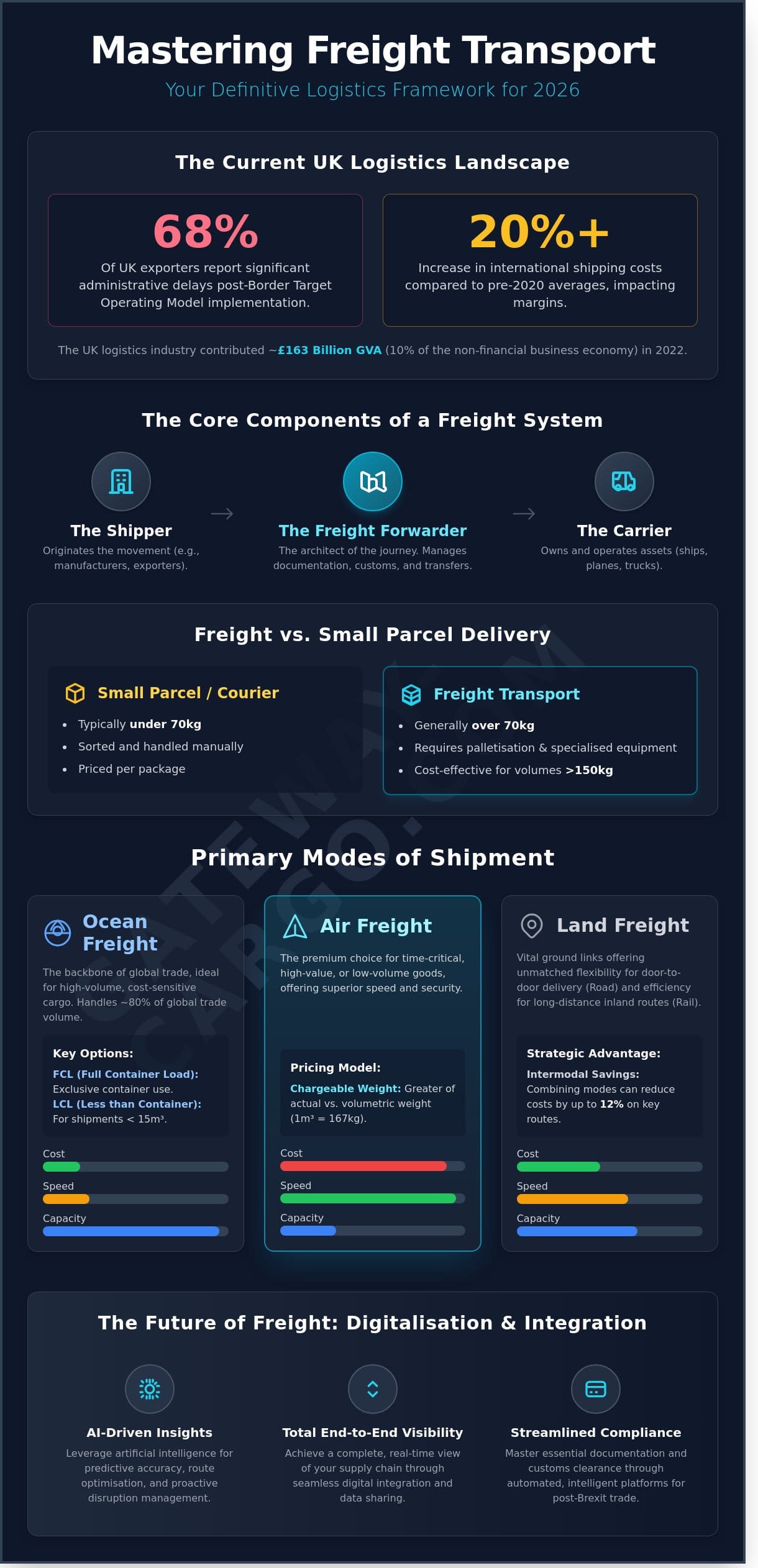
Did you know that 68% of UK exporters reported significant administrative delays following the final phase of the Border Target Operating Model in April 2024? You’ve likely felt the impact of these complexities on your bottom line, especially as international shipping costs remain 20% higher than pre-2020 averages. It’s a challenge to maintain a seamless supply chain when you’re balancing tight margins against the urgent need to meet 2030 sustainability targets. We understand that finding reliable freight transport solutions in this environment requires more than just moving goods; it requires a strategic, data-driven approach.
This guide serves as your definitive reference for mastering logistics in 2026. We’ll provide a clear framework for evaluating the trade-offs between cost and speed, ensuring your cargo moves efficiently across air, ocean, and road networks. You’ll gain the expert knowledge needed to navigate post-Brexit customs with confidence and learn how to integrate AI-driven strategies into your operations. We’re going to break down every essential mode and compliance requirement to help you build a more resilient and profitable business model.
Key Takeaways
- Distinguish between goods and movement to identify the most effective intermodal and multimodal strategies for your specific cargo requirements.
- Optimise your logistics strategy by balancing the trade-offs between speed, cost, and sustainability to build a more resilient supply chain.
- Navigate the complexities of international freight transport by mastering the essential documentation required for efficient customs clearance and compliance.
- Leverage AI-driven insights and digital integration to achieve total end-to-end visibility and predictive accuracy for your 2026 operations.
Defining Freight Transport in the Modern Economy
Freight transport describes the physical process of moving commodities, merchandise, and bulk goods across global supply chains. While these terms are often used interchangeably, professional logistics requires a clear distinction. ‘Freight’ refers to the actual goods or cargo being moved; ‘transport’ is the mechanical act of relocation via road, rail, sea, or air. In the UK, this sector is a cornerstone of national stability. The logistics industry contributed approximately £163 billion in Gross Value Added (GVA) to the UK economy in 2022. This figure represents roughly 10% of the UK’s non-financial business economy, underlining its role in maintaining trade fluidity.
Achieving seamless logistics isn’t just a technical requirement for modern enterprises. It’s a fundamental driver of business growth. When a supply chain is optimised, it reduces lead times and frees up working capital. Companies that master their freight transport strategies can respond to market shifts with greater agility, ensuring that products reach the end consumer without unnecessary friction or cost overruns.
The Core Components of a Freight System
A functional freight system relies on three primary pillars to ensure goods move from point A to point B without delay:
- The Shipper: This is the party that originates the movement. They’re typically manufacturers, wholesalers, or exporters who require their products to reach a customer or a secondary facility.
- The Carrier: These are the companies that own and operate the physical assets. This includes container ships, cargo aircraft, and heavy goods vehicles (HGVs). They’re responsible for the actual custody of the cargo during transit.
- The Freight Forwarder: Acting as the architect of the journey, the forwarder organises the end-to-end process. They manage the complex documentation, customs clearance, and intermodal transfers required to keep cargo moving across borders.
Freight vs. Small Parcel Delivery
The distinction between courier services and freight transport is defined by weight, volume, and handling requirements. Most carriers classify a shipment as freight once it exceeds 70kg. Beyond this weight, items usually require palletisation to ensure stability and safety during transit. Unlike small parcels that are sorted manually, freight requires specialised equipment. This includes forklifts, dock levellers, and 20-foot or 40-foot shipping containers.
Businesses typically transition from courier services to freight when their shipping volumes reach a specific scale. If a company regularly ships more than 150kg of goods to a single destination, moving to a palletised freight model often reduces the cost per unit. This transition allows for better protection of high-value stock and more predictable delivery windows within a professional B2B framework.
Primary Modes of Shipment: Air, Ocean, and Land
Effective supply chain management relies on four primary pillars: sea, air, road, and rail. Each mode offers distinct advantages regarding speed, cost, and reliability. Choosing the right method directly influences a business’s liquidity; for example, air freight accelerates inventory turnover while ocean freight might tie up capital for 30 to 45 days during transit. Intermodal transport is the use of two or more modes in a single journey without handling the freight itself. Strategic mode selection, alongside multimodal logistics, helps specialists bridge geographical gaps and reduce overall freight transport costs by up to 12% on specific international lanes.
Ocean Freight: The Backbone of International Trade
Ocean vessels handle approximately 80% of global trade volume. High-volume cargo finds its most economical route through this mode. Shippers choose between Full Container Load (FCL) for exclusive container use, and Less than Container Load (LCL) for smaller volumes. LCL is typically the better financial choice for shipments under 15 cubic metres. Proximity to major UK hubs like the Port of Felixstowe reduces drayage costs and improves schedule reliability for businesses across the country.
Air Freight: Speed and High-Value Cargo
When goods are time-critical or carry a high value-to-weight ratio, air cargo is the standard. Air cargo provides enhanced security for electronics and pharmaceuticals, which reduces the risk of theft or damage during transit. Carriers calculate costs based on “chargeable weight,” the greater of actual weight or volumetric weight. A common industry ratio is 1:6000, meaning one cubic metre equals 167kg. Chargeable weight ensures that light, bulky items are priced fairly against dense cargo.
Road and Rail: The Vital Ground Links
Road freight provides unmatched flexibility for door-to-door delivery across the UK. Lorries serve as the primary mode for “last-mile” logistics, ensuring goods reach their final destination efficiently. Conversely, rail freight has grown in popularity for long-haul land transport due to its efficiency:
- Sustainability: Moving goods by rail can reduce carbon emissions by up to 76% compared to heavy goods vehicles.
- Capacity: A single freight train can replace approximately 76 lorries, significantly easing road congestion.
- Reliability: Fixed schedules avoid the traffic delays common on the UK’s motorway network.
Companies looking to optimise their freight transport often integrate rail for its sustainability and consistent transit times.
Strategic Evaluation: Speed, Cost, and Environmental Impact
Balancing the “Logistics Triangle” requires a precise trade-off between lead times, expenditure, and carbon output. For many UK businesses, the assumption that sustainable freight transport carries a prohibitive price tag is outdated. Data from 2023 indicates that optimising routes through AI-driven digital strategies can reduce fuel consumption by up to 15%, directly lowering both costs and emissions simultaneously.
Bespoke solutions are essential. A high-value electronics shipment requires a different Incoterm and speed profile compared to seasonal retail stock. Our specialists use predictive analytics to determine which mode serves your specific product category best, ensuring capital isn’t unnecessarily tied up in slow-moving transit. It’s about finding the “sweet spot” where efficiency meets economy.
Cost Analysis of Freight Modes
Direct costs like port fees and fuel surcharges are only the surface. Shippers must account for indirect expenses, including insurance premiums and warehousing. In 2024, the cost of capital tied in transit averages 0.5% to 1.5% of total cargo value per month. Looking ahead to the 2026 market, we anticipate price volatility driven by UK Emissions Trading Scheme (ETS) adjustments. Budgeting for these shifts now prevents margin erosion later.
- Direct Costs: Ocean freight rates (currently averaging £1,800 to £3,200 for 40ft containers on key routes) and terminal handling charges.
- Indirect Costs: Inventory carrying costs and potential delay penalties that impact liquidity.
Sustainability as a Competitive Advantage
Environmental responsibility is now a regulatory necessity. The UK’s Streamlined Energy and Carbon Reporting (SECR) framework means large shippers must disclose their carbon footprint. Transitioning to EV vehicles for final-mile road freight transport isn’t just a “green” choice; it avoids London’s ULEZ charges and similar clean air zone fees in Birmingham and Bristol. These savings add up quickly for high-frequency shippers.
Green Corridors are emerging as vital infrastructure. These specific routes, such as the zero-emission maritime routes planned for the North Sea, allow businesses to claim verified emission reductions. This transparency builds trust with consumers and partners alike. It transforms a logistical necessity into a powerful brand asset that secures long-term contracts.
Navigating Complexity: Documentation and Compliance
Customs clearance remains the single most common bottleneck in international freight transport, often accounting for 35% of total transit delays. Success depends on the precision of three essential documents: the Bill of Lading, the Commercial Invoice, and the Packing List. Discrepancies as small as a mismatched weight on a Packing List can lead to HMRC inspections that hold cargo for 7 to 10 days. Incoterms 2020 remain the global standard for defining the risk and responsibility between buyers and sellers. Expert freight forwarders act as the vital link here, managing these administrative hurdles to ensure goods don’t languish at the border.
Understanding Incoterms and Liability
Common terms like FOB, CIF, and DDP dictate where liability shifts. Selecting the wrong term often results in unexpected costs; for instance, a buyer using DDP without a UK EORI number might find themselves unable to reclaim the 20% import VAT. Even with “guaranteed” carriers, cargo insurance is non-negotiable. Standard carrier liability under the Hague-Visby Rules often limits compensation to approximately £2 per kilogram, which rarely covers the full value of high-tech or luxury goods.
The Customs Clearance Process
Classification is the foundation of compliance. Every item needs an HS (Harmonised System) code, which determines the duty rate. In the UK, the Customs Declaration Service (CDS) requires 10-digit commodity codes for imports. Accuracy is vital because a single misclassification can trigger back-dated duty payments and fines reaching £2,500 per entry. Proactive classification helps mitigate the risk of port congestion at hubs like Felixstowe, where inspection queues can grow by 15% during peak seasonal surges.
Optimise your supply chain with our bespoke freight solutions today.
The Future of Freight: Digitalisation and Integration
The global logistics market is moving beyond simple transport. By 2025, more than 80% of logistics providers plan to implement some form of AI-driven route planning to combat rising fuel costs and urban congestion. This shift isn’t just about speed; it’s about precision. Predictive maintenance now allows operators to identify vehicle faults 72 hours before a breakdown occurs, which significantly reduces the risk of delays. This level of foresight ensures that freight transport remains uninterrupted, protecting your margins and your reputation.
A smarter supply chain relies on total data integration. When every partner in the chain shares real-time data, the result is a seamless flow of information that matches the physical movement of goods. Recent industry data shows that companies using integrated digital platforms see a 15% improvement in overall equipment effectiveness. By removing silos, businesses can react to port strikes or weather disruptions in minutes rather than days.
AI and Digital Strategy in Logistics
Real-time tracking has evolved. Modern systems don’t just tell you a vessel’s coordinates in the Atlantic; they provide a precise delivery window for the final mile. This end-to-end visibility allows UK businesses to reduce safety stock levels by up to 12% because they can rely on accurate arrival data. Digital platforms have also removed the friction from booking. What once required dozens of emails now happens through automated interfaces, reducing administrative overheads by an average of £4,500 per month for mid-sized firms.
Data is also identifying hidden inefficiencies in warehousing and distribution. By analysing throughput patterns, AI can suggest layout changes that reduce picking times by 20%. These incremental gains are essential for maintaining a competitive edge in a high-cost environment.
Choosing a Forward-Looking Logistics Partner
Fleet size used to be the primary metric for choosing a provider. Today, a partner’s digital infrastructure and commitment to sustainability are equally vital. In 2024, 60% of UK shippers prioritised “green” logistics and tech-readiness in their procurement processes. You need bespoke solutions that adapt to your specific requirements, rather than rigid, one-size-fits-all services that fail to account for market volatility.
Gateway Cargo provides this flexibility, combining deep industry expertise with modern digital strategies. Our focus on “Seamless Logistics for a Smarter Supply Chain” means we don’t just move cargo; we optimise your entire approach to global trade. Optimise your freight transport with the specialists at Gateway Cargo to ensure your supply chain is resilient and ready for the future.
Future-Proof Your Supply Chain Strategy
Effective freight transport is the backbone of the UK economy, but staying competitive in 2024 requires a shift toward intelligent, data-led operations. Success relies on balancing the immediate demands of speed and cost against the long-term necessity of regulatory compliance and environmental impact. Industry data shows that AI-integrated logistics can improve delivery accuracy by over 12%, making it a vital tool for modern businesses. It’s not just about moving cargo; it’s about creating a transparent flow that adapts to global market shifts.
Gateway Cargo offers the technical edge your business needs to excel. We’ve developed an AI-driven digital logistics strategy to streamline complex routes and provide actionable insights. Our team champions proactive sustainability by providing EV vehicle options, ensuring your operations align with the UK’s 2050 Net Zero targets. We provide bespoke solutions for air, ocean, and road that are tailored to your specific commercial requirements.
Discover bespoke freight solutions for your business and start optimising your logistics today. We’re ready to help you navigate the future with confidence.
Frequently Asked Questions
What is the difference between freight and cargo?
Freight refers to the commercial transport of goods by road, rail, air, or sea, whereas cargo typically describes the goods themselves while in transit by ship or aircraft. Our specialists view freight as the overall service and cargo as the physical consignment. Most UK logistics firms use these terms interchangeably; however, freight often carries a specific financial connotation regarding the transport fee paid to the carrier.
How do I calculate the cost of freight transport?
You calculate the cost of freight transport by evaluating the chargeable weight, which is the greater of the actual weight or volumetric weight. For a standard 1,200mm x 1,000mm UK pallet, carriers apply a specific rate per mile plus a fuel surcharge, which averaged 14% in early 2024. Additional costs include £50 to £150 for customs entries and any specific Incoterm obligations like insurance or port handling fees.
What are the most common documents needed for international freight?
International shipments require three core documents: the commercial invoice, the packing list, and the Bill of Lading or Air Waybill. Since the UK left the EU single market in 2021, you’ll also need an EORI number and a Customs Declaration (C88). These documents ensure your goods clear HMRC inspections without delays. We recommend keeping digital copies for at least 6 years to satisfy UK tax and audit requirements.
How long does ocean freight take compared to air freight?
Ocean freight from China to the UK typically takes 35 to 45 days, while air freight completes the same journey in 5 to 8 days. This 80% reduction in transit time comes at a higher price point, making air freight ideal for high-value electronics or urgent stock. For shorter routes, such as London to Warsaw, road freight often matches air speed within a 72-hour window at lower costs.
What is intermodal transport and why is it used?
Intermodal transport involves moving goods in a single loading unit, like a 40-foot container, using two or more modes of transport without handling the freight itself. It’s used to optimise supply chain efficiency and reduce carbon emissions by up to 30% compared to road-only routes. By combining rail for long-haul legs and HGV for final-mile delivery, businesses achieve a smarter balance between cost, speed, and environmental impact.
How can I make my freight transport more sustainable?
You can make your freight transport more sustainable by switching to HVO (Hydrotreated Vegetable Oil) fuel, which reduces CO2 emissions by up to 90%. Gateway Cargo also utilises EV vehicles for urban deliveries within London’s Ultra Low Emission Zone to eliminate tailpipe pollutants. Consolidating smaller shipments into Full Container Loads (FCL) further reduces the carbon footprint per tonne by 15% compared to multiple smaller journeys.
What does a freight forwarder actually do?
A freight forwarder acts as an expert intermediary between the shipper and various transportation services to coordinate the movement of goods. We manage the entire logistics chain, from booking space on vessels to negotiating rates and handling complex customs documentation. By leveraging our global network, we provide bespoke solutions that ensure your consignments arrive on time while you focus on your core business operations.
Is rail freight faster than road freight for long distances?
Rail freight is often slower than road freight for distances under 500 miles, but it offers superior reliability and speed on transcontinental routes. A freight train can travel from China to the UK in 18 to 22 days, which is twice as fast as sea freight. While a single HGV is more flexible for door-to-door delivery, rail moves 76% more volume per journey, making it a smarter choice for bulk movements.