
Freight Shipping Services: A Complete Guide for Businesses
Navigating the complexities of logistics-from deciphering acronyms like LTL and FCL to avoiding unforeseen costs and customs delays-is a significant challenge for any UK business. An incorrect choice can lead to inflated costs, damaged goods, and significant operational disruption. However, with the right knowledge, selecting the optimal freight shipping services becomes a strategic advantage, ensuring your goods move efficiently and predictably across the country or around the globe.
This comprehensive guide is designed to demystify the process. We will explore the different types of freight shipping available, from road and rail to sea and air, providing the clarity you need to make informed decisions. Our goal is to empower you with the confidence to select the most efficient and cost-effective solution for your specific business requirements, transforming a complex logistical challenge into a seamless part of your supply chain.
Key Takeaways
- Utilise a practical 5-factor framework to assess your shipment’s unique requirements, ensuring you select the most efficient and cost-effective transport solution.
- Distinguish between the core freight modes-Road, Air, and Ocean-to align your shipping strategy with your specific budget and delivery timelines.
- Explore how modern freight shipping services extend beyond transport to include value-added solutions like customs clearance and warehousing, safeguarding your goods.
- Understand the strategic advantages of partnering with a freight forwarder, who acts as a logistics specialist to optimise your entire shipping process.
What Are Freight Shipping Services? A Foundation for Your Business
At its core, freight shipping is the process of transporting large or bulk quantities of goods domestically or internationally by land, sea, or air. Unlike sending a small package, this service is designed for substantial commercial shipments that form the critical links in a company’s supply chain. The physical process of moving these commodities, known as Freight transport, is the engine of global commerce, enabling businesses to source materials and deliver finished products to markets worldwide. Engaging with professional freight solutions is not merely a logistical choice; it is a strategic decision that directly impacts operational efficiency, cost management, and customer satisfaction.
Freight vs. Parcel: Understanding the Distinction
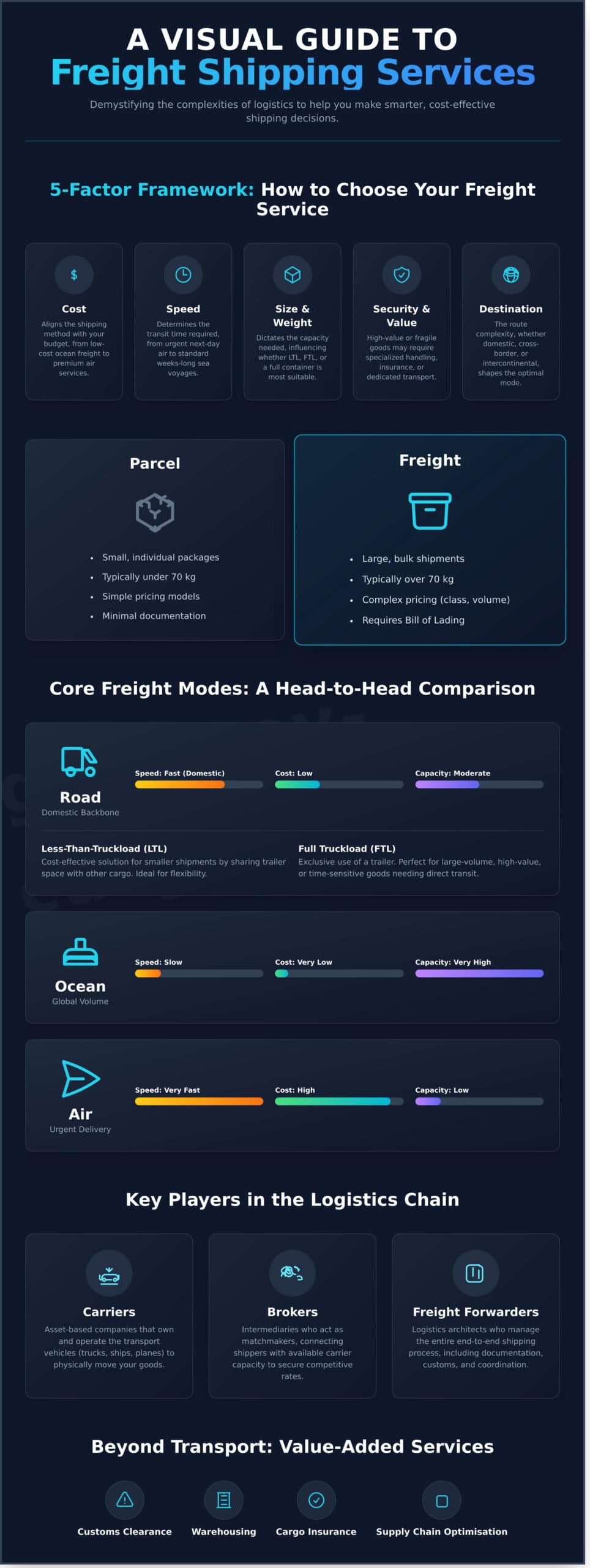
The primary difference between freight and standard parcel shipping lies in size and weight. While parcel services handle small, individual packages, freight is reserved for shipments typically exceeding 70 kg. Think of it as the difference between mailing a single shoebox versus transporting an entire pallet of them. This scale difference fundamentally changes the handling, pricing, and documentation. Freight shipments are often palletised, requiring specialised equipment like forklifts, and are priced based on factors like freight class and volume, whereas parcels use simpler models. The required documentation, such as a Bill of Lading for freight, is also far more comprehensive.
Key Roles in the Freight Industry
Navigating the logistics landscape involves understanding the specialists who facilitate the movement of your goods. Each plays a distinct role in creating a seamless transit from origin to destination.
- Carriers: These are the asset-based companies that physically own and operate the transport vehicles. This includes shipping lines managing ocean vessels, haulage companies with fleets of lorries, and airlines with cargo planes.
- Brokers: A broker acts as an intermediary, connecting a shipper that has goods to move with a carrier that has available capacity. They are matchmakers who leverage their network to find competitive rates, primarily in the road freight sector.
- Freight Forwarders: Forwarders are the logistics architects for your supply chain. They manage the entire shipping process from end-to-end, arranging transport with multiple carriers, handling all documentation and customs clearance, and providing a single point of contact.
For any business operating on a regional or global scale, leveraging professional freight shipping services is essential for success. A reliable logistics partner optimises your supply chain, mitigates risks, and ensures your goods arrive securely and on schedule, providing the foundation for sustainable growth.
Core Types of Freight Shipping: Exploring Your Options
Navigating the world of logistics begins with understanding the fundamental modes of transport available. The optimal choice depends entirely on your specific requirements for speed, cost, and cargo volume. The three primary modes-Road, Air, and Ocean-form the foundation of global supply chains. Often, these are combined into an intermodal solution to provide seamless door-to-door delivery. Selecting the right combination is crucial for optimising your logistics strategy. For a broader look at how these elements fit together, this Guide to Freight Shipping Services offers valuable industry insights.
To simplify the decision-making process, consider this high-level comparison:
| Mode | Speed | Cost | Capacity |
|---|---|---|---|
| Road Freight | Fast (Domestic) | Low | Moderate |
| Ocean Freight | Slow | Very Low | Very High |
| Air Freight | Very Fast | High | Low |
Road Freight: The Backbone of Domestic Shipping
Road freight is the most flexible and widely used method for domestic and cross-border transport within the UK and into Europe. It provides essential final-mile delivery for nearly all shipments. Key options include:
- Less-Than-Truckload (LTL): Ideal for smaller shipments that do not require a full trailer, offering a cost-effective solution by sharing space with other cargo.
- Full Truckload (FTL): Provides exclusive use of a trailer, perfect for large-volume, high-value, or time-sensitive shipments that require direct transit.
Ocean Freight: The Global Trade Workhorse
As the most economical of all freight shipping services, ocean freight is indispensable for international trade. It is the preferred solution for transporting large, heavy, or non-urgent goods across continents. The primary services are:
- Less-Than-Container-Load (LCL): Your cargo is consolidated with other shipments in a single container, allowing you to pay only for the space you use.
- Full-Container-Load (FCL): You secure the exclusive use of a standard 20′ or 40′ container, offering greater security and faster transit times than LCL.
Air Freight: For Speed and High-Value Goods
When speed is the critical factor, air freight is the unparalleled choice. While it represents the highest cost per kilogram, it is justified for time-sensitive, perishable, or high-value goods where transit time directly impacts value. Different service levels, from express to standard, allow for a balance between speed and budget. Air freight is the optimal solution for urgent stock replenishments, medical supplies, and luxury products where supply chain velocity is paramount.
How to Choose the Right Freight Service: A 5-Factor Framework
Selecting the optimal freight shipping services is a critical business decision that directly impacts your supply chain’s efficiency and cost-effectiveness. There is no single “best” option; the right choice depends entirely on the unique requirements of your cargo. This practical framework outlines five key factors to consider, enabling you to make an informed and strategic decision for every shipment.
Factor 1 & 2: Speed and Budget
The core trade-off in logistics is often between transit time and cost. You must determine the urgency of your shipment against your budget constraints. The hierarchy is straightforward:
- Air Freight: The fastest option, ideal for time-sensitive, high-value, or perishable goods. It comes at the highest cost.
- Ocean Freight: The most economical choice, especially for large volumes. It has the longest transit times, requiring careful planning.
- Road/Rail Freight: A flexible and balanced option for domestic UK and cross-channel European shipments, offering a middle ground on speed and price.
Factor 3 & 4: Shipment Size and Goods Type
The physical characteristics of your cargo are a decisive factor. Shipment volume and weight determine whether you require a Full Container Load (FCL) or a Less than Container Load (LCL) service. Beyond size, the nature of your goods dictates handling protocols. Perishable items may require refrigerated containers, hazardous materials demand strict compliance with safety regulations, and fragile goods need specialised packing and stowage. These requirements will guide your selection of carrier and service level.
Factor 5: Origin and Destination
The geographical journey of your shipment fundamentally defines your options. The different modes of freight transport are each suited to specific distances and infrastructure. While a domestic UK delivery will rely on our robust road and rail networks, an international shipment from Asia will almost certainly utilise ocean freight. Furthermore, the accessibility of the final destination matters. Congested ports or remote inland locations can impact transit times and costs, making an experienced logistics partner invaluable. Let our specialists find the optimal solution for your shipment.
Beyond Transportation: Value-Added Freight Services
In today’s complex global market, premier freight shipping services extend far beyond the simple port-to-port movement of containers. A truly effective logistics partner provides an integrated suite of services designed to optimise your entire supply chain. These value-added solutions mitigate risk, enhance operational efficiency, and provide the end-to-end visibility necessary for strategic decision-making. They transform a series of separate logistical tasks into a single, seamless, and intelligently managed process.
Customs Clearance and Compliance
Navigating UK customs is a critical stage where delays and errors can prove costly. Our specialist customs brokerage services ensure your shipments comply with all HMRC regulations. We manage the precise preparation and submission of all necessary documentation, handle duty and VAT calculations, and facilitate timely clearance. A minor compliance error can lead to significant fines, storage charges, and supply chain disruption, making expert management an invaluable asset.
Warehousing and Distribution
An effective logistics strategy often requires more than direct delivery. We offer flexible warehousing and distribution solutions that create a smarter supply chain. These services include:
- Short-term and long-term storage in secure, strategically located facilities.
- Comprehensive inventory management systems for full visibility.
- Order fulfilment services, including pick-and-pack and final-mile distribution across the UK.
By integrating warehousing into your freight plan, you can optimise stock levels and improve delivery times to your end customers.
Cargo Insurance and Risk Management
It is crucial to understand the difference between carrier liability and comprehensive cargo insurance. Carrier liability is often minimal, legally limited by international conventions, and may not cover the full value of your goods. Cargo insurance, however, protects your financial interest against loss or damage up to the full commercial value of your shipment. Investing in proper insurance is a fundamental component of a robust risk mitigation strategy, providing peace of mind and financial security. To learn more about our integrated solutions, visit gateway-cargo.com.
Why Partner with a Freight Forwarder for Your Shipping Needs?
Many businesses initially ask, “Why not go directly to a carrier?” While this may seem like a direct route, it often bypasses the strategic value and operational efficiency that a logistics partner provides. A freight forwarder is not merely a middleman; they are an integrated logistics architect, managing the immense complexity of global shipping on your behalf. They function as a dedicated extension of your team, focused on optimising your entire supply chain.
Expertise and Problem-Solving
Navigating the global trade landscape requires deep, specialist knowledge. A freight forwarder brings critical expertise to ensure your shipments are compliant, cost-effective, and on schedule. This includes:
- Regulatory Navigation: Expertly managing complex UK and international customs declarations, tariffs, and post-Brexit trade requirements to avoid costly fines and delays.
- Proactive Management: Anticipating and resolving potential disruptions such as port congestion, carrier delays, or customs holds before they impact your business operations.
- Strategic Advice: Providing expert guidance on optimising shipping routes, choosing between FCL and LCL, and balancing transit times with costs.
Network and Cost-Efficiency
Freight forwarders leverage their extensive networks and significant shipping volumes to deliver advantages that individual businesses cannot access alone. Their established relationships with multiple ocean carriers translate directly into more competitive pricing and greater flexibility. This means you gain access to a wider range of sailing schedules and service levels, ensuring your freight shipping services are perfectly aligned with your budget and timeline. For businesses with smaller consignments (LCL), forwarders also provide cost-effective consolidation solutions.
A Single Point of Contact
Coordinating with ocean carriers, haulage companies, customs agents, and warehouses creates a significant administrative burden. A freight forwarder simplifies this entire process into one seamless relationship. You gain a dedicated specialist responsible for your shipment from origin to final destination, providing end-to-end visibility through a unified tracking platform. This streamlined communication saves valuable time and eliminates the friction of managing multiple vendors, allowing you to focus on your core business.
Ready to simplify your global logistics? Discover how a partnership with Gateway Cargo can optimize your supply chain.
Optimise Your Supply Chain with a Strategic Freight Partner
Mastering your business logistics begins with a clear understanding of your options. As we’ve explored, selecting the appropriate mode of transport and service level is a critical decision that directly impacts your efficiency and bottom line. However, navigating the complexities of freight shipping services requires more than just knowledge; it demands a strategic partner dedicated to optimising your supply chain.
At Gateway Cargo, our specialists work as an extension of your team to design and implement these strategies. By leveraging our global network of vetted carriers, in-house customs clearance expertise, and technology that provides end-to-end supply chain visibility, we deliver reliable and intelligent logistics solutions. Ready to move forward with confidence? Request a Consultation for Your Bespoke Freight Solution and let us help you build a more resilient and efficient future for your business.
Frequently Asked Questions
What is the difference between a freight forwarder and a carrier?
A carrier is a company that physically owns and operates the transport assets, such as the ships, aircraft, or lorries used to move goods. In contrast, a freight forwarder is a logistics specialist that orchestrates the entire shipment on your behalf. We act as your single point of contact, procuring space with optimal carriers, managing complex documentation, and coordinating the end-to-end journey to ensure a seamless and efficient supply chain solution for your business.
How are freight shipping costs and rates calculated?
Freight shipping costs are determined by several key factors. The primary elements are the shipment’s chargeable weight (the greater of its actual or volumetric weight), the distance and route, and the mode of transport. Additional costs include fuel surcharges, port handling fees, customs clearance charges, and insurance. Our specialists provide transparent, all-inclusive quotes in British Pounds (£) that consolidate these variables, giving you a clear understanding of your total logistics expenditure.
What is a freight class and why is it important for LTL shipping?
While the formal “freight class” system is specific to the US, the principle of density-based pricing is crucial for Less-than-Truckload (LTL) or groupage road freight in the UK and Europe. Cargo is categorised based on its density, handling requirements, and stowability. This classification directly impacts the shipping rate; less dense, bulkier items typically incur a higher cost per kilogram. Correct classification is vital for accurate quoting and avoiding unexpected fees.
Do I need to purchase cargo insurance for my shipment?
Yes, we strongly recommend purchasing dedicated cargo insurance. A carrier’s liability is legally limited by international conventions and will rarely cover the full commercial value of your goods in the event of loss or damage. All-risk cargo insurance protects your financial investment against unforeseen events during transit. It is an essential risk management tool that provides comprehensive financial protection and peace of mind for your valuable shipments, ensuring your supply chain remains secure.
What documents are required for international freight shipping?
For international shipments involving the United Kingdom, several documents are essential. The core requirements include a Commercial Invoice, a detailed Packing List, and a Bill of Lading (for ocean freight) or an Air Waybill. Depending on the commodity and trade route, a Certificate of Origin or specific import/export licences may also be necessary. A valid UK EORI number is mandatory for all businesses. Our specialists manage this documentation to ensure seamless customs compliance.
How can I track my freight shipment?
Gateway Cargo provides a sophisticated digital platform for tracking your consignments. This technology is a core component of our freight shipping services, offering clients complete, real-time visibility from origin to destination. Through our secure client portal, you can monitor key milestones, access shipping documents, and receive predictive ETAs. This centralised data stream allows for proactive management and helps you optimise your supply chain with reliable, up-to-the-minute information.