
How to Reduce Shipping Costs for Small Business: A Strategic 2026 Guide
According to the 2024 Pitney Bowes Parcel Shipping Index, average shipping costs per parcel rose by 5.6% due to carrier surcharges and aggressive annual rate adjustments. You’ve likely noticed your profit margins shrinking as these costs climb; it’s a common challenge when you’re trying to figure out how to reduce shipping costs for small business without the volume leverage of global competitors. Managing the complexity of international customs and hidden fees often feels like a heavy burden on your operations. We agree that your business deserves a smarter, more predictable supply chain that doesn’t penalize your growth.
This strategic guide provides a clear roadmap to optimise your logistics by leveraging professional expertise and modern freight forwarding solutions. You’ll learn how to lower your overheads through bespoke consolidation strategies, AI-driven route planning, and a deeper understanding of intermodal freight modes. We’ll explore how to transform your logistics from a source of uncertainty into a streamlined competitive advantage for 2026. Our specialists have designed these insights to help you regain control over your margins and build a more resilient future.
Key Takeaways
- Identify the core drivers of 2026 transport inflation and learn why transitioning from parcel shipping to scalable freight models is essential for protecting your margins.
- Master the relationship between volumetric weight and final invoices to discover how to reduce shipping costs for small business through precision packaging audits.
- Evaluate the cost-efficiency of Air, Ocean, and Road modes, focusing on LCL (Less than Container Load) as a strategic tool for high-frequency cargo.
- Eliminate hidden overheads by mastering Incoterms and customs protocols to avoid unexpected destination charges and costly storage demurrage.
- Secure exclusive contract rates and supply chain stability by evolving from spot-market transactions to collaborative partnerships with expert logistics specialists.
Understanding the 2026 Logistics Landscape: Why Small Business Shipping Costs are Rising
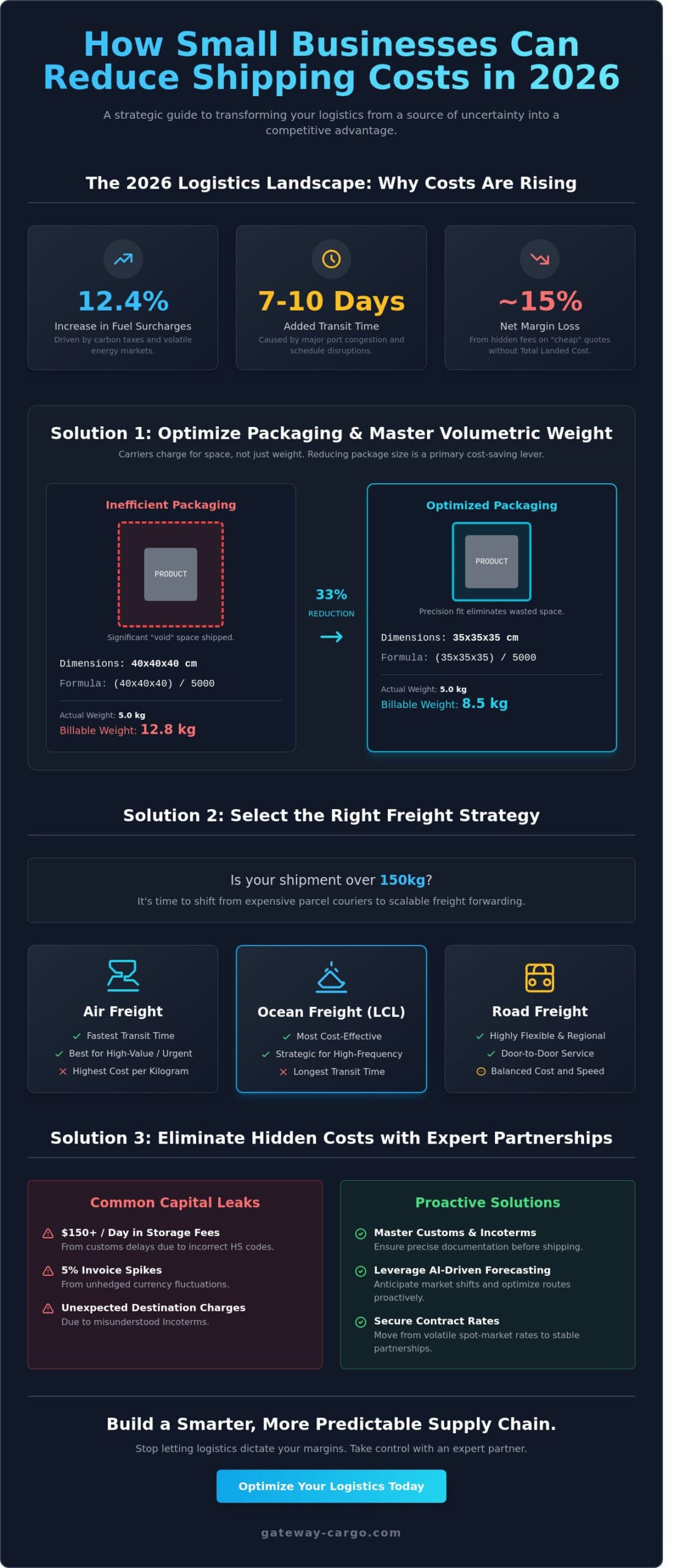
By early 2026, global transport inflation remains a primary concern for SMEs. Fuel surcharges have increased by an average of 12.4% compared to 2024 levels, driven by new maritime carbon taxes and fluctuating energy markets. Port congestion in major hubs like Singapore and Rotterdam continues to disrupt schedules, often adding seven to ten days to standard transit times. These delays don’t just stall inventory; they inflate operational expenses through increased holding costs and emergency restocking fees. Learning how to reduce shipping costs for small business starts with recognizing these external pressures. Traditional parcel shipping often becomes a margin killer during rapid scaling because courier rates don’t scale linearly with weight or volume. High volume courier fees eat away at profits that should be reinvested in growth.
To protect your bottom line, you must calculate the Total Landed Cost. This metric includes the purchase price, freight, insurance, duties, and local handling fees. Without this holistic view, a “cheap” quote often results in a 15% loss in net margin once the final invoice arrives at your warehouse. A professional partner provides the stability needed to manage this global volatility, acting as an expert extension of your internal team to maintain cost predictability.
The Shift from Parcel to Freight
Small businesses often reach a tipping point where courier services become unsustainable for their budget. Scaling beyond 150kg per shipment usually triggers the need for international shipping services. Standard parcel carriers lack the volume-based pricing models required for consistent bulk growth. Freight forwarding is a strategic service that aggregates volume to secure lower rates for SMEs. Utilizing this approach moves your business away from retail-rate shipping toward wholesale logistics. It transforms shipping from a reactive expense into a managed, predictable asset.
Hidden Costs in the Supply Chain
Invisible leaks drain capital from your business daily. Customs delays due to incorrect HS codes can result in storage fees exceeding $150 per day per container in major international ports. Currency fluctuations add another layer of risk, potentially increasing international invoices by 5% overnight if not hedged correctly. Our Smarter Supply Chain methodology identifies these leaks before they occur. Professional specialists use AI-driven data to forecast these shifts, ensuring that documentation is precise and routes are optimized for cost. Implementing this proactive strategy is essential for anyone looking for how to reduce shipping costs for small business in a volatile market.
Optimising Physical Logistics: Packaging and Volume Management
Small businesses often overlook the hidden costs of shipping air. Physical logistics optimisation is a primary lever for how to reduce shipping costs for small business in 2026. If your packaging isn’t precise, you’re paying for volume you don’t use. Carriers prioritise space efficiency, meaning the physical dimensions of your parcel often matter more than its actual mass. Efficient volume management ensures you only pay for the space your product requires.
The Science of Volumetric Weight
Carriers use a specific formula to determine billable weight, typically length x width x height divided by a volumetric divisor, such as 5,000 for international air freight. This means a lightweight but bulky item can be billed at a much higher rate than its scale weight suggests. For instance, a box measuring 40x40x40cm has a volumetric weight of 12.8kg. If the product inside weighs only 5kg, you’re still invoiced for 12.8kg.
Reducing each dimension by just 5cm to a 35x35x35cm box drops the billable weight to 8.5kg. Over a shipment of 1,000 units, this 33% reduction in billable volume prevents significant capital leakage. Choosing 200gsm recycled corrugated cardboard offers a sustainable, lightweight alternative that maintains structural integrity without the weight penalties of traditional heavy-duty materials.
- Measure the “void” or empty space in every standard box size currently in your inventory.
- Implement variable-depth boxes to eliminate the need for excessive dunnage and filler.
- Switch from heavy wooden pallets to lightweight honeycomb paper or plastic alternatives for air freight.
- Audit 32 ECT (Edge Crush Test) materials to ensure you aren’t over-packaging and adding unnecessary grams.
Bespoke packaging does more than save space; it acts as a preventative measure against cargo damage. Custom inserts ensure products remain stationary during transit, which directly reduces the frequency of insurance claims and costly reverse logistics. Data from 2024 industry reports suggests that right-sizing packaging can reduce damage rates by up to 18%.
Consolidation Strategies for SMEs
Individual LCL (Less than Container Load) shipments are often inefficient for growing brands. Buyer’s consolidation allows you to group orders from multiple suppliers into a single FCL (Full Container Load). This strategy can reduce terminal handling charges by approximately 25% compared to multiple smaller shipments. Our bespoke freight solutions help SMEs identify these consolidation opportunities to streamline their international arrivals.
Strategic warehousing also plays a role in how to reduce shipping costs for small business. By holding stock in distribution centres closer to high-density customer hubs, you reduce the “last mile” distance. While this may increase inventory holding costs by 12% to 15%, the savings on long-haul shipping fees and improved delivery speeds typically result in a net profit increase for the fiscal year.
Strategic Freight Selection: Choosing the Right Mode for Your Cargo
Selecting the right transportation mode is a primary lever when determining how to reduce shipping costs for small business. Each mode offers a distinct balance of speed, cost, and reliability. Road freight remains the backbone of regional distribution, while international trade relies on the strategic interplay between air and ocean routes. Understanding these nuances allows you to align your logistics spend with your specific business model.
LCL vs FCL: The Small Business Dilemma
Small businesses often struggle to fill an entire shipping container. Less than Container Load (LCL) allows you to pay only for the specific space you use. A professional freight forwarder manages this through co-loading, where they consolidate your cargo with other shipments to fill a single container. This shared cost model makes global trade accessible for smaller volumes without the overhead of unused space.
Full Container Load (FCL) isn’t just for massive corporations. If your shipment exceeds 15 cubic metres (CBM), FCL often becomes more economical. Even if the container isn’t 100% full, the flat rate for a 20-foot unit can be lower than the aggregate CBM fees of LCL. FCL also offers enhanced security and faster transit times because your goods aren’t handled at multiple consolidation hubs. This reduces the risk of damage and eliminates the time spent waiting for other shipments to be deconsolidated at the port of arrival.
Air Freight vs Ocean Freight: Balancing Speed and Spend
The choice between air and sea depends on your product margins and inventory cycles. While air freight is typically 4-5 times more expensive than ocean freight, it can reduce warehousing costs by enabling a Just-In-Time inventory model. In 2026, air freight is strategically reserved for high-margin electronics, pharmaceuticals, or emergency stock replacements. For standard inventory replenishment, ocean freight remains the primary tool to optimise your logistics budget.
Intermodal logistics combines different modes, such as rail and road, to move cargo from ports to final destinations. This approach is vital for reducing “last-mile” expenses, which can account for up to 53% of total shipping costs in certain supply chains. By moving cargo by rail for the longest leg of the journey, businesses can lower their carbon footprint and their overall spend. Implementing these intermodal solutions is a proven method for how to reduce shipping costs for small business in a volatile market where fuel prices fluctuate frequently.
- LCL: Best for shipments between 1 and 12 CBM to keep costs proportional to volume.
- FCL: Economical for shipments over 15 CBM or for high-value goods requiring extra security.
- Air Freight: Use only for time-critical or high-margin items to avoid eroding profit.
- Intermodal: Leverage rail-to-road transitions to cut last-mile delivery fees by up to 20%.
Reducing Hidden Costs: Customs, Incoterms, and Digital Strategy
Hidden fees often represent the difference between a profitable quarter and a deficit. While base freight rates are easy to compare, destination charges and administrative penalties frequently catch smaller operators off guard. Understanding how to reduce shipping costs for small business requires a shift from reactive booking to proactive supply chain management. This involves auditing every stage of the journey, from the legal terms of sale to the digital tools used for tracking.
Mastering Incoterms for Better Margins
Choosing the right Incoterm is a primary lever for cost control. Many small businesses default to Delivered Duty Paid (DDP) because the seller handles everything. However, this convenience comes with a hidden markup. Sellers often add a 10% to 15% buffer to cover their own risk and administrative effort. By switching to FCA (Free Carrier) or FOB (Free On Board), you gain direct control over the carrier selection and the actual freight spend.
Taking control of your logistics allows you to consolidate shipments and negotiate directly with forwarders. It’s vital to understand your specific freight transport obligations to avoid paying twice for the same service. Managing the process yourself eliminates the “black box” pricing associated with DDP and ensures you aren’t subsidizing the supplier’s logistics profit margins.
Leveraging AI and Digital Tools
Digital transformation isn’t just for global conglomerates. In 2026, AI-driven platforms are essential for any business looking at how to reduce shipping costs for small business. These tools automate the quote comparison process, instantly analyzing hundreds of lanes to find the most efficient route. Using digital documentation also reduces administrative labor costs by approximately 30%, as it eliminates manual data entry and reduces human error in customs filings.
- Real-time visibility: Tracking tools prevent “emergency air freight” by alerting you to delays early, allowing for cheaper sea or road alternatives.
- Route optimisation: AI algorithms analyze historical port data to suggest routes that avoid seasonal bottlenecks.
- Automated Insights: Data-driven platforms predict port congestion. During the 2024 supply chain disruptions, businesses using predictive analytics avoided demurrage fees that reached $200 per container per day.
Expert customs clearance is your final line of defense against unexpected costs. Incorrect tariff classifications or missing paperwork lead to storage demurrage and regulatory fines. Our logistics specialists work as part of your team to ensure every declaration is precise. This proactive stance on compliance keeps your cargo moving and your budget intact. By integrating these digital strategies with expert oversight, you transform your supply chain into a leaner, more predictable asset.
Building a Smarter Supply Chain: Collaborative Partnerships and Sustainability
Small businesses often treat logistics as a transactional expense. To truly master how to reduce shipping costs for small business in 2026, you must shift your perspective. A freight forwarder shouldn’t be a mere vendor. They function best as an extension of your internal team. Relying on the spot market for every shipment creates budget volatility. Industry data from 2025 shows that spot market rates can fluctuate by as much as 30% within a single quarter. Long-term partnerships allow SMEs to secure “contract rates.” These fixed agreements provide a buffer against market spikes and ensure your margins remain protected throughout the year.
The Value of Bespoke Logistics Solutions
One-size-fits-all courier services often lead to wasted spend. A tailored strategy identifies efficiencies that generic providers overlook. Having a dedicated account manager means your specialist understands your specific favorite routes and seasonal volume shifts. Gateway Cargo focuses on “Seamless Logistics” for SMEs. This approach integrates specialists directly into your workflow to solve complex challenges. By analyzing your specific shipping patterns, these experts can consolidate shipments or suggest alternative intermodal paths that reduce total landed costs by an average of 12% compared to standard air freight.
Sustainability as a Cost-Saving Tool
Green logistics is now a financial necessity. As carbon taxes become more prevalent in 2026, businesses using traditional high-emission methods face rising operational levies. Utilizing EV vehicles and “green corridors” helps you avoid these penalties. Optimizing routes to reduce emissions also lowers fuel consumption. This creates a direct link between environmental impact and cost stability. Smarter routing doesn’t just save the planet; it saves capital. To audit your current supply chain today, follow these actionable steps:
- Analyze lane data: Identify your top five most frequent routes and request contract pricing to avoid spot market volatility.
- Consolidate shipments: Aim to transition at least 20% of your smaller shipments into larger, consolidated loads to lower per-unit costs.
- Evaluate green options: Ask your provider for a breakdown of EV availability for local distribution to stay ahead of upcoming carbon regulations.
Strategic partnerships and sustainable practices are the final pieces of the cost-reduction puzzle. Efficiency is the result of planning, not luck. It’s about building a supply chain that is resilient enough to handle global shifts while remaining lean enough to protect your bottom line.
Future-Proofing Your 2026 Shipping Strategy
Success in the 2026 logistics market requires a transition from reactive spending to a proactive, data-driven approach. By mastering volume management and strategic freight selection, you’ll protect your margins against the rising operational costs forecasted in the 2026 Global Logistics Report. Implementing a digital strategy and leveraging consolidation are essential steps for maintaining a competitive edge. Understanding how to reduce shipping costs for small business is about integrating efficiency into every stage of the supply chain, from initial packaging to final customs clearance.
Gateway Cargo delivers the expertise you need to streamline these complex operations. We employ an AI-driven digital strategy for route optimisation and provide expert customs clearance to prevent expensive administrative delays. Our team specializes in SME freight consolidation (LCL), ensuring you benefit from shared container space and reduced overheads. You don’t have to navigate these global challenges alone when expert solutions are available to your team.
Request a bespoke freight quote to start reducing your logistics costs today
We’re ready to help you transform your logistics into a seamless, cost-effective engine for growth.
Frequently Asked Questions
How can a small business negotiate better shipping rates?
Small businesses can negotiate better rates by consolidating volume and providing accurate shipping forecasts to their carriers. Carriers often offer discounts ranging from 15% to 35% for accounts that demonstrate consistent volume. Leveraging a freight forwarder’s collective buying power is another effective strategy to access tier-one pricing typically reserved for larger corporations.
What is the cheapest way to ship internationally for a small business?
Ocean freight, specifically Less than Container Load (LCL) shipping, remains the most cost-effective method for international transit. While sea freight takes 20 to 45 days compared to air transport, the cost is often five times lower per kilogram. Utilizing LCL allows SMEs to pay only for the space their cargo occupies within a shared container.
Is it cheaper to use a freight forwarder or a courier like DHL?
It’s generally cheaper to use a freight forwarder for shipments exceeding 100 kilograms, while couriers like DHL are more efficient for small parcels. Couriers operate on a fixed-rate model for door-to-door delivery. Freight forwarders provide bespoke logistics solutions that optimize the entire supply chain, reducing total landed costs for larger or more complex consignments.
How does volumetric weight affect my shipping costs?
Volumetric weight charges you based on the space a package occupies rather than its actual mass. Carriers use a specific divisor, such as 5000 for international air freight, to calculate this figure. If your package is light but bulky, you’ll pay for the larger weight. This is a critical factor when learning how to reduce shipping costs for small business through efficient packaging.
What are the most common hidden fees in international shipping?
Common hidden fees include terminal handling charges (THC), fuel surcharges, and documentation fees. According to 2024 industry reports, these ancillary costs can account for up to 20% of the total freight bill. Businesses should also watch for demurrage and detention charges, which accrue if cargo stays at a port beyond the agreed free time.
Can switching Incoterms really save my business money?
Switching Incoterms can significantly reduce expenses by giving your business more control over the logistics chain. Moving from CIF (Cost, Insurance, and Freight) to FOB (Free on Board) allows the buyer to choose their own carrier and avoid hidden markups often applied by the seller. This shift can lower total transport costs by 15% on average.
How does a freight forwarder help with customs clearance for SMEs?
Freight forwarders act as licensed specialists to ensure all documentation complies with local regulations, preventing costly delays. They manage the Harmonized System (HS) code classification for your goods, which determines the specific duty rate. Correct classification is essential because errors can lead to customs fines or the overpayment of taxes.
Is air freight ever cheaper than ocean freight for small shipments?
Air freight is rarely cheaper than ocean freight, but the price gap narrows for shipments weighing less than 45 kilograms. When considering how to reduce shipping costs for small business, you must factor in the total cost of ownership. Air freight reduces inventory holding costs and insurance premiums, which often offsets the higher transport rate for urgent, high-value goods.