
Sustainable Logistics Provider: Navigating Green Supply Chains in 2026
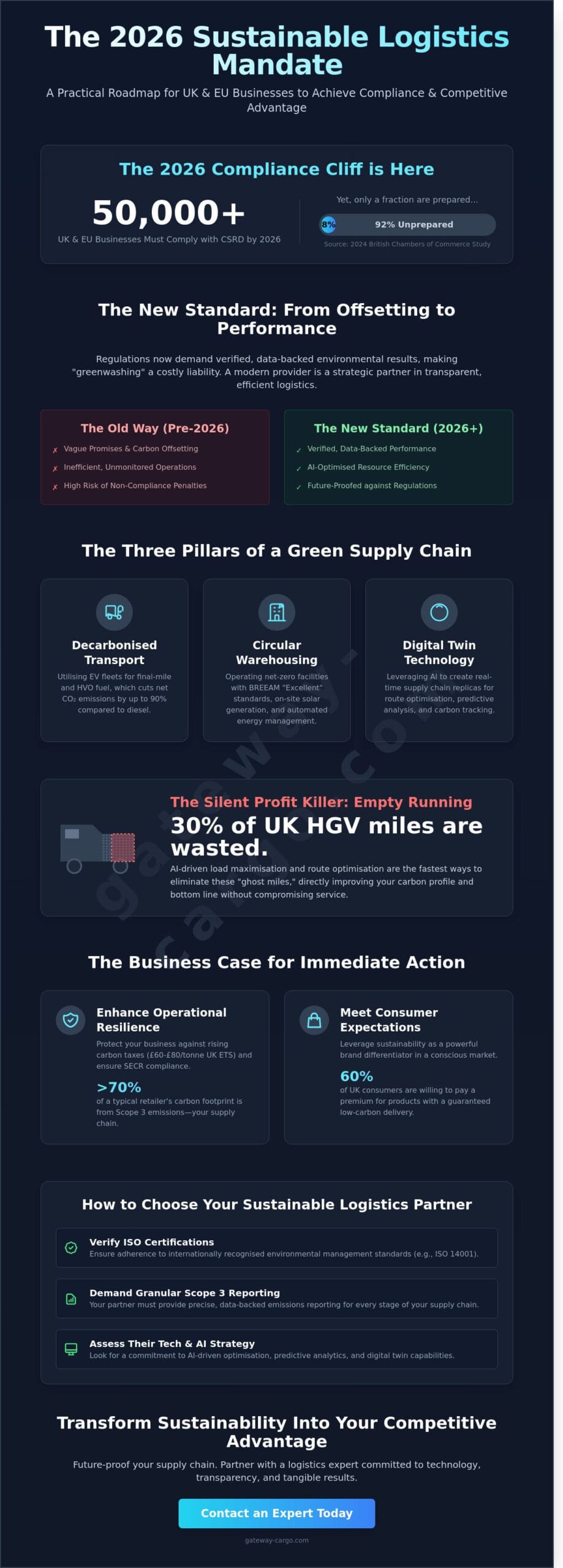
By 2026, over 50,000 UK and EU businesses will be required to comply with the Corporate Sustainability Reporting Directive (CSRD), yet a 2024 study by the British Chambers of Commerce revealed that only 8% of firms currently track their full carbon footprint. You’re likely facing the dual challenge of meeting these strict Scope 3 mandates while managing the premium costs associated with green fuel alternatives. It’s a complex shift, especially when the price gap between traditional diesel and electric freight often strains your quarterly budgets. Choosing a reliable sustainable logistics provider has become a vital strategic move to protect both your reputation and your profit margins.
We believe that environmental responsibility should strengthen your business rather than hinder it. This article delivers a practical roadmap to transform your supply chain into a sustainable competitive advantage using AI-driven route optimisation and smarter intermodal shifts. You’ll learn which transport modes provide the most effective carbon-to-cost ratios and how to implement the transparent reporting that UK regulators now demand. We’ll explore the specific technological partnerships and alternative fuel strategies that will define the industry as we move toward 2026.
Key Takeaways
- Understand the shift from basic carbon offsetting to verified, data-backed environmental performance to future-proof your supply chain for 2026.
- Explore how AI-driven route optimisation and electric vehicle fleets can significantly reduce fuel consumption and eliminate inefficient empty miles.
- Evaluate the carbon intensity of different transport modes to effectively balance lead times and costs against your corporate net-zero targets.
- Learn how to rigorously audit a sustainable logistics provider using ISO certifications and advanced digital reporting for Scope 3 emissions.
- Discover how to integrate bespoke green solutions and AI-driven digital strategies to transform sustainability into a long-term competitive advantage.
What is a Sustainable Logistics Provider in 2026?
By 2026, the definition of a What is a Sustainable Logistics Provider has evolved from a niche preference to a rigorous regulatory requirement. It’s no longer acceptable to rely on simple carbon offsetting to mask inefficient operations. A modern sustainable logistics provider integrates environmental performance into every facet of the supply chain, moving beyond vague promises to deliver verified, data-backed results. This shift marks the end of “greenwashing” as UK and EU regulations now demand granular transparency. A provider in 2026 acts as a strategic consultant, ensuring your freight moves through a network designed for minimum environmental impact and maximum resource efficiency.
2026 represents a definitive turning point for global supply chains. The UK’s Sustainability Disclosure Requirements (SDR) and the EU’s Corporate Sustainability Due Diligence Directive (CSDDD) have moved from proposal to full implementation. These frameworks mean that 75% of large UK enterprises now require precise emissions data from their transport partners to avoid heavy financial penalties. Choosing a sustainable logistics provider isn’t just an ethical choice; it’s a move to protect your bottom line against the rising costs of the UK Emissions Trading Scheme (UK ETS), where carbon prices have historically fluctuated around £60 to £80 per tonne.
The Core Components of Green Logistics
The foundation of a green supply chain rests on three pillars that combine physical hardware with digital intelligence. In road transport, the focus has shifted heavily toward electrification and the use of Hydrotreated Vegetable Oil (HVO), which can reduce net CO2 emissions by up to 90% compared to standard diesel. By 2026, electric HGVs are becoming a common sight in UK urban centres as businesses race to meet Clean Air Zone requirements.
- Decarbonised Transport: Utilising hydrogen fuel cells for long-haul and battery-electric vehicles for final-mile delivery.
- Circular Warehousing: Facilities now utilise BREEAM “Excellent” standards, incorporating on-site solar generation and automated energy management systems to reach net-zero status.
- Digital Twin Technology: Using AI to create digital replicas of supply chains, allowing for real-time carbon tracking and the optimisation of routes to eliminate “empty running” miles.
Why Your Business Needs a Sustainable Partner Now
The business case for sustainability has shifted from brand reputation to operational resilience. Scope 3 emissions, which encompass all indirect emissions in a company’s value chain, often account for more than 70% of a retailer’s total footprint. Without a partner capable of providing accurate Scope 3 reporting, your business risks non-compliance with the Streamlined Energy and Carbon Reporting (SECR) framework.
Consumer expectations have also reached a tipping point. Recent 2025 market data indicates that 60% of UK consumers are willing to pay a premium for products with a guaranteed low-carbon delivery history. By partnering with an expert logistics specialist, you future-proof your operations against upcoming port levies and tightening emissions standards, ensuring that your supply chain remains both competitive and compliant in an increasingly regulated global market.
The Technology Driving Sustainable Freight Forward
Technology serves as the backbone for any modern The Technology Driving Sustainable Freight initiative, turning abstract environmental goals into measurable operational gains. Logistics firms now utilise Internet of Things (IoT) sensors to monitor load factors in real time, ensuring no vehicle leaves a warehouse with wasted capacity. This focus on load factor maximisation directly targets the “empty running” problem. In 2023, Department for Transport statistics showed that empty running accounted for roughly 30% of all HGV kilometres in the UK. Eliminating these “ghost miles” is the fastest way to improve a supply chain’s carbon profile without compromising service levels.
AI and Digital Strategy in Logistics
Predictive analytics now prevents logistical bottlenecks before they manifest at port terminals or distribution centres. By analysing historical traffic patterns and weather data, a sustainable logistics provider can select the most efficient “green corridor” for every shipment. AI-optimised logistics is a tool that reduces emissions by up to 15% through smarter routing. These digital frameworks also incorporate blockchain technology to provide transparent, immutable tracking for carbon credits. This ensures that every offset purchased is backed by verifiable data, providing the audit trail that stakeholders now demand. Choosing a sustainable logistics provider that invests in these digital assets is essential for long-term compliance.
Modern Hardware: From EVs to Sustainable Aviation Fuel (SAF)
Decarbonising the physical movement of goods requires a shift in propulsion technology. In the UK, the adoption of 44-tonne electric HGVs is accelerating as battery density improves. Trials like the Zero Emission HGV and Infrastructure Demonstrator (ZEHID) programme are currently validating these vehicles for long-haul use. Urban last-mile delivery has already transitioned significantly. Electric van fleets now dominate deliveries within London’s Ultra Low Emission Zone, reducing local NOx emissions to zero.
For longer distances, Sustainable Aviation Fuel (SAF) remains the primary lever for reducing air cargo footprints. SAF can reduce lifecycle CO2 emissions by up to 80% compared to traditional jet fuel. The UK government’s mandate requiring 10% SAF in the fuel mix by 2030 is already driving investment in this sector. Simultaneously, short-sea shipping across the English Channel is seeing increased investment in hybrid and battery-powered vessels. These ships reduce fuel consumption during port manoeuvres and coastal transit. To see how these technologies integrate into your operations, you can explore bespoke freight solutions tailored for the 2026 regulatory environment.
Comparing Transport Modes: Balancing Speed, Cost, and Carbon
Selecting the right mode of transport is the most direct way to influence a supply chain’s carbon footprint. A recent analysis of trends in sustainable logistics highlights that transport accounts for nearly 90% of a typical logistics provider’s emissions. Businesses must weigh the urgency of delivery against the environmental cost. A sustainable logistics provider doesn’t just move goods; they optimise the route and mode to meet specific carbon targets. This requires a granular understanding of carbon intensity across air, ocean, road, and rail.
Ocean vs Air: The Environmental Divide
Ocean freight remains the benchmark for efficiency, emitting roughly 10 to 40 grams of CO2 per tonne-kilometre. In contrast, air freight can exceed 500 grams. For companies using international shipping services, the choice often depends on cargo value and shelf life. While air is necessary for urgent medical supplies or high-value electronics, shifting just 10% of air volume to sea can reduce total transport emissions by over 30%. Many carriers now adopt ‘slow steaming’—reducing vessel speeds by 2 to 3 knots—to cut fuel consumption by 15% to 20%. The trade-off is a longer lead time, requiring more precise inventory planning.
The Rise of Rail and Road Electrification
Rail serves as a vital middle ground, offering faster transit than sea at a fraction of the carbon cost of road or air. In the UK, rail freight produces 76% less CO2 than the equivalent HGV journey. For the ‘last-mile’, the focus has shifted to road electrification. By 2026, many UK city centres have implemented strict zero-emission zones. Using regional hubs allows a sustainable logistics provider to consolidate cargo and deploy electric vans for final deliveries. This reduces urban congestion and lowers the cost per delivery in the long term.
Balancing these modes requires a cost-benefit analysis that looks beyond the initial freight rate. While low-carbon fuels like HVO (Hydrotreated Vegetable Oil) can cost £0.15 to £0.25 more per litre than standard diesel, they offer up to 90% reduction in net CO2. Intermodal strategies help find the ‘green sweet spot’ by combining modes, such as:
- Sea-Air: Using ocean for the long-haul and air for the final leg to balance cost and speed.
- Rail-Road: Utilizing rail for transcontinental routes and electric vehicles for local distribution.
- Barge-Road: Leveraging UK inland waterways for bulk goods to bypass congested road networks.
It’s clear that sustainable transport often requires a trade-off in lead times. However, the financial impact is increasingly mitigated by carbon taxes and the rising cost of traditional fossil fuels. By 2026, the data shows that businesses prioritising low-carbon modes are better positioned to handle fluctuating energy prices and stricter environmental regulations.
How to Choose and Audit Your Sustainable Logistics Partner
Selecting a sustainable logistics provider is a strategic decision that requires rigorous due diligence. It’s no longer enough to accept broad promises of “green shipping” at face value. In 2026, corporate accountability hinges on verifiable data and infrastructure investment. You need a partner that integrates environmental accountability into every stage of the journey, from initial booking to final mile delivery. Follow these five steps to ensure your partner’s operations align with your ESG targets.
- Step 1: Verify certifications. Look for ISO 14061, which provides a framework for quantifying and reporting greenhouse gas emissions. Request their latest EcoVadis rating; a ‘Gold’ or ‘Platinum’ status indicates they’re in the top 5% of companies evaluated for sustainability.
- Step 2: Assess digital reporting. Scope 3 emissions often account for 90% of a company’s total carbon footprint. Your partner must offer automated, granular reporting that breaks down emissions by shipment, mode, and route.
- Step 3: Evaluate physical assets. Physical infrastructure is the backbone of green logistics. Audit their fleet for electric heavy goods vehicles (HGVs) and check if their distribution centres utilise solar arrays or rainwater harvesting systems.
- Step 4: Audit sub-contractors. A provider is only as green as their weakest link. Ensure they have a strict environmental compliance code for their third-party carriers and sub-contractor networks.
- Step 5: Test for bespoke flexibility. The best partners offer tailored solutions. They should be able to pivot between speed and sustainability, providing slower, lower-carbon routes when your inventory levels allow.
Key Metrics to Track in Your Partnership
To maintain a high-performing supply chain, you must monitor specific KPIs that reflect true environmental impact. These metrics provide the transparency needed for stakeholders and regulatory bodies alike.
- CO2e per tonne-kilometre: This is the industry standard for measuring freight efficiency. It tracks the mass of greenhouse gases emitted per tonne of cargo transported over one kilometre.
- Load utilisation rates: Moving half-empty containers is inefficient and costly. Aim for a partner that maintains utilisation rates above 85% through smart consolidation.
- Renewable energy percentage: Track the proportion of electricity sourced from renewable providers across their UK warehousing and distribution hubs.
Questions to Ask During the Tender Process
During the procurement phase, use these targeted questions to separate leaders from laggards. These queries test the depth of their commitment and the technical accuracy of their data.
- How do you calculate and verify your carbon savings data to ensure it meets the latest UK government reporting standards?
- What is your specific roadmap for achieving Net Zero, and does it include interim targets for 2030 and 2035?
- Can you provide a freight forwarder perspective on multi-modal green options, such as shifting road freight to rail or short-sea shipping?
Finding a sustainable logistics provider that matches your corporate values is the first step toward a resilient supply chain. If you’re ready to optimise your operations with data-driven green solutions, contact our specialists today to discuss your bespoke requirements.
Bespoke Green Solutions with Gateway Cargo
Gateway Cargo doesn’t treat environmental responsibility as an optional extra. We integrate sustainability into every bespoke freight solution we design for our partners. By 2026, the requirement for low-carbon transport has evolved into a regulatory necessity. We utilise AI-driven digital strategies to identify the most efficient routes, which has helped our clients reduce empty running by up to 15% across UK road networks. This smarter approach ensures your goods move with precision while minimising wasted fuel.
Our commitment to your goals is backed by physical infrastructure. We’ve invested significantly in an EV fleet for final-mile deliveries within major UK urban centres, including London’s Ultra Low Emission Zone. By utilising designated green corridors and intermodal shifts, we help your business reduce its local environmental impact. Choosing Gateway Cargo as your sustainable logistics provider means your cargo moves through a network designed for the future.
Transparency remains the foundation of our service. We provide the granular insights you need for your annual sustainability reports and SECR compliance. Our digital platform tracks Scope 3 emissions with high accuracy, giving you a clear view of the carbon intensity of every shipment. We believe that data-driven decisions are the only way to achieve genuine decarbonisation in the supply chain.
Why Gateway Cargo is Your Forward-Thinking Partner
Our logistics specialists work as an extension of your team to optimise every shipment. We understand that your reputation depends on reliability. Our focus on “Seamless Logistics” ensures that moving toward eco-friendly methods doesn’t increase operational complexity. You’ll find updates on the latest green regulations and global logistics volatility in our supply chain news today. We ensure your business stays ahead of legislative changes before they impact your bottom line.
Getting Started with a Greener Supply Chain
Transitioning to a more sustainable logistics provider requires a structured, data-led approach. We don’t expect you to change your entire model overnight. Instead, we conduct a baseline carbon audit of your current logistics to identify high-impact areas for improvement. Our team then develops a phased transition plan tailored to your specific industry requirements. This plan often includes:
- Shifting heavy long-haul freight from road to rail to reduce emissions per tonne-kilometre.
- Implementing smart consolidation strategies to increase vehicle fill rates.
- Utilising sustainable aviation fuel (SAF) options for time-critical international shipments.
Every business has unique challenges and environmental targets. Contact our specialists today for a tailored consultation. We’ll help you define a roadmap that aligns your logistics operations with your corporate green goals.
Future-Proofing Your Supply Chain for 2026 and Beyond
The transition toward a carbon-neutral economy isn’t a distant goal; it’s a current operational requirement for UK businesses aiming to meet 2050 Net Zero targets. Success in 2026 depends on integrating AI-driven route optimisation to slash unnecessary mileage and deploying an EV fleet for urban distribution to navigate increasing Clean Air Zone restrictions. Transparency is equally vital. Companies now require detailed Scope 3 carbon reporting to satisfy both regulatory bodies and stakeholders who demand measurable environmental accountability.
Selecting the right sustainable logistics provider means finding a partner that treats your environmental goals as their own. Gateway Cargo delivers these capabilities through bespoke freight strategies that don’t compromise on speed or reliability. By leveraging 2026 technology today, you’ll reduce your carbon footprint while maintaining a competitive edge in the UK market. It’s time to transform your distribution model into a lean, green, and highly efficient operation.
Optimise your supply chain with our sustainable logistics solutions today.
Frequently Asked Questions
What exactly makes a logistics provider ‘sustainable’ in 2026?
In 2026, a sustainable logistics provider is defined by its commitment to net-zero operations through electrified fleets and carbon-neutral warehousing. These providers utilise 100% renewable energy and maintain a fleet where at least 40% of heavy goods vehicles (HGVs) run on hydrogen or electric power. They provide real-time carbon visibility, allowing clients to track emissions at a granular level for every shipment across the United Kingdom.
Is sustainable logistics significantly more expensive for small businesses?
Sustainable logistics doesn’t always carry a premium; in fact, route optimisation can reduce fuel consumption by up to 15%. While Sustainable Aviation Fuel (SAF) can cost 3 to 5 times more than traditional jet fuel, many carriers offer “book and claim” systems that allow small businesses to contribute smaller amounts. UK businesses often find that the long-term savings from improved efficiency and reduced waste offset the initial £50 to £200 increase in monthly administration fees.
How do I report Scope 3 emissions from my freight forwarding activities?
You report Scope 3 emissions by calculating the indirect greenhouse gas output from your entire value chain, including all outsourced transport. Under the UK’s Streamlined Energy and Carbon Reporting (SECR) framework, you must use the Greenhouse Gas Protocol standards. A professional sustainable logistics provider will supply you with verified data sets, typically delivered in a standardised GLEC framework format, to ensure your annual reports are audit-ready.
Can air freight ever be considered a sustainable transport option?
Air freight remains the most carbon-intensive mode, but it’s becoming more sustainable through the adoption of Sustainable Aviation Fuel (SAF) and next-generation electric cargo planes. By 2026, many UK-based carriers aim to use 10% SAF blends, which can reduce lifecycle emissions by up to 80% compared to fossil fuels. It’s best used selectively for high-value goods where speed is critical, paired with carbon removal credits to balance the remaining impact.
What are ‘green corridors’ in international shipping?
Green corridors are specific trade routes between major port hubs, such as the route between the Port of Dover and Calais, that support zero-emission shipping. These corridors provide the necessary infrastructure, including bunkering for green ammonia or electric charging points for vessels. By 2026, the UK government’s Clean Maritime Plan aims to have at least six of these corridors operational to accelerate the decarbonisation of global trade lanes.
How does AI help in reducing the carbon footprint of my deliveries?
AI reduces your carbon footprint by processing millions of data points to find the most fuel-efficient routes and maximise vehicle load factors. Predictive analytics can decrease “empty running”, which is when trucks drive without cargo, by 20% across UK road networks. These smarter algorithms ensure that every mile driven contributes to the delivery, directly lowering the total CO2e per parcel and improving the overall efficiency of your supply chain.
What certifications should I look for in a green logistics partner?
You should look for ISO 14001 for environmental management and the B Corp certification, which evaluates a company’s total social and environmental impact. In the UK, a reputable sustainable logistics provider should also be a member of the Smart Freight Centre and adhere to the GLEC Framework for emissions accounting. These credentials prove that the partner meets the rigorous 2026 standards for transparency and carbon reduction.