
FCA Incoterm Explained: A Complete Guide to Free Carrier
In the complex landscape of global logistics, selecting the appropriate Incoterm is a critical decision that directly impacts cost, risk, and responsibility. Uncertainty over who is liable for transport costs, customs clearance, or the exact moment risk transfers can lead to unforeseen expenses and disputes. The Free Carrier (FCA) Incoterm is a versatile and widely-used rule, particularly for containerised freight, but its nuances must be fully understood to avoid potential liabilities.
This definitive guide delivers the clarity required to master the FCA rule. We provide a complete breakdown of buyer and seller responsibilities, identify the specific points of risk transfer, and draw clear comparisons to other terms like EXW and FOB. By understanding these critical details, you can confidently choose the right Incoterm, accurately calculate costs, and execute smoother, more predictable transactions for your UK-based and international shipments.
Key Takeaways
- Clearly define your obligations by understanding that the seller’s responsibility ends precisely when goods are delivered to the buyer’s nominated carrier.
- Mitigate disputes and financial risk by specifying the ‘named place’ in your agreement, as this dictates the exact point of risk transfer.
- Optimise your shipping strategy by comparing the fca Incoterm with alternatives like EXW and FOB to select the most suitable rule for your cargo.
- Ensure seamless transit and customs clearance by mastering the specific documentation and communication protocols essential for FCA shipments.
What is FCA (Free Carrier)? The Official Definition in Shipping
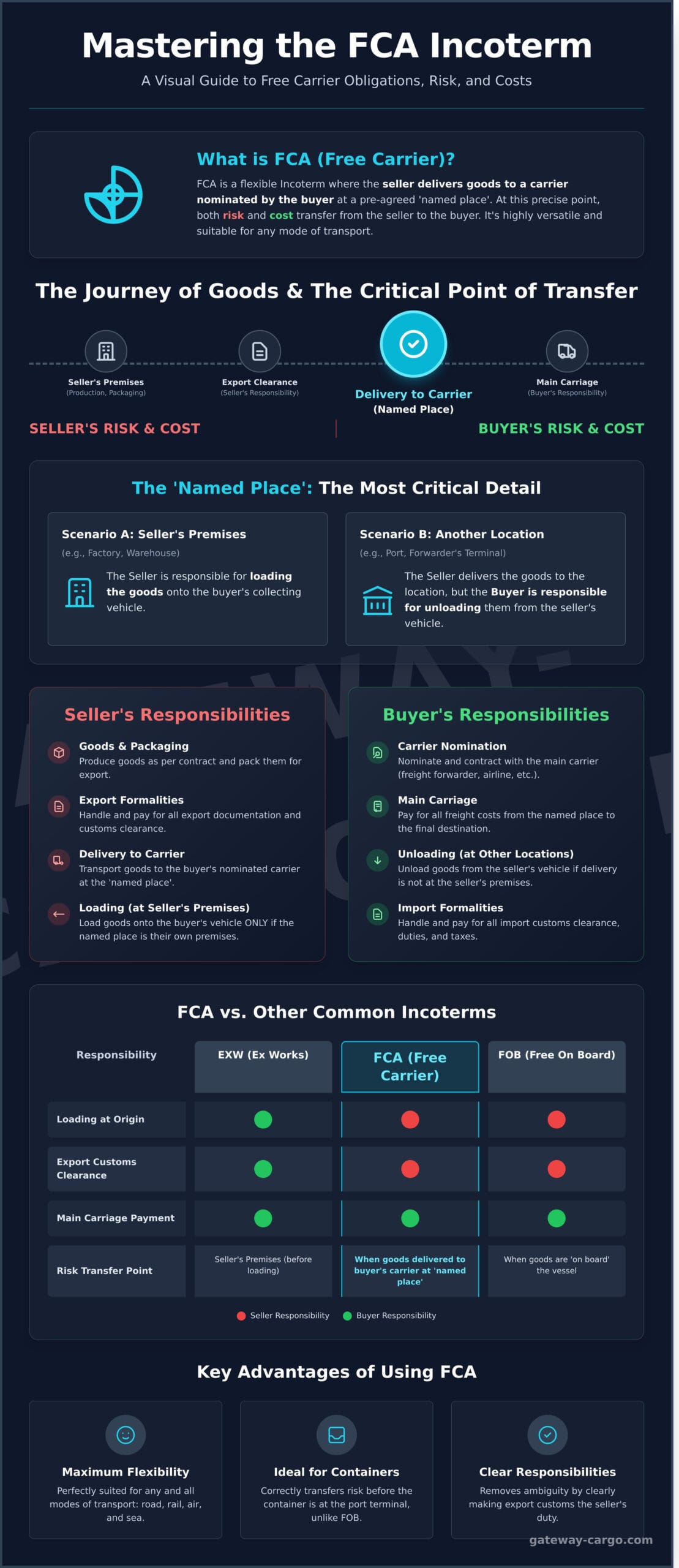
In the precise language of international trade, FCA stands for ‘Free Carrier’. It is one of the 11 official Incoterms® rules published by the International Chamber of Commerce (ICC) to provide a universal framework for global shipping contracts. The core principle of the FCA (Free Carrier) rule is straightforward: the seller is responsible for delivering the goods to a carrier nominated by the buyer at a pre-agreed location, known as the ‘named place’.
This named place is a critical detail in any FCA agreement. It could be the seller’s own premises (like a factory or warehouse) or another location, such as a freight forwarder’s terminal or an airport. The transfer of risk from the seller to the buyer occurs at the exact moment the goods are delivered to this carrier. Once the carrier has taken possession, the buyer assumes all subsequent risks and costs for the remainder of the journey.
The Role of FCA in Incoterms 2020
As part of the latest Incoterms 2020 revision, FCA is recognised for its significant flexibility. Unlike more restrictive terms, it can be utilised for any mode of transport, including road, rail, air, and sea, or any combination thereof. Its adaptability has led to its increasing popularity as a modern, practical alternative to traditional terms like FOB (Free On Board) and EXW (Ex Works), offering greater clarity and a more logical distribution of responsibilities in contemporary logistics.
Why is FCA a Flexible and Widely Used Term?
The widespread adoption of the fca term is due to its robust application in modern supply chains. It is particularly well-suited for containerized ocean freight, as it correctly assigns risk transfer before the container is loaded at the port terminal, a key advantage over FOB. The rule excels in multimodal transport scenarios-for example, when goods are collected by truck from a UK factory and delivered to a railhead for onward transit. Furthermore, it clearly designates export clearance as the seller’s duty, removing ambiguity and providing a secure, documented handover.
Seller vs. Buyer: A Clear Breakdown of Obligations Under FCA
Understanding the precise division of responsibilities is fundamental to the successful application of any Incoterm. For FCA (Free Carrier), this division is marked by a single, critical event: the delivery of goods to the buyer’s nominated carrier at the agreed-upon ‘named place’. At this exact point, the majority of risk and cost transfers from the seller to the buyer. This clarity is a core strength of the term, defined precisely within the official Incoterms® 2020 rules published by the International Chamber of Commerce.
To ensure a seamless transaction, both parties must have a complete understanding of their respective duties. Below, we outline the specific obligations for both the seller and the buyer when operating under the fca term.
The Seller’s Responsibilities
The seller’s duties are focused on preparing the goods and facilitating their handover for the main leg of the journey. The seller is responsible for all costs and risks up to the point of delivery to the buyer’s carrier.
- Goods and Packaging: Producing the goods as per the sales contract and ensuring they are packed appropriately for export and transport.
- Export Formalities: Handling and paying for all export documentation and customs clearance formalities required in the country of origin, including any necessary export licenses or pre-shipment inspections.
- Delivery to Carrier: Transporting the goods to the buyer’s nominated carrier at the agreed ‘named place’ of delivery on the agreed date or within the agreed period.
- Loading: If the named place is the seller’s own premises (e.g., their factory or warehouse), the seller is responsible for loading the goods onto the buyer’s collecting vehicle. This is a key distinction from other locations.
The Buyer’s Responsibilities
Once the goods are handed over to their nominated carrier, the buyer assumes control, risk, and subsequent costs. The buyer’s responsibilities cover the main international transit and final delivery.
- Carrier Nomination: Nominating and contracting with the main carrier (such as a freight forwarder, shipping line, or airline) to transport the goods from the named place.
- Main Carriage: Paying for all freight costs associated with the main carriage from the point of delivery onwards to the final destination.
- Unloading: If delivery occurs at any location other than the seller’s premises (e.g., a port terminal or freight forwarder’s warehouse), the buyer is responsible for unloading the goods from the seller’s vehicle.
- Import Clearance: Managing and paying for all import customs clearance formalities, duties, and taxes (like VAT) upon arrival in the United Kingdom.
- Insurance: Arranging and paying for cargo insurance to cover the goods during the main transit. While not mandatory under FCA, it is a highly recommended measure to mitigate risk.
The ‘Named Place’: The Most Critical Detail in an FCA Agreement
Within any Free Carrier (FCA) agreement, no detail carries more weight than the ‘named place of delivery’. This specific location, designated in the sales contract, determines the precise point where the responsibility for the goods-and the associated risks and costs-transfers from the seller to the buyer. This nuance is the most common source of misunderstanding and costly disputes in FCA transactions. The flexibility of the rule allows for two distinct scenarios, and failing to specify which one applies can lead to significant operational and financial liabilities.
Understanding the distinction is fundamental to optimising your supply chain and mitigating risk. The named place dictates not only where the handover occurs but also which party is responsible for the critical loading and unloading procedures.
Scenario 1: Delivery at the Seller’s Premises
When the named place is the seller’s own location, such as their factory or warehouse, the seller’s obligations are clear. They are responsible for loading the goods onto the transport vehicle provided by the buyer’s nominated carrier. Once the goods are safely loaded onto that truck, the delivery is complete, and all risk transfers to the buyer.
- Example: FCA, Seller’s Warehouse, 123 Industrial Rd, Shanghai.
- Risk Transfer Point: As soon as the cargo is loaded onto the buyer’s collecting vehicle.
Scenario 2: Delivery at Another Location
Alternatively, the parties may agree on another named place, such as a port terminal, an airport, or a freight forwarder’s warehouse. In this case, the seller is responsible for arranging and paying for the transport to deliver the goods to this location. However, their responsibility ends when their vehicle arrives at the named place. The seller is not responsible for unloading the goods from their truck. The risk transfers to the buyer when the goods are on the seller’s vehicle at the destination, ready for unloading by the buyer’s carrier.
- Example: FCA, Gateway Cargo Warehouse, Port of Felixstowe.
- Risk Transfer Point: When the seller’s truck arrives at the named warehouse, with the goods available for unloading.
To prevent disputes over damaged goods or unexpected charges, the sales contract must be explicit. A vague term like “FCA Manchester” is insufficient. Is it the seller’s depot in Manchester or a forwarder’s terminal? As detailed in the International Trade Administration guide to Incoterms, precision is paramount. Specifying the full address and the exact point of delivery is the only way to ensure both parties have a clear, shared understanding of their obligations.
FCA vs. Other Incoterms: A Practical Comparison for Shippers
Selecting the correct Incoterm is a critical decision that directly impacts your shipment’s cost, risk, and control. While Free Carrier (FCA) offers significant advantages in flexibility and clarity, understanding how it compares to other common terms is essential for optimising your logistics strategy. This comparison clarifies the key distinctions in risk and responsibility to help you make an informed choice for your supply chain.
FCA vs. EXW (Ex Works)
Under Ex Works (EXW), the seller has the minimum possible obligation: to make the goods available at their own premises, such as a factory or warehouse. From that point, the buyer is responsible for all subsequent tasks, including loading the goods and managing all export documentation and procedures. This arrangement can present significant challenges and costs for a UK-based buyer importing goods, as they are tasked with navigating complex export regulations in a foreign country. FCA is a more practical and secure solution, as it places the responsibility for export clearance and loading onto the seller, who is better positioned to handle these local requirements efficiently.
FCA vs. FOB (Free On Board)
The distinction between FCA and Free On Board (FOB) is one of the most crucial in modern shipping, particularly for containerized freight. The primary difference lies in the precise point where risk transfers from the seller to the buyer.
- FCA (Free Carrier): Risk transfers when the goods are delivered to the carrier at a pre-agreed location, such as the container yard (CY) at the port of departure.
- FOB (Free On Board): Risk transfers only once the goods are physically loaded ‘on board’ the vessel.
While this may seem like a minor difference, it has major implications. A container can sit at a terminal for days before being loaded, where it is vulnerable to damage. If damage occurs at the terminal under FOB terms, it creates a contentious liability gap. For this reason, the fca rule is the officially recommended Incoterm for all containerized transport. It provides a clear, unambiguous point of handover that aligns with the operational realities of modern container logistics. FOB remains suitable, but primarily for non-containerized bulk cargo like grain or oil.
Choosing the right Incoterm is fundamental to a seamless supply chain. For expert guidance on applying the best terms for your specific shipments, contact our logistics specialists.
Practical Tips and Documentation for Using FCA
Understanding the theoretical framework of any Incoterm is essential, but successful implementation depends on mastering the practical details. Moving from theory to real-world application of the fca rule requires a focus on precise documentation and clear communication to prevent costly delays and disputes. By addressing common pain points proactively, both shipper and buyer can ensure a smooth and efficient transaction.
Bills of Lading and On-Board Notation
A significant update in Incoterms 2020 directly addresses a common issue for sellers using Letters of Credit. Buyers can now instruct their carrier to issue a Bill of Lading (B/L) with an “on-board” notation to the seller after the goods are loaded. This is critical for sellers who need to present this specific document to a bank to get paid. Crucially, this option must be explicitly agreed upon by both parties in the sales contract.
Insurance and Risk Management
Under FCA terms, neither the seller nor the buyer is obligated to arrange insurance for the main leg of the journey. However, since risk transfers to the buyer once the goods are delivered to the nominated carrier, it is imperative for the buyer to secure comprehensive cargo insurance. This policy should provide cover from the moment of delivery at the named place. Failing to do so exposes the buyer to the full financial risk of cargo loss or damage during transit.
Communication is Key
Seamless execution of an FCA shipment is impossible without clear and timely communication between the seller, the buyer, and the nominated carrier. Ambiguity is the enemy of an optimised supply chain. To ensure clarity:
- The Buyer Must: Provide the seller with clear and complete instructions regarding the nominated carrier, including contact details, location, and required delivery times.
- The Seller Must: Notify the buyer as soon as the goods have been delivered to the carrier and provide the commercial invoice and any other documentation required for the buyer to arrange main carriage and import customs clearance.
Navigating these documentary and communication requirements is where expertise makes a difference. Let our experts manage your FCA shipments seamlessly.
Optimise Your Shipments with the FCA Incoterm
Mastering the Free Carrier Incoterm is a strategic advantage for any business engaged in international trade. As we have explored, its flexibility across multiple transport modes and the clear demarcation of responsibilities make it a powerful tool for shippers. The most critical element remains the precise definition of the ‘named place,’ as this single detail dictates the exact point where risk and cost transfer from seller to buyer. A comprehensive understanding of the FCA rule is therefore fundamental to mitigating potential disputes and controlling expenditure within your supply chain.
While this guide provides a solid foundation, applying these rules effectively requires specialist expertise. At Gateway Cargo, our logistics specialists are experts in all Incoterms 2020 rules, utilising a vast global network to provide seamless freight management. We are committed to delivering bespoke solutions for your air, ocean, and road freight requirements, ensuring your cargo moves efficiently and predictably.
Need expert guidance on Incoterms for your next shipment? Contact Gateway Cargo today.
Empower your business with the right knowledge and partnership to move your freight forward with confidence.
As businesses grow through international trade, their financial needs also evolve. For companies and investors navigating the complexities of the private market, including pre-IPO opportunities, resources from specialists like BGS Capital can provide valuable guidance.
Frequently Asked Questions About FCA
Who pays for freight charges in an FCA shipment?
The buyer is responsible for paying the main freight charges in an FCA shipment. The seller’s obligation is fulfilled once the goods are delivered to the buyer’s nominated carrier at the agreed-upon named place. From that point, all costs associated with the main carriage, whether by air, sea, or road, are borne by the buyer. This arrangement provides the buyer with greater control over their logistics provider and shipping costs.
Is insurance mandatory when using the FCA Incoterm?
No, cargo insurance is not a mandatory requirement for either the buyer or the seller under the FCA Incoterm. However, it is strongly advised. The risk of loss or damage transfers from the seller to the buyer once the goods are in the carrier’s custody. As the buyer bears the risk for the majority of the transit, it is in their best interest to arrange for comprehensive insurance coverage for the shipment from the point of delivery onwards.
What is the main difference between FCA and FOB for container shipping?
The primary difference lies in the point where risk transfers from the seller to the buyer. Under FCA, risk transfers when the seller delivers the goods to the carrier at a named inland point, such as a warehouse or terminal. For FOB (Free On Board), risk only transfers once the goods are loaded on board the vessel. For modern container shipping, FCA is often the more appropriate term as it accurately reflects the handover of a container to the carrier at the terminal, before it is loaded onto the ship.
Can FCA be used for all modes of transport, including air and sea?
Yes, FCA is a highly versatile Incoterm designed for use across all modes of transport. This includes road, rail, air, and sea freight, making it an excellent choice for multimodal shipments. This flexibility is a key advantage over terms like FOB or CIF, which are specifically intended for sea and inland waterway transport only and are not suitable for air freight or containerised road and rail movements.
What does ‘FCA [City Name]’ mean on a commercial invoice?
This notation specifies the exact named place where the seller’s responsibility for the goods ends and the buyer’s begins. For example, ‘FCA Felixstowe’ indicates that the seller must deliver the goods to the buyer’s nominated carrier at a specific location in Felixstowe. At this point, risk and cost transfer to the buyer. It is crucial to be as precise as possible with the location to avoid any disputes regarding delivery obligations.
Who is responsible for Terminal Handling Charges (THC) under FCA?
The buyer is responsible for Terminal Handling Charges (THC) at the port of origin. Under the FCA rule, the seller’s responsibility ceases when the goods are delivered to the buyer’s carrier before the main transit begins. Since THC are costs associated with the main carriage (e.g., loading the container onto the vessel), they fall under the buyer’s scope of costs, as the buyer is the party contracting and paying for the main freight.
Does the seller have to arrange export clearance with FCA?
Yes, the seller is obligated to manage and pay for all export customs formalities. This responsibility includes obtaining any necessary export licences, lodging the official export declaration with HM Revenue and Customs (HMRC) in the UK, and settling any duties or taxes required for the goods to leave the country of origin. The buyer, in turn, is responsible for handling the import clearance procedures and costs upon arrival in the destination country.