
Air Cargo Rates News & Market Analysis: The Latest Update for Shippers
Navigating the complexities of the global air freight market presents a persistent challenge for UK shippers. Unpredictable rate fluctuations can disrupt budgets and complicate supply chain planning, making access to reliable market intelligence more critical than ever. To effectively manage logistics costs and maintain a competitive edge, businesses require more than just pricing data; they need actionable insights. Our latest analysis provides the essential air cargo rates news and market intelligence your business needs to anticipate change.
In this comprehensive update, we analyse the key factors driving current rate volatility, from fluctuating fuel surcharges to shifts in global capacity. We will examine critical trade lanes relevant to the UK market and provide data-driven strategic insights. Our goal is to equip you with the knowledge to optimise your shipping strategy, mitigate risks, and build a more resilient and cost-effective supply chain for the months ahead.
Key Takeaways
- Gain a clear understanding of the current air freight market trajectory and how key performance indicators are shaping global shipping costs.
- Access the latest air cargo rates news and see how macroeconomic factors, including UK inflation, are directly influencing market volatility.
- Identify opportunities to optimise your budget by analysing the specific supply and demand dynamics on critical trade lanes to and from the United Kingdom.
- Develop a more resilient shipping strategy by learning how the current balance between dedicated freighter and passenger belly-hold capacity impacts rates and availability.
Current State of the Global Air Cargo Market: A Data-Driven Snapshot
The global air cargo market is currently navigating a period of cautious stabilisation following several years of unprecedented volatility. After the sharp rate declines seen throughout last year, the market now shows signs of a demand floor, with capacity largely aligning with current shipment volumes. For businesses relying on air freight, understanding the latest air cargo rates news is essential for optimising supply chain budgets and making informed logistics decisions. The current environment presents a complex picture of regional variations and a shifting balance between spot and contract pricing.
Global Air Cargo Rates (Average Spot Price per kg)

Data reflects average global spot rates for general cargo over the past quarter. Source: Gateway Cargo Analysis.
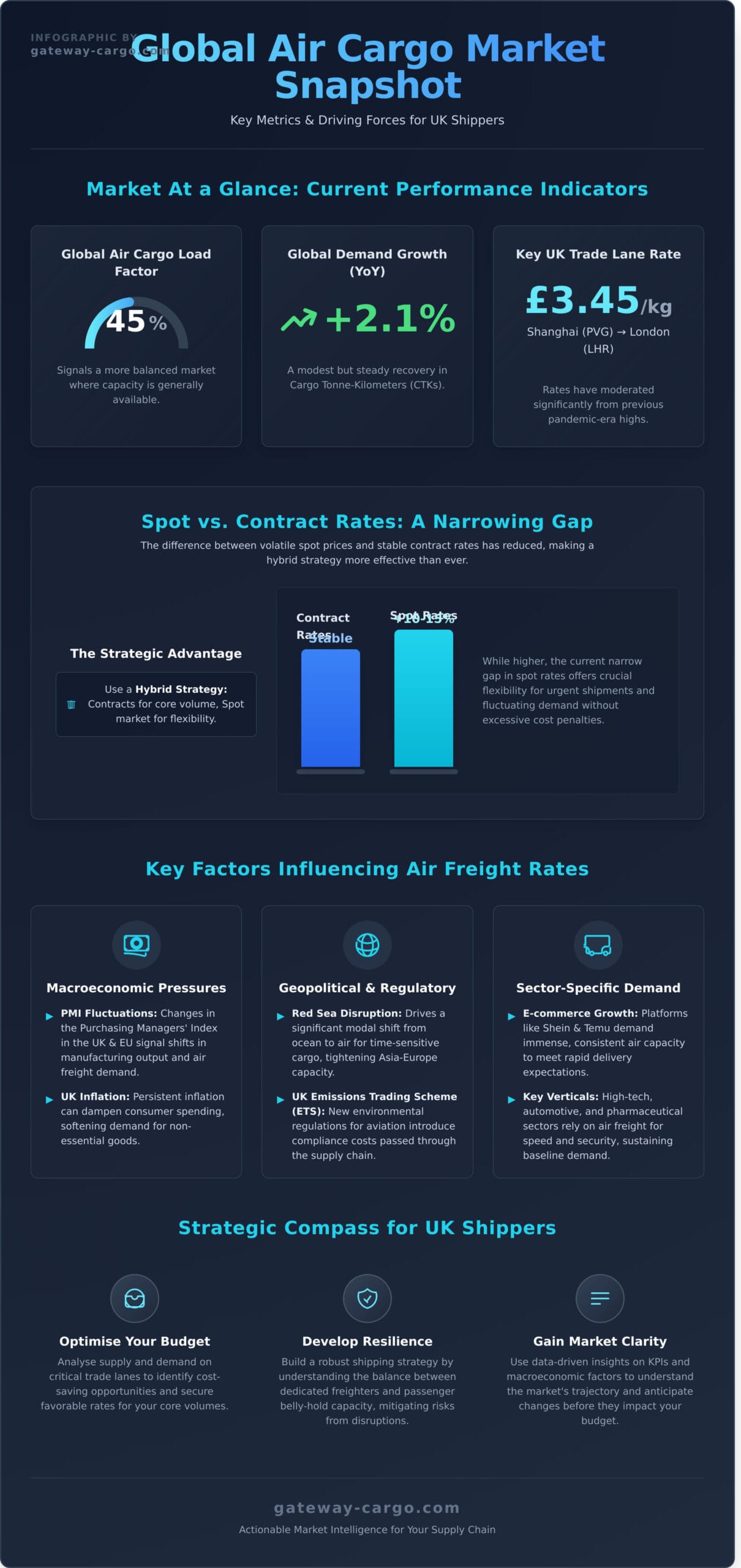
The global air cargo load factor, a key indicator of market tightness, currently hovers around 45%. While this figure is below the peaks seen during the pandemic, it signals a more balanced market where capacity is generally available but can become constrained on high-demand routes, particularly out of key Asian manufacturing hubs. To interpret these figures effectively, it’s vital to understand the basics of what is air cargo and how its operational capacity is measured against demand.
Key Metrics from Industry Indexes
Leading industry benchmarks provide a granular view of the market. According to the latest IATA report, global air cargo demand, measured in cargo tonne-kilometers (CTKs), showed a modest year-on-year increase of 2.1%, confirming a slow but steady recovery. The Baltic Air Freight Index (BAI) reflects this trend, with key routes like Hong Kong (HKG) to Europe showing price stabilisation. Similarly, TAC Index data indicates that rates from Shanghai (PVG) to London (LHR) are approximately £3.45 per kg, a significant moderation from previous highs.
Spot Rates vs. Contract Rates: What’s the Current Strategy?
The gap between volatile spot market rates and more stable long-term contract rates has narrowed considerably. Currently, spot rates are, on average, only 10-15% higher than contract prices on major lanes. In this market, a hybrid strategy is often the most effective solution. Securing capacity for core, predictable volumes via contracts provides stability, while leveraging the spot market offers flexibility for urgent or fluctuating demand. Relying solely on the spot market carries the risk of price spikes during seasonal peaks or unforeseen disruptions.
Analysis of Key Factors Driving Air Cargo Rates Today
Understanding the current landscape of air freight requires a detailed analysis of interconnected global factors. The rates shippers see today are not determined by a single variable, but by a complex interplay of economic, geopolitical, and market-specific pressures. For businesses in the United Kingdom, staying informed on the latest air cargo rates news is essential for strategic supply chain planning and cost management.
Macroeconomic indicators serve as a primary barometer for demand. A fluctuating Purchasing Managers’ Index (PMI) across the UK and Europe can signal shifts in manufacturing output and, consequently, the need for air freight. Similarly, persistent inflation can dampen consumer spending, potentially softening demand for non-essential goods while prioritising the rapid transit of high-value products.
Geopolitical and Regulatory Headwinds
Global conflicts continue to reshape air corridors and influence costs. The ongoing disruption in the Red Sea, for instance, has driven a significant modal shift from ocean to air for time-sensitive cargo on Asia-Europe routes, tightening capacity and elevating rates. Concurrently, new environmental regulations, such as the expansion of the UK Emissions Trading Scheme (ETS) to include aviation, introduce compliance costs that are inevitably passed through the supply chain.
Demand from E-commerce and Key Verticals
The relentless growth of e-commerce remains a dominant force. High-volume platforms like Shein and Temu demand immense, consistent air capacity to meet consumer expectations for rapid delivery. The sheer volume of goods moving on key trade lanes, a trend also reflected in official U.S. air freight statistics, puts sustained pressure on rates. In the UK, key verticals such as pharmaceuticals and high-tech manufacturing also drive demand for specialised, temperature-controlled, and secure air freight, often insulating these lanes from broader market softening.
Jet Fuel Price Fluctuations and Surcharges
Jet fuel prices represent a significant and volatile component of operational costs. Carriers pass these fluctuations on to shippers through fuel surcharges, which can be calculated as a percentage of the freight charge or as a fixed cost per kilogram (e.g., £0.75/kg). As global energy markets remain unpredictable, these surcharges can change with little notice. Proactive shippers should work closely with their logistics partners to forecast these variable costs and build a buffer into their freight budgets to avoid unexpected financial strain.
Regional Deep Dive: Rate & Capacity Analysis on Major Trade Lanes
Global air freight is not a monolithic market; it is a complex network of individual trade lanes, each with unique supply and demand dynamics. Understanding these regional nuances is fundamental to optimising your logistics strategy and managing costs effectively. The latest air cargo rates news consistently shows that pricing on a lane from Shanghai to London will differ significantly from a trans-Atlantic route.
Asia-Pacific to North America & Europe
The major eastbound trade lanes from Asia remain the engine of global air cargo. Rates from key hubs like Hong Kong (HKG), Shanghai (PVG), and Singapore (SIN) to Europe and North America are heavily influenced by high-value goods, including consumer electronics, e-commerce, and pharmaceuticals. While capacity has stabilised since the pandemic, demand-side pressures during peak seasons can cause rates to surge, often exceeding £3.50 per kilogram from primary Chinese airports to the UK. Shippers must plan proactively for Q4 to secure capacity at competitive prices.
Trans-Atlantic Routes (Europe-North America)
The trans-Atlantic market has seen a significant return to normalcy, driven by the recovery of passenger aviation. This has reintroduced substantial belly-hold capacity, placing downward pressure on rates compared to cargo-only freighter operations. Westbound routes from the UK and EU to North America are typically robust, carrying high-value industrial, automotive, and pharmaceutical goods. However, persistent challenges with ground handling and labour shortages at key North American airports can still introduce delays and ancillary costs, impacting the total landed cost of shipments.
Intra-Asia and Emerging Markets
While major east-west lanes dominate headlines, other markets present strategic opportunities for UK businesses.
- Intra-Asia: This remains the world’s largest and most dynamic regional market, fuelled by complex manufacturing supply chains. Efficiently navigating this network is critical for businesses sourcing components across multiple Asian countries.
- Middle East & Latin America: We are observing increased cargo flows into the Middle East, which serves as a crucial transit hub connecting Asia, Europe, and Africa. Concurrently, growing consumer markets in Latin America are creating new demand for UK exports, representing a key growth opportunity for forward-looking shippers.
Understanding the cultural and policy landscapes of these regions is just as important as tracking cargo data. For journalism that explores the human side of business and identity in this critical trade nexus, the Gulf–ASEAN Exchange provides valuable perspectives.
Monitoring these evolving trade patterns allows for greater supply chain diversification and resilience. At Gateway Cargo, our specialists provide the expert insights needed to navigate these regional complexities and secure optimal solutions for your business.
Air Cargo Capacity Outlook: Freighters vs. Belly Hold
Understanding the available air cargo capacity is fundamental to anticipating cost fluctuations. The global supply is sourced from two distinct channels: dedicated freighter aircraft designed exclusively for cargo, and the belly hold of passenger aeroplanes. The dynamic balance between these two sources directly influences market stability and is a key focus of current air cargo rates news.
As the logistics landscape normalises post-pandemic, the interplay between freighter and belly capacity is shifting once again, creating both opportunities and challenges for UK businesses managing their supply chains.
The Role of Passenger Fleet Belly Capacity
The steady return of international passenger travel from major UK hubs like Heathrow and Manchester is a significant factor in the current market. Every long-haul flight re-added to schedules, particularly on busy transatlantic and Asia-Europe trade lanes, introduces substantial new cargo capacity. This influx of supply generally helps to soften rates and provides more shipping options. However, belly capacity has its limitations; it is unsuitable for oversized, heavy, or certain classes of dangerous goods that require the specialised capabilities of a dedicated freighter.
Dedicated Freighter Market Trends
The dedicated freighter fleet, which expanded significantly to meet pandemic-era demand, is now in a period of optimisation. While utilisation rates have moderated from their peak, sustained demand from the global e-commerce sector continues to drive a need for reliable, scheduled freighter services. In response, leading carriers are modernising their fleets, with many placing orders for new, more fuel-efficient aircraft like the Boeing 777-8F and Airbus A350F while phasing out older, less economical models. This strategic shift aims to enhance efficiency and sustainability in the long term.
For shippers, navigating this evolving capacity landscape is crucial. Understanding which type of capacity best suits your cargo and staying informed on the latest air cargo rates news allows for more strategic and cost-effective logistics planning. Our specialists at Gateway Cargo continuously analyse these market trends to secure the optimal solution for your shipments.
Strategic Recommendations for Shippers in a Volatile Market
Understanding the factors influencing air freight costs is crucial, but true strategic advantage comes from translating that knowledge into action. Staying informed on the latest air cargo rates news is only the first step; the next is implementing robust strategies to mitigate costs and enhance supply chain performance. The following recommendations provide a framework for navigating market volatility with confidence.
Optimizing Your Mode of Transport
While air freight offers unparalleled speed, it is not always the most cost-effective solution. For shipments where transit time is flexible, a multi-modal approach can deliver significant savings. Sea-air services, for example, provide a balance between the speed of air and the economy of ocean freight. A specialist freight forwarder can analyse your specific requirements-from product value to delivery deadlines-to recommend the optimal blend of services that protects both your budget and your schedule.
Booking and Contract Strategies
In a fluctuating market, timing is everything. Proactive planning and advanced booking can secure capacity and insulate your business from last-minute price surges. For businesses with consistent, high-volume shipping needs, a Block Space Agreement (BSA) can be a powerful tool. BSAs offer:
- Rate Stability: Locked-in rates protect against market spikes.
- Guaranteed Capacity: Your space is secured, even during peak season.
However, they require commitment. An expert logistics partner can leverage their carrier relationships and aggregate volume to negotiate favourable terms on your behalf, advising whether a BSA or the dynamic spot market best suits your current needs.
Building Supply Chain Resilience
Over-reliance on a single trade lane or carrier creates significant risk. Geopolitical events, labour strikes at key UK airports, or localised capacity shortages can cause severe disruptions. By diversifying your routes and carrier portfolio, you create redundancies that keep your cargo moving. This strategy requires deep market insight and constant monitoring. Partnering with a logistics expert provides the necessary visibility and communication to proactively reroute shipments and manage exceptions before they impact your business.
This principle of resilience extends to personnel logistics as well. When disruptions occur at UK airports, ensuring key staff have reliable ground transportation is crucial for maintaining business continuity. For companies operating in or traveling through the London area, a service like Speedy Cars 247 can provide dependable airport transfers, helping to mitigate the impact of travel uncertainty.
Ready to build a more resilient and cost-effective shipping strategy? Partner with our experts to navigate market volatility. Request a consultation.
Navigating Your Strategy in a Dynamic Air Cargo Market
The global air freight landscape remains in a state of flux, defined by fluctuating capacity, regional rate disparities, and shifting economic pressures. As this analysis shows, a proactive and informed strategy is no longer optional-it is essential for maintaining supply chain resilience. Staying current with the latest air cargo rates news is critical, but true optimisation comes from partnering with an expert who can translate that data into actionable intelligence for your business.
At Gateway Cargo, we provide more than just transport; we deliver clarity and control. Leveraging our global network across key trade lanes and our team’s expert market analysis, we design bespoke, multi-modal logistics solutions that mitigate risk and enhance efficiency. We are your dedicated partner in navigating the complexities of the UK and global markets.
Take control of your air freight strategy. Get a bespoke air freight solution. Contact Gateway Cargo today. Let us help you transform market volatility into a competitive advantage.
Frequently Asked Questions
How are air cargo rates calculated?
Air cargo rates are calculated based on several key variables. The primary factor is the chargeable weight of the shipment, which considers both its actual weight and its volume. Other critical components include the origin and destination airports, the chosen airline carrier, and applicable surcharges. These often cover fuel, security screening mandated at UK airports, and handling fees. The required transit speed-whether express or standard-also significantly influences the final cost in pounds sterling (£).
What is chargeable weight and how does it affect my shipping costs?
Chargeable weight is the metric used by carriers to determine your shipping cost. It is the higher value between the shipment’s actual gross weight in kilograms and its volumetric weight. Volumetric weight is calculated by multiplying the package’s length, width, and height in centimetres and dividing by a specific factor, typically 6000 for air freight. This ensures that light but bulky items, like foam packaging, are priced fairly for the space they occupy on an aircraft.
Will air cargo rates go down in the second half of the year?
Predicting precise market movements is challenging, but current air cargo rates news and industry analysis provide valuable insights. Historically, rates can increase in the second half of the year due to the pre-Christmas peak season driving demand. However, factors like fluctuating jet fuel prices, global economic stability, and available cargo capacity can also apply downward pressure. We advise clients to monitor market updates closely and plan shipments strategically to mitigate potential volatility in the UK and global markets.
How can I reduce my air freight costs without sacrificing speed?
Optimising your air freight costs requires a strategic approach. Consolidating smaller shipments into one larger consignment can significantly reduce the per-kilogram rate. Furthermore, efficient packaging that minimises volumetric weight is crucial. Working with a logistics specialist allows you to access a network of carriers, enabling flexible routing solutions and leveraging negotiated rates. This expert partnership helps secure cost-effective options without compromising on essential transit times for your supply chain.
What is the difference between an all-in rate and a rate with surcharges?
An “all-in” air cargo rate provides a single, consolidated price per kilogram, bundling the base freight cost with all anticipated surcharges like fuel, security, and handling. This offers simplicity and cost predictability. In contrast, a rate with surcharges presents a lower base rate with each additional charge listed separately. While this provides greater transparency into the cost structure, the final amount can fluctuate if surcharges, such as the fuel component, change before shipment.
How does a freight forwarder help secure better air cargo rates?
A freight forwarder acts as a strategic partner to secure more competitive air cargo rates. By consolidating freight from multiple clients, we command significant buying power and negotiate volume-based contracts with airlines operating from key UK hubs. Our logistics specialists also possess deep market knowledge, allowing us to identify the most efficient routes and carriers for your specific needs. This expertise translates directly into optimised costs and a more resilient supply chain for your business.