
Full Container Load (FCL): A Comprehensive Guide for Shippers
Navigating the complexities of global shipping can be a significant challenge. If you’re questioning whether a full container load (FCL) is right for your cargo volume, or are concerned about the security risks and potential delays of sharing container space, you are not alone. The logistics industry is filled with terminology that can create confusion, making it difficult for UK businesses to determine the most efficient and cost-effective shipping strategy for their supply chain.
This comprehensive guide is designed to provide clarity. We will demystify the FCL process from start to finish, exploring its core benefits and breaking down the step-by-step journey of a shipment. By comparing FCL directly with Less than Container Load (LCL) options, we aim to empower you with the expert insights needed to optimise your freight operations. You will gain the confidence to make smarter logistics decisions, ensuring your cargo arrives safely, on time, and within budget.
Key Takeaways
- FCL shipping provides exclusive use of a container, offering a dedicated and secure transport solution for your goods.
- Evaluate the primary advantages of FCL, including enhanced security, reduced transit times, and potential cost efficiencies for larger shipments.
- Identify the key scenarios where a full container load becomes the optimal choice for your shipment’s volume, value, and delivery timeline.
- Master the step-by-step FCL process and learn how to select the appropriate container type to protect your cargo and optimise costs.
What is a Full Container Load (FCL)?
In global logistics, a Full Container Load (FCL) refers to a standard of ocean freight where a shipper leases the exclusive use of a dedicated shipping container. As a cornerstone of the modern system of intermodal freight transport, FCL shipping means that all the goods within that single container belong to one party. This method provides a secure, sealed, and efficient transport solution from the point of origin to the final destination.
A frequent misconception is that the term ‘full’ implies the container must be filled to its maximum capacity. In practice, a shipper chooses a full container load for its exclusivity. Businesses often select FCL even for cargo that does not utilise the entire space, prioritising the benefits of a dedicated container, such as enhanced security, reduced transit times, and minimised handling over pure volume optimisation. This stands in direct contrast to Less than Container Load (LCL) shipping, which is designed for smaller consignments.
FCL vs. LCL: The Fundamental Difference
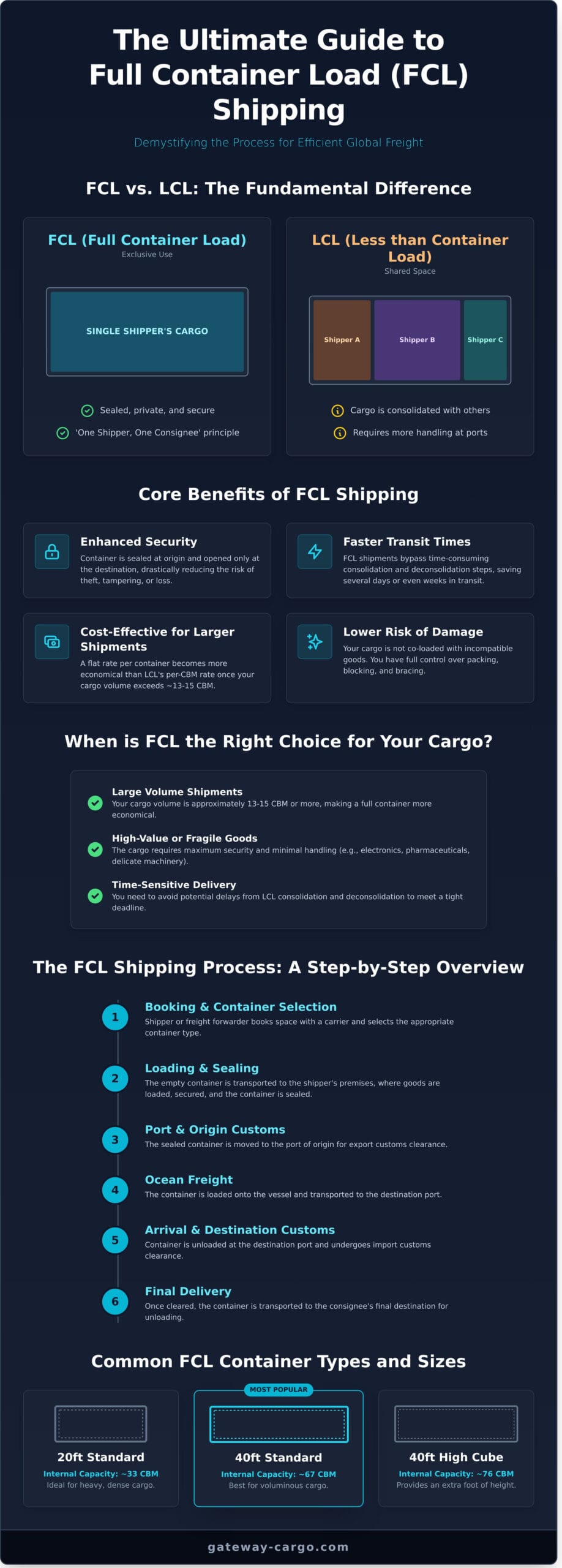
The primary distinction between FCL and LCL is not merely volume, but exclusivity. With FCL, a single shipper controls the entire container, ensuring their cargo is not mixed with goods from other companies. LCL, conversely, involves a freight forwarder consolidating multiple smaller shipments from various shippers into one shared container. The choice is strategic: FCL offers a private, sealed unit, while LCL provides a cost-effective solution for smaller-scale shipping needs.
The ‘One Shipper, One Consignee’ Principle
FCL shipping operates on a streamlined ‘one shipper, one consignee’ model. The shipper (the exporter or seller) is responsible for the cargo, and the consignee (the importer or buyer) is the sole recipient. This entire consignment is documented under a single Bill of Lading (B/L), which serves as the contract of carriage and title for all goods inside. This singular documentation simplifies the entire logistics process, from origin handling to customs clearance at major UK ports, leading to greater efficiency and predictability in your supply chain.
The Core Benefits of Choosing FCL Shipping
For businesses with significant cargo volumes, selecting a full container load (FCL) offers distinct operational and financial advantages that can optimise the entire supply chain. This shipping method provides a dedicated, secure, and efficient solution that directly impacts transit times, cargo safety, and overall costs. The primary benefits are most realised when a shipment is large enough to make exclusive container use a viable strategy.
Enhanced Security and Reduced Handling
With FCL, your container is sealed at your premises or the forwarder’s warehouse and remains sealed until it reaches the consignee. This single-touch process drastically minimises handling at ports and transit hubs. For UK businesses shipping high-value goods, such as electronics or pharmaceuticals, this exclusive chain of custody significantly mitigates the risk of theft, tampering, or loss during transit.
Faster Transit Times
FCL shipments bypass the time-consuming processes of consolidation and deconsolidation required for Less than Container Load (LCL) freight. This can shorten total transit time by several days or even weeks. The container moves directly from the port of loading to the port of discharge without intermediate stops for other cargo. This direct transit is a core feature of the FCL shipping process and ensures your goods reach their final destination more quickly.
Cost-Effectiveness for Larger Shipments
While LCL is priced per cubic metre, FCL is charged at a flat rate per container. This creates a critical break-even point for shippers. Once your cargo volume reaches approximately 13-15 cubic metres, booking an entire 20ft container often becomes more economical than paying the higher per-unit rate for LCL. For example, a shipment of 15 CBM might cost £2,250 via LCL (£150/CBM), whereas a full container load might be a flat rate of £2,000, offering substantial savings.
Lower Risk of Damage
Because your goods are the sole contents of the container, the risk of damage from external sources is virtually eliminated. Your cargo is not co-loaded with poorly packaged, incompatible, or heavy goods from other shippers. This gives you complete control over how your products are loaded, blocked, and braced, ensuring fragile or sensitive items are properly secured for the entire journey, which is a critical advantage for businesses shipping delicate products.
When is FCL the Right Choice for Your Cargo?
Selecting the optimal freight mode is a critical decision for any logistics manager or business owner. While Less than Container Load (LCL) offers flexibility for smaller shipments, a full container load (FCL) provides distinct advantages in specific scenarios. To optimise your supply chain, consider the following criteria to determine if FCL is the most efficient and secure solution for your freight.
Based on Shipment Volume
The most common determinant is cargo volume. As a general rule, FCL becomes the more cost-effective option for shipments exceeding 15 cubic metres (CBM). A standard 20ft container holds approximately 33 CBM, meaning you don’t need to fill it completely for FCL to be the logical choice. Calculating your CBM is straightforward: simply multiply the length, width, and height of your packaged goods in metres.
Based on Cargo Type and Value
Beyond volume, the nature of your goods is a crucial factor. FCL is the preferred method when cargo integrity and security are paramount. Consider FCL for:
- High-Value Goods: The container is sealed at your premises and remains sealed until it reaches the destination, significantly reducing the risk of theft or damage.
- Fragile or Sensitive Cargo: FCL minimises handling. Your goods are not consolidated with other cargo, lowering the risk of breakage or contamination during transit.
- Specialised Shipments: Cargo requiring specific conditions, such as temperature-controlled (reefer) containers for perishables, almost always moves via FCL to ensure a controlled environment.
Based on Urgency and Predictability
When time is a critical component of your supply chain, the full container load shipping method offers superior speed and reliability. FCL shipments bypass the time-consuming LCL processes of consolidation at the port of origin and deconsolidation at the destination. This direct transit results in faster, more predictable delivery schedules, making it an essential solution for just-in-time manufacturing, seasonal product launches, and time-sensitive retail deadlines.
The FCL Shipping Process: A Step-by-Step Overview
Navigating the logistics of international shipping can seem complex, but the process for a full container load shipment is a structured and methodical journey. Understanding these stages demystifies the process and highlights where a logistics specialist provides critical value. From initial booking to final delivery, each step is designed to ensure your cargo moves securely and efficiently across the globe.
Here is a breakdown of the end-to-end FCL shipping process from the shipper’s perspective.
Step 1: Booking and Container Dispatch
The process begins once you have a quote. Your freight forwarder books the container space with a carefully selected ocean carrier, securing a competitive rate and optimal transit time. Following this, an empty container is dispatched from a nearby depot and transported to your specified premises for loading. This initial land transport of the container is a crucial logistics step known in the industry as drayage.
Step 2: Loading, Sealing, and Documentation
Properly preparing your goods is the foundation of this step. For businesses dealing in bulk materials, this often involves automated packaging. Industry leaders like Choice Bagging Equipment provide the systems that efficiently bag products, making them ready for palletizing and securing within the container.
As the shipper, you are responsible for loading and securing your cargo inside the container. This can be arranged as a ‘live load’, where the driver waits on-site, or a ‘drop and pick’, where the container is left for a day or two for more flexible loading. Once packed, the container is locked with a unique, high-security seal. Your logistics partner then prepares the vital shipping documents, including the Bill of Lading (B/L), which acts as the title for the goods.
Step 3: Port Arrival and Ocean Transit
The sealed container is transported by road or rail to the UK port of origin, such as Felixstowe or Southampton. Here, it must clear export customs procedures, a complex process managed seamlessly by your freight forwarder to prevent delays. Once cleared, the container is loaded onto the designated vessel. It then begins its ocean transit, with its journey tracked by advanced systems to provide you with full visibility.
Step 4: Arrival, Customs, and Final Delivery
Upon arrival at the destination port, the container is unloaded from the vessel. It then undergoes import customs clearance, where all duties and taxes are settled and regulatory compliance is verified by your forwarder’s local agents. After clearing customs, the container is collected from the port and transported via drayage to the final destination-the consignee’s warehouse or facility-completing the door-to-door journey of your full container load.
Common FCL Container Types and Sizes
Selecting the appropriate container is a critical step in optimising your full container load shipment. The right choice ensures your cargo is transported securely, efficiently, and cost-effectively. This guide provides a practical reference to the most common container options, helping you determine the ideal solution for your freight requirements.
Standard Dry Containers (20′ and 40′)
The most widely used containers in global logistics, standard dry containers are versatile and suitable for a vast range of general cargo. They are weatherproof and ideal for transporting palletised goods, electronics, textiles, and other non-perishable items. The 20-foot container is excellent for heavy, dense cargo, while the 40-foot option provides double the volume for lighter, more voluminous goods. For taller cargo, the 40-foot High Cube (HC) container offers an extra foot of vertical clearance.
Refrigerated Containers (Reefers)
Refrigerated containers, commonly known as ‘reefers’, are essential for shipping perishable goods that require a consistent, temperature-controlled environment. These specialised units are equipped with refrigeration systems to protect sensitive cargo such as food products, pharmaceuticals, and flowers from spoilage during transit. It is vital to note that reefers require a continuous power source from the vessel, port, and truck to maintain their internal temperature.
Specialized Containers (Open Top and Flat Rack)
For cargo that exceeds the dimensions of standard containers, specialised equipment provides a reliable solution.
- Open Top Containers: Featuring a removable tarpaulin roof, these are designed for oversized items like tall machinery or large raw materials that must be loaded by crane from above.
- Flat Rack Containers: With collapsible or fixed end walls but no side walls or roof, flat racks are perfect for heavy, wide, or bulky cargo, including vehicles, industrial pipes, and construction equipment.
| Container Type | Internal Dimensions (L x W x H) | Volume Capacity | Max Payload |
|---|---|---|---|
| 20′ Dry | 5.9m x 2.35m x 2.39m | 33 CBM | 28,000 kg |
| 40′ Dry | 12.0m x 2.35m x 2.39m | 67 CBM | 26,500 kg |
| 40′ High Cube | 12.0m x 2.35m x 2.70m | 76 CBM | 26,500 kg |
Matching your cargo to the correct container is fundamental for an efficient full container load strategy. For bespoke advice on the optimal container for your goods, our logistics specialists are ready to help.
How a Freight Forwarder Optimizes Your FCL Shipments
Navigating the complexities of a full container load shipment requires more than just booking space on a vessel. To truly optimise your supply chain, a strategic logistics partner is essential. A professional freight forwarder, such as Gateway Cargo, transforms the FCL process from a potential operational burden into a streamlined, cost-effective, and reliable component of your global trade strategy.
Securing Competitive Rates and Capacity
One of the most significant advantages of partnering with a freight forwarder is access to preferential pricing and secured capacity. We consolidate shipping volumes from numerous clients, which provides us with substantial negotiating power with ocean carriers. This leverage translates directly into more competitive rates for your business than you could typically secure independently. Beyond cost savings, our established carrier relationships grant us access to space allotments, ensuring your cargo has a confirmed spot on a vessel. This is crucial during peak seasons, mitigating the risk of your container being ‘rolled’ to a later sailing and disrupting your supply chain.
Managing Complex Documentation and Customs
The administrative requirements for international shipping are extensive and exacting. A single FCL shipment involves a Bill of Lading, commercial invoice, packing list, and detailed customs declarations. Minor errors or omissions in this paperwork can lead to significant delays at port, incurring costly demurrage and detention charges or even fines from HMRC. Gateway Cargo’s specialists manage this entire process with precision. We ensure all documentation is compliant, correct commodity codes are used, and declarations are submitted accurately for smooth and timely customs clearance into the United Kingdom.
Providing End-to-End Visibility and Support
Engaging a forwarder provides a single, dedicated point of contact for your shipment’s entire journey, from the factory door to its final destination. This eliminates the need for your team to coordinate with multiple vendors, such as hauliers, carriers, and customs agents, providing clear and consistent communication. Modern forwarders enhance this with sophisticated tracking platforms, offering real-time visibility of your cargo. This transparency allows for better inventory planning, risk management, and a smarter supply chain. By managing rates, documentation, and providing constant support, we don’t just move your container; we optimise the entire logistics function.
For a smarter, more reliable supply chain, partner with Gateway Cargo for seamless FCL solutions.
Harness the Power of FCL for a Smarter Supply Chain
Understanding when and how to utilise Full Container Load shipping is a critical component of an efficient logistics strategy. As we have explored, FCL offers unparalleled security, faster transit times, and significant cost savings for businesses with enough cargo to fill a dedicated container. By selecting the correct container type and partnering with an expert, you can gain a substantial competitive advantage in the global marketplace.
Ultimately, mastering the full container load model transforms your supply chain from a cost centre into a strategic asset. At Gateway Cargo, our global network of expert logistics specialists delivers bespoke freight solutions tailored to your needs, underpinned by a firm commitment to building sustainable and efficient supply chains. Take the next step towards seamless logistics. Request a quote for your FCL shipment and optimise your supply chain.
Frequently Asked Questions About Full Container Load Shipping
Do I have to physically fill a container for an FCL shipment?
Contrary to the name, you are not required to fill the container to its maximum capacity. A full container load (FCL) shipment means you have exclusive use of the entire container for your goods. This option is often chosen for security, to avoid potential damage from co-loading with other cargo, or when the volume of goods makes it more cost-effective than Less than Container Load (LCL) shipping, even if space remains.
How are FCL shipping costs calculated?
FCL shipping costs are calculated primarily as a flat rate per container, determined by the container size (e.g., 20ft or 40ft) and the shipping route. This base rate is then supplemented by various surcharges. These can include a Bunker Adjustment Factor (BAF) for fuel price fluctuations and Terminal Handling Charges (THC) at both origin and destination ports. Our specialists provide a transparent quotation in GBP (£), detailing all applicable charges for your specific logistics requirements.
Who is responsible for loading and unloading an FCL container?
For a standard FCL shipment, the responsibility for loading and securing the cargo into the container lies with the shipper. This is often referred to as “Shipper’s Load, Stow, and Count.” Correspondingly, the consignee is responsible for unloading the container upon its arrival at the final destination. Gateway Cargo can, however, arrange for these services as part of a bespoke, door-to-door logistics solution to optimise your supply chain.
What is a Bill of Lading (B/L) in FCL shipping?
The Bill of Lading (B/L) is a critical legal document in FCL shipping that serves three primary functions. Firstly, it acts as a receipt for the goods shipped. Secondly, it constitutes the contract of carriage between the shipper and the carrier. Finally, and most importantly, it serves as the document of title, meaning the holder of the original B/L has the right to take possession of the cargo at the destination port.
Is FCL always faster than LCL?
Generally, FCL shipments have a faster transit time than Less than Container Load (LCL) shipments. This is because an FCL container moves directly from the shipper to the port and then to the consignee without intermediate handling. It bypasses the time-consuming consolidation and deconsolidation processes at warehouses required for LCL cargo. This streamlined journey significantly reduces potential delays, offering a more predictable and efficient logistics solution for time-sensitive supply chains.
Can I ship hazardous materials in an FCL container?
Yes, it is possible to ship hazardous materials (HAZMAT) or dangerous goods (DG) via an FCL container, provided all regulations are strictly followed. The cargo must be correctly classified, packaged, labelled, and declared according to the International Maritime Dangerous Goods (IMDG) Code. All necessary documentation, such as the Dangerous Goods Note (DGN), must be accurately completed. Our logistics specialists are proficient in managing these complexities to ensure full compliance and safe transport.