
Choosing International Shippers: A Complete Guide for Businesses in 2026
For UK businesses expanding into global markets, the landscape of international logistics can appear overwhelmingly complex. Concerns over customs delays, unexpected costs, and the sheer volume of documentation can hinder growth and create significant operational friction. Selecting the right partner from a vast pool of international shippers is a critical decision that directly impacts your supply chain’s efficiency and your bottom line.
This comprehensive 2026 guide is designed to demystify the process. We provide the essential insights needed to navigate the global freight landscape with confidence. Here, you will learn to distinguish between carriers, brokers, and freight forwarders, identify the key criteria for evaluating potential partners, and implement strategies to optimise your shipping operations. The objective is clear: to empower your business with the knowledge to secure a reliable, cost-effective solution, ensuring your goods are handled professionally from origin to final destination.
Key Takeaways
- Understand the distinct roles of freight forwarders, carriers, and brokers to select the most effective partner for your supply chain.
- Selecting the right international shippers is critical for navigating complex UK and global customs regulations and avoiding costly documentation errors.
- Utilise a strategic checklist to vet potential partners by asking targeted questions about their global network, technological integration, and service levels.
- Demystify the end-to-end shipping journey, from quote to final delivery, to better manage timelines and expectations for your cross-border shipments.
What Are International Shippers & Why Choosing Right is Critical
In global commerce, the term ‘international shippers’ refers not to a single entity, but to the complex network of companies responsible for moving goods across national borders. This ecosystem includes ocean carriers, airlines, road hauliers, and logistics specialists. For any business involved in importing or exporting, navigating this landscape presents significant challenges, primarily centred on customs compliance, precise documentation, and the intricate coordination of logistics.
Selecting the right shipping partner is a critical strategic decision. An expert partner optimises your supply chain, reduces transit times, and controls costs, becoming a genuine asset to your operation. Conversely, an inadequate partner can create a cascade of costly delays, customs penalties, and damage to your business’s reputation. At the heart of every successful shipment are essential documents that act as its passport, including:
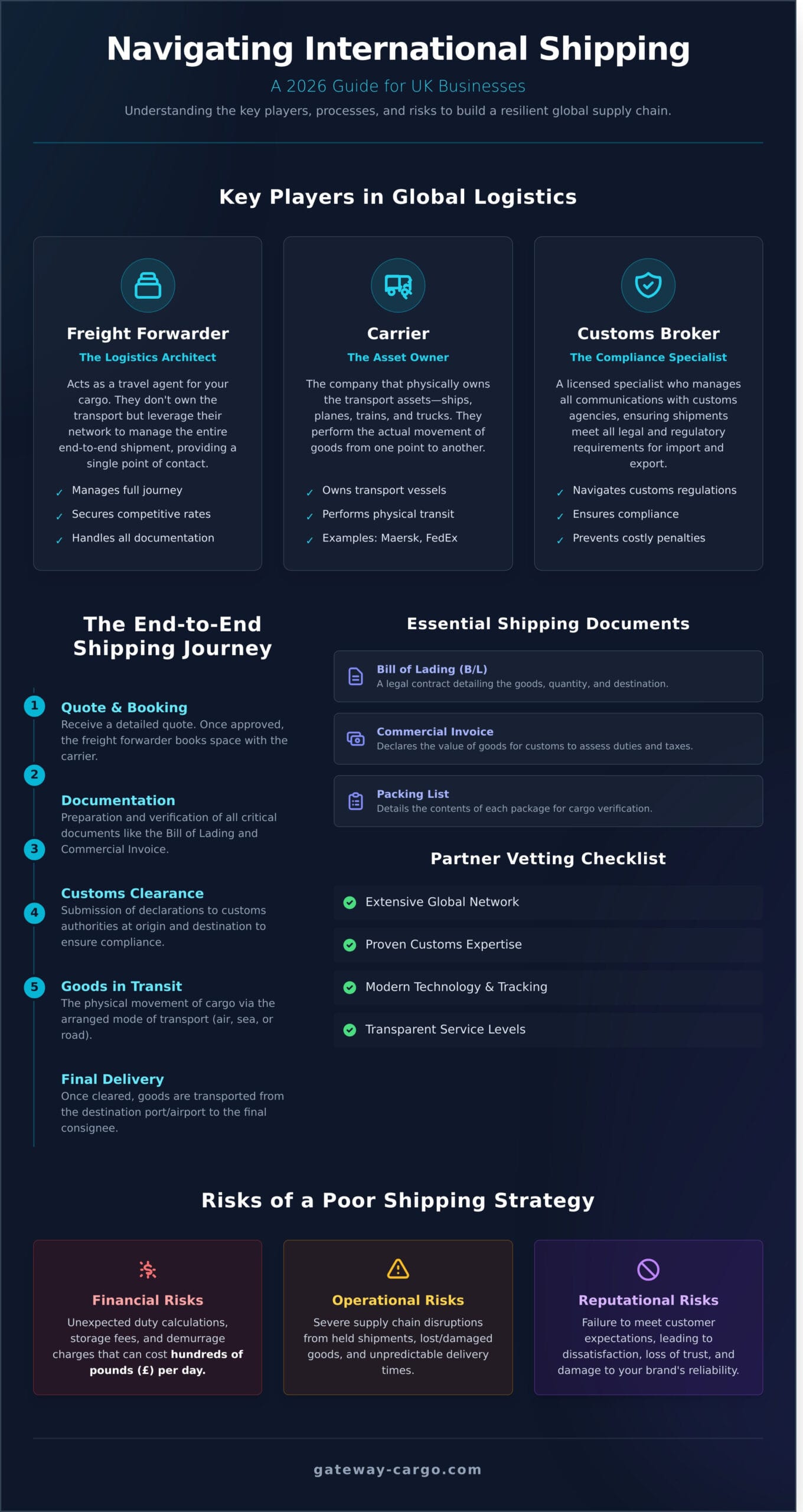
- The Bill of Lading (B/L): A legal document between the shipper and the carrier detailing the type, quantity, and destination of the goods being carried.
- Commercial Invoice: A document required by customs to determine the true value of the imported goods for the assessment of duties and taxes.
- Packing List: A detailed list that specifies the contents of each package in the shipment, used by customs to verify the cargo.
The Core Functions of a Global Shipping Partner
A proficient global shipping partner manages the entire transit process, providing end-to-end solutions. Their role is to consolidate complex tasks into a seamless service. A key player in this is often the freight forwarder, an agent who organises shipments for individuals or corporations. Core functions include:
- Goods Transportation: Arranging the physical movement of cargo via the most efficient modes, whether by air, ocean, or road freight.
- Customs Navigation: Managing the complex customs clearance process, ensuring all declarations are accurate and compliant with UK and international regulations.
- Documentation Management: Preparing, verifying, and submitting all necessary paperwork to prevent delays and ensure legal compliance.
Risks of a Poor Shipping Strategy
An inefficient or poorly managed shipping strategy exposes your business to significant and avoidable risks. These vulnerabilities can impact your finances, operations, and customer relationships, undermining your competitive advantage. Key risks include:
- Financial Risks: Incurring unexpected costs from incorrect duty calculations, storage charges, and demurrage fees, which can amount to hundreds of pounds (£) per day.
- Operational Risks: Facing severe supply chain disruptions due to held shipments, lost or damaged goods, and unpredictable delivery timelines.
- Reputational Risks: Failing to meet customer delivery expectations, leading to dissatisfaction, loss of trust, and potential damage to your brand’s reliability.
Key Players in Global Logistics: Forwarder vs. Carrier vs. Broker
The global supply chain is a complex network of specialised services. For international shippers, understanding the distinct roles of a freight forwarder, a carrier, and a customs broker is fundamental to optimising operations. Each plays a critical, yet different, part in moving goods across borders efficiently and in full compliance with regulations. This section clarifies these key distinctions to help you build a smarter supply chain.
The Role of a Freight Forwarder
A simple analogy is to think of a freight forwarder as a travel agent for your cargo. They are logistics architects who manage a shipment’s entire end-to-end journey. A forwarder does not physically transport the goods but acts as an intermediary, leveraging its extensive network of carriers to secure the most efficient routes and competitive rates. They provide a single point of contact, coordinating all aspects of the complex international shipping and logistics process, including documentation, booking, and final delivery.
The Role of a Carrier
A carrier is an entity that owns the physical transportation assets-the ships, aircraft, trains, and lorries-used to move goods. They are the companies that perform the actual transit from one port or airport to another. Prominent examples include ocean lines like Maersk, air cargo operators such as FedEx, and major airlines. While a business can book directly with a carrier, many international shippers find it more efficient to use a forwarder to manage these relationships and coordinate multi-modal transport solutions.
The Role of a Customs Broker
A customs broker is a highly specialised and licensed professional responsible for navigating the complexities of customs clearance. Their primary function is to prepare and submit the required documentation to governmental agencies, such as HM Revenue & Customs (HMRC) in the UK, ensuring every shipment complies with all import and export laws. This specialist role is crucial for avoiding costly delays, fines, and penalties at the border. Today, most leading freight forwarders offer in-house customs brokerage services, providing a seamless, integrated solution.
How to Choose the Right International Shipping Partner: A Checklist
Selecting a logistics partner is a critical business decision. The right partner acts as an extension of your team, optimising your supply chain and mitigating risks. The best choice is not universal; it depends entirely on your unique operational needs, trade lanes, and growth objectives. The goal is to find a provider that transforms complexity into a streamlined, reliable process.
To help you evaluate potential international shippers, use the following checklist. Posing these questions will provide the clarity needed to make an informed decision and secure a partner built for your success.
Evaluating Services and Network
A partner’s physical capabilities and global reach are the foundation of their service. Ensure their infrastructure aligns with your current and future shipping requirements. Ask potential partners:
- What transport modes and services do you offer? Confirm they can manage your specific needs, whether it is air freight for urgent consignments, ocean freight for bulk goods (both Full Container Load, FCL, and Less than Container Load, LCL), or intermodal road and rail solutions.
- How extensive is your global network and local expertise? A wide network is valuable, but deep knowledge within your key markets is essential for navigating local customs, regulations, and logistics challenges efficiently.
- Can you provide a complete, end-to-end solution? Enquire about their ability to manage the entire journey, from warehousing and consolidation at the origin to customs clearance and final-mile delivery at the destination.
Assessing Technology and Expertise
Modern logistics runs on data and deep industry knowledge. A forward-looking partner leverages technology to provide transparency and has the expertise to handle the nuances of your specific cargo. Consider these questions:
- What level of visibility and tracking do you provide? A robust digital platform offering real-time tracking and comprehensive shipment data is no longer a luxury but a necessity for effective supply chain management.
- Do you have proven experience with our industry or cargo type? Specialised goods, such as perishables, hazardous materials, or high-value electronics, require specific handling protocols and expertise. A partner’s experience should also include navigating the complex regulatory landscapes of your key markets. For instance, a proficient partner must understand compliance requirements set by bodies like the U.S. Federal Maritime Commission when shipping to the United States.
- What is your communication and customer support structure? Determine if you will have a dedicated point of contact. Clear, proactive communication is critical for resolving issues swiftly and keeping you informed of your shipment’s status.
The International Shipping Process: From Quote to Final Delivery
For businesses new to global trade, the journey from a supplier’s factory to your warehouse can seem complex. However, when managed by an experienced freight forwarder, the process becomes a series of clear, predictable stages. Understanding this journey provides transparency and empowers you to make smarter supply chain decisions. Here is a breakdown of the typical international shipping process, from initial request to final delivery.
Stage 1: Quoting, Booking, and Documentation
The process begins with securing a precise quote. You will provide your logistics partner with key shipment details, including the origin and destination, cargo dimensions and weight, and the required mode of transport (air or ocean). Once you approve the quote, the booking is confirmed. At this point, you must provide essential commercial documents, primarily the Commercial Invoice and Packing List. These documents are critical for customs declarations. Finally, your freight forwarder arranges for the collection of your cargo from the supplier’s factory or warehouse, officially starting its physical journey.
Stage 2: Transit and Customs Clearance
With the cargo in transit, the focus shifts to regulatory compliance. First, your shipment undergoes export customs clearance in the country of origin. This ensures all local export regulations are met. The cargo then begins its main transit via ocean vessel or aircraft. Upon arrival in the United Kingdom, the most critical phase begins: import customs clearance. This is where a customs broker or a forwarder with brokerage capabilities provides immense value. They prepare and submit the necessary declarations to HMRC, manage any required inspections, and calculate the correct import duty and VAT. Navigating this stage efficiently is paramount for all international shippers to avoid costly delays and penalties.
Stage 3: Final Mile Delivery
Once your shipment has been successfully cleared by UK customs and all duties have been paid, it is released from the port or airport. The cargo is then transported to a local distribution centre or warehouse. From here, the final delivery is scheduled. Your logistics partner will coordinate with you to arrange a suitable time for the goods to be delivered directly to your business premises, completing the door-to-door transit. Our logistics specialists at Gateway Cargo are here to optimise and manage every step of this process on your behalf.
Gateway Cargo: Your Strategic Partner for Seamless International Shipping
Navigating the complexities of global trade requires more than just a service provider; it demands a strategic partner. Throughout this guide, we’ve explored the critical role of a customs broker and the challenges that arise in cross-border logistics. The decision is not merely about finding a vendor to move goods, but about integrating an expert into your team who can protect your interests, mitigate risks, and create a competitive advantage. At Gateway Cargo, we embody this partnership model, providing the expertise and infrastructure that successful international shippers depend on for a resilient and efficient supply chain.
Our philosophy is built on delivering seamless logistics for a smarter supply chain, allowing you to focus on your core business while we manage the intricate details of global transit.
Bespoke Solutions for Your Supply Chain
We understand that no two businesses have the same logistical needs. Our specialists work as an extension of your team to design and implement tailored solutions across all freight modes, including air, ocean, and road. By managing the complexities of carrier negotiations and route planning, we optimise your transit times and costs. Crucially, our integrated customs clearance services ensure your shipments comply with all UK and international regulations, moving through ports and borders without costly delays.
Technology-Driven for a Smarter Supply Chain
In today’s market, information is as valuable as the cargo itself. We empower international shippers with full visibility through our advanced tracking and logistics platforms, providing real-time data on your shipments from origin to destination. Our teams leverage this data to proactively identify opportunities, optimise routes for greater efficiency, and reduce your overall logistics spend. This commitment to technology ensures your supply chain is not only reliable but also intelligent and prepared for the future. Contact our specialists to design your international shipping strategy.
Secure Your Global Supply Chain with the Right Partner
Choosing the right international shippers is more than a logistical decision; it is a critical strategic move that directly impacts your profitability and customer satisfaction. The global shipping landscape of 2026 demands a partner who not only understands the complexities of freight forwarding and customs but can also serve as an extension of your team, proactively navigating challenges and identifying opportunities for optimisation.
At Gateway Cargo, we provide this strategic advantage. By leveraging our global network of logistics specialists and an advanced AI-driven digital strategy, we deliver bespoke freight solutions that create a smarter, more efficient supply chain for your business. We transform complex logistical hurdles into your competitive edge.
Are you ready to enhance your global trade operations? Request a consultation to optimize your international logistics. Take the decisive step towards building a more resilient and successful global business today.
Frequently Asked Questions for International Shippers
What is the cheapest way to ship internationally?
For most commercial goods, ocean freight is the most cost-effective method for international shipping. If you do not have enough cargo to fill a whole container, Less than Container Load (LCL) shipping offers a highly economical solution. While sea freight provides significant cost savings compared to air, it has longer transit times. The optimal solution always depends on balancing your specific budget, volume, and delivery timeline requirements to create a smarter supply chain.
How long does international shipping typically take?
Transit times vary significantly based on the mode of transport and route. Air freight from major global hubs to the UK typically takes 3-7 days. Ocean freight is considerably longer; for example, a shipment from China to a UK port usually takes 4-6 weeks. These timelines are estimates and can be affected by factors such as port congestion, customs clearance processes, and inland transportation at both the origin and destination.
What are Incoterms and why are they important for international shippers?
Incoterms (International Commercial Terms) are a set of globally recognised rules that define the responsibilities of sellers and buyers. They clarify who is responsible for paying for and managing the shipment, insurance, documentation, and customs clearance. For international shippers, using the correct Incoterm is critical as it prevents misunderstandings, allocates costs and risks accurately, and ensures a seamless transaction from collection to delivery.
What is the difference between FCL and LCL ocean shipping?
FCL stands for Full Container Load, where you lease an entire shipping container for your exclusive use. LCL means Less than Container Load, where your goods are consolidated with cargo from other shippers to fill a container. FCL is generally faster and more secure once packed, making it ideal for larger shipments. LCL is a flexible and cost-effective solution for smaller volumes, as you only pay for the space your cargo occupies.
What documents are required for international shipping?
The core documents required for all international shipments into the UK are a Commercial Invoice, a Packing List, and a Bill of Lading (for ocean freight) or an Air Waybill (for air freight). Depending on the commodity and origin, you may also need a Certificate of Origin, import licences, or other specialised permits. A proficient customs broker ensures all documentation is accurate and compliant to avoid costly delays at the border.
Who is responsible for paying customs duties and taxes?
The responsibility for paying customs duties and VAT is determined by the Incoterms agreed upon in the sale. In most cases, the importer of record (the buyer in the UK) is responsible for these charges upon the goods’ arrival. However, if goods are shipped under DDP (Delivered Duty Paid) terms, the seller assumes responsibility for all costs, including any import duties and taxes, delivering a seamless solution for the buyer.
Can international shippers handle hazardous or oversized cargo?
Yes, specialist freight forwarders provide bespoke solutions for transporting hazardous materials (hazmat) and oversized or out-of-gauge (OOG) cargo. This type of freight requires expert handling, specialised equipment, and adherence to strict international and UK regulations. A logistics specialist will manage the complex documentation, packaging requirements, and carrier selection to ensure safe and compliant transit from origin to final destination.
How do I get an accurate quote from an international shipper?
To receive an accurate quote, you must provide comprehensive details. This includes the collection and delivery postcodes, the precise weight and dimensions (length, width, height) of the packaged goods, and the commodity type, ideally with its HS code. Specifying the agreed-upon Incoterm is also critical. Complete and precise information enables your logistics partner to provide a reliable quote that covers all anticipated costs and optimises your freight expenditure.