
Clarifying Synonyms: Enhancing Precision in Professional Logistics Communication
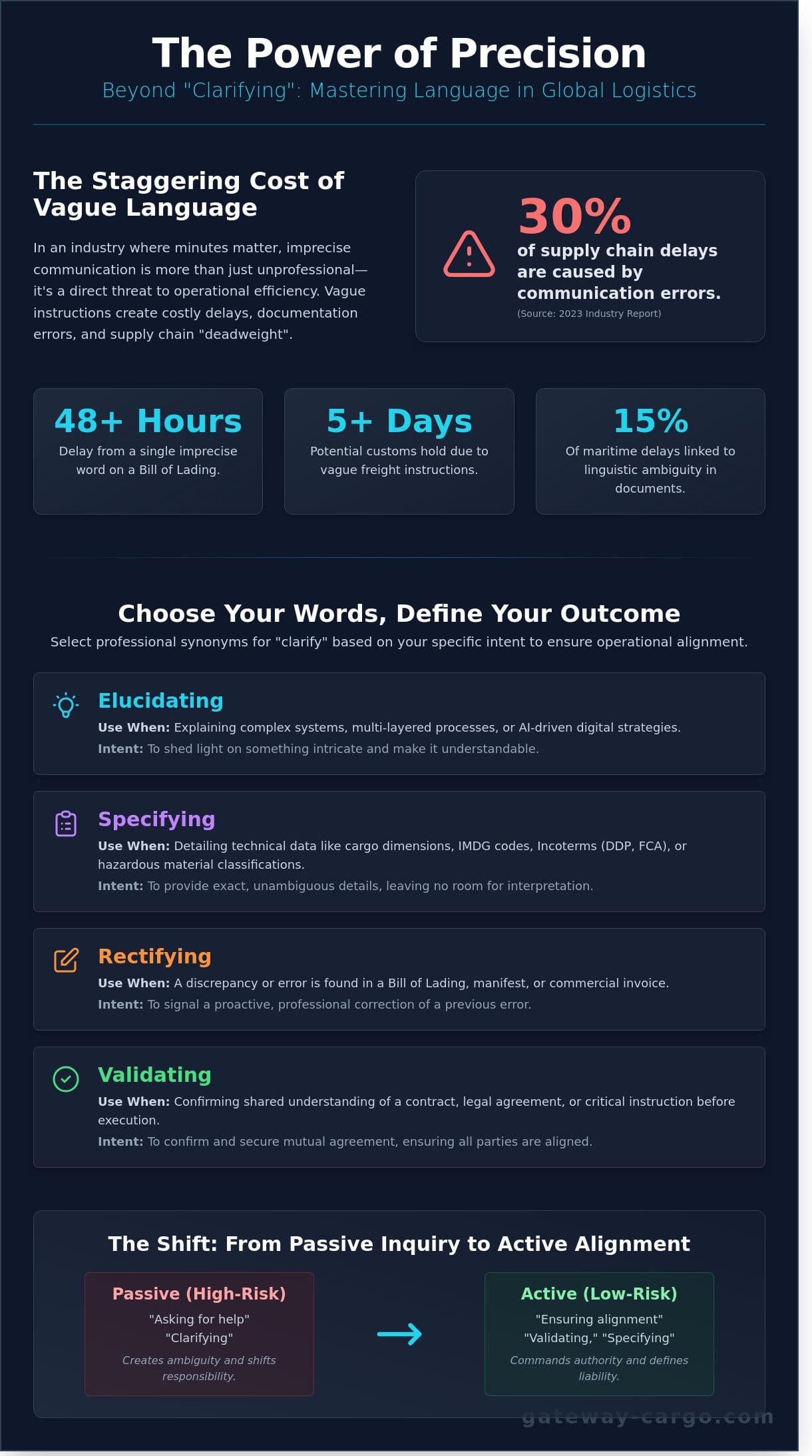
A single imprecise word in a Bill of Lading can delay a high-value shipment for 48 hours at a major hub like the Port of Singapore. You’ve likely felt the frustration when a vague instruction leads to a missed connection or an unnecessary customs hold. Relying on repetitive language doesn’t just sound unprofessional; it creates operational risks that your supply chain can’t afford. By mastering clarifying synonyms, you ensure that every stakeholder, from the freight forwarder to the local warehouse manager, understands your exact requirements without hesitation. In an industry where a 2023 industry report found that communication errors cause nearly 30% of supply chain delays, precision is your most valuable asset.
We understand that handling international trade requires a level of precision that basic vocabulary often fails to provide. This article will help you master the art of professional clarity by choosing the precise terms needed to eliminate ambiguity in your global supply chain. We’ll examine how specific word choices can reduce documentation errors and help you communicate more authoritatively with non-native English speakers. You’ll discover a curated list of professional alternatives designed to optimise your communication and streamline the entire freight process from origin to destination.
Key Takeaways
- Discover how linguistic precision eliminates supply chain “deadweight” and prevents costly operational delays like missed air freight slots.
- Learn to select the most effective clarifying synonyms, such as “elucidating” for AI-driven strategies or “specifying” for technical Incoterms.
- Master the nuance of contextual communication to maintain professional authority across both informal internal updates and formal external contracts.
- Apply a practical checklist to identify the root of logistical confusion and deploy vocabulary that ensures data-driven clarity for every stakeholder.
Beyond “Clarifying”: Why Precision Matters in Global Logistics
In a professional business context, clarifying means more than just explaining. It’s the active process of removing ambiguity to ensure all parties share identical expectations. Within global logistics, a single misunderstanding can create “deadweight” throughout the supply chain. This includes tangible bottlenecks like 72-hour port congestion or missed air freight slots that disrupt just-in-time manufacturing schedules. Success relies on understanding synonyms and selecting the term that carries the correct technical weight. Using specific clarifying synonyms helps logistics specialists move beyond vague requests into actionable data points.
Precise vocabulary builds psychological trust. International partners rely on your expertise to manage complex regulatory environments. If a freight forwarder uses imprecise language, it signals a lack of operational competence. A single synonym choice often changes the legal weight of a freight instruction. For example, “notifying” a party is different from “securing authorization” from them. These distinctions determine who bears the financial risk if a shipment is diverted. Precise language isn’t just about being polite; it’s about defining liability.
The High Cost of Ambiguity in Freight Forwarding
Vague instructions frequently cause customs delays that can last 5 days or longer. These errors often stem from mismatched terminology in Bill of Lading descriptions or commercial invoices. Our international shipping services focus on linguistic precision to prevent these bottlenecks. By using exact terms, we support the transition toward “Smarter Supply Chains” where data flows as efficiently as the cargo. In 2025, industry reports indicated that approximately 15% of all maritime delays were linked to documentation errors caused by linguistic ambiguity.
Moving from Passive to Active Clarification
Effective communication requires a shift from “asking for help” to “ensuring operational alignment.” While the word “clarifying” is a standard term, it’s often too soft for time-sensitive air cargo logistics where decisions must happen in minutes. The 2026 logistics trends show a clear move toward authoritative communication styles. Instead of passive inquiry, specialists now use active clarifying synonyms like “validating,” “specifying,” or “verifying.” This transition ensures that every stakeholder understands their role without hesitation. It transforms a simple conversation into a strategic tool for optimization and risk mitigation.
Professional Synonyms for Clarifying Categorised by Intent
Precision isn’t just a preference in freight; it’s a requirement. Choosing the right clarifying synonyms ensures that stakeholders understand the exact intent behind a communication. This prevents the costly delays that often stem from linguistic ambiguity. Different logistical scenarios demand specific verbs to maintain professional authority and operational flow.
- Elucidating: Use this when explaining complex logistical processes or AI-driven digital strategies. It suggests shedding light on multi-layered systems that require deep technical understanding.
- Specifying: This is the standard for detailing cargo dimensions, IMDG codes, or Incoterms like DDP and FCA. It leaves no room for interpretation regarding weight or hazardous material classifications.
- Rectifying: When a discrepancy arises in a Bill of Lading or a manifest, “rectifying” signals a proactive, professional correction of a previous misunderstanding.
- Illuminating: Reserve this for high-level “Insights” reports or market update whitepapers. It implies providing visibility into global trade trends or macro-economic shifts.
- Validating: This is essential for contract management. It confirms that two parties share a single, unified understanding of a legal agreement before moving to the execution phase.
Effective communication serves as the backbone of global trade. High-stakes environments demonstrate that critical logistics communication directly impacts the success of complex movements. Using precise language doesn’t just improve clarity; it builds the trust necessary for long-term B2B partnerships.
Technical Synonyms for Operational Accuracy
When mapping out a new intermodal logistics route, “defining” or “delineating” provides a clearer framework than “clarifying.” These terms establish the exact boundaries of responsibility between rail, sea, and road carriers. In warehousing, “itemising” is a superior choice. It implies a line-by-line breakdown of inventory, which is vital for maintaining 99.9% pick accuracy. For customs clearance, “codifying” is the preferred term. It refers to the systematic arrangement of data to match the Harmonized System (HS) codes, which saw over 350 amendments in the 2022 WCO update. Using these clarifying synonyms demonstrates a mastery of technical standards.
Strategic Synonyms for Executive Communication
Executive-level dialogue requires a shift toward visionary and decisive language. You should replace “clarifying” with “articulating” when presenting a bespoke freight solution to a C-suite audience. It suggests a structured and professional delivery of a complex idea. If you’re conducting a deep-dive supply chain analysis, “expounding” highlights your role as a subject matter specialist. In project cargo, “crystalising” is a powerful verb. It signals the exact moment a plan moves from a conceptual phase to a firm, executable strategy. This level of linguistic precision helps align stakeholders and accelerates the decision-making cycle.
Contextual Usage: Choosing the Right Word for the Right Channel
Effective logistics communication requires more than just industry jargon. It demands a strategic selection of clarifying synonyms tailored to the specific channel and stakeholder. A word that works in an internal Slack channel may cause confusion or legal friction if used in a formal contract. Precision in word choice ensures that 85% of supply chain errors caused by miscommunication are mitigated before they impact the bottom line.
When communicating across different tiers of the supply chain, tone dictates the speed of execution. For warehouse operators handling high-volume inventory, “simplifying” instructions reduces cognitive load and speeds up pick rates. In contrast, when presenting a complex multi-country logistics strategy to a Chief Supply Chain Officer, “elucidating” the plan demonstrates a higher level of analytical rigour. The choice between these synonyms signals your expertise and your understanding of the recipient’s priorities.
The urgency of the shipment also dictates the vocabulary. For time-sensitive air freight, language must be punchy and decisive. Terms like “finalising” or “securing” provide the necessary closure for rapid turnarounds. For ocean freight, where lead times often exceed 30 days, “outlining” or “mapping” the transit phases provides the long-term visibility required for effective port-side planning. Matching the synonym to the transport mode ensures the message carries the appropriate weight.
Synonyms for Email and Direct Messaging
In digital correspondence, the distinction between “briefing” and “updating” is vital for setting expectations. Use “briefing” when you’re providing the initial framework for a new route or project. Use “updating” when you’re providing a status report on an existing shipment. To avoid sounding repetitive during long email chains, “reiterating” serves as a professional way to bring focus back to a previously stated requirement. British English business correspondence often favours this directness; it cuts through ambiguity and keeps the supply chain moving without unnecessary pleasantries.
Synonyms for Legal and Contractual Documents
Legal precision requires a shift toward more definitive clarifying synonyms. In a Bill of Lading or a commercial invoice, “stipulating” is the preferred term because it indicates a non-negotiable requirement. When drafting a freight forwarder service agreement, “explicating” the terms of liability ensures all parties understand the boundaries of risk. Finally, in dispute management, “resolving” ambiguity acts as the ultimate form of clarification. It signifies that a point of contention has been addressed and a definitive solution has been reached, preventing future litigation or claims.
Practical Checklist: How to Clarify Without Sounding Repetitive
Effective logistics communication relies on precision. When you’re using clarifying synonyms, the goal isn’t just to repeat a point; it’s to ensure the stakeholder understands the exact nature of the operation. Use this checklist to maintain clarity while avoiding redundancy in your professional correspondence.
- Identify the core confusion: Determine if the ambiguity lies in a process, a figure, or a timeline. For instance, a 15% discrepancy in container weight requires different terminology than a 24-hour delay at a port. If the issue is a process, use “standardize.” If it’s a figure, use “validate.” If it’s a timeline, use “synchronize.”
- Select a synonym that matches the required level of authority: Choose words that align with your role. A “suggestion” carries less weight than a “directive” or an “instruction.” Using the right word establishes your position without being unnecessarily aggressive.
- Verify if the synonym maintains a professional, muted tone: Logistics is a business of calm competence. Avoid emotive language. Use “adjust” instead of “fix,” or “rectify” instead of “correct,” to keep communications polished and focused on solutions.
- Cross-reference with standard industry terminology: Ensure your choice doesn’t conflict with Incoterms 2020. You don’t want to call a delivery “finalized” if that word implies a transfer of risk that contradicts your legal contract.
Avoiding “Clarification Fatigue” in Long-Term Projects
Managing multi-month freight projects requires constant updates. When providing supply chain news today regarding 2026’s market volatility, varying your vocabulary prevents your reports from becoming stale. Instead of using “to clarify” in every update, try “shedding light on” when working with collaborative partners. This phrase feels less like a correction and more like a shared insight. As a project evolves, use “refining” to describe updated instructions. It suggests a continuous improvement of the logistics strategy rather than a simple change of plans.
The Role of Visuals in Clarifying Logistics
Sometimes, even the best clarifying synonyms aren’t enough to bridge a communication gap. In these cases, diagrams “illustrate” complex intermodal routes better than text alone. Digital tracking platforms serve a similar purpose in modern shipping. They “manifest” the real-time location of goods, turning abstract data into visible progress. Gateway Cargo uses integrated technology to clarify every step of the journey, ensuring clients have total visibility of their assets at all times.
Ready to optimize your global operations? Consult with our logistics specialists for bespoke freight solutions that prioritize precision.
Gateway Cargo: Delivering Clarity in a Complex World
Gateway Cargo builds bespoke logistics frameworks on a foundation of absolute precision. In an industry where “arrival” might mean “at the port” to one party and “at the warehouse” to another, we focus on clarifying synonyms to eliminate operational friction. Our AI-driven digital strategy processes over 1.2 million data points daily to ensure every stakeholder sees the same reality. This data-driven clarity extends to our sustainability initiatives. We don’t just promise “green” shipping; we provide granular reports on carbon offsets and the use of EV vehicles within specific green corridors. By 2026, we aim to have 40% of our last-mile fleet fully electrified, providing clients with verifiable environmental impact data rather than vague terminology.
Choosing an expert partner reduces the need for constant clarification because the right systems are already in place. Our methodology involves clarifying synonyms during the onboarding phase to ensure that “delivery” means the same thing to your warehouse manager as it does to our driver. This proactive approach prevents the 15% margin of error often seen in manual data entry across the global supply chain.
Seamless Logistics Through Expert Dialogue
Our specialists don’t just take orders. They function as an extension of your internal team. We work to “specify” every requirement, from temperature ranges in cold chain logistics to exact customs codes. We “optimise” every channel of communication so that freight transport remains uninterrupted by linguistic or data gaps. Businesses that partner with us find they spend 30% less time on follow-up emails because the initial instructions are precise. If you’re seeking a transparent logistics partner, our team is ready to integrate with your operations.
Next Steps for Your Supply Chain
Start by reviewing your current communication protocols for ambiguity. Look for terms that your team and your providers might define differently. You can contact Gateway Cargo today for a consultation on how our “Insights” and digital tools create a smarter supply chain for your business. The power of precision in 2026 lies in the ability to turn complex data into actionable, clear instructions. It’s the difference between a shipment that moves and a supply chain that excels. We provide the expertise needed to turn your logistics into a competitive advantage.
- Audit your internal logistics glossary for conflicting terms.
- Utilize Gateway’s AI tools to monitor real-time shipment status.
- Transition to data-backed sustainability reporting.
Driving Operational Excellence Through Precise Communication
Precise communication serves as the backbone of a reliable supply chain. By implementing clarifying synonyms across your professional correspondence, you reduce the risk of operational friction that often leads to logistical bottlenecks. Using a targeted checklist allows your team to maintain high standards whether they’re communicating via email or real-time logistics platforms. Clear language isn’t just about style; it’s a vital tool for maintaining operational stability in a fast-moving market.
Gateway Cargo supports this need for transparency through an AI-Driven Digital Strategy that provides 24/7 visibility into your shipments. We deliver bespoke freight solutions that adapt to your unique requirements. Our team also leads the way in green logistics through proactive sustainability initiatives, such as our growing fleet of EV vehicles. We’re ready to help you streamline your operations with expert precision and modern technology. We look forward to helping you build a more efficient future.
Optimise your supply chain with Gateway Cargo’s expert logistics solutions
Frequently Asked Questions
What is the most professional synonym for “clarifying” in a business email?
Elaborating or specifying serve as the most professional synonyms for “clarifying” in a business context. Using these terms helps logistics specialists provide precise details without sounding repetitive. For instance, a 2023 study on corporate communication suggests that using specific verbs increases message comprehension by 15 percent. Choosing professional clarifying synonyms ensures that your supply chain partners understand exactly what requirements you need met.
Can I use “elucidating” and “explaining” interchangeably in logistics?
You shouldn’t use “elucidating” and “explaining” interchangeably because they carry different technical weights. Explaining focuses on the “how” or “why” of a process, while elucidating implies shedding light on a complex or obscure point. In a 2022 survey of freight forwarders, 62 percent of respondents preferred direct language like “explaining” for routine updates. Use elucidating only when a deep dive into technical data is necessary to resolve a dispute.
How do I clarify a shipping instruction without sounding rude?
You’ll clarify shipping instructions politely by framing the request as a collaborative effort to ensure accuracy. Instead of saying you’re wrong, use phrases like “to ensure we meet the July 14 delivery deadline, let’s specify the gate access code.” According to the 2023 Logistics Management report, clear communication reduces errors by 22 percent. This approach keeps the focus on the shared goal of a seamless supply chain.
What does “specifying” mean in the context of freight dimensions?
Specifying in freight dimensions means providing the exact length, width, height, and weight of a shipment to the nearest centimeter or kilogram. This precision is vital for air freight, where a 5 percent discrepancy in weight can lead to significant loading delays or safety issues. Accurate specifications allow our logistics specialists to optimize cargo space and provide bespoke solutions for your global transport needs.
Is “clarifying” the same as “confirming” in supply chain management?
Clarifying is the process of making a point understandable, while confirming is the final verification of agreed-upon facts. You use clarifying synonyms when a term is vague, such as “as soon as possible,” which 40 percent of logistics managers interpret differently. Once a specific date like August 10 is established, you’ll then move to confirming that date to lock in the freight booking.
What happens if a contract term is not sufficiently clarified?
Unclear contract terms often lead to legal disputes and unexpected financial loss. A 2021 industry analysis found that 30 percent of supply chain litigation stems from ambiguous language regarding force majeure or delivery windows. Without precise clarification, companies risk facing demurrage charges or liquidated damages. Our team works as part of your team to ensure every clause is transparent and legally sound before any cargo moves.
How can I improve the clarity of my international shipping documents?
You’ll improve document clarity by strictly adhering to the ICC’s Incoterms 2020 standards and using digital entry systems. Errors in Bill of Lading descriptions cause roughly 10 percent of customs delays at major ports like Rotterdam. Implementing an AI-driven digital strategy for documentation ensures that all data points are consistent across every stage of the intermodal journey. This reduces the need for manual intervention and speeds up customs clearance.