
Heavy Haul and Project Cargo Services: A Strategic Guide to Complex Logistics
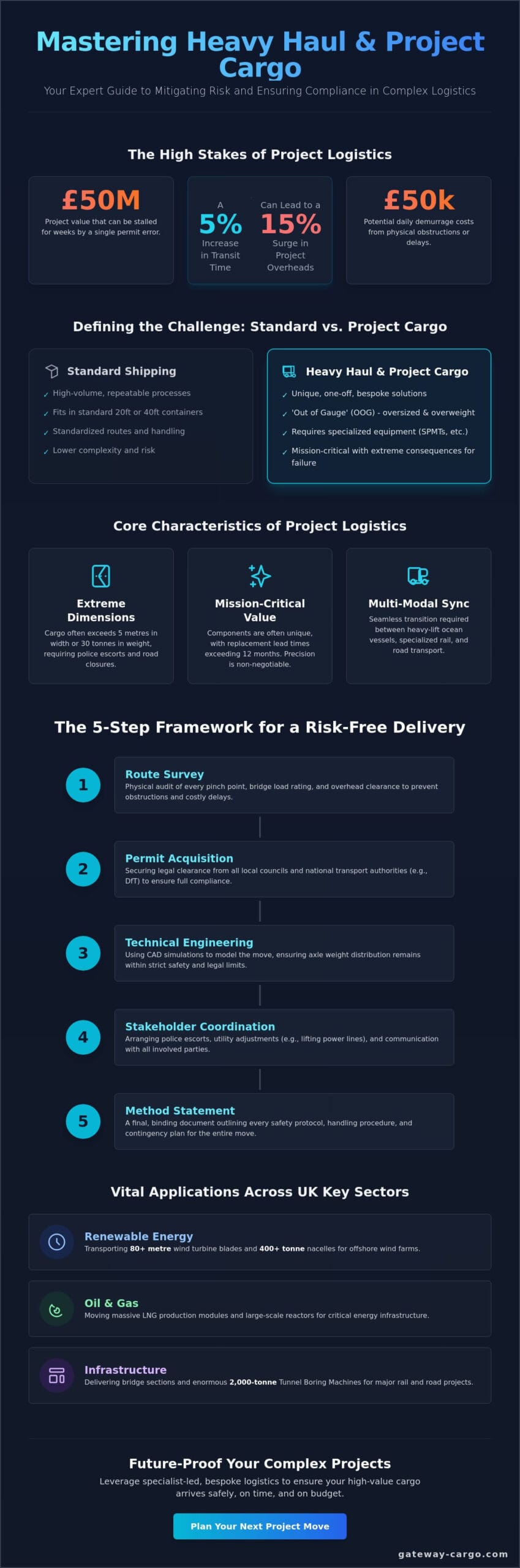
If a single permit error can stall a £50 million infrastructure project for weeks, is your logistics strategy truly resilient? You’ve likely experienced the frustration of regulatory delays or the stress of unpredictable costs when managing heavy haul and project cargo services. It’s a common reality where a 5% increase in transit time can lead to a 15% surge in total project overheads. We understand that the fear of cargo damage and the complexity of UK transport permits can make these moves feel like a high-stakes gamble.
This guide provides the expert insights you need to master these complexities through meticulous planning and risk mitigation. You’ll discover how to secure a risk-free delivery schedule while maintaining full regulatory compliance. We’ll explore the integration of sustainable logistics into heavy projects, ensuring your operations are both efficient and forward-looking. From managing Department for Transport (DfT) guidelines to optimising bespoke freight solutions, this overview prepares you for a smarter, more reliable supply chain.
Key Takeaways
- Understand how to navigate the 2026 landscape of heavy haul and project cargo services by mastering bespoke engineering and detailed route surveys.
- Learn the essential steps for securing international permits and conducting site surveys to mitigate physical obstacles for abnormal loads.
- Discover how to optimise multi-modal strategies, comparing road, rail, and breakbulk shipping to enhance efficiency for oversized freight.
- Leverage AI-driven digital strategies to predict transit delays and ensure real-time visibility for high-value project moves.
- Explore how integrating sustainable logistics and a bespoke, specialist-led approach can future-proof your most complex industrial projects.
Defining Heavy Haul and Project Cargo Services in 2026
In the current industrial climate, heavy haul and project cargo services represent the most complex tier of global logistics. Unlike standard freight, Project cargo involves the movement of oversized, overweight, or high-value equipment that won’t fit into traditional 20ft or 40ft containers. These shipments require bespoke engineering, meticulous route planning, and specialized equipment to ensure safe delivery. By 2026, the demand for these services has intensified as global supply chains move toward larger, modularized components for efficiency.
Distinguishing these operations from standard international shipping services is essential for effective risk management. While standard shipping relies on high-volume, repeatable processes, heavy haul is defined by its uniqueness. A core concept here is the ‘Out of Gauge’ (OOG) classification. This term applies when cargo dimensions exceed the internal width, height, or length of a standard container. It necessitates the use of flat racks, open-top containers, or specialized trailers like self-propelled modular transporters (SPMTs).
The economic impact of this sector is substantial. Project logistics serves as the backbone for the UK’s energy transition and infrastructure upgrades. Without these specialized capabilities, the construction of massive offshore wind farms or the expansion of the National Grid would stall. These high-stakes movements often involve components worth millions of pounds. A single day’s delay can result in significant liquidated damages for the end-user, making precision non-negotiable.
Key Characteristics of Project Logistics
- Non-standard dimensions: Cargo often exceeds 5 metres in width or 30 tonnes in weight, requiring police escorts or temporary road closures.
- Mission-critical value: Components are frequently one-of-a-kind assets where replacement lead times can exceed 12 months.
- Multi-modal synchronization: Successful delivery requires a seamless transition between heavy-lift ocean vessels, rail corridors, and specialized road transport.
Industry-Specific Applications
The application of heavy haul and project cargo services is vital across three primary UK sectors. In renewable energy, logistics providers transport wind turbine blades exceeding 80 metres and nacelles weighing over 400 tonnes. The oil and gas sector relies on the movement of massive LNG production modules and large-scale reactors. Finally, infrastructure projects depend on the delivery of bridge sections and 2,000-tonne tunnel boring machines for major rail and road developments.
The Critical Role of Pre-Planning and Site Surveys
Success in heavy haul and project cargo services isn’t determined on the road, but weeks or months before the engines start. A single oversight in height clearance or axle weight distribution can result in multi-million pound delays or structural damage. Logistics specialists follow a rigorous five-step pre-planning framework to mitigate these risks.
- Route Survey: Physical identification of every pinch point, bridge, and gradient.
- Permit Acquisition: Securing legal clearance from local councils and national transport authorities.
- Technical Engineering: Using CAD simulations to model the move and ensure weight distribution remains within safety limits.
- Stakeholder Coordination: Arranging police escorts and utility adjustments, such as lifting overhead power lines.
- Method Statement: Producing a final, binding document that outlines every safety protocol and handling procedure.
Route Surveys: Identifying the Path of Least Resistance
A route survey is the foundation of project safety, serving as a comprehensive physical audit of the intended transit path. Specialists must verify bridge load ratings and overhead clearances, particularly for tunnels and power lines that may not match outdated digital maps. In the UK, this often involves assessing narrow rural roads or historical infrastructure that can’t support modern heavy-lift equipment. Evaluating port infrastructure is equally vital; for example, ensuring that a specific terminal has the heavy-lift crane capacity to manage a 300-tonne transformer. Detailed surveys prevent the £15,000 to £50,000 daily demurrage costs that occur when cargo is stranded due to physical obstructions.
Regulatory Compliance and Permit Management
Managing the legalities of abnormal loads requires deep knowledge of varying jurisdictions. In the UK, movers must comply with the Road Vehicles (Authorisation of Special Types) (General) Order 2003 (STGO). If your project extends to North America, you’ll need to account for Federal and state regulations for oversize loads, which vary significantly by state line. Specialized freight forwarders act as the primary liaison between your business and these authorities, managing everything from customs clearance for multi-part shipments to the 2024 updates in environmental compliance standards. Expert oversight is non-negotiable when managing heavy haul and project cargo services across international borders.
Proactive permit management ensures that every legal requirement is satisfied before the cargo reaches the port, maintaining the seamless flow of your project. You can optimise your supply chain by integrating these regulatory experts early in the procurement phase to avoid costly last-minute bottlenecks.
Multi-Modal Strategies for Abnormal Loads
Efficient heavy haul and project cargo services demand a synchronised multi-modal strategy. By 2026, the industry anticipates a 12% rise in the adoption of Ro-Ro (Roll-on/Roll-off) shipping for oversized industrial machinery. This method reduces the reliance on vertical lifting, which inherently lowers the risk of structural stress during transit. Choosing between ocean, road, and rail isn’t just about cost; it’s about mitigating the £5,000 to £15,000 daily demurrage fees that accumulate when transitions fail. Intermodal transfer points represent the “danger zones” of the supply chain. Data suggests that 65% of project cargo damage occurs during these transitions, making rigorous oversight at the quay or railhead vital for success.
Ocean Freight: Breakbulk and Heavy Lift Vessels
Breakbulk shipping is the primary choice for loads that exceed standard container dimensions. When selecting a vessel, logistics planners must decide between geared ships with onboard cranes or relying on shore-based infrastructure. Geared vessels offer flexibility in smaller UK ports, while shore-based cranes at major hubs like London Gateway provide the capacity for lifts exceeding 1,000 tonnes. Safety depends on precision lashing and dunnage. We follow the IMO Code of Safe Practice for Cargo Stowage and Securing (CSS Code) to ensure stability against dynamic sea forces. Partnering with heavy lift and project cargo experts allows for the development of bespoke sea-fastening plans. These plans are critical for managing port congestion, which can stall project timelines by 4 to 7 days if not proactively managed through pre-cleared customs documentation.
Road and Rail: The Final Mile of Heavy Haulage
Land-based transport for abnormal loads requires specialised equipment to protect UK infrastructure. Multi-axle hydraulic trailers distribute extreme weight to comply with bridge strike prevention and axle-load regulations. For the most complex moves, SPMTs (Self-Propelled Modular Transporters) provide 360-degree manoeuvrability for loads over 500 tonnes, allowing for millimetre-precision positioning. Rail freight is gaining traction as a sustainable alternative; it’s capable of reducing carbon emissions by approximately 76% compared to heavy road haulage for long-distance transit. The “last-mile” remains the most challenging phase. Delivering to remote wind farms or construction sites often involves navigating narrow rural lanes. Our specialists conduct physical route surveys to identify obstacles like low-hanging cables or weak culverts. This ensures the heavy haul and project cargo services provided are as seamless on the final delivery leg as they were during the ocean crossing.
Mitigating Risk with AI and Sustainable Logistics
Managing heavy haul and project cargo services involves high-stakes variables where traditional planning often falls short. AI-driven digital strategies now allow logistics teams to predict and avoid transit delays by analysing historical traffic patterns, port congestion, and seasonal weather data. This level of foresight is vital for high-value project moves where a single day of downtime at a construction site can result in losses exceeding £15,000. Real-time visibility ensures that every stakeholder knows the exact position and condition of the cargo, transforming reactive problem-solving into proactive management.
Real-Time Monitoring and Digital Twins
Digital twins let engineers simulate transport conditions before the physical move begins. By creating a virtual replica of the cargo and the UK road network, we identify potential structural stress points or clearance issues. IoT sensors attached to the freight provide constant data on tilt, shock, and temperature. For firms looking to stay ahead of market shifts, supply chain news today highlights how these technologies are essential for navigating the volatility expected throughout 2026.
Green Corridors and Sustainable Heavy Haul
Sustainability is a core requirement for modern industrial projects. We utilise carbon offsetting programmes specifically designed for large-scale logistics to balance the environmental impact of heavy machinery transport. Optimising routes doesn’t just save time; it reduces fuel consumption by up to 12 percent on long-haul journeys. Gateway Cargo remains dedicated to building smarter, greener supply chains by integrating EV support vehicles to lead convoys and manage traffic during complex manoeuvres.
Effective risk management for heavy haul and project cargo services must move beyond standard cargo insurance. While basic policies cover physical damage, they rarely account for the complex business interruption costs associated with infrastructure projects. A robust strategy includes:
- Route Surveys: Physical inspections of bridges and narrow UK junctions to prevent physical strikes.
- Contingency Planning: Pre-approved alternative routes in case of sudden road closures or structural failures.
- Bespoke Coverage: Insurance extensions that cover the specific replacement value and lead times of custom-engineered components.
Relying on data-driven insights and sustainable practices ensures your project remains on track and within budget. If you’re planning a complex move, contact our project cargo specialists to discuss a bespoke logistics strategy.
Bespoke Project Logistics with Gateway Cargo
Standard freight models often fail when applied to complex industrial movements. Gateway Cargo treats every heavy haul and project cargo services requirement as a unique engineering challenge rather than a simple transport booking. Our bespoke approach is essential because no two oversized loads share the same constraints. Whether it’s a 150-tonne transformer for a National Grid substation or wind turbine components destined for the Scottish Highlands, we customise the route, equipment, and permits to match the specific dimensions of the cargo.
We leverage a global network of technical partners and heavy-lift specialists across six continents. This reach allows us to maintain control over the entire supply chain, regardless of the geographic location. Our end-to-end management covers the full lifecycle of a move. We supervise the initial lift from the factory floor, manage the multi-modal transit via road, rail, or sea, and oversee the final positioning on the foundation at the destination site.
The Gateway advantage lies in merging traditional technical expertise with digital innovation. We use AI-driven strategy tools to optimise routes and predict potential bottlenecks before they cause delays. This ensures a smarter supply chain that remains resilient even against the unpredictable nature of project cargo. By combining human experience with data-led insights, we provide a level of precision that minimises risk and protects your capital investment.
Why Partner with Gateway Cargo?
Our team brings decades of experience in handling Out of Gauge (OOG) and breakbulk shipments. We don’t just move cargo; we provide a solution-oriented mindset that anticipates challenges like bridge height restrictions or port congestion. Our expertise in heavy haul and project cargo services ensures that your most valuable assets are in safe hands.
- Dedicated project managers: Our specialists work as part of your team, providing a single point of contact throughout the project lifecycle.
- Solution-oriented mindset: We identify potential hurdles in the planning phase to prevent costly on-site delays.
- Technical proficiency: We handle all UK and international permit requirements, ensuring full compliance with local transport regulations.
Requesting a Project Consultation
Effective planning for a complex move often starts 12 months before the actual transport date. To provide an accurate quote, prepare detailed technical specifications including CAD drawings, weight distribution charts, and centre of gravity data. This precision allows our engineers to select the correct trailers and lifting gear for the job.
You can contact Gateway Cargo for a bespoke project logistics solution to begin the scoping process. Our specialists will review your requirements to build a comprehensive timeline that ensures your project remains on schedule and within budget. We focus on transparency and reliability, ensuring you have the insights needed to make informed decisions for your supply chain.
Future-Proof Your Complex Logistics Strategy
Mastering large-scale movements in 2026 requires a shift from reactive transport to proactive engineering. Success depends on rigorous pre-planning and detailed site surveys that identify potential bottlenecks long before departure. By leveraging an AI-Driven Digital Strategy, you gain real-time tracking and data-led insights that protect your high-value assets throughout their journey. It’s no longer enough to move goods; you must do so with a focus on technical efficiency and environmental impact.
Navigating the UK’s evolving regulatory landscape for heavy haul and project cargo services demands a partner who understands both engineering precision and sustainable practice. Gateway Cargo provides bespoke engineering for every OOG shipment alongside proactive sustainability through EV support options to align with your corporate ESG goals. Our specialists work as part of your team to ensure even the most abnormal loads reach their destination without unnecessary delays or costs. You’ll find that the right expertise transforms logistical hurdles into significant competitive advantages.
Optimize your next project with Gateway’s bespoke cargo solutions
We’re ready to help you navigate your next complex challenge with confidence and precision.
Frequently Asked Questions
What is the difference between heavy haul and project cargo?
Heavy haul refers to the transport of individual loads that exceed standard legal weight or dimension limits on UK roads. Project cargo involves the domestic or international coordination of multiple shipments for a specific, large-scale undertaking. While heavy haul focuses on a single 60 tonne asset, project cargo encompasses the entire logistics chain for a site, such as moving 200 components for a new manufacturing facility over 12 months.
How do I determine if my shipment is Out of Gauge (OOG)?
A shipment is classified as Out of Gauge if its dimensions exceed the internal capacity of a standard 40 foot high cube container. This means any cargo wider than 2.35m, longer than 12.03m, or taller than 2.69m requires specialised equipment. Gateway Cargo specialists use these precise measurements to secure the correct heavy haul and project cargo services, often utilising flat racks or open top containers for safe transit.
What documents are required for international project cargo services?
International moves require a commercial invoice, a packing list, and a Bill of Lading. For UK exports, you’ll need an EORI number to file a Customs Declaration via the Customs Declaration Service (CDS). Large projects also demand Method Statements and Risk Assessments (RAMS). These documents ensure compliance with health and safety standards during the loading and unloading of complex, high-value equipment.
How much lead time is needed to plan a heavy haul project?
You should allow a minimum of 4 to 8 weeks for planning a heavy haul project in the UK. This timeframe accounts for the 5 to 10 working days required for STGO (Special Types General Order) notifications to police and bridge authorities. Complex moves involving road closures or the removal of street furniture often require 12 weeks to obtain the necessary permits from local councils.
Can project cargo be transported via air freight?
Project cargo can be transported via air freight using specialised nose-loading aircraft like the Antonov An-124 or Boeing 747-8F. These aircraft accommodate single pieces weighing up to 120 tonnes or items exceeding 30 metres in length. While it’s more expensive than ocean freight, air transport reduces transit times from weeks to 48 hours for critical components that are essential for project continuity.
What are the biggest risks in project logistics, and how are they managed?
Physical damage and regulatory delays are the primary risks, which we manage through 3D lift planning and rigorous route surveys. Industry data suggests that 80% of cargo claims result from poor packing or securing. We mitigate this by using certified lashing specialists and providing comprehensive marine insurance. This coverage protects the full replacement value of your assets against unforeseen incidents during transit.
How does Gateway Cargo handle customs clearance for multi-part projects?
We manage multi-part projects using Staged Consignment relief, which allows components arriving on different vessels to be classified under a single commodity code. Our team coordinates with HMRC to ensure all individual shipments are linked to the primary project authorisation. This approach simplifies the duty calculation and ensures a seamless logistics experience for complex infrastructure builds involving hundreds of separate deliveries.
Are there sustainable options for moving heavy or oversized equipment?
Sustainable options include using HVO (Hydrotreated Vegetable Oil) fuel for road transport and selecting Green Corridors for ocean freight. Gateway Cargo offers carbon offsetting through verified UK Woodland Carbon Code projects. By switching to HVO, you can reduce CO2 emissions by 90% compared to traditional diesel. This makes it a viable, eco-friendly solution for heavy haul and project cargo services in the modern market.