
DAP Incoterm Explained: A Complete Guide for International Shippers in 2026
What if the “delivered” price you quoted your buyer actually costs your business an extra £1,250 in unforeseen quay rent and port storage fees? You already know that precise logistics are the backbone of a smarter supply chain, but even a minor misunderstanding of risk transfer can lead to significant financial leakage. Industry data from 2024 shows that 31% of UK exporters encounter unexpected destination costs simply because the point of delivery wasn’t clearly defined. Using the dap Incoterm correctly is the solution to these hidden liabilities.
We’ll help you master the complexities of Delivered At Place to optimize your global operations and protect your bottom line. You’ll gain a clear framework for choosing between DAP and DDP, alongside actionable strategies to reduce the risk of expensive demurrage and detention. This guide breaks down the exact moment risk shifts and how to manage local customs clearance without the usual friction.
Key Takeaways
- Understand the fundamental transfer of risk and responsibility under the dap Incoterm to ensure your international shipments reach their UK destination without logistical friction.
- Clarify the division of obligations between parties, specifically the buyer’s critical role in managing UK customs clearance and VAT to prevent costly regulatory bottlenecks.
- Evaluate the strategic trade-offs between DAP and DDP to determine which model offers the most robust compliance and cost-efficiency for your specific trade routes.
- Identify how to navigate the “unloading trap” and mitigate exposure to unexpected £GBP charges resulting from demurrage and detention at the point of delivery.
- Learn how to leverage AI-driven digital strategies and specialist expertise to transform your logistics into a smarter, more resilient global supply chain.
What is the DAP Incoterm? Definition and Core Meaning
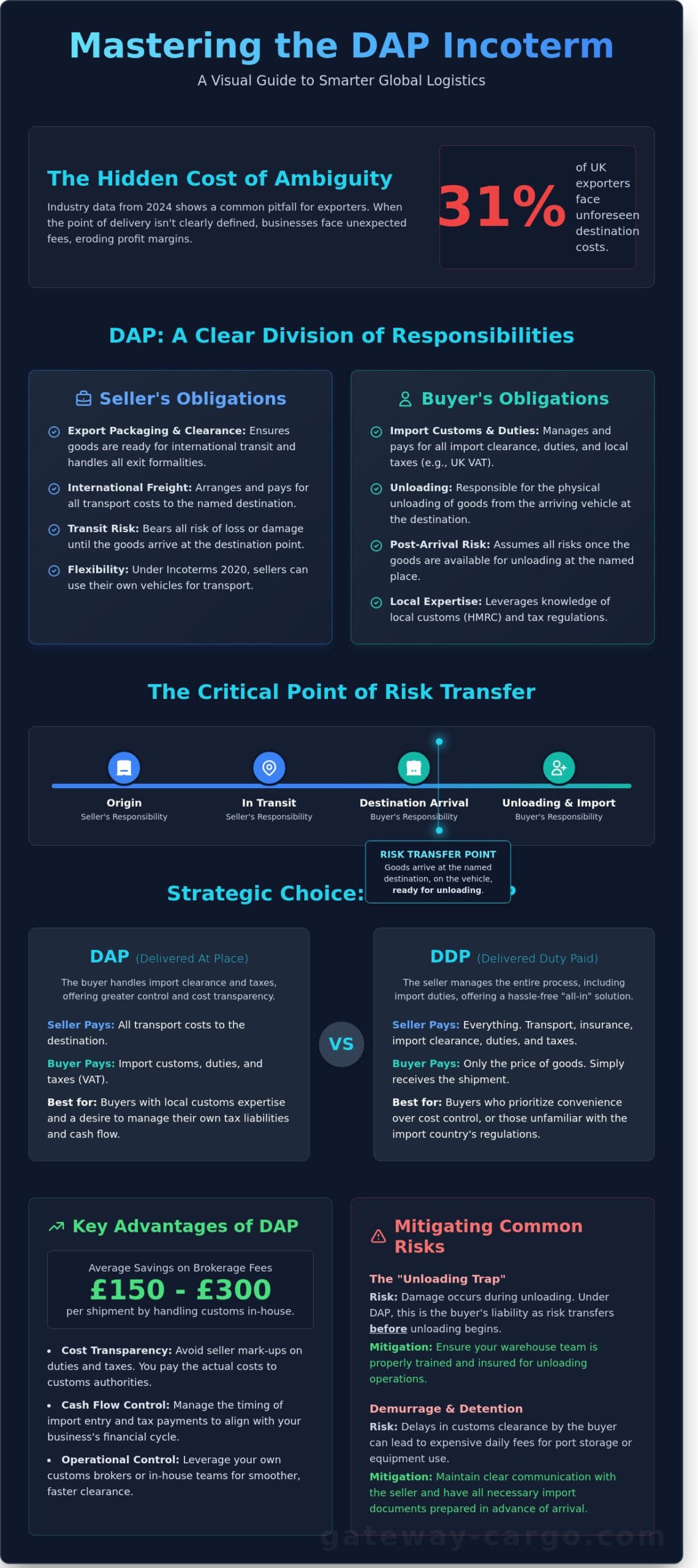
Delivered At Place, commonly referred to as dap, is a versatile shipping agreement defined by the International Chamber of Commerce (ICC). It places the majority of the transport responsibility on the seller’s shoulders while leaving the final administrative hurdles to the buyer. Under the Incoterms 2020 rules, which became the global standard on 1 January 2020, the seller is responsible for all costs and risks associated with moving goods to a specifically named destination. This includes export packaging, freight charges, and any transit insurance required until the cargo reaches its arrival point.
The fundamental shift occurs when the goods arrive at the destination. While the seller manages the logistics of the journey, the buyer must handle import clearance, duties, and local taxes such as UK VAT. This arrangement creates a balanced partnership. The seller provides the logistical expertise to move goods across borders, while the buyer uses their local knowledge to navigate domestic customs regulations. This is particularly effective for UK importers who have established relationships with HMRC and possess their own deferment accounts for duty payments.
The transition from the 2010 standards to the current 2020 rules introduced subtle but vital clarifications. The most significant change involves the “means of transport” clause. The 2020 update explicitly allows sellers to use their own transport vehicles rather than being forced to hire a third-party carrier. This provides greater flexibility for European suppliers delivering directly to UK sites via road freight. It ensures that businesses with private fleets can maintain full control over the supply chain without violating the technical definitions of the term.
The Critical Point of Delivery
Precision is vital when defining the “named place of destination” in a contract. Under ICC 2020 text, delivery occurs when the goods are placed at the buyer’s disposal on the arriving means of transport. Crucially, the cargo must be ready for unloading. If a shipment arrives at a Manchester warehouse at 09:00, the seller’s risk terminates the moment the vehicle stops at the bay; the buyer then assumes the risk for the actual physical unloading process. This distinction prevents disputes over damage caused by forklift operators or warehouse staff during the final stage of arrival.
Why Shippers Choose DAP in 2026
Modern businesses often select dap when they possess specialised local customs expertise. By 2026, many UK importers have integrated digital customs software that allows them to clear goods in-house, saving an average of £150 to £300 per shipment in third-party brokerage fees. This model offers high cost transparency. Instead of paying a seller’s marked-up “all-in” price for delivery and duty, the buyer pays the actual freight cost and manages their own tax liabilities. It aligns perfectly with B2B distribution models where the buyer wants to control the timing of the import entry to manage cash flow more effectively.
- Seller Responsibility: Export clearance, international freight, and delivery to the named site.
- Buyer Responsibility: Import customs entry, payment of duties/VAT, and unloading.
- Risk Transfer: Occurs at the named place, once the vehicle arrives and is ready for unloading.
Seller and Buyer Responsibilities Under DAP Terms
Understanding the division of obligations under dap is essential for maintaining a lean supply chain. The seller assumes the majority of the logistical burden, managing the movement of goods until they reach the agreed-upon destination. However, the buyer remains responsible for the critical administrative hurdles of importation. This split requires a high degree of transparency between both parties to avoid costly port storage fees or demurrage charges. Clear communication ensures that the hand-off occurs without the cargo sitting idle at a border.
According to the International Trade Administration, clear definitions of these responsibilities prevent disputes and ensure that insurance coverage is adequate. For UK businesses, this means identifying exactly where the seller’s risk ends. Usually, this point is when the vehicle arrives at the named place, ready for unloading, but still on the arriving transport. If the seller fails to provide the necessary documents for the buyer to clear customs, they may be liable for the resulting delays.
The Seller’s To-Do List
The seller’s primary goal is to deliver the cargo safely to the buyer’s doorstep or a designated terminal. This process begins with export packaging and marking. Goods must be secured for international transit to withstand the rigours of ocean or air travel. The seller then arranges and pays for the main carriage. Whether it’s a £4,500 air freight shipment or a £1,200 road haulage trip from Europe, these costs sit on the seller’s balance sheet until the point of delivery.
- Export Clearance: The seller handles all export formalities, licences, and costs in the country of origin.
- Main Carriage: They manage the contract of carriage via road, rail, air, or sea to the named place.
- Delivery Documentation: The seller must provide a delivery document, such as a Bill of Lading or a sea waybill, allowing the buyer to take possession.
The Buyer’s Critical Duties
The buyer takes over once the goods arrive at the destination. Their most significant responsibility is import customs clearance. Data from 2023 suggests that 38% of international shipping delays stem from incorrect customs paperwork or unpaid duties. Under dap terms, the buyer must act quickly to process the entry. If a shipment arrives at a UK warehouse, the buyer is liable for the 20% Import VAT and any relevant tariffs dictated by the UK Global Online Tariff. They also handle the physical unloading of the goods, which must be completed promptly to avoid vehicle detention charges.
- Import Formalities: Managing all local licences, permits, and customs declarations required by HMRC.
- Taxes and Duties: Paying all local taxes, VAT, and customs duties upon arrival in the UK.
- Unloading: The buyer must have the necessary equipment, such as forklifts or cranes, ready to unload the vehicle.
Bridging the gap between these two sets of responsibilities often requires a specialist. Logistics providers manage the intricate flow of documentation, including the Commercial Invoice, Packing List, and Bill of Lading. These documents act as the passport for the cargo. For businesses looking to streamline this process, bespoke freight solutions can help manage the transition of risk seamlessly. A freight forwarder ensures that the seller’s transport timeline aligns perfectly with the buyer’s customs brokerage capacity. This coordination reduces the risk of the cargo sitting idle, which can cost upwards of £180 per day in quay rent at major UK ports like Felixstowe or Southampton.
DAP vs. DDP: Choosing the Right Strategy for Your Supply Chain
Deciding between these two Incoterms often dictates the total profitability of an international trade contract. While DDP offers a “landed cost” experience for the buyer, it forces the seller to manage foreign tax jurisdictions and local regulations. This creates a steep administrative climb for the exporter. For a £50,000 shipment of industrial machinery, the difference in tax handling can represent £10,000 in recoverable or non-recoverable VAT. Choosing DAP vs. DDP shifts the primary responsibility for import clearance and duty payment to the party best equipped to handle it: the local buyer. Under dap terms, the buyer maintains control over their local customs process, which is often more efficient than a foreign seller attempting to act as a local entity.
The Hidden Risks of DDP
Sellers often underestimate the “Importer of Record” (IOR) requirement. To ship DDP into many territories, a seller must have a local legal entity or a fiscal representative. Without this, they cannot legally clear goods through customs. In 2023, data suggested that 18% of cross-border B2B shipments faced delays due to incorrect IOR status. Using dap simplifies the seller’s administrative burden significantly. The seller’s responsibility ends when the goods arrive at the named place, ready for unloading. This setup shields the seller from local VAT liabilities that can reach 20% of the cargo value in the UK. Because the buyer acts as the importer, they can often reclaim this VAT, whereas a foreign seller under DDP might see it become a sunk cost.
DAP for Ocean vs. Air Freight
Shipping by sea introduces the risk of demurrage and detention. At major UK ports like Felixstowe or Southampton, daily demurrage charges can exceed £160 per container after the initial free period. Under DAP, the seller must ensure the vessel reaches the port, but the buyer’s speed in clearing customs determines if these fees accrue. If the buyer fails to provide documentation, the seller is not liable for those port storage costs. For air freight, the timeline is much tighter. A shipment from Heathrow might arrive at a destination in 8 hours. If the buyer isn’t ready to process the import, storage fees at airside facilities accumulate faster than at sea ports. For door-to-door DAP shipments, intermodal transfers require precise documentation. If a container moves from rail to truck, the named place must be clearly defined to avoid disputes over who pays the final leg’s haulage.
Financial impact and cash flow management are critical factors in this choice. Consider these points:
- Capital Retention: Under DDP, the seller pays import duties upfront, tying up capital for weeks. For a high-frequency supply chain moving £250,000 of goods monthly, this leads to a significant cash flow deficit.
- Tax Reclamation: Buyers in the UK can use their own deferment accounts with HMRC. This ensures the seller isn’t acting as a bank for the buyer’s tax obligations.
- Complexity Management: DAP is preferred for high-value cargo where customs jurisdictions are complex, as the buyer possesses the local expertise to handle specific tariff codes and exemptions.
By selecting the right term, businesses optimise their logistics spend and reduce the likelihood of cargo being held at the border. While DDP might seem like a premium service, the administrative simplicity of DAP often provides a more reliable route for complex global supply chains.
Managing Risks and Avoiding Hidden Costs in DAP Shipments
The transition of responsibility in a dap agreement happens at a specific, often misunderstood moment. Under these terms, the seller’s obligation ends when the vehicle arrives at the named destination, ready for unloading. This creates what specialists call the ‘unloading trap.’ If your cargo requires a specialist hiab crane or a heavy-duty forklift to get it off the trailer, the buyer must arrange and fund this equipment. Disputes frequently occur when a driver arrives at a UK warehouse only to find no means to offload. These logistics failures result in ‘failed delivery’ charges, which typically start at £250 per attempt for standard heavy goods vehicles.
Port delays represent another significant financial hazard for both parties. In 2023, average dwell times at major UK ports like Felixstowe and Southampton fluctuated, often leaving importers with unexpected demurrage fees. Because the buyer handles import clearance under this Incoterm, any administrative lag is their financial burden. If they fail to provide the correct commodity codes or deferment account details, the container sits at the quay. These charges often escalate to £100 or £150 per day after the initial five-day free period. While the seller manages the physical transport, the buyer’s administrative speed dictates the final cost of the operation.
Insurance isn’t a mandatory requirement for sellers under the official rules. However, data suggests that 82% of logistics professionals recommend bespoke cargo insurance for international movements. Since the seller carries the risk until the goods reach the destination, any damage in transit falls directly on their balance sheet. A £40,000 shipment of electronics damaged by sea spray or rough handling becomes a total loss if the seller relies solely on standard carrier liability. These carrier limits often pay as little as £1.30 per kilogram, which doesn’t come close to covering high-value freight.
Navigating Customs Delays
If a buyer fails to clear customs, the goods are often moved to a temporary storage facility or a bonded warehouse. This creates a complex grey area regarding the transfer of risk. While the seller is technically responsible for the goods until they reach the named place, the buyer is liable for any costs or risks arising from their failure to perform import obligations. The seller’s liability for delivery is suspended during any period where a customs hold-up is caused solely by the buyer’s failure to provide documentation or pay HMRC duties.
The Importance of Precise Wording
Vague destination strings lead to expensive litigation and redirected haulage fees. A ‘bad’ description would be ‘DAP London,’ whereas a ‘good’ description specifies ‘DAP Unit 4, Gateway Trade Park, SE10 0JF, UK, Incoterms 2020.’ For last-mile delivery to remote Scottish Highlands or rural Welsh locations, costs can spike by 35% compared to standard motorway routes. Precise wording ensures the haulier’s quote is accurate and prevents ‘out of area’ surcharges from appearing on the final invoice. It’s also vital to integrate the 2020 legal language to ensure both parties are protected by the most recent ICC standards.
Optimizing Your DAP Logistics with Gateway Cargo
Managing the complexities of dap agreements requires more than just a carrier; it demands a strategic partner. Gateway Cargo’s specialists act as a direct extension of your internal team, removing the administrative burden of coordinating international transit. We provide bespoke freight solutions that align with the specific requirements of the Delivered-at-Place Incoterm, ensuring every shipment reaches its named destination with precision. By integrating our expertise into your workflow, you gain the ability to scale your operations without the overhead of managing multiple local contractors or navigating unfamiliar regional regulations.
Our AI-driven digital strategy underpins every shipment we handle. This technology provides real-time tracking and predictive analytics, which is essential when the seller bears the risk until the goods are ready for unloading. You’ll receive instant updates on cargo status, allowing for proactive decision-making if port congestion or weather events threaten your delivery schedule. This level of visibility transforms a standard logistics process into a smarter supply chain, giving you the data needed to refine your lead times and improve customer satisfaction levels across the United Kingdom and beyond.
Global Reach, Local Expertise
Successful handovers at the named place depend on local knowledge. Gateway Cargo maintains an extensive network of destination specialists who understand the nuances of UK infrastructure and regional logistics hubs. We manage all warehousing and staging requirements at the final destination, ensuring goods are positioned correctly for the buyer. Our team navigates HMRC regulations and the Customs Declaration Service (CDS) with total accuracy, preventing the costly delays that often occur during the transition from international freight to local delivery.
In a 2023 case study, a West Midlands-based automotive component manufacturer utilized our multi-modal dap solutions to overhaul their European distribution. By synchronizing sea freight into the Port of Southampton with immediate road transfers, they achieved a 14% reduction in total transit times. We handled all intermediate storage and local coordination, allowing the client to maintain a lean inventory model while meeting strict delivery windows for their Tier 1 customers.
The Future of Smarter Supply Chains
Modern logistics requires a commitment to environmental responsibility. We help you integrate sustainability into your Incoterm strategy by utilizing green corridors and an expanding fleet of EV vehicles. This is particularly beneficial for deliveries into UK urban centres with active Clean Air Zones, such as London, Birmingham, or Bristol. By choosing low-emission transport for the final leg of the journey, you reduce your carbon footprint and ensure compliance with evolving environmental legislation without sacrificing efficiency.
- EV Fleet Integration: We use electric heavy goods vehicles for short-haul and final-mile deliveries to minimize nitrogen dioxide emissions.
- Carbon Reporting: Gain clear data on the environmental impact of your shipments to support your corporate ESG goals.
- Optimised Routing: Our AI algorithms calculate the most fuel-efficient paths, reducing unnecessary mileage and fuel consumption.
Bespoke freight solutions are no longer a luxury; they’re a necessity for businesses looking to compete in a global market. Whether you’re moving high-value electronics or industrial machinery, our team ensures your DAP obligations are met with professional rigour. It’s time to move beyond traditional shipping and embrace a logistics model built for the future.
Optimize your freight with Gateway Cargo’s specialists today
Mastering Your Global Logistics Strategy for 2026
Navigating international trade requires more than just a basic understanding of shipping terms. By 2026, successful UK exporters must balance the seller’s obligation to deliver goods ready for unloading against the buyer’s responsibility for import clearance and local VAT. Mastering dap terms allows your business to maintain control over transit costs while ensuring goods reach their destination safely. It’s about mitigating the risk of unexpected terminal charges that can often exceed £500 per container if logistics aren’t handled with precision.
Gateway Cargo provides the infrastructure needed to turn these complex regulations into a competitive advantage. Our AI-Driven Digital Strategy offers 24/7 real-time tracking across our global network of specialists, ensuring your cargo never disappears into a black hole. We’re also leading the transition to greener logistics through our investment in EV vehicle solutions for final-mile deliveries within the UK and beyond. This commitment helps your firm meet tightening carbon reporting requirements while maintaining peak efficiency.
Don’t leave your international margins to chance. Request a bespoke freight quote for your DAP shipments today and let our team build a smarter, more resilient supply chain for your business. We’re ready to help you scale with confidence.
Frequently Asked Questions
Who pays the freight under DAP terms?
The seller pays all freight costs required to transport the goods to the agreed destination. These expenses include export licensing, packaging, and carriage fees until the vehicle reaches the named place. The buyer only becomes responsible for costs once the goods arrive and are ready for unloading at the final site.
Does DAP include customs clearance?
No, the buyer is responsible for all import customs clearance procedures and associated taxes. Under dap terms, the seller’s obligation ends when the goods are ready for unloading at the destination. The buyer must settle UK Global Tariff payments, which often range from 0% to 20% based on the specific commodity code of the shipment.
What is the difference between DAP and DPU?
The primary distinction is the responsibility for unloading the cargo at the destination. In a dap agreement, the buyer is responsible for the cost and risk of unloading the goods. Under DPU (Delivered at Place Unloaded), the seller must unload the items. The ICC introduced DPU in the 2020 Incoterms revision to replace the previous DAT term.
Who is responsible for unloading the goods in a DAP shipment?
The buyer carries the responsibility for unloading the goods from the arriving transport vehicle at the named destination. The seller’s delivery is complete when the vehicle reaches the specified location. If a warehouse requires a forklift or crane for offloading, the buyer must arrange and pay for this equipment to avoid delays.
Is insurance mandatory for DAP Incoterms?
Neither the buyer nor the seller is legally required to provide insurance under these specific terms. However, the seller bears all risks until the goods reach the destination. Most logistics specialists recommend a marine or transit insurance policy covering 110% of the total cargo value to protect against potential damage during the journey.
Can DAP be used for all modes of transport?
Yes, this term is highly flexible and applies to air, sea, road, and rail transport. It’s an ideal choice for intermodal shipments where cargo moves through multiple stages, such as an ocean voyage followed by road haulage. This versatility makes it a standard choice for UK businesses managing complex global supply chains.
What happens if the buyer doesn’t pay import duties in a DAP agreement?
If the buyer fails to pay import duties, HMRC will hold the goods at the UK border or port. The seller isn’t liable for these delays or any resulting storage fees. HMRC often applies demurrage charges exceeding £75 per day, and these costs remain the buyer’s responsibility until the cargo is cleared for entry.
How is DAP different from CIF?
The main difference lies in the mode of transport and the point where risk transfers. CIF is strictly for sea and inland waterway transport, whereas the other term applies to any transport method. Under CIF, risk transfers once the goods are on the vessel. In this agreement, the seller retains the risk until the goods arrive at the final destination.