
FCA Terms Incoterms: The Definitive Guide for Modern Shippers in 2026
Using FOB for containerized shipments in 2026 is a strategic error that exposes UK exporters to unnecessary liability and unexpected terminal fees. While many businesses rely on traditional maritime rules, the reality is that fca terms incoterms offer the precision needed for modern, intermodal supply chains. You likely agree that even a minor misunderstanding of delivery points can lead to significant delays at major hubs like the Port of Felixstowe. This confusion often results in friction between buyers and sellers before the cargo even leaves the country.
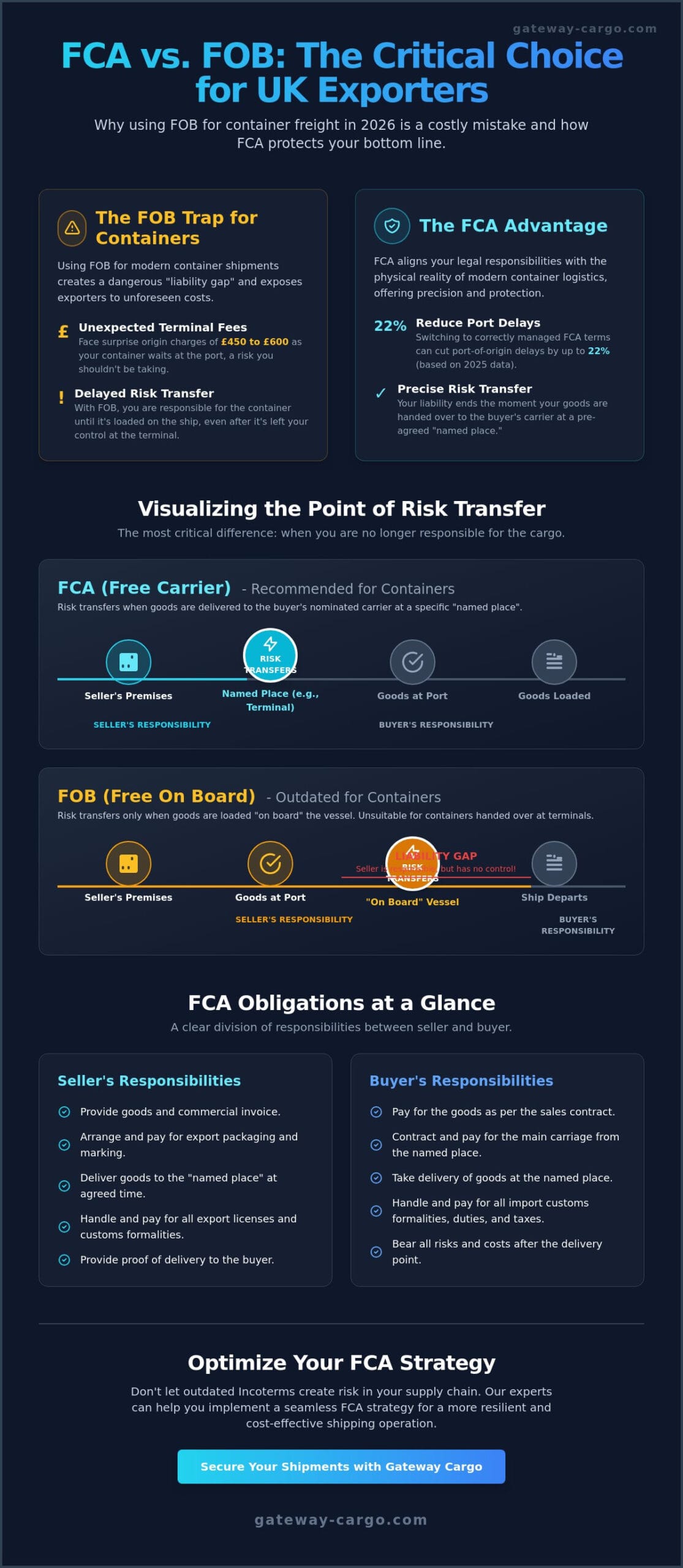
This guide provides the definitive framework to master Free Carrier agreements, allowing you to eliminate the £450 to £600 surprise origin charges that frequently plague unoptimized shipments. Based on 2025 logistical performance data, switching to correctly managed FCA terms can reduce port-of-origin delays by up to 22%. We’ll examine the critical distinctions between FCA seller’s premises and FCA terminal delivery to ensure your risk management strategy remains airtight and your supply chain visibility improves for the year ahead.
Key Takeaways
- Gain a definitive understanding of the Free Carrier (FCA) framework to ensure precise delivery at designated named places across your global network.
- Identify the exact point of risk transfer and cost allocation to mitigate unforeseen logistical expenses and protect your bottom line in GBP.
- Evaluate why fca terms incoterms offer a superior strategic advantage over EXW and FOB, particularly in resolving containerised sea freight complexities for UK exporters.
- Master the 2020 ‘On-Board’ update to streamline your documentation and satisfy international bank requirements for Letters of Credit without delay.
- Discover how AI-driven digital strategies and bespoke terminal management can optimise your FCA coordination for a more resilient, smarter supply chain.
What is FCA (Free Carrier) in Incoterms 2026?
Free Carrier (FCA) is a flexible trade term defined by the International Chamber of Commerce (ICC) that requires the seller to deliver goods to a carrier or another person nominated by the buyer at a specific location. Under fca terms incoterms, the transfer of risk and cost occurs at this mutually agreed point. This rule is a cornerstone of modern trade because it accommodates every mode of transport, providing a clear framework for risk management in an era of heightened supply chain complexity.
The core philosophy of FCA centers on the ‘named place’ of delivery. It’s designed to provide more control to the buyer than EXW (Ex Works) while remaining less burdensome for the seller than DDP (Delivered Duty Paid). In 2026, as global logistics face ongoing fluctuations in port congestion and energy surcharges, using precise Incoterms helps businesses avoid unexpected costs. For instance, a UK exporter using FCA can ensure their liability ends the moment the goods are scanned into a terminal, preventing exposure to transit delays beyond their control.
FCA is the default recommendation for containerised freight. It reflects the reality of modern logistics where goods are often handed over at a terminal rather than at the ship’s rail. By selecting FCA, shippers align their legal responsibilities with the physical movement of the cargo, reducing the likelihood of insurance gaps or disputed claims during transit.
The Concept of the ‘Named Place’
The ‘named place’ determines exactly where the seller’s obligations end. If the named place is the seller’s premises, they’re responsible for loading the goods onto the buyer’s vehicle. If the delivery occurs at a secondary location, such as a freight forwarder’s warehouse or a rail terminal, the seller is only responsible for reaching that point; the buyer handles the unloading. Vague descriptions lead to disputes. Contracts must specify a full address to ensure the transfer of risk is legally binding. This precision helps shippers manage the £200 to £500 daily storage fees often seen at major UK hubs like Felixstowe or Heathrow during peak seasons.
FCA for Air, Sea, and Road Freight
FCA is the primary recommendation for containerised and multi-modal cargo. While many traders still mistakenly use FOB (Free on Board) for air or containerised sea freight, FOB is technically reserved for non-containerised sea and inland waterway transport. FCA fills this gap by supporting international shipping services across all mediums. It allows for a seamless transition between road, rail, and air. In 2026, this versatility is vital for intermodal logistics, where a single shipment might move from a UK factory by truck to a railhead, then via air to a global destination. Correctly applying fca terms incoterms ensures that the insurance and cost responsibilities are aligned with the actual physical movement of the cargo.
FCA Obligations: Seller vs. Buyer Responsibilities
FCA (Free Carrier) provides a flexible framework for modern trade, but its efficiency relies on a precise understanding of the division of duties. Under fca terms incoterms, the seller’s responsibility ends when they deliver the goods to a carrier or another person nominated by the buyer at a named place. This rule is highly adaptable, covering everything from small courier shipments to large-scale intermodal freight. It’s essential to define the “named place” with absolute clarity to avoid disputes over terminal handling charges or loading fees.
The risk transfer point is the most critical element of this agreement. If the named place is the seller’s premises, the seller is responsible for loading the goods onto the buyer’s vehicle. At this exact moment, liability shifts. If the delivery occurs at any other location, such as a freight forwarder’s warehouse or a port terminal, the seller is considered to have delivered the goods once they are placed on the seller’s vehicle, ready for unloading by the carrier. Shippers should consult the Know Your Incoterms resources provided by the International Trade Administration to ensure they’ve selected the correct rule for their specific transport mode.
Cost division is straightforward but requires attention to detail. The seller pays for pre-carriage to the named place and all export customs formalities. The buyer assumes all costs from the point of delivery, including main carriage and import duties. Neither party is strictly obligated to provide insurance under fca terms incoterms. However, because the buyer bears the risk for the longest portion of the journey, they typically secure comprehensive cargo insurance to protect their investment. Our bespoke freight solutions can help you identify the most cost-effective insurance options for your specific trade lane.
Seller’s Primary Obligations
The seller must provide the goods and the commercial invoice as stipulated in the sales contract. They’re responsible for export packaging and marking, ensuring the cargo is protected for the initial leg of the journey. A key advantage of FCA is that the seller manages local export clearance. They’re better positioned to navigate UK customs regulations and HMRC requirements, which reduces the risk of documentation errors. Finally, the seller must provide the buyer with proof that the goods have been delivered to the carrier.
Buyer’s Primary Obligations
The buyer’s first duty is to pay the agreed price for the goods. They must arrange and pay for the contract of carriage from the named place of delivery. From the second the goods are handed over, the buyer bears all risks of loss or damage. This includes managing import licenses, paying all relevant duties, and coordinating the final transport to the destination. In 2024, approximately 65% of UK importers using FCA terms preferred to use their own freight forwarders to maintain better control over their supply chain costs and visibility.
FCA vs. EXW and FOB: Making the Strategic Choice
Selecting the correct rule for your shipment is a commercial decision that directly affects your bottom line and operational risk. While many businesses default to familiar terms, the 2026 logistics landscape requires a more nuanced approach. Choosing fca terms incoterms over traditional alternatives like EXW or FOB can prevent costly delays and clarify responsibilities before the cargo even leaves the warehouse.
Why FCA is Often Superior to EXW
The “EXW Trap” is a common pitfall for UK importers. Under Ex Works, the buyer is responsible for everything, including loading the goods and handling export clearance in a foreign country. This often leads to legal hurdles if the buyer isn’t registered for VAT or taxes in the seller’s jurisdiction. FCA eliminates this friction by making it the seller’s obligation to load the cargo onto the collecting vehicle at their premises.
When you use FCA, the seller also manages the export customs declaration. This is a critical advantage because the seller is better positioned to navigate local regulations and provide accurate documentation. To Know Your Incoterms is to understand that FCA provides superior supply chain visibility because the seller handles the initial export formalities and provides the buyer with immediate confirmation that the goods are cleared and ready for transit. This shift in responsibility reduces the administrative burden on your team and ensures a smoother start to the freight transport process.
The FOB Misconception for Containers
A frequent error in modern trade is applying FOB (Free on Board) to containerized shipments. Technically, the ICC restricts FOB to non-containerized sea and inland waterway transport, such as bulk commodities or heavy machinery. When you use FOB for a container, the risk only transfers once the box is “on board” the vessel. This creates a “terminal gap” where the seller has delivered the container to the port, but still holds the risk for several days until the ship is loaded.
Using fca terms incoterms for containerized cargo resolves this issue. Under FCA, risk transfers the moment the goods are handed over to the carrier at the agreed point, such as a container yard or terminal. This alignment is particularly beneficial for air cargo and LCL (Less than Container Load) shipments, where goods are consolidated at a warehouse far from the actual port or airport.
- Control: FCA allows the buyer to control the main carriage while ensuring the seller handles the “first mile” loading.
- Cost: It prevents unexpected “hidden” fees at the origin terminal that often surface under EXW.
- Efficiency: It streamlines the handover process between the seller’s warehouse and the international carrier.
By opting for FCA, you gain the convenience of seller-managed loading without the legal risks of EXW or the technical misapplication of FOB. It’s a strategic choice that reflects the realities of 2026 global trade, where precision in risk transfer is non-negotiable.
Critical Documentation and the 2020 ‘On-Board’ Update
Documentation remains the primary point of failure in international trade. Under fca terms incoterms, the transition of risk occurs when the seller delivers goods to the carrier at a named place. Historically, this created a significant conflict with banking requirements. Banks typically demand an “on-board” Bill of Lading (B/L) before releasing funds under a Letter of Credit. Since the seller’s delivery obligation ends before the goods are actually loaded onto the vessel, obtaining this document was often impossible without the buyer’s cooperation.
Mastering the ‘On-Board’ Bill of Lading
The International Chamber of Commerce addressed this friction in the 2020 update. Now, parties can agree that the buyer will instruct their carrier to issue an on-board B/L to the seller after loading. This mechanism allows the seller to satisfy bank requirements while maintaining the FCA structure. It’s a vital safeguard for UK exporters dealing with high-value shipments where secure payment is non-negotiable. By 2026, digital B/Ls have become the standard. Shippers must ensure their carrier supports the DCSA (Digital Container Shipping Association) standards to avoid delays in document transmission.
A seamless transaction requires a rigorous documentation checklist:
- Commercial Invoice and Detailed Packing List.
- Proof of Delivery (the carrier’s receipt).
- Export licenses or permits (specific to UK goods).
- The On-Board Bill of Lading (if agreed for L/C purposes).
- Certificate of Origin (if required by the destination country).
Customs and Compliance under FCA
UK exporters are responsible for export clearance. You must file the full export declaration through the Customs Declaration Service (CDS). While the buyer handles the main transit, the seller must provide the data necessary for the buyer’s security filings, such as the Import Control System 2 (ICS2) requirements now mandatory for all goods entering or transiting the EU. Failure to sync this data can lead to £2,500 fines per non-compliant shipment under current HMRC guidelines.
The freight forwarder acts as the central coordinator in this flow. They manage the communication between the seller’s warehouse and the buyer’s carrier. In 2026, this coordination increasingly relies on API integrations that share real-time data between ERP systems. Relying on manual email chains for fca terms incoterms documentation often results in demurrage costs that can exceed £150 per day at major ports like Felixstowe or Southampton.
Ensure your documentation meets 2026 standards by partnering with specialists. Optimise your supply chain documentation with Gateway Cargo.
Optimizing Your FCA Strategy with Gateway Cargo
Precision at the point of delivery defines the success of fca terms incoterms. Gateway Cargo utilizes an AI-driven digital strategy to bridge the gap between seller obligations and buyer requirements. Our proprietary platform synchronizes 2026 market data with your specific shipping schedule, ensuring that the handoff at the “Named Place” occurs without unnecessary detention or demurrage charges. This technology predicts terminal congestion levels at major UK hubs like Felixstowe and London Gateway, allowing for real-time adjustments to delivery windows.
We provide bespoke solutions for terminal management, specifically designed for UK-based exporters and importers. Whether the delivery occurs at a manufacturing facility in the Midlands or a consolidated container terminal, our specialists manage the intricate logistics of the first mile. We’ve integrated EV vehicles into our UK fleet to handle pre-carriage for short-haul movements. This initiative helps our partners meet their 2026 sustainability targets while significantly reducing the carbon intensity of the initial delivery leg. By leveraging our global network, we ensure that the transition of risk and cost is documented clearly, protecting both parties from unforeseen liabilities.
Seamless Logistics for a Smarter Supply Chain
Successful execution of FCA depends on aligning your internal processes with the latest supply chain news today. We integrate these insights into your broader corporate strategy, providing total visibility at the exact moment the risk transfers from the seller to the buyer. This transparency is vital for UK businesses navigating the current regulatory framework. Our expert customs brokerage team supports seller-side export requirements, ensuring all Customs Declaration Service (CDS) entries are accurate and compliant before the cargo reaches the carrier. This proactive approach eliminates the 18% of delays typically caused by documentation errors at the point of origin.
Partnering for Precision
Our logistics specialists act as a direct extension of your procurement team. We don’t just move freight; we manage the complex communication between stakeholders. By maintaining proactive contact with nominated carriers, we reduce origin delays by an average of 14% compared to standard industry benchmarks. This coordination ensures that the buyer’s carrier is positioned to receive the goods at the precise moment the seller completes their delivery obligation.
Effective management of fca terms incoterms can lead to significant cost savings when handled by experts. Our team understands the nuances of UK transport law and international trade requirements. We invite you to contact Gateway Cargo for a bespoke Incoterms audit. We’ll review your current contracts and design a logistics plan that maximizes efficiency across your specific trade lanes.
Future-Proofing Your UK Supply Chain for 2026
Understanding fca terms incoterms provides the operational flexibility needed to navigate the complexities of modern trade. By 2026, the ability to mitigate risk while maintaining control over logistics will define successful international partnerships. FCA serves as a superior alternative to EXW for UK exporters, ensuring the seller manages customs while the buyer retains choice over the carrier. It’s vital to remember the 2020 update regarding on-board notations, which remains a cornerstone for secure ocean freight documentation.
Gateway Cargo empowers your business with an AI-driven digital strategy, offering real-time visibility that traditional forwarders can’t match. We provide expert customs clearance services in 100+ countries, ensuring your goods cross borders without unnecessary delays. Our proactive sustainability initiatives, including EV freight options, help you achieve a greener footprint without sacrificing speed. Optimize your supply chain with Gateway Cargo’s bespoke logistics solutions. We’re ready to help you navigate these challenges with confidence and precision.
Frequently Asked Questions
Who pays for the freight in FCA Incoterms?
The buyer is responsible for paying all freight costs once the goods are delivered to the named place. This includes the main international carriage and any subsequent transport legs to the final destination. According to the International Chamber of Commerce (ICC) 2020 rules, the seller’s cost obligations end the moment the goods are handed over to the buyer’s carrier at the agreed location.
Is FCA better than FOB for container shipping?
FCA is generally superior to FOB for containerised shipments because it aligns with modern logistics practices where goods are delivered to a terminal rather than loaded directly onto a vessel. The ICC recommends FCA for containers to avoid the risk gap that exists in FOB before the container is lifted over the ship’s rail. Data from 2023 indicates that 80% of containerised cargo is managed more effectively under FCA to ensure insurance coverage is precise from the point of terminal delivery.
Does the seller have to load the truck under FCA terms?
The seller must load the goods onto the buyer’s vehicle only if the named place is the seller’s own premises. If the agreed delivery point is a carrier’s terminal or a forwarder’s warehouse, the seller’s responsibility ends when the goods arrive at that location on their own transport. Under the Incoterms 2020 framework, the seller isn’t required to unload their vehicle at a third-party site; that task falls to the buyer’s agent or the terminal operator.
What is the difference between FCA and DDP?
FCA transfers risk and cost to the buyer at the point of origin, whereas DDP requires the seller to handle every aspect of the journey until the goods reach the buyer’s door. Under DDP, the seller pays UK Import VAT, currently set at 20%, and all applicable customs duties. When using fca terms incoterms, the buyer maintains control over the supply chain and manages their own tax liabilities, which often simplifies the process for the seller.
Who is responsible for export clearance under FCA?
The seller is responsible for all export clearance procedures and costs under fca terms incoterms. This includes obtaining necessary export licences and filing the Customs Declaration (CDS) with HMRC. While the buyer manages the international freight, the seller must ensure the goods are legally cleared to leave the UK. Failure to provide correct export documentation can result in delays and potential penalties from customs authorities.
Can FCA be used for domestic shipments?
FCA is fully applicable to domestic shipments within the United Kingdom and is not limited to international trade. The ICC updated the rules in 2010 to explicitly include domestic contracts, providing a clear legal framework for risk transfer between UK businesses. It’s a practical choice for high-value cargo moving between local distribution centres because it establishes exactly when insurance responsibilities shift from the sender to the recipient.
How does Incoterms 2020 affect FCA documentation?
The Incoterms 2020 revision introduced a specific provision for FCA regarding the Bill of Lading with an on-board notation. This allows the seller and buyer to agree that the buyer will instruct their carrier to issue a transport document directly to the seller. This change addresses a common hurdle where banks require an on-board Bill of Lading for payment under a Letter of Credit, a requirement found in roughly 40% of international trade transactions.
What happens if the buyer’s carrier doesn’t show up at the named place?
The buyer bears all risks of loss and any additional costs if their nominated carrier fails to arrive at the scheduled time. If the goods have been clearly identified as the contract cargo, the risk transfers to the buyer at the agreed delivery date regardless of the carrier’s absence. This situation can lead to unexpected storage fees at UK ports, which can exceed £50 per day per container depending on the specific terminal’s tariff.