
The Invisible Chain: Impact of Logistics Failure on Brand Reputation in 2026
In 2026, the most expensive consequence of a missed shipment isn’t the £5,000 fine for a breach of contract; it’s the permanent erosion of your brand’s digital equity. You’ve likely seen how a single viral social media post regarding a delivery delay can reach 50,000 potential customers in under four hours. This immediate visibility ensures that the impact of logistics failure on brand reputation is no longer just an operational concern, but a boardroom-level crisis that threatens long-term growth. We understand that maintaining consistency is the bedrock of professional trust, especially when high-value B2B partnerships are at stake.
This guide explores how supply chain disruptions transcend simple costs to fundamentally alter customer perception. You’ll discover a structured framework for quantifying reputation risk and learn strategies to transform your supply chain into a powerful competitive advantage. We’ll also outline practical steps to mitigate damage when unforeseen disruptions occur, ensuring your business remains a reliable partner in an increasingly volatile market.
Key Takeaways
- Recognise why logistics serves as the ultimate “brand handshake,” where the performance of a freight forwarder is viewed by customers as a direct extension of your brand’s promise.
- Quantify the impact of logistics failure on brand reputation by evaluating the “viral complaint” phenomenon and the significant internal resource drain caused by service recovery efforts.
- Identify the strategic differences between B2C and B2B risks, specifically how a single logistics delay can create a damaging “downstream effect” for your corporate clients.
- Master proactive mitigation strategies, including the adoption of AI-driven visibility tools to move from reactive tracking to predictive, brand-saving alerts.
- Discover how specialist [ocean freight](https://gateway-cargo.com) solutions and a seamless logistics philosophy can be utilised as a primary defence for your brand equity.
The Physical Handshake: Why Logistics is the Final Stage of Brand Building
In 2026, the distinction between a product and its delivery has evaporated. We define the Logistics-Reputation Nexus as the critical intersection where digital marketing promises meet physical reality. For the modern UK enterprise, the impact of logistics failure on brand reputation is no longer a secondary concern; it’s a primary risk factor. When a customer clicks “buy,” they aren’t just purchasing an item. They’re entering into a trust agreement that concludes only when the goods arrive in perfect condition.
The courier or freight forwarder is the only physical representative of your brand that a customer might ever encounter. If a delivery is late or damaged, the client doesn’t blame the third-party carrier. They blame the name on the invoice. This is the core of “The Invisible Chain,” a concept where backend operational efficiency serves as the primary driver for frontend brand loyalty. A deep understanding of what logistics entails is now essential for any board-level strategy. It’s the silent infrastructure that keeps a brand’s promise intact across global borders.
The Psychology of the Broken Promise
The Service Recovery Paradox suggests that a customer might think more highly of a company after a successful fix than if no failure occurred. However, by 2026, the margin for error has narrowed. The first failure is often the most critical because it shatters the initial trust. Late shipments trigger “anxiety loops” for both B2B procurement managers and B2C shoppers, leading to a permanent loss of confidence. Logistics failure is a breach of the psychological contract between a business and its client. This breakdown often results in a 35% drop in repeat purchase intent after just one significant delay.
Logistics as a Marketing Asset
Forward-thinking companies are moving away from traditional freight models toward “Logistics-as-a-Service” (LaaS). This shift transforms delivery from a cost centre into a competitive advantage. High-quality international shipping services act as silent brand ambassadors, ensuring that the final “handshake” is professional and precise. In the UK market, where 72% of businesses now prioritise delivery speed over price, the impact of logistics failure on brand reputation can be the difference between market leadership and obsolescence. We’ve moved beyond simply getting it there; we’re now focused on delivering a bespoke experience that reinforces your brand identity at every mile.
The Ripple Effect: Quantifying the Impact of Logistics Failure on Brand Reputation
Logistics failures are no longer private operational hiccups. In 2026, a single delayed container or a mismanaged shipment triggers a cascade of financial and reputational damage. When a brand fails to deliver, the immediate cost isn’t just the lost sale; it’s the erosion of the “price premium” customers are willing to pay for reliability. If your delivery history is inconsistent, shoppers will naturally gravitate toward lower-priced competitors, viewing your premium pricing as unjustified. The impact of logistics failure on brand reputation is most visible when customer loyalty, built over years, evaporates after a single failed “final mile” experience.
The internal drain is equally severe. Data from 2025 industry audits suggests that resolving a single delivery failure requires up to 15 internal touchpoints across customer service, warehouse, and finance teams. This administrative burden diverts resources from growth-oriented activities, costing UK businesses an estimated £12,000 per month in lost productivity for mid-sized firms. Regaining a lost customer in this climate is 10x harder than acquiring a new one, as the “trust deficit” created by a missed deadline often becomes permanent. The impact of logistics failure on brand reputation manifests as a long-term decline in customer lifetime value that far exceeds the cost of the original freight bill.
Social Media and the Megaphone Effect
Public frustration thrives on a lack of transparency. When real-time tracking fails to provide answers, customers turn to LinkedIn or X to air their grievances. A single cargo damage dangerous goods declaration error can reach 50,000 impressions within hours if shared by an influential buyer. Brands must “own the narrative” by providing proactive updates before the customer feels the need to complain. Building supply chain resilience through better data visibility is the only way to prevent these viral crises from defining your brand’s public image.
The B2B Perspective: From Contract Breach to Relationship Collapse
In the B2B sector, reputation is measured in contractual penalties and collapsed partnerships. When a supplier’s delivery is inconsistent, B2B partners are forced to carry “safety stock,” which ties up capital and increases warehousing costs. Your delivery history has become your new resume; 84% of procurement managers now review three-year delivery performance data during the RFP process. B2B reputation is built on predictability over speed. If you’re looking to stabilise your distribution, our bespoke freight solutions provide the consistency required to protect your professional standing. One missed shipment doesn’t just delay a project; it signals to your partners that your brand is a liability to their own operational efficiency.
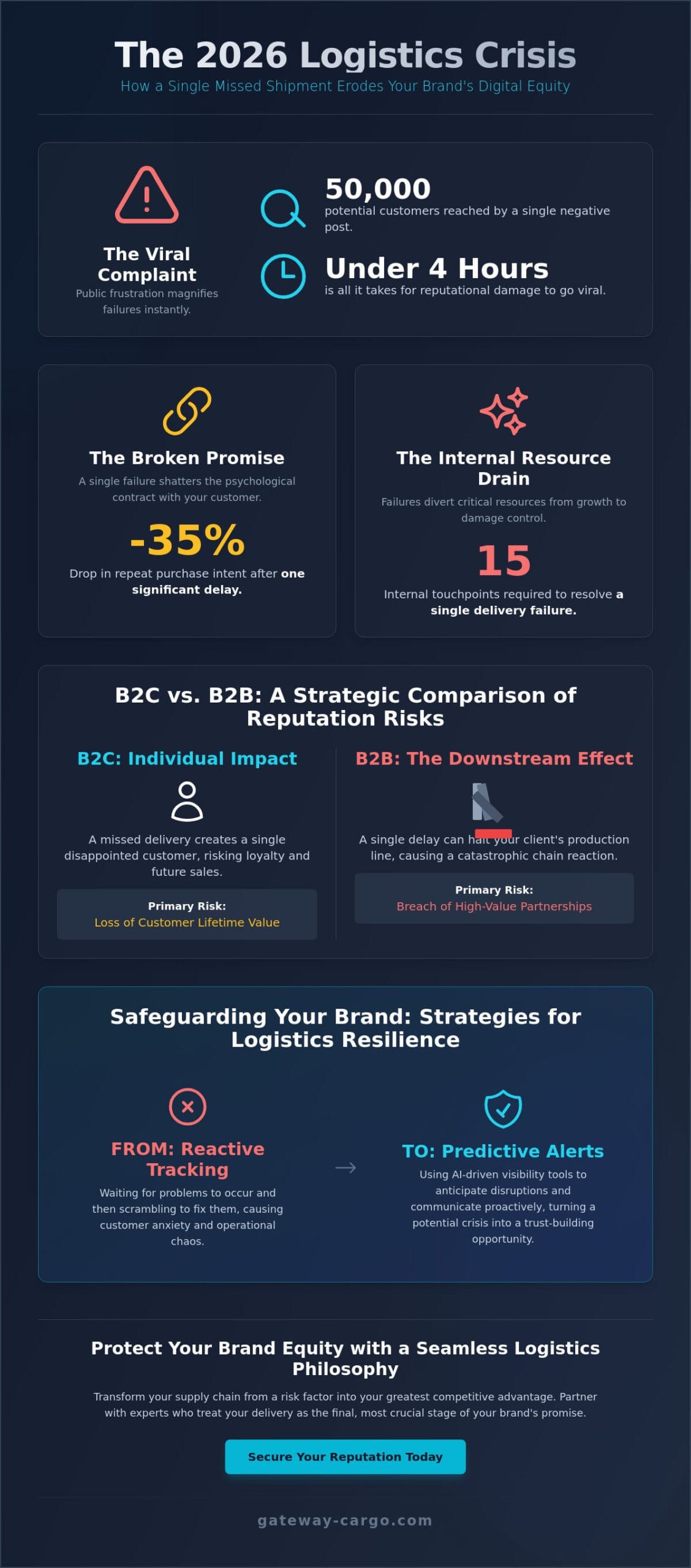
B2C vs. B2B Reputation Risks: A Strategic Comparison
The impact of logistics failure on brand reputation varies significantly depending on whether the end-user is an individual consumer or a corporate entity. In the B2C sector, a failure is often an isolated, emotional event. For B2B partners, a failure is a structural threat to their entire business model. This leads to the “Downstream Effect.” If your shipment of raw materials arrives late to a UK factory, their production line halts. Your failure immediately becomes their failure to their own retailers. It’s a domino effect that can dissolve industrial partnerships built over decades.
Research published in the Journal of Emerging Technologies and Innovative Research highlights the impact of efficient logistics on maintaining these professional bonds. While a B2C customer might be appeased with a £10 voucher or a free delivery code, B2B failures involve much larger financial tails. A single missed delivery could trigger contractual penalty clauses or the loss of a framework agreement worth £500,000 annually. Professional standing in the B2B world relies heavily on technical precision, particularly regarding customs clearance and regulatory adherence. Errors at the border don’t just delay goods; they signal a lack of operational maturity to your global partners.
Consumer Sentiments: Speed and Transparency
By 2026, the “Amazon Effect” has created a baseline expectation for hyper-visibility. Consumers don’t just want their items; they want to see the item’s journey in real-time via GPS. Last-mile failures are the primary driver of negative online reviews and social media backlash. Even for heavy freight items, the “unboxing” experience matters. If a pallet arrives with torn shrink-wrap or scuffed edges, the consumer perceives the brand as negligent. The psychological impact of a delayed delivery in 2026 is higher than ever, as consumers now plan their daily schedules around precise 60-minute delivery windows.
Corporate Sentiments: Compliance and Continuity
For B2B entities, the impact of logistics failure on brand reputation is tied to legal and ethical standing. Non-compliance with international standards like C-TPAT or IMDG can lead to a brand being blacklisted by major global distributors. A strategic freight forwarder acts as a shield, ensuring that compliance is never compromised and that the client’s reputation for reliability remains intact. Professional brand positioning also requires absolute Incoterm accuracy. Misapplying these terms suggests a lack of global expertise, which can be just as damaging to a corporate reputation as a physical delay.
Safeguarding Your Brand: Strategies for Logistics Resilience
Resilience isn’t a luxury in 2026; it’s a fundamental requirement for survival. To mitigate the negative impact of logistics failure on brand reputation, companies must shift from defensive postures to proactive strategies. Proactive communication stands as the primary tool for damage control. Data from 2025 industry audits shows that brands that alert customers to a delay within four hours of its occurrence retain 82% more customer trust than those that wait for the customer to enquire first. Silence is often interpreted as incompetence or a lack of care.
Diversifying freight transport modes ensures that a single regional bottleneck, such as congestion at the Port of Dover or disruptions on the M25, doesn’t paralyse your entire operation. Integrating a “Sustainability Shield” through green logistics also provides a reputational buffer. By utilising EV HGVs for final-mile deliveries in UK Clean Air Zones, brands demonstrate a commitment to corporate social responsibility. This ethical alignment can often offset the frustration of minor transit delays by highlighting your contribution to a net-zero future.
Leveraging AI for Smarter Visibility
AI-driven visibility transforms logistics from a black box into a transparent stream of actionable data. Predictive analytics now warn procurement teams of potential disruptions up to 72 hours before they manifest. The industry is moving away from the reactive “Where is my stuff?” model. Instead, modern systems allow for a “Here is the new ETA” approach, where customers are updated automatically based on real-time weather and traffic intelligence. This level of data transparency builds “Radical Trust” by proving your organisation is in total control of the variables it can see.
Building a “Reputation-First” Logistics Partnership
Choosing a logistics partner requires looking beyond the cost per pallet. You need a provider that treats your brand equity with the same rigour as you do. Key criteria for selection should include the partner’s ability to offer bespoke solutions for high-value or time-sensitive cargo, where the impact of logistics failure on brand reputation is most severe.
Staying informed through supply chain news today helps brands anticipate global volatility before it reaches British shores. A partner that provides these insights acts as an extension of your team, ensuring you aren’t caught off guard by shifting regulations or geopolitical shifts. This collaborative approach turns your supply chain into a competitive advantage rather than a hidden liability.
Optimising the Future: How Gateway Cargo Protects Your Brand Equity
Gateway Cargo operates on a philosophy of “Seamless Logistics,” treating every shipment as a critical component of your company’s market value. In 2026, the impact of logistics failure on brand reputation is more severe than ever. Industry data suggests that 84% of UK consumers won’t return to a brand after a single poor delivery experience. We mitigate this risk by acting as a proactive shield for your brand equity. Our specialists manage the complexities of ocean freight, ensuring that global disruptions don’t become local PR crises. By leveraging an AI-driven digital strategy, we provide the real-time visibility modern retailers require to manage customer expectations accurately. This transparency transforms the supply chain from a hidden liability into a visible asset for your business.
Bespoke Solutions for Complex Challenges
Our logistics specialists work as a direct extension of your internal team. When UK ports like Felixstowe or Southampton face sudden congestion or customs regulations shift, having a global specialist on your side is vital. We don’t just move cargo; we solve problems before they reach your customers. This commitment to “Smarter Supply Chains” means we anticipate bottlenecks and redirect resources dynamically. It’s about maintaining your brand’s promise of reliability even when global conditions are volatile. We provide the stability needed to ensure the impact of logistics failure on brand reputation remains a concern for your competitors, not your business.
The Future is Sustainable and Secure
Environmental accountability is a core pillar of brand health in 2026. Gateway’s green initiatives, including the integration of EV vehicles for final-mile delivery and the use of green corridors, help clients meet strict UK environmental standards. Ethical logistics isn’t a niche preference; it’s a requirement for premium brand positioning. By reducing carbon footprints through optimised routing and sustainable transport, we help you align with the values of the modern, eco-conscious consumer. Protecting your brand means protecting the planet. Our infrastructure is built to support both goals simultaneously. Optimise your supply chain with Gateway Cargo today to secure your market position and ensure long-term growth.
Securing Your Brand’s Physical Promise for 2026
Logistics functions as the final, critical handshake between your business and your customer. In the UK market, where consumer expectations are at an all-time high, your supply chain is your reputation. Recent industry data shows that 84% of shoppers won’t return to a retailer after a single poor delivery experience. This underscores the devastating impact of logistics failure on brand reputation. It’s no longer enough to offer a great product; you must ensure it arrives on time, every time, to maintain long-term loyalty.
Gateway Cargo provides the stability your business needs to navigate global complexities. We offer AI-driven digital visibility and bespoke global freight solutions that adapt to your specific requirements. By integrating proactive sustainability and EV initiatives, we help your brand align with the UK’s 2050 net-zero targets while ensuring peak operational efficiency. Don’t let a fragmented supply chain undermine your hard-earned brand equity. Our specialists work as part of your team to deliver seamless results across air, ocean, and road freight.
Partner with Gateway Cargo to secure your brand’s physical promise
Reliable logistics is the foundation of a smarter supply chain. We’re ready to help you turn your delivery network into a powerful competitive advantage.
Frequently Asked Questions
How does logistics failure specifically impact customer loyalty?
Logistics failure reduces customer retention rates by 17% after just one late delivery, according to 2024 industry benchmarks. When a shipment doesn’t arrive on time, the breach of trust often outweighs the product quality itself. In the UK market, 68% of consumers state they won’t return to a brand after two delivery issues. This direct impact of logistics failure on brand reputation forces businesses to spend five times more on customer acquisition than retention.
Can a brand recover its reputation after a major supply chain failure?
Recovery is possible through radical transparency and a structured 90 day remediation plan. Brands that communicate delays within 15 minutes of detection see a 20% higher customer satisfaction score than those that wait. By 2026, UK businesses must provide real-time data to rebuild trust. Success depends on implementing smarter supply chain solutions that prevent recurring errors and demonstrate a commitment to operational excellence.
What is the reputation cost of poor delivery visibility?
The reputation cost of poor visibility manifests as a 25% increase in customer service enquiries, which strains internal resources and increases overheads. Each negative social media mention regarding delivery uncertainty reaches an average of 1,000 potential UK buyers. Without end to end tracking, a brand loses its position as a reliable partner. This lack of transparency creates an invisible chain of dissatisfaction that erodes market share over a 12 month period.
How do B2B logistics failures differ from B2C failures in terms of brand damage?
B2B failures cause systemic operational disruption, whereas B2C failures typically impact individual sentiment. A missed UK industrial delivery can halt a production line, leading to contractual penalties of up to £50,000 per hour. B2C damage is often spread across social platforms. In a B2B context, the impact of logistics failure on brand reputation is measured by the loss of long term contracts and professional credibility within tight industry circles.
What role does a freight forwarder play in protecting a brand’s reputation?
A freight forwarder acts as a strategic buffer by managing customs clearance and intermodal transitions to ensure seamless delivery. By using bespoke freight solutions, specialists mitigate risks before they reach the end customer. In 2026, forwarders provide the digital infrastructure needed to maintain a smarter supply chain. They protect your brand by resolving 95% of transit exceptions before the client is even aware of a potential delay.
Is sustainability in logistics now a requirement for brand reputation in 2026?
Sustainability is a non-negotiable requirement, with 73% of UK procurement officers now including carbon footprint data in their supplier evaluations. Brands failing to use EV vehicles or green corridors face reputational risks as laggards in environmental responsibility. Adopting sustainable logistics isn’t just about ethics; it’s a core component of a modern brand identity. Companies that don’t optimise for net zero targets by 2026 risk losing access to the growing eco-conscious market.
How can AI and predictive analytics prevent brand-damaging delays?
AI prevents delays by analysing historical data and real-time weather patterns to predict disruptions 48 hours before they occur. These digital strategies allow logistics specialists to reroute air or ocean freight proactively. By 2026, predictive analytics can reduce transit-related brand damage by 30%. This proactive approach ensures your supply chain remains resilient against global volatility while maintaining your status as a reliable and forward-looking industry leader.
What should a brand’s first response be when a major shipping error occurs?
A brand’s first response must be an immediate, data-driven notification to the affected parties within one hour of the incident. You should offer a clear resolution, such as an automatic refund of shipping fees or an expedited replacement. UK consumer law and professional standards require honesty about the root cause. This directness preserves integrity and demonstrates that your organisation prioritises the customer’s operational continuity over its own convenience.