
The Impact of Logistics Failure on Brand Reputation: A 2026 Strategic Guide
A 2023 study by Brightpearl revealed that 85% of UK consumers won’t return to a retailer after a single poor delivery experience. While many businesses treat shipping as a back-end cost, the impact of logistics failure on brand reputation often results in a permanent loss of customer lifetime value. It’s a challenge you likely know well; balancing the demand for real-time visibility and sustainability targets with the rising costs of reliable freight. Choosing “cheap” carriers might save a few pounds today, but it risks the trust your brand has built, which a marketing budget can’t easily fix.
This 2026 strategic guide explores how supply chain disruptions transcend operational costs to permanently alter brand equity. We’ll provide a professional framework to quantify your reputation risk and justify the move toward smarter, more resilient logistics. You’ll discover specific strategies to mitigate the fallout of unavoidable disruptions and ensure your supply chain supports your long-term growth targets.
Key Takeaways
- Understand how the modern supply chain has evolved from a back-end operation into a primary driver of brand identity within the 2026 UK landscape.
- Learn to quantify the true impact of logistics failure on brand reputation by looking beyond immediate freight claims to the “iceberg effect” of customer churn.
- Identify the “invisible failures,” such as customs clearance errors and regulatory non-compliance, that can erode B2B trust and lead to substantial hidden financial costs.
- Discover how to leverage the “Service Recovery Paradox” to turn operational delays into opportunities for building deeper client loyalty through proactive communication strategies.
- Explore how transitioning to a strategic partnership with AI-driven logistics specialists can safeguard your brand equity and prevent disruptions before they occur.
The Evolution of Logistics as a Brand Touchpoint
In the 2026 commercial landscape, the supply chain has migrated from the warehouse floor to the centre of brand strategy. Operational efficiency now dictates market perception more than traditional advertising. The Evolution of Logistics as a Brand Touchpoint reflects a fundamental shift where the “last mile” has become the only mile that truly matters to the end consumer. British businesses now recognise that a product is only as good as the reliability of its arrival. When a shipment is delayed or mishandled, the impact of logistics failure on brand reputation is immediate. Industry data from 2025 suggests that 73% of UK B2B buyers will switch suppliers after just two delivery inconsistencies, proving that logistics is no longer a back-end function but a front-facing brand identity.
Global volatility has forced a change in marketing narratives. Resilience is the new luxury. Companies that can guarantee “smarter” supply chain solutions use their logistics infrastructure as a core marketing claim to inspire confidence. The psychology of the “Delivery Promise” has evolved; customers equate shipping reliability with the inherent quality of the product itself. If a company cannot manage its freight, the market assumes it cannot manage its quality control.
Logistics as the New First Impression
The physical arrival of goods represents the most tangible interaction a customer has with a brand. While digital ordering systems are increasingly frictionless, the physical reality of freight remains the ultimate test of a brand’s promise. A sleek website cannot compensate for a damaged pallet or a missed delivery window in the Midlands. Logistics Brand Equity is the cumulative trust built through consistent delivery. This equity is fragile. In an era of instant feedback, the impact of logistics failure on brand reputation can be amplified across social media and industry forums within minutes of a failed delivery attempt.
The Era of Radical Transparency
Real-time tracking has transformed customer expectations for international shipping services. Transparency is no longer a premium feature; it’s a baseline requirement for professional operations. “Dark periods” in the shipping cycle, where data is unavailable for more than four hours, trigger significant customer anxiety and erode trust. By 2026, UK customers view a lack of granular data as a direct signal of operational incompetence. Businesses must provide:
- Real-time GPS positioning for road and ocean freight.
- Automated alerts for customs clearance milestones.
- Proactive notification of potential disruptions before they occur.
Data-driven logistics specialists work as part of the client’s team to ensure this transparency remains a competitive advantage rather than a liability.
The Anatomy of a Logistics Failure: More Than Just “Late”
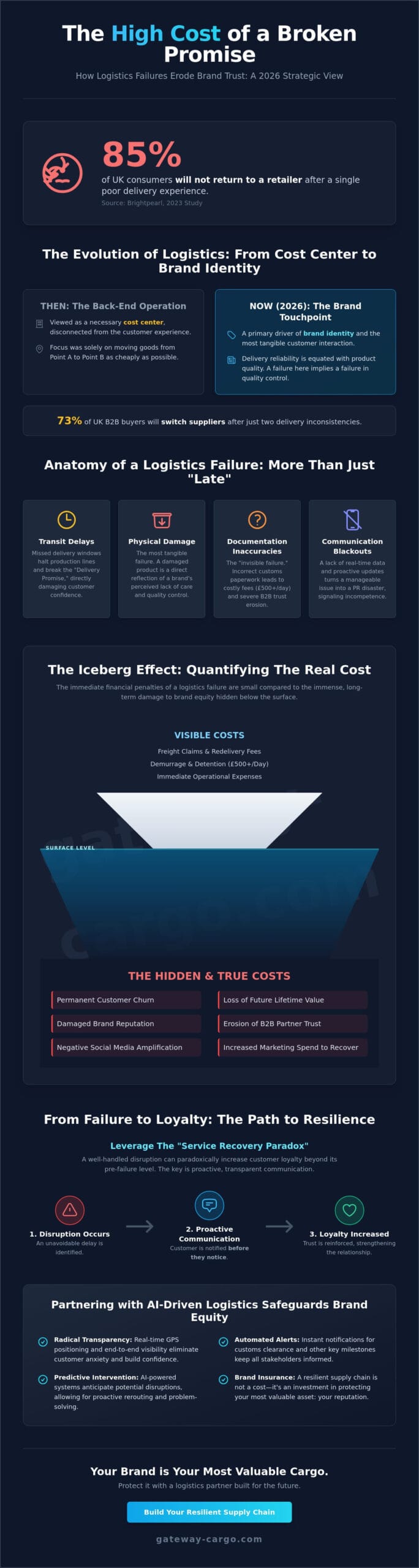
Logistics failure is often simplified as a missed delivery window. In reality, it represents a multi-layered breakdown in the value chain that directly influences how stakeholders perceive your business. The impact of logistics failure on brand reputation extends through four primary categories: transit delays, physical cargo damage, documentation inaccuracies, and communication blackouts. While a delay is visible, a communication blackout during a crisis is often what turns a manageable error into a lasting PR disaster.
A single error by a freight forwarder can trigger a cascade of supply chain disruptions. If a bill of lading is misfiled, it doesn’t just stop one container; it halts production lines and creates a deficit in retail inventory. Academic research Quantifying the Ripple Effect: The Real Cost of Damage suggests that the financial recovery from these events is often faster than the reputational recovery. Trust is fragile. Once a partner views your supply chain as volatile, they’ll seek alternatives to protect their own margins.
The B2B Trust Gap: Customs and Compliance
Documentation errors are the “invisible failures” that erode B2B trust most aggressively. In the UK market, incorrect commodity codes or missing Rules of Origin declarations lead to HMRC interventions and immediate port congestion. This results in demurrage and detention fees that can easily exceed £500 per day per container. Being “that supplier” whose goods are perpetually stuck in customs creates a perception of incompetence. Expert brokerage acts as a shield for your professional reputation, ensuring compliance is a competitive advantage rather than a bottleneck. You can optimise your freight strategy to avoid these preventable administrative failures.
Sustainability as a Reputation Risk
By 2026, the “Ethics Failure” has become a significant threat to corporate standing. Using high-emission routes or failing to provide EV last-mile options can lower your corporate ESG scores, leading to divestment or loss of contract tenders. Conscious consumers and B2B partners now scrutinise Scope 3 emissions with the same rigour as financial statements. Failing to offer green corridor options is no longer just an operational choice; it’s a strategic disadvantage. Green Logistics serves as a primary driver for brand premium pricing and long-term loyalty. The impact of logistics failure on brand reputation is most severe when it contradicts a company’s public commitment to sustainability.
- Delay: Erodes reliability and disrupts downstream schedules.
- Damage: Signals a lack of care for the product and the end-user.
- Documentation: Leads to legal scrutiny and unexpected financial penalties.
- Communication: Magnifies every other failure by leaving partners in the dark.
Quantifying the Ripple Effect: The Real Cost of Damage
The financial damage of a failed delivery extends far beyond the immediate value of the goods. Logistics specialists refer to this as the Iceberg Effect. While a freight claim for damaged cargo might cost £500, the underlying structural damage to the business is often ten times higher. In the UK market, the impact of logistics failure on brand reputation manifests as lost future revenue and increased operational overheads. It’s a hidden drain on capital.
Data shows that 84% of UK consumers won’t return to a brand after just one poor delivery experience. This churn represents a massive erosion of Customer Lifetime Value (CLV). If a B2B client’s average annual spend is £25,000, a single missed shipment doesn’t just cost the £2,000 freight value; it risks the entire £125,000 five-year projected revenue. Retaining a customer is five times cheaper than acquiring a new one, yet logistics failures force businesses into a constant, expensive cycle of replacement.
Internal costs also mount quickly. Logistics errors place a heavy burden on internal teams. Sales departments spend 20% of their productive time firefighting delivery issues rather than generating new leads. Customer service teams see a 40% spike in ticket volume during supply chain disruptions. This leads to burnout and increased staff turnover costs. Every minute spent explaining a delay is a minute lost on growth.
Social Proof and the Viral Complaint
By 2026, the speed of information is instantaneous. A delayed pallet at a regional distribution centre can be photographed and shared on LinkedIn within minutes. These public failures create a permanent digital footprint. Negative reviews that include keywords like “shipping delay” or “broken delivery” hurt SEO rankings and lower conversion rates by up to 15%. Monitoring brand sentiment throughout the logistics cycle is a core business requirement. Businesses must implement Strategic Recovery: Turning Failure into Loyalty to mitigate these public relations risks before they escalate.
The Opportunity Cost of Disruption
Logistics failures act as a Reputation Tax on future growth. When bidding for high-value contracts, a history of delivery failures can result in a 10% to 15% discount demand from procurement teams. Investors also track these metrics closely. Staying informed through supply chain news today helps leaders understand how global volatility impacts market confidence. If a brand can’t prove its logistics resilience, it’ll struggle to scale into new international markets. The risk of failure simply outweighs the potential reward for stakeholders. Reliability is the ultimate currency in 2026.
Strategic Recovery: Turning Failure into Loyalty
A supply chain disruption doesn’t have to result in a permanent loss of business. The Service Recovery Paradox demonstrates that customers often feel more loyal to a brand after a well-handled error than they did before the incident occurred. When you manage a crisis with precision, you demonstrate the resilience of your operations. The negative impact of logistics failure on brand reputation is often mitigated not by the absence of problems, but by the speed and transparency of the resolution.
Effective recovery requires a 30-minute rule. If a shipment is delayed at a UK hub like Felixstowe or Southampton, you must notify the client within half an hour of detection. Reactive communication, where the client discovers the delay themselves, destroys trust. Proactive communication relies on data to provide “The Why” and “The Solution” in a single interaction. Don’t just report a delay; explain that a port bottleneck occurred and confirm that you’ve already initiated an alternative road freight route to ensure delivery by the following morning. This level of detail transforms a failure into a demonstration of competence.
The Proactive Communication Framework
Reliability is built through structured responses. We use a three-step approach to maintain brand integrity during disruptions:
- Step 1: Immediate detection via AI-driven tracking that flags deviations from the scheduled route in real-time, often before the driver is even aware of the delay.
- Step 2: Transparent client notification that includes a pre-set alternative, such as switching from sea to rail to bypass road congestion on the M25.
- Step 3: Post-incident analysis and process adjustment. We review the data to see if the failure was a one-off event or a systemic weakness that requires a new route strategy.
Diversification as a Brand Strategy
Relying on a single mode of freight transport represents a significant reputation risk. If your entire inventory is tied to ocean freight during a period of industrial action at major ports, your brand loses its ability to promise consistency. Air freight serves as an essential “emergency brake,” allowing businesses to move critical stock quickly when traditional channels fail.
Building a bespoke logistics plan that accounts for regional volatility is no longer optional. It’s a requirement for UK businesses navigating post-Brexit customs and global shipping shifts. By leveraging intermodal flexibility, you can bypass sudden road or port bottlenecks without the customer feeling the friction. This ensures that the impact of logistics failure on brand reputation remains minimal even when global conditions are volatile. It’s about having a smarter supply chain that adapts in seconds.
Partnering for Protection: Why Gateway Cargo is Brand Insurance
In the UK’s high-stakes retail and manufacturing sectors, your logistics provider shouldn’t be a simple service vendor. They’re the guardian of your customer’s final impression. While a vendor focuses on moving a pallet from point A to point B, a strategic partner focuses on the long-term health of your business. Gateway Cargo operates as brand insurance, specifically designed to mitigate the impact of logistics failure on brand reputation through rigorous, proactive management.
We’ve moved beyond reactive logistics. Our AI-driven digital strategy identifies potential disruptions, such as port congestion or adverse weather, before they affect your bottom line. Research from 2024 indicates that 81% of UK consumers are unlikely to shop with a brand again after a single delivery failure. We prevent this by moving away from one-size-fits-all models. Every client receives a bespoke solution tailored to their specific sector, whether that involves cold-chain integrity or navigating the complexities of the UK-EU trade corridor.
- Strategic Alignment: We synchronise our operations with your brand values.
- Predictive Analytics: We use AI to forecast delays and reroute shipments in real-time.
- Sustainable Innovation: Our commitment to EV vehicles and carbon-neutral targets protects your brand’s ethical standing.
The Gateway Advantage: Expertise Meets Technology
Our logistics specialists don’t just work for you; they work as part of your team. This collaborative approach ensures that every decision aligns with your brand’s core promises. We provide end-to-end visibility, allowing you to track shipments and provide accurate updates to your stakeholders. By 2026, leadership in the supply chain will be defined by technology and sustainability. Gateway’s investment in AI monitoring and EV vehicles helps you meet the UK’s Net Zero goals while keeping costs controlled and deliveries on schedule.
Taking the Next Step Toward Resilience
The first step to securing your future is a comprehensive audit of your current logistics risk profile. You need to know exactly where the impact of logistics failure on brand reputation could hit your business hardest. Transitioning to a smarter, more resilient supply chain doesn’t require a total shutdown of your current processes. We specialise in phased implementations that upgrade your capabilities without disrupting your daily flow.
In the world of global trade, your reputation is the most valuable cargo you’ll ever ship. Secure it with a partner that treats your brand as their own. It’s time to move beyond survival and start building a supply chain that acts as a competitive advantage.
Future-Proofing Your Brand Through Logistics Excellence
By 2026, logistics will be the primary differentiator for UK enterprises. A single delivery error is no longer just a logistical hiccup; it’s a direct threat to your market standing. Recent industry data shows that 84% of UK consumers won’t shop with a retailer again after a poor delivery experience. This underscores the devastating impact of logistics failure on brand reputation in a hyper-connected market. Protecting your brand requires a transition from traditional shipping to a smarter, more resilient supply chain model.
Gateway Cargo provides the stability your business needs to scale with confidence. Our AI-Driven Digital Strategy offers real-time visibility that eliminates uncertainty. We support your Net Zero goals through proactive sustainability solutions, including a modern fleet of EV vehicles. Whether you’re managing complex international routes or local distribution, our bespoke freight solutions ensure your brand promise is kept every time. It’s time to transform your logistics from a cost centre into a powerful tool for customer loyalty.
Secure your brand reputation with Gateway Cargo’s bespoke logistics solutions. We’re ready to optimise your operations today.
Frequently Asked Questions
How does logistics affect brand image?
Logistics serves as the physical manifestation of your brand promise. A 2024 study by Loqate found that 68% of UK consumers won’t return to a retailer after a single poor delivery experience. When goods arrive late or damaged, it erodes the trust you’ve built through marketing. Efficient delivery reinforces your reputation as a reliable partner, while failure suggests a lack of operational control.
Can a single shipping delay really ruin my business reputation?
A single delay rarely destroys a business, but it can permanently sever a specific client relationship. In the B2B sector, 43% of firms state that delivery reliability is their primary KPI for supplier evaluation. The impact of logistics failure on brand reputation is cumulative. One missed deadline might lead to a £5,000 penalty clause or the loss of a contract renewal worth significantly more.
What are the most common logistics failures in 2026?
Data from the 2026 Logistics Performance Index highlights that AI-sync errors and greenwashing claims are now top risks. Specifically, 15% of failures stem from legacy systems failing to integrate with new UK customs platforms. Other common issues include capacity crunches in green corridors and lithium-battery transport non-compliance. These technical oversights lead to port delays and regulatory fines that damage your standing with stakeholders.
How do I communicate a shipping delay to a B2B client without losing their trust?
Transparency is the most effective tool for maintaining trust during a crisis. You should notify the client within 30 minutes of identifying a disruption, providing a new estimated time of arrival based on real-time telematics. Avoid vague excuses. Instead, explain the specific cause, such as a 4-hour delay at the Port of Felixstowe, and outline the corrective actions your specialists are taking to mitigate the delay.
Is it worth paying more for a freight forwarder with better tracking technology?
Investing in superior tracking technology is a strategic move to protect your bottom line. Research indicates that companies using AI-driven visibility tools reduce their customer inquiry volume by 35%. While the initial freight cost might be 10% higher, the reduction in manual administrative tasks and the prevention of stockouts provide a clear return on investment. Real-time data allows you to proactively manage expectations before a delay becomes a failure.
How does sustainable logistics impact my brand reputation?
Sustainability is no longer optional for UK businesses aiming for Net Zero by 2050. Using EV vehicles and carbon-neutral warehousing improves your ESG rating, which 76% of institutional investors now use to screen partners. If your logistics chain relies on high-emission legacy transport, you risk being excluded from lucrative government tenders and corporate contracts that require strict carbon reporting.
What is the “Service Recovery Paradox” in logistics?
The Service Recovery Paradox occurs when a customer’s confidence in a brand increases after a successful resolution of a failure. If a shipment is lost but your team resolves it with an immediate replacement and a credit note, the client may view you as more reliable than if the error never happened. This shows your ability to handle complex challenges. It’s a critical component in managing the impact of logistics failure on brand reputation.
How can I measure the financial impact of reputation damage from logistics?
You can quantify damage by tracking the Customer Lifetime Value and the cost of new customer acquisition following a major failure. If your churn rate increases by 5% after a series of logistics issues, calculate the lost revenue from those accounts. Additionally, monitor social sentiment scores and Net Promoter Scores. A 10-point drop in NPS often correlates with a measurable decrease in quarterly contract renewals.