
Freight Insurance: What It Covers and Why Your Business Needs It in 2026
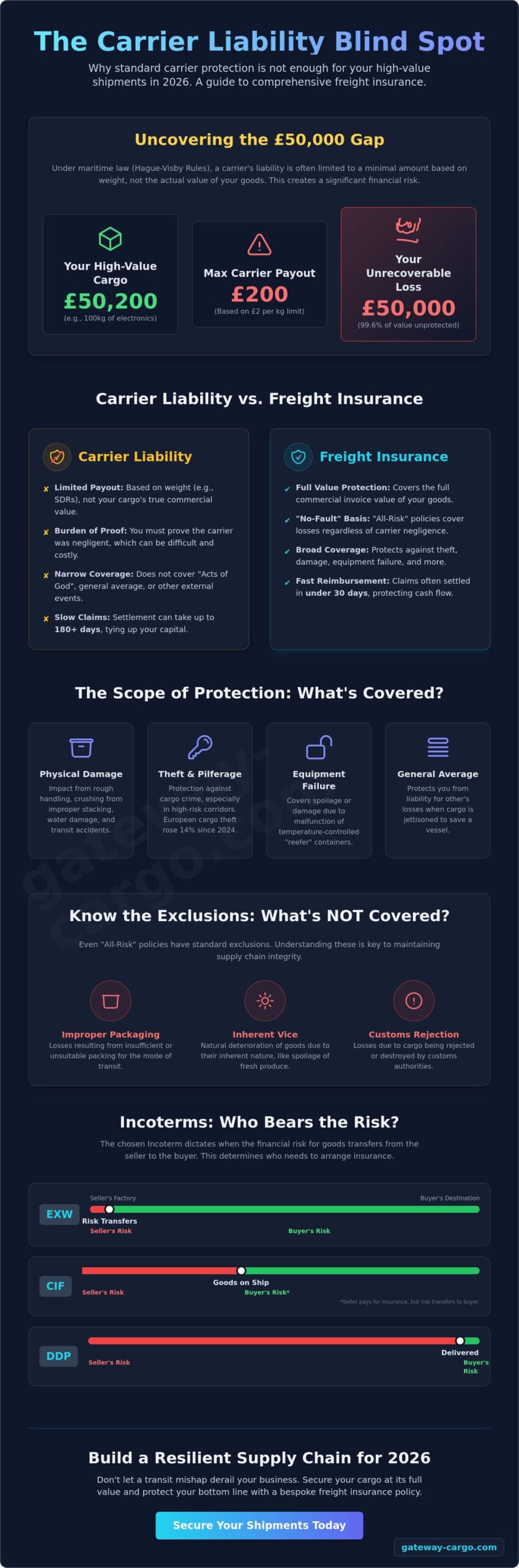
Did you know that under the Hague-Visby Rules, a carrier’s liability for damaged goods is often capped at just £2 per kilogram? For a UK business exporting high-value equipment, this statutory limit can turn a minor transit mishap into a £50,000 unrecoverable loss. It’s a sobering reality that standard carrier contracts aren’t designed to fully protect your bottom line. We understand the frustration of trying to decode complex maritime laws while managing a global supply chain. You shouldn’t have to be a legal expert to ensure your capital is secure from port to port.
This article provides an authoritative look at freight insurance what it covers and why it’s a vital component of a smarter supply chain in 2026. You’ll discover the critical differences between All-Risk and Named Perils policies, allowing you to make informed decisions that optimise your risk management strategy. We’ll also provide a practical framework to evaluate your insurance ROI and help you identify the specific gaps where carrier liability fails. From customs clearance hurdles to intermodal transitions, we’re here to help you build a more resilient and professional logistics operation.
Key Takeaways
- Understand the critical distinction between limited carrier liability and comprehensive supplemental policies to ensure your assets are protected at their full commercial value.
- Gain a detailed breakdown of freight insurance what it covers, including protection against physical damage, equipment failure, and theft within high-risk transit corridors.
- Identify the “Liability Gap” by learning how Special Drawing Rights (SDRs) and weight-based limits can result in significant financial shortfalls for UK businesses during a claim.
- Master how to avoid common coverage exclusions, such as packaging errors and inherent vice, to maintain the integrity of your global supply chain.
- Explore how bespoke, AI-driven logistics strategies can optimise your risk management and provide smarter, future-proof solutions for high-value shipments in 2026.
What is Freight Insurance? Defining the Shield for Your Cargo
Freight insurance is a supplemental policy designed to protect goods against physical loss, theft, or damage while they move through the global supply chain. While many businesses assume carrier liability is sufficient, it often falls short of the actual cargo value. In essence, What is Freight Insurance? serves as a financial guarantee that covers the gap between a carrier’s limited legal liability and the full commercial invoice value of your goods. Understanding freight insurance what it covers is the first step in protecting your bottom line from unpredictable transit events.
Domestic transit insurance typically handles UK-wide road or rail movements. In contrast, international marine cargo insurance addresses the complexities of transoceanic shipping and air freight. Supply chain volatility in 2026 remains high, with regional conflicts and climate-related port disruptions becoming more frequent. Recent data from industry risk reports shows a 14% increase in cargo theft across European transit corridors since 2024. Relying solely on standard carrier terms exposes your business to significant financial risk. If a vessel is delayed or cargo is damaged, a comprehensive policy ensures your capital isn’t tied up for months. Without it, a standard claim can take 180 days to settle; with a bespoke policy, many businesses see reimbursement in under 30 days. This speed is vital for maintaining healthy cash flow.
The Legal Framework of Modern Cargo Protection
International treaties like the Hague-Visby Rules for sea freight and the Montreal Convention for air cargo set strict limits on carrier liability. These limits are often based on weight rather than value. This means you might only receive £2 per kilogram for a shipment of high-value electronics. Your freight forwarder acts as a strategic partner here, helping you identify these gaps before the goods leave the warehouse. It’s vital to distinguish between “declared value” on a Bill of Lading, which merely increases carrier liability for a fee, and a dedicated insurance policy that provides broader “all-risk” coverage. Freight insurance what it covers usually includes external causes of loss that “declared value” simply won’t touch.
Who is Responsible? The Intersection of Insurance and Incoterms
The choice of Incoterms determines who pays the premium and who bears the risk during transit. Under CIF (Cost, Insurance, and Freight), the seller is obligated to provide insurance, while under DDP (Delivered Duty Paid), the seller handles all costs until the cargo reaches the buyer’s door. You must verify insurance clauses in your commercial contracts to avoid “double insuring” or leaving a gap where neither party is covered. For standard 2026 Incoterms, the transfer of risk occurs at the precise moment the goods are loaded onto the vessel or delivered to the carrier’s terminal, depending on the specific three-letter code used.
- DDP: Seller bears all risk and costs to the destination.
- CIF: Seller pays for insurance, but risk transfers to the buyer once goods are on the ship.
- EXW: Buyer bears all risk from the moment the goods leave the seller’s factory.
What Freight Insurance Covers: The Scope of Protection
Understanding freight insurance what it covers is the first step toward building a resilient supply chain in 2026. While many assume carriers bear all the risk, their liability is often strictly limited by international conventions. According to the legal definition of cargo insurance, these policies provide much broader protection, covering the full value of goods against diverse threats that fall outside a carrier’s standard responsibility.
Physical damage is the most frequent claim category. This includes impacts from rough handling, equipment failure in temperature-controlled “reefer” containers, and crushing due to improper stacking. In the UK market, theft and pilferage are rising concerns. Statistics from 2024 indicated a 7% increase in cargo-related crimes at motorway service areas and port perimeters. High-value goods moving through “hot” transit zones require specific coverage that accounts for both the physical loss of the item and the financial disruption to your operations.
Physical Loss vs. Damage: Understanding the Nuance
It’s vital to distinguish between a total loss and partial damage. A total loss occurs when a vessel sinks, a plane crashes, or a warehouse fire destroys the entire inventory. Partial damage is more subtle, such as “hidden damage” where the outer packaging appears intact but the internal components are shattered. Comprehensive policies also protect goods while they’re held in warehousing and distribution facilities, bridging the gap between different legs of the journey. This ensures your capital is protected from the moment it leaves the factory until it reaches the final customer.
The “General Average” Risk in Ocean Freight
General Average is an ancient maritime law that remains a major financial threat to modern shippers. If a ship’s master sacrifices cargo or incurs expenses to save the vessel during an emergency, all cargo owners share the cost proportionally. Following the Dali bridge incident in early 2024, many shippers faced unexpected bills reaching tens of thousands of pounds. Without insurance, you must pay a cash bond before your cargo is released. A professional policy handles this bond immediately, preventing your goods from being held hostage by legal requirements.
Natural disasters, often classified as “Acts of God,” are another critical area. Whether it’s the 2025 storm surges in the North Sea or seismic activity affecting global ports, standard carrier liability rarely covers these events. Insurance provides the only guaranteed safety net for your investment. If you’re looking to optimise your risk management, evaluating these specific coverage areas is a logical starting point for any UK business.
Carrier Liability vs. Freight Insurance: Bridging the Gap
Understanding the distinction between carrier liability and comprehensive cover is vital for protecting your balance sheet. Many shippers mistakenly assume that their transport provider is responsible for the full value of their goods if something goes wrong. This is a costly misconception. Carriers operate under international conventions that cap their financial responsibility to a fraction of your cargo’s actual value, creating what specialists call the liability gap.
Most compensation is calculated using Special Drawing Rights (SDRs), which is a global reserve asset defined by the International Monetary Fund. Because these payouts are based on the weight of the shipment rather than its commercial value, high-value items are particularly vulnerable. If you ship a 10kg parcel of high-end electronics worth £5,000, a weight-based payout might only return £230. This discrepancy highlights why understanding freight insurance what it covers is essential for any business moving goods in 2026.
The burden of proof also differs significantly between these two options. To win a liability claim against a carrier, you must prove they were negligent. This is a difficult, adversarial process that often requires months of legal back-and-forth. Settlement timelines for carrier claims typically stretch between six and nine months. Freight insurance operates differently. It covers the loss regardless of fault, and most claims are settled within 21 to 30 days, ensuring your cash flow remains stable.
Limits of Carrier Liability by Mode of Transport
Liability limits vary across different transit methods. Ocean freight governed by the Hague-Visby Rules offers some of the lowest protections in the industry. While air cargo under the Montreal Convention provides higher limits of 22 SDR per kilogram, it still fails to cover the full cost of many modern commodities. For domestic UK road haulage, carrier liability often covers as little as £2 per kilogram under standard industry terms. These rigid caps mean that for many shipments, the carrier’s maximum payout won’t even cover your shipping costs, let alone the product value.
The “Exoneration” Clauses: When Carriers Pay Zero
Legal loopholes known as exoneration clauses allow carriers to avoid payment entirely in specific scenarios. Events such as strikes, riots, or “Acts of God” like extreme weather are generally excluded from carrier responsibility. If a storm damages your container at sea, the carrier is often legally excused from paying a single penny. Insurance is the only mechanism to protect your investment against these unpreventable transit accidents. You can work with international shipping services to audit your current liability exposure and identify where your contracts leave you at risk. This proactive approach ensures your freight insurance what it covers aligns perfectly with the specific risks of your trade lanes.
What Is NOT Covered: Common Exclusions and Pitfalls
Understanding freight insurance what it covers requires a clear-eyed look at what it excludes. Many UK businesses assume a policy protects against every possible loss, but standard contracts contain specific carve-outs. These exclusions protect insurers from risks that are within the shipper’s control or are inevitable parts of the logistics process. Standard exclusions often surprise shippers who haven’t studied the fine print of their policy before a crisis occurs.
Inherent vice is a primary exclusion that frequently catches businesses off guard. This refers to the natural deterioration of goods. If you ship untreated steel that develops rust due to atmospheric moisture, or fruit that over-ripens during a standard transit time, insurers will likely deny the claim. They view these as internal properties of the cargo rather than external accidents. Similarly, losses caused by willful misconduct, such as a shipper knowingly using an unseaworthy vessel or failing to disclose hazardous materials, result in an immediate denial of coverage.
Financial losses due to delays are another significant pitfall. Most policies only cover physical damage or loss of the cargo itself. If a late delivery causes your business to lose a £50,000 contract or miss a seasonal sales window, standard insurance won’t reimburse those lost profits. You’re only compensated for the physical state of the goods, not the consequential business impact.
The Critical Importance of Proper Packaging
Insufficient packaging is the most frequent reason for claim rejection in the UK market. Insurers expect goods to withstand the rigours of international transit, including mechanical handling and pressure from other cargo. UK exporters must follow standardized export packing requirements for air and ocean freight. We recommend documenting every stage of the packing process with high-resolution photos. This evidence proves the cargo was secured correctly before it left your facility. Without this proof, an insurer can easily argue that the damage resulted from your own negligence rather than a transit incident.
Named Perils vs. All-Risk Coverage
Choosing the right policy type determines the breadth of your protection. A Named Perils policy is a budget-friendly option, but it only covers specific events explicitly listed in the document, such as fire, sinking, or derailment. If an event isn’t listed, you don’t have a claim. This type of policy is often too restrictive for modern high-value electronics or precision machinery.
All-Risk coverage is the gold standard for modern supply chain news today. It covers all physical loss or damage from any external cause, unless specifically excluded. While more expensive, it provides the comprehensive security required for complex global routes. For most UK businesses, the additional premium is a small price for the certainty it provides when freight insurance what it covers aligns with your actual risk exposure.
Protect your bottom line with a policy that fits your specific trade lanes. Contact our logistics specialists today to audit your current coverage and identify hidden gaps.
Securing Your Supply Chain: Bespoke Solutions with Gateway Cargo
Gateway Cargo integrates insurance into an AI-driven digital logistics strategy that looks beyond basic transit. We don’t treat protection as a passive expense. Instead, our platforms evaluate real-time data to align coverage with your specific risk profile. This approach is essential for 2026, where global volatility requires more than a one-size-fits-all policy. When businesses examine freight insurance what it covers, they often find that standard terms fall short for high-value or time-sensitive shipments. We provide bespoke freight solutions that account for the unique vulnerabilities of UK-to-EU transit or complex global air freight routes.
The transition to sustainability also changes your risk landscape. The use of EV vehicles and the establishment of green corridors in the UK introduce new variables into the supply chain. While these initiatives reduce carbon footprints, they involve different handling requirements and routing through low-emission zones. Our specialists ensure your policy reflects these modern realities, protecting your bottom line as you transition to a greener operation.
Partnering with Logistics Specialists for Risk Mitigation
Working with a dedicated freight forwarder simplifies the claims process significantly. If an incident occurs, you aren’t left to deal with insurers alone. Gateway’s global network provides local support at the point of loss, ensuring that evidence is gathered and documented immediately. Logistics data from 2025 indicates that managed claims are resolved 30% faster than those handled independently.
We provide constant value through our “Insights” platform. This resource offers market updates that help you predict high-risk transit periods, such as seasonal port congestion or predicted industrial actions. Our logistics specialists work as part of your team to ensure you’re prepared before a shipment even leaves the warehouse. We focus on three core areas of mitigation:
- Local Expertise: On-the-ground teams in major global hubs to manage incidents in real-time.
- Predictive Analysis: Using historical data to avoid routes with high rates of damage or theft.
- Regulatory Alignment: Ensuring all documentation meets 2026 UK and international standards to prevent claim denials.
Optimising Your Smart Supply Chain
Digital tracking is the most effective defence against “mysterious disappearance” claims. By monitoring goods at every milestone, we create a transparent audit trail. This visibility reduces the likelihood of theft and provides the concrete evidence needed if you ever have to explain freight insurance what it covers to stakeholders during a loss adjustment. In 2025, firms using integrated digital tracking saw a 22% reduction in cargo theft incidents across UK road networks.
Integrating insurance into your end-to-end logistics planning for 2026 ensures there are no gaps in your protection. From the moment goods are packed to the final mile of delivery, every stage is accounted for within a single, cohesive strategy. It’s about building a resilient framework that supports business growth without unnecessary exposure.
Ready to protect your cargo? Contact our specialists today for a cargo insurance quote that matches your real-world exposure and helps you build a smarter, safer supply chain.
Secure Your Supply Chain for 2026 and Beyond
Relying on standard carrier liability often leaves a significant financial gap in your risk management strategy. In the UK, international conventions like CMR limit recovery to approximately £9.00 per kilogram for road transit, which rarely covers the total value of high-specification cargo or sensitive electronics. Gaining a clear understanding of freight insurance what it covers is essential to protect your business from theft, damage, or general average claims that can disrupt your bottom line. It’s the difference between a minor setback and a catastrophic financial loss.
Gateway Cargo delivers bespoke freight solutions across ocean, air, and road networks, ensuring your goods are protected at every stage of the journey. We integrate an AI-driven digital strategy to proactively identify and reduce risks before they impact your operations. For companies aiming to meet carbon reduction targets, our sustainability-focused logistics include EV vehicle options for cleaner, more efficient transport. You don’t have to navigate the complexities of global trade alone. Our specialists work as part of your team to provide precision and reliability in an unpredictable market.
Optimise your supply chain with bespoke freight insurance solutions from Gateway Cargo
We’re ready to help you build a more resilient and efficient future for your logistics operations.
Frequently Asked Questions
Is freight insurance mandatory for international shipping?
Freight insurance isn’t legally mandatory for most international shipments, but it’s often a contractual requirement under Incoterms 2020. If you trade under CIF (Cost, Insurance, and Freight) or CIP (Carriage and Insurance Paid To) terms, the seller must provide cover. Without it, your business faces the full financial impact of cargo loss, as carrier liability rarely covers the total value of the goods.
How much does freight insurance typically cost?
Freight insurance costs typically range from 0.3% to 0.5% of the total insured value, which includes the cost of goods, freight, and a 10% uplift for administrative expenses. For a shipment valued at £50,000, your premium might sit between £150 and £250. Rates vary based on the cargo type, destination, and chosen transport mode.
What is the difference between freight insurance and freight liability?
Freight insurance provides first-party protection for the full value of your goods, while freight liability only covers the carrier’s legal responsibility. Under the CMR Convention for road transport, a carrier’s liability is capped at 8.33 Special Drawing Rights (SDR) per kilogram, which equals roughly £9.20. If your high-value cargo is damaged, liability payments will likely fall far short of your actual losses.
Can I buy freight insurance for a single shipment?
You can definitely purchase freight insurance for a single shipment through a “single-trip” or “ad hoc” policy. This is a practical solution for businesses that don’t ship regularly or have a one-off high-value delivery. When looking at freight insurance what it covers, these individual policies generally protect against theft, damage, and loss during a specific transit window.
How do I file a freight insurance claim if my goods are damaged?
You should notify your insurer immediately and document the damage with high-resolution photographs before signing the proof of delivery. Most UK policies require a formal claim submission within 7 days of receipt. You’ll need to provide the commercial invoice, packing list, and a damage report to support your request for reimbursement.
Does freight insurance cover customs duties and taxes?
Standard policies don’t automatically include customs duties and taxes, but you can request this specific extension. When evaluating freight insurance what it covers, it’s vital to ensure your policy accounts for the 20% VAT and any applicable UK import duties. Including these costs ensures you aren’t out of pocket for taxes paid on goods that never reached their destination.
What happens if my cargo is lost due to a natural disaster?
“All-Risk” policies generally cover cargo lost due to natural disasters like storms or floods, though specific “Force Majeure” clauses apply. The World Shipping Council notes that 661 containers were lost at sea in 2022. Without comprehensive cover, you’d struggle to recover costs since carriers aren’t usually held liable for “Acts of God.”
Is “All-Risk” insurance truly comprehensive for all types of cargo?
“All-Risk” insurance is the broadest cover available under Institute Cargo Clauses (A), but it doesn’t cover every possible scenario. Exclusions typically include damage caused by insufficient packaging, inherent vice, or delays. Your business must ensure all goods are packed to industry standards to avoid claim rejection, as insurers won’t pay for losses resulting from avoidable negligence.