
Required Documents for International Shipping: A 2026 Strategic Guide
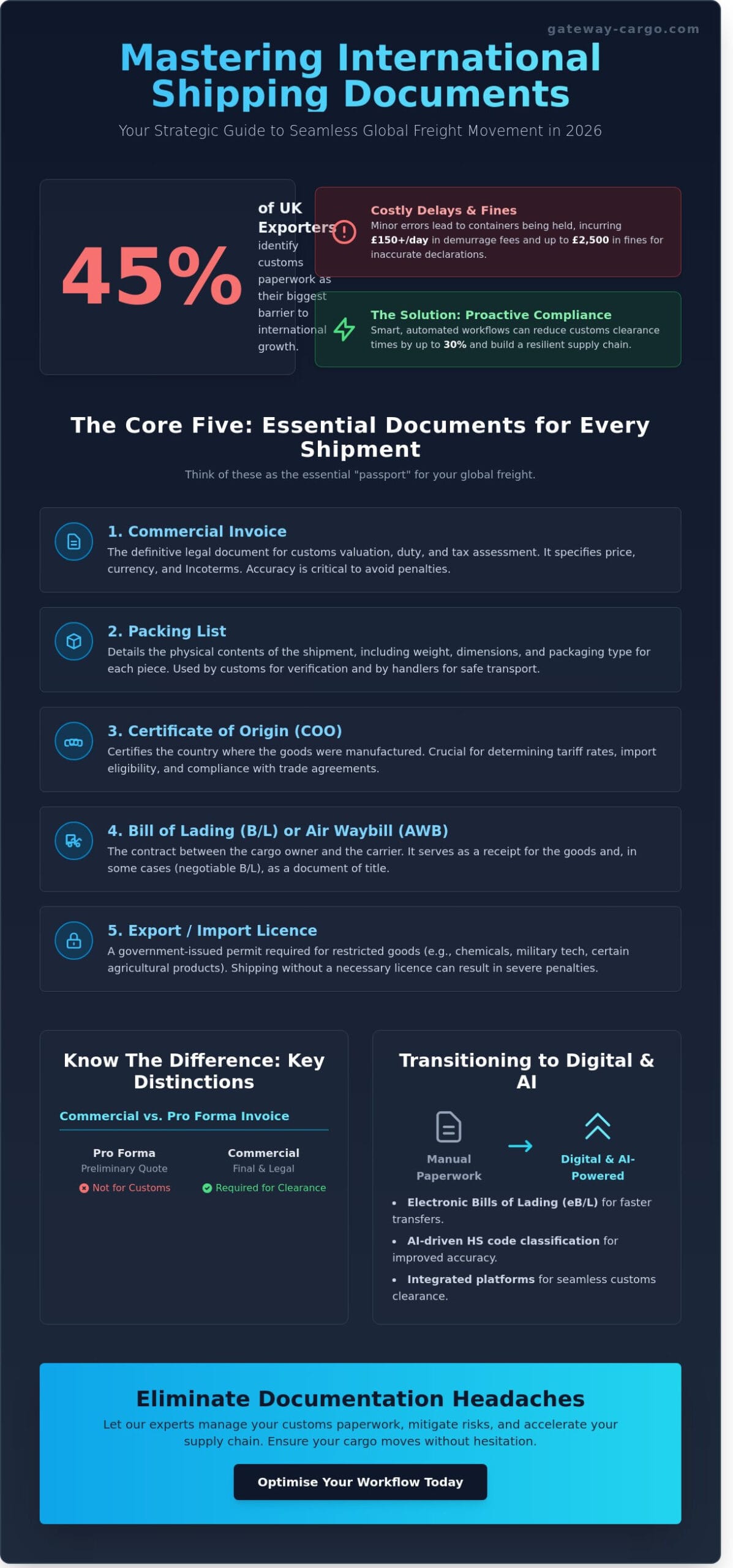
Did you know that 45% of UK exporters identified customs paperwork as their biggest barrier to international growth in a recent British Chambers of Commerce report? It’s a staggering figure that highlights how easily a minor administrative oversight can lead to a container being held at a terminal for days, incurring avoidable demurrage fees. Most logistics professionals agree that managing the required documents for international shipping has become more complex as digital standards evolve. You’ve likely felt the pressure of ensuring every commercial invoice and packing list is flawless to avoid the sting of a £2,500 fine for inaccurate declarations.
This strategic guide promises to help you master the essential paperwork and digital compliance standards necessary for seamless global freight movement in 2026. We’ll provide a clear checklist of every critical document, from Certificates of Origin to the latest digital Bill of Lading requirements. By implementing these smarter, automated workflows, you can expect to reduce customs clearance times by up to 30% and build a more resilient, forward-looking supply chain. Our logistics specialists have designed this guide to help you optimise your operations and ensure your cargo moves across borders without hesitation.
Key Takeaways
- Understand why precise documentation serves as the essential “passport” for global freight and how it remains the primary factor in eliminating port congestion.
- Master the foundational required documents for international shipping, focusing on 2026 standards for Commercial Invoices and Packing Lists to ensure accurate valuation and handling.
- Navigate the complexities of mode-specific requirements and the impact of the latest Incoterms on document responsibility for UK-based air and ocean freight.
- Optimise your workflow by transitioning to digital strategies, including Electronic Bills of Lading and AI-driven HS code classification for seamless compliance.
- Learn how integrated customs clearance and bespoke freight solutions can act as a professional extension of your team to mitigate regulatory risks.
The Strategic Importance of International Shipping Documentation
International trade relies on a precise paper trail as much as it does on physical vessels. Think of the required documents for international shipping as the digital and physical passport for your freight. Without these credentials, cargo remains stationary. In 2023, industry data indicated that nearly 30% of global port delays were linked directly to documentation discrepancies. When paperwork is precise, it acts as a lubricant for the supply chain. When it’s flawed, it creates immediate bottlenecks at major UK hubs like Felixstowe or London Gateway.
Errors aren’t just administrative nuisances. They carry heavy price tags that impact your bottom line. In the UK, demurrage fees can exceed £150 per container per day once the initial free period at the port expires. Detention fees add another layer of cost if the equipment isn’t returned to the terminal on time. These expenses erode profit margins quickly and are almost entirely avoidable through meticulous record-keeping.
Customs Compliance is a fundamental pillar of supply chain resilience that ensures all trade activities align with statutory requirements to prevent operational disruptions.
Documentation as a Catalyst for Velocity
Speed in logistics depends on information moving faster than the cargo itself. Pre-filed documents allow HMRC systems to process entries before the vessel even berths. This often results in “green lane” clearance, where goods move directly from the quay to the haulier without delay. How Gateway Cargo Optimises Your Documentation Workflow involves ensuring that data accuracy remains at 100% to lower the probability of physical inspections. Transitioning from reactive paperwork to proactive data management turns your documentation into a strategic asset that accelerates the entire transit cycle.
The Legal and Financial Risks of Non-Compliance
Accuracy is a legal obligation, not a choice. Misdeclaring Harmonised System (HS) codes can lead to back-dated VAT and duty payments, along with significant civil penalties from HMRC. As the Importer of Record, your business holds the ultimate legal liability for the data submitted, regardless of who prepared the forms. Correct documentation also serves as the foundation for cargo insurance. If a claim arises for lost or damaged goods, insurers will scrutinise the required documents for international shipping
The Core Five: Essential Documents for Every Shipment
Managing global trade requires precision in paperwork to avoid costly delays at the border. Industry data suggests that 30% of shipment delays stem from documentation errors or omissions. Understanding The Core Five: Essential Documents for Every Shipment ensures your cargo moves through UK customs and international ports without friction. These items represent the primary required documents for international shipping that define your cargo’s legal, financial, and physical status.
The foundational documents include the Commercial Invoice for valuation, the Packing List for physical handling, and the Certificate of Origin for tariff application. For transport, the Bill of Lading or Waybill acts as the contract of carriage. Finally, Export or Import Licences are vital for restricted goods, such as chemicals or high-tech components. Our specialists often see shipments held because a single weight figure on the Packing List doesn’t match the Commercial Invoice, proving that consistency is as important as the documents themselves.
Commercial Invoice vs. Pro Forma Invoice
A Pro Forma invoice serves as a preliminary quote or a draft, often used by buyers to secure letters of credit or import permits before the transaction is finalised. It isn’t a demand for payment and HMRC won’t accept it for final customs clearance. In contrast, the Commercial Invoice is the definitive legal document used for duty and tax assessment. It must specify the currency (typically GBP for UK-based exporters), Incoterms 2020, and a precise description of the goods. A common mistake is under-valuing goods to reduce duty. This often triggers a Customs Civil Penalty, which can reach £2,500 per error in the UK. Accurate valuation is essential to optimise your tax liability and maintain compliance.
The Bill of Lading: Negotiable vs. Non-Negotiable
The Bill of Lading (B/L) is a legal document issued by a carrier to a shipper. In ocean freight, a negotiable B/L allows the transfer of ownership while the cargo is in transit, which is common in bulk commodity trading. Air Waybills (AWB) are strictly non-negotiable; they serve as a receipt and contract of carriage but don’t represent the title of the goods. Modern logistics relies heavily on the “Telex Release” method, where the physical B/L isn’t required at the destination, significantly accelerating the release process. It’s vital to ensure the “Consignee” and “Notify Party” fields are 100% accurate. A single typo in these fields can halt a £50,000 shipment for days while the carrier verifies the identity of the recipient.
If you’re looking to streamline your documentation process, our bespoke freight solutions provide the expert oversight needed to ensure every form is filed correctly the first time.
Mode-Specific and Regional Requirements in 2026
Logistics in 2026 demands a granular understanding of how transport modes dictate the required documents for international shipping. While basic invoices remain constant, the technical paperwork varies significantly between the tarmac and the quay. Precision in these filings prevents costly dwell times at customs checkpoints.
Air Freight vs. Sea Freight Documentation
Air Waybills (AWB) function as a strictly non-negotiable contract of carriage. Unlike sea freight, they don’t represent ownership of the goods, which speeds up the release process at the airport. For sea freight, you’ll manage the Master Bill of Lading (MBL) issued by the carrier and the House Bill of Lading (HBL) issued by the forwarder. The vessel manifest is critical for clearance; failing to list every container accurately can lead to fines exceeding £500 per discrepancy at UK ports like Felixstowe or Southampton. Referencing a FedEx International Shipping Checklist helps ensure no smaller certificate is overlooked during the pre-loading phase.
Incoterms and the Transfer of Documentation Responsibility
Your choice of Incoterm determines who prepares the required documents for international shipping. Under DDP (Delivered Duty Paid), the seller assumes almost all documentary burdens, including import clearances and duty payments. It’s a high-responsibility choice that streamlines the buyer’s experience. Conversely, Ex Works (EXW) puts the buyer in total control but increases their risk if the seller provides inaccurate data. Aligning these terms with professional international shipping services ensures that liability is clearly defined before the cargo leaves the warehouse.
Regional Nuances and Dangerous Goods
Regional mandates have tightened significantly heading into 2026. The EU’s Import Control System 2 (ICS2) now requires complete Safety and Security data for all goods entering or transiting Europe by road, rail, and sea. In the United States, the Importer Security Filing (ISF), commonly known as 10+2, remains mandatory for ocean cargo and must be filed 24 hours before loading.
Special requirements for Dangerous Goods (DG) add another layer of complexity. If you’re shipping lithium batteries, you must provide a UN38.3 Test Summary and ensure the Dangerous Goods Declaration matches the specific UN number (such as UN3480). For chemical shipments, an updated Material Safety Data Sheet (MSDS) is mandatory. These documents must reflect 2026 safety standards to avoid immediate rejection by carrier safety officers.
- EU ICS2: Mandatory electronic filing for all maritime and road imports.
- US ISF: Requires 10 data elements from the importer and 2 from the carrier.
- Asian Trade Blocs: RCEP member states often require specific Certificates of Origin to qualify for preferential tariff rates.
- Battery Compliance: Strict adherence to IATA and IMO packaging declarations for energy storage products.
Transitioning to Digital Strategies and AI Compliance
Digital transformation isn’t a distant goal; it’s a current requirement for UK exporters aiming to stay competitive. The global shipping industry is rapidly moving toward a 100% adoption rate of the Electronic Bill of Lading (eBL) by 2026, a standard driven by the Digital Container Shipping Association (DCSA). This shift fundamentally changes how businesses manage the required documents for international shipping by replacing physical paper trails with secure, instant digital transfers. AI now handles the complex task of HS code classification, achieving accuracy rates above 95% and significantly reducing the risk of customs fines. Blockchain technology supports this by creating an immutable audit trail, providing customs authorities with a single, unalterable version of the shipping data. Transitioning to digital documentation supports sustainability goals by eliminating the need for physical document couriers and reducing the carbon emissions associated with global paper logistics.
The Paperless Revolution in Logistics
Modern logistics relies on seamless API integration between a company’s ERP system and their freight forwarder. When your internal software communicates directly with shipping platforms, the risk of manual data entry errors vanishes. This digital link ensures that the information on your commercial invoice matches the shipping manifest perfectly. It also solves “lost document syndrome,” a common issue where physical papers are misplaced at port terminals or during international courier transit. By 2025, digitised workflows are projected to save the global trade sector over £3 billion in administrative overheads. Reducing the reliance on physical couriers doesn’t just save money; it slashes the carbon footprint of your administrative operations, aligning your logistics with modern ESG standards.
AI-Driven Data Validation
AI-driven platforms now perform automated “sanity checks” that compare data across all required documents for international shipping. If the weight listed on a packing list doesn’t align with the commercial invoice, the system flags the discrepancy before the cargo ever leaves the warehouse. These tools also analyse years of historical customs data to predict potential delays at specific borders, allowing you to choose more efficient routes. Incorporating these digital tools is essential for developing a smarter supply chain that can withstand global volatility. By using predictive analytics, you can anticipate regulatory changes and adjust your documentation strategy before new laws take effect.
Ready to modernise your shipping processes? Partner with Gateway Cargo to implement AI-driven documentation solutions that improve your bottom line.
How Gateway Cargo Optimises Your Documentation Workflow
Managing the required documents for international shipping involves more than just filling out forms; it requires a strategic approach to regulatory compliance. Gateway Cargo provides bespoke freight solutions that align with your specific trade lanes and commodity types. Our integrated customs clearance services function as a direct extension of your internal team, removing the administrative burden from your daily operations. You gain real-time visibility into every document status, ensuring your compliance health remains optimal throughout the transit cycle.
Our commitment to modern logistics includes a robust transition toward paperless digital strategies. By digitising the workflow, we reduce manual entry errors and contribute to industry sustainability goals. This digital-first approach ensures that all parties in the supply chain access the same verified data. It prevents the delays often caused by physical paperwork discrepancies at UK ports like Felixstowe or Southampton.
Expert Guidance from Logistics Specialists
Our freight forwarder experts possess deep technical knowledge of complex regulations, including the IMDG code for dangerous goods. We don’t just process papers; we provide proactive alerts for expiring licences or upcoming changes in UK trade policy. A recent implementation for a manufacturing client demonstrated the power of our digital pre-filing system. By submitting data electronically before the vessel arrived, we reduced customs clearance times by 40%. This efficiency allowed their cargo to move from port to warehouse without the standard 48-hour administrative lag typically seen in manual processes.
Seamless Integration for Global Trade
Efficiency in global trade depends on how well your documentation syncs with your physical freight transport network. Gateway Cargo bridges this gap by ensuring every required documents for international shipping set is validated before the vessel even departs. This precision prevents costly demurrage charges and storage fees that often accrue when paperwork is incomplete. We handle the intricacies of UK HMRC requirements and the Customs Declaration Service (CDS) so you can focus on scaling your business internationally.
Ready to optimise your supply chain documentation and ensure total compliance across your global shipments?
Future-Proofing Your Global Trade Strategy
Success in 2026 demands a shift from reactive paperwork to proactive digital management. Mastering the required documents for international shipping remains the foundation of a resilient supply chain; however, the landscape has evolved. The UK’s transition to fully digital customs environments means manual errors lead to costly delays and non-compliance penalties. You must prioritise the core five documents while adopting AI-driven strategies to ensure every data point aligns with HMRC and international standards.
Gateway Cargo provides the expertise needed to navigate these complexities. Our AI-driven digital strategy ensures error-free compliance, supported by a global network of customs clearance specialists. We’re committed to proactive sustainability, utilising EV logistics and paperless workflows to reduce your carbon footprint while maintaining peak efficiency. Don’t let documentation bottlenecks hinder your growth in an increasingly digital marketplace.
Optimise your supply chain with Gateway Cargo’s bespoke logistics solutions.
Let’s build a smarter, more sustainable future for your freight together.
Frequently Asked Questions
What is the most important document for international shipping?
The Commercial Invoice is the most critical document for your shipment. It serves as the primary record for customs authorities to determine duties and taxes. Without a precise invoice, goods face immediate seizure or delays at UK ports like Felixstowe. It provides the legal basis for the transaction and must match the physical cargo exactly to ensure a smarter supply chain.
Can I use a digital copy of the Bill of Lading for customs clearance?
You can use an Electronic Bill of Lading (eBL) for customs clearance in the UK. The Electronic Trade Documents Act 2023 gives digital documents the same legal standing as paper versions. This shift reduces administrative overhead and speeds up the release of goods. You must ensure the carrier and the destination port support digital processing before opting out of paper records.
What happens if there is an error on the Commercial Invoice?
Errors on a Commercial Invoice lead to delays, financial penalties, or incorrect duty assessments by HMRC. If the declared value is understated, UK customs may impose a fine of up to £2,500 under the Customs Civil Penalty scheme. You must issue a corrected invoice immediately and notify your freight forwarder to amend the customs entry. Accuracy is vital for maintaining a compliant supply chain.
Do I need a Certificate of Origin for every country?
No, you don’t need a Certificate of Origin for every shipment; however, it’s essential for claiming preferential tariff rates. For example, exports to the EU require specific proof of origin to benefit from 0% tariffs under the UK-EU Trade and Cooperation Agreement. You should check the specific requirements for your destination country to avoid paying unnecessary duties or facing customs delays.
How long should I keep international shipping documents for audit purposes?
You must keep all required documents for international shipping for at least 4 years to comply with UK HMRC regulations. This includes the Commercial Invoice, Packing List, and proof of export. Some businesses choose to retain these records for 6 years to align with broader UK tax laws. Digital storage is acceptable as long as the records remain legible and accessible for official inspections.
What is an HS Code and why is it required on all documents?
An HS Code is a 6 to 10 digit number used globally to classify traded products. It determines the specific tariff rates and regulatory requirements for your cargo. Using an incorrect code leads to overpayment of taxes or legal disputes with customs. In the UK, the Trade Tariff tool provides the specific 10-digit commodity codes needed for imports and exports to ensure compliance.
Is a Packing List mandatory if I have a Commercial Invoice?
Yes, the Packing List is a mandatory requirement for most international shipments. While the invoice focuses on the financial value, the packing list provides technical details like weight, dimensions, and packaging types. Customs officers and warehouse staff use this document to verify the physical contents of a container without opening every box. This document is essential for required documents for international shipping.
How does DDP shipping affect the documentation I need to provide?
Under Delivered Duty Paid (DDP) terms, the seller assumes all responsibility for costs and documentation until the goods reach the buyer’s door. This means the seller must handle the import declaration and pay all UK VAT and duties. The documentation must clearly state the DDP Incoterm to ensure the buyer isn’t accidentally billed by the carrier. It requires high coordination between the shipper and the logistics specialist.