
Temperature-Controlled Logistics for Perishables: A Guide to Global Cold Chain Management in 2026
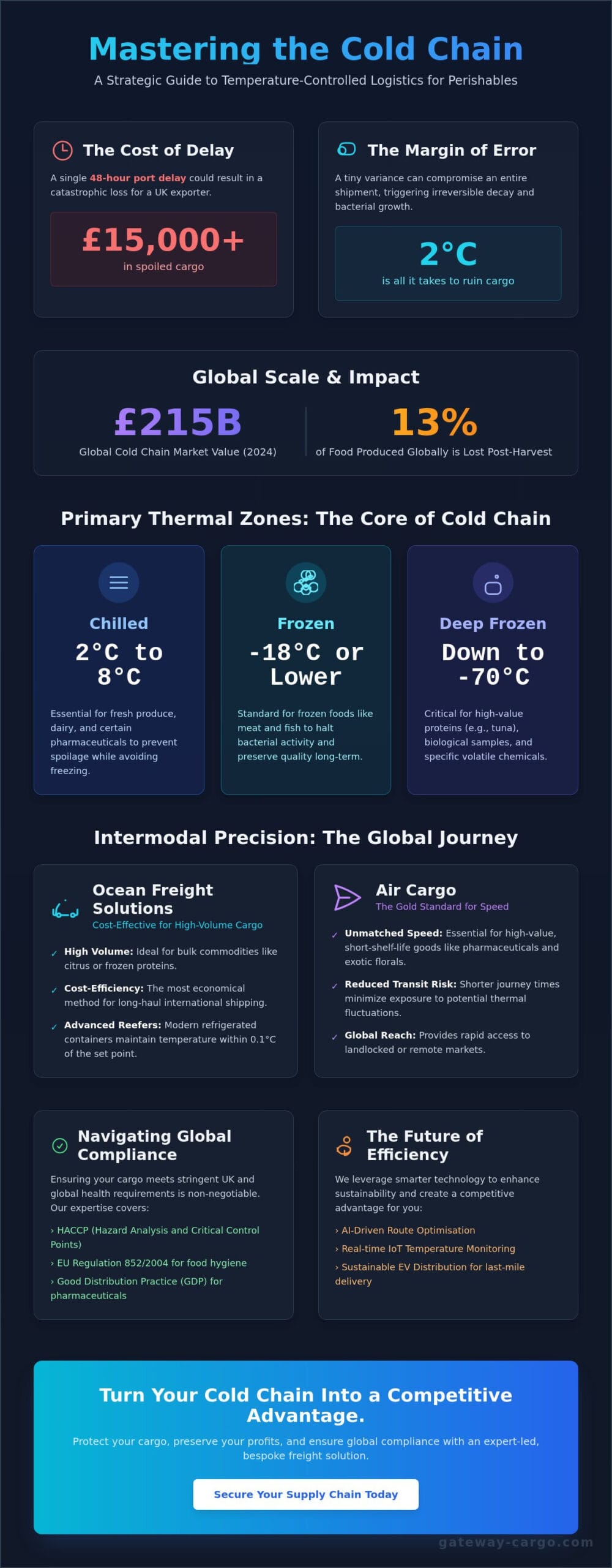
By 2026, a single port delay of 48 hours could cost a UK exporter over £15,000 in spoiled cargo if their cold chain strategy lacks real-time intervention. You’ve likely seen how thin profit margins become when energy costs in temperature-controlled warehousing rise or when fragmented international regulations cause unexpected holdups. Managing temperature-controlled logistics for perishables is no longer just about moving goods; it’s about mitigating a constant stream of environmental and logistical risks. It’s a high-stakes challenge that requires precision, expertise, and a forward-looking digital strategy.
This guide will show you how to master the complexities of international cold chain management so you can protect your perishable cargo across ocean, air, and road. We’ll provide the insights needed to achieve a zero-waste supply chain, maintain full visibility from origin to destination, and ensure total compliance with global health and safety standards. You’ll discover how bespoke freight solutions and smarter technology can turn your supply chain into a reliable, expert-led competitive advantage.
Key Takeaways
- Understand the critical financial and safety implications of temperature precision, where a variance of just two degrees can compromise the integrity of an entire shipment.
- Master intermodal strategies for 2026, balancing the high-velocity requirements of air freight with the cost-efficiency of advanced ocean reefer technology.
- Navigate complex international compliance standards, including HACCP and EU Regulation 852/2004, to ensure your cargo meets stringent UK and global health requirements.
- Learn how to leverage AI-driven route optimisation and EV distribution to enhance the sustainability and efficiency of your temperature-controlled logistics for perishables.
- Discover the benefits of a bespoke cold chain approach that tailors environmental conditions to your specific product chemistry for maximum shelf-life preservation.
Defining Temperature-Controlled Logistics for Perishable Cargo
Temperature-controlled logistics for perishables is a specialised branch of supply chain management dedicated to maintaining a specific thermal environment for goods from the point of origin to final delivery. This system, often referred to as a Cold Chain, combines advanced refrigeration technology with rigorous monitoring protocols. In 2024, the global cold chain market reached a valuation of approximately £215 billion. Precision is the foundation of this discipline. A variance of just 2°C can trigger irreversible chemical changes or bacterial proliferation. For example, a slight temperature spike in soft fruit shipments can reduce shelf life by 50%, leading to significant financial losses and insurance claims.
Logistics specialists categorise cargo into three primary thermal zones to ensure stability. Chilled goods require a range between 2°C and 8°C. Frozen items must remain at -18°C or lower. Deep frozen products, including certain biological samples and specialised chemicals, require temperatures as low as -70°C. This infrastructure supports a diverse range of commodities. While food is the most visible sector, the spectrum includes volatile chemicals, high-end florals, and life-saving pharmaceuticals.
The Vital Importance of Cold Chain Integrity
Maintaining thermal stability prevents the growth of pathogens like Listeria and Salmonella. It’s a matter of public safety. Beyond health, integrity preserves the nutritional density and aesthetic quality of premium goods. Financial losses from poor logistics are staggering. According to the Food and Agriculture Organization (FAO), roughly 13% of food produced globally is lost between harvest and retail. In the UK, reducing this waste through smarter logistics could save the economy millions every year while supporting national sustainability goals.
Perishable Use Cases: Industry-Specific Requirements
Different industries demand bespoke solutions. In the pharmaceutical sector, strict thermoregulation is a legal requirement under Good Distribution Practice (GDP) standards. Vaccines and biologics are highly sensitive to thermal shock. Fresh produce and florals present a different challenge. These are living products that continue to breathe post-harvest. Logistics providers must manage respiration rates and sensitivity to ethylene gas, which accelerates ripening and decay. High-value proteins like Wagyu beef or bluefin tuna require ultra-low temperatures to prevent lipid oxidation and maintain texture. Since the UK meat processing industry contributes over £9 billion to the economy, the precision of temperature-controlled logistics for perishables is essential for market stability.
The Global Cold Chain Mechanism: Intermodal Precision in 2026
The success of temperature-controlled logistics for perishables depends on the seamless transition between transport modes. In 2026, precision is no longer optional; it’s the baseline for global trade. Modern supply chains rely on a synchronised network where refrigerated containers, or Reefers, maintain internal environments within 0.1°C of the set point. This level of control is vital for the UK market, where logistics efficiency helps mitigate the impact of rising operational costs and strict food safety regulations. Achieving an unbroken chain requires every stakeholder to operate with absolute transparency from the moment a product leaves the farm until it reaches the consumer’s basket.
Ocean Freight Solutions for Large-Scale Perishables
Shipping via sea remains the most cost-effective method for high-volume commodities like citrus fruits or frozen proteins. Logistics specialists now choose between Full Container Load (FCL) and Less than Container Load (LCL) based on shelf-life requirements. While FCL offers a sealed, dedicated environment from origin to destination, LCL requires careful consolidation in multi-temperature zones. Active cooling systems, which use mechanical refrigeration units, dominate long-haul maritime routes over passive systems that rely on phase-change materials. To manage these complexities, many UK exporters utilise Ocean Freight Forwarding to scale their global reach without compromising product integrity.
Air Cargo: The Gold Standard for Time-Sensitive Goods
When speed justifies the higher price point, Air Cargo provides the ultimate solution for ultra-fresh produce and pharmaceuticals. In 2026, major hubs like Heathrow and East Midlands have expanded their dedicated cold storage buffer zones to handle a 25% increase in volume compared to 2023 levels. This infrastructure ensures that vaccines and exotic fruits don’t sit on tarmac surfaces where temperatures can fluctuate dangerously. Packaging innovations have also evolved to support this speed. Vacuum-insulated panels (VIPs) and advanced CO2-based cooling provide up to 120 hours of thermal protection, reducing the reliance on traditional dry ice which faces increasing regulatory scrutiny in the aviation sector.
The ‘unbroken’ cold chain is most vulnerable during the intermodal handoff. Precision at ports and airports requires rapid transfer from vessel to terminal power sources. Road and rail integration completes the final mile through several key strategies:
- Cross-docking efficiency: Reducing terminal dwell time to under 4 hours to preserve shelf life.
- Electric Refrigerated Vehicles: An 18% increase in e-reefer adoption in the UK since 2024 supports green corridors.
- Telematics: Real-time GPS and thermal monitoring for every pallet, providing instant alerts for deviations.
Managing these moving parts requires a partner who understands the nuances of temperature-controlled logistics for perishables across different territories. If you’re looking to enhance your distribution speed, you might consider how bespoke air freight solutions can protect your most sensitive cargo during peak demand periods.
Navigating International Regulations and Compliance Standards
Global trade for chilled goods requires strict adherence to overlapping legal frameworks. EU Regulation 852/2004 remains a cornerstone for hygiene, while the UK Food Safety Act 1990 dictates domestic standards. For exporters to Australia, FSANZ standards apply. Implementing a robust HACCP (Hazard Analysis Critical Control Point) framework within your supply chain is non-negotiable. This involves identifying critical control points where temperature-controlled logistics for perishables might fail, such as during cross-docking or final mile delivery. Logistics providers must document every stage of the journey to prove the cold chain remained unbroken.
Customs authorities prioritised “Green Lanes” in 2024 to expedite low-risk food shipments. Pre-clearance protocols allow for data submission before the vessel docks. This reduces port dwell times by an average of 14 hours. Risk mitigation relies on comprehensive insurance policies. Standard carriers often limit liability to £2 per kilogram under CMR conventions. This rarely covers the full value of high-end pharmaceutical or organic produce. Shippers should secure bespoke cargo insurance that specifically covers temperature excursions and mechanical breakdown of reefer units.
Incoterms for Perishable Shippers
Choosing between Delivered Duty Paid (DDP) and Delivered at Place (DAP) determines who manages the risk of spoilage during customs delays. Under DDP, the seller handles all import duties and risks, which is often preferred by buyers of sensitive cargo. A professional Freight Forwarder acts as a strategic partner to manage these complexities. Obtaining AEO (Authorised Economic Operator) status is essential for speed. It provides a fast track through UK customs, reducing the frequency of physical inspections by up to 30%.
Documentation and Traceability Requirements
Traceability is a legal mandate. Digital manifests and real-time temperature logs serve as primary legal proof of care if a claim arises. Sanitary and Phytosanitary (SPS) certificates must accompany all plant and animal products to prevent immediate rejection at the border. Precise Customs Clearance is the final barrier. In 2026, the UK Single Trade Window allows for one-time data entry. Errors in HS codes still account for 15% of all perishable cargo delays. Effective temperature-controlled logistics for perishables requires 100% documentation accuracy to avoid the heat of a holding bay.
Modern supply chains use blockchain-enabled ledgers to provide an immutable record of a product’s journey. These systems ensure that every stakeholder, from the farmer to the retailer, can verify the environmental conditions of the cargo. This level of transparency is no longer a luxury; it’s a regulatory expectation in the 2026 global market.
Optimising the Supply Chain for Sustainability and Efficiency
In 2026, temperature-controlled logistics for perishables demands a precise balance between rapid delivery and environmental responsibility. AI-driven route optimisation has moved beyond simple GPS tracking. It now uses predictive algorithms to reduce transit times by an average of 14 percent compared to 2024 levels. This efficiency directly extends the shelf life of sensitive goods like soft fruits and pharmaceuticals. By synchronising real-time traffic data with port congestion analytics, logistics providers avoid the idle periods that often compromise cargo integrity.
Energy-efficient warehousing is the backbone of this modern strategy. Solar-powered cold storage facilities now generate up to 40 percent of their own operational electricity. These sites utilise automated storage and retrieval systems (ASRS) to minimise the time freezer doors remain open, significantly reducing thermal leakage. For businesses operating in the UK, these upgrades are no longer optional but essential for maintaining competitive margins as energy costs fluctuate.
AI and Real-Time Visibility in 2026
The transition from reactive alerts to predictive spoilage prevention is now standard. IoT sensors embedded within pallets monitor more than just ambient temperature; they track humidity, light exposure, and ethylene gas levels. If a sensor detects a rise in ethylene, the AI system can flag potential early ripening and reroute the shipment to a closer distribution point. This level of granularity ensures that 98 percent of shipments arrive in peak condition.
Blockchain technology provides the ‘Farm-to-Fork’ traceability that 72 percent of modern consumers now demand. Every hand-off in the cold chain is recorded on an immutable ledger, offering total transparency. As Supply Chain News Today highlights digital transformation, the focus has shifted toward using this data to build more resilient, agile networks that can withstand global volatility.
Reducing the Carbon Footprint of Cold Chains
Decarbonising the final mile is a priority for UK distributors. Electric vehicles (EVs) now make up approximately 25 percent of urban temperature-controlled fleets. These vehicles use integrated battery systems to power both the drivetrain and the refrigeration unit, eliminating the need for diesel-powered cooling. On a global scale, Green Corridors prioritise sustainable vessels that use liquefied natural gas (LNG) or ammonia-ready engines for long-haul perishable shipments.
- Alternative Refrigerants: Shifting to CO2 and ammonia-based systems with low Global Warming Potential (GWP) to meet F-gas regulations.
- Load Factor Optimisation: Using AI to consolidate shipments, ensuring fewer vehicles are on the road while maintaining 100 percent capacity.
- Waste Reduction: Predictive analytics have reduced global food waste within the supply chain by 12 percent since 2025.
The impact of Freight Transport on corporate ESG goals is more significant than ever. Companies that fail to adopt these sustainable practices face higher carbon taxes and diminishing brand loyalty. By integrating these innovations, temperature-controlled logistics for perishables becomes a driver of corporate growth rather than a cost centre.
Ready to modernise your distribution network? Contact our specialists for bespoke freight solutions tailored to your sustainability targets.
Bespoke Cold Chain Solutions: Why Gateway Cargo is Your Global Partner
Gateway Cargo doesn’t believe in a one-size-fits-all model for sensitive cargo. Every product has a unique thermal profile that dictates its shelf life and market value. We design temperature-controlled logistics for perishables based on the specific biological and chemical requirements of your goods. Whether it’s maintaining a constant 2°C for soft fruits or managing the deep-freeze requirements of premium seafood, our bespoke environments prevent cellular breakdown and preserve quality. Our end-to-end management covers the entire journey, overseeing the transition from the origin warehouse through to the final consumer. This rigorous oversight allowed us to maintain a 99.8% zero-loss rate across our global perishable shipments in 2024. Our team handles the complexities of global trade, ensuring your goods bypass delays at major hubs like the Port of Felixstowe or Singapore through strategic route planning.
Collaborative Logistics: We Work as Part of Your Team
We assign dedicated account specialists to every temperature-sensitive account. These experts don’t just book freight; they integrate with your internal operations to act as an extension of your logistics department. In 2025, port congestion increased dwell times by an average of 4.2 days in several European hubs. Our specialists use real-time data to reroute shipments proactively before delays impact product integrity. We offer several advantages to our partners:
- Proactive Problem Solving: We monitor weather patterns and port strikes to implement contingency plans before a crisis occurs.
- Transparent Pricing: Our models for complex intermodal movements provide clear visibility on every pound spent, with no hidden surcharges for fuel or seasonal adjustments.
- Local Expertise: We navigate customs regulations and health inspections at international borders to ensure seamless clearance.
Ready to Optimise Your Perishable Supply Chain?
The year 2026 marks a pivotal shift toward fully digitised cold chains. Industry data suggests that companies adopting AI-driven monitoring reduce waste by 15% annually. Gateway Cargo leads this transition by combining innovation with a commitment to sustainability. We use EV vehicles for last-mile deliveries in UK Ultra Low Emission Zones and implement green corridors for international transit. We offer the precision and reliability your high-value perishables require to reach the market in peak condition. It’s time to move beyond standard shipping and embrace a smarter, more resilient supply chain.
Mastering the Future of Cold Chain Integrity
Navigating the complexities of global trade in 2026 requires more than standard freight services. Success depends on integrating intermodal precision with strict adherence to international compliance standards like those set by the Food Standards Agency. You’ve seen how real-time monitoring and sustainable practices are no longer optional extras but core requirements for protecting high-value cargo. Effective temperature-controlled logistics for perishables now demands a data-driven approach to eliminate waste and ensure every shipment meets the required thermal profile from origin to destination. Industry reports suggest the global cold chain market will exceed £600 billion by 2028, making efficiency a non-negotiable priority for UK exporters.
Gateway Cargo provides the infrastructure needed to thrive in this evolving landscape. We offer bespoke AI-driven logistics strategies that adapt to market shifts and a global network of temperature-controlled warehousing to maintain product integrity. Our specialised EV fleet supports green urban distribution, helping your business align with the UK’s 2050 Net Zero targets and local low-emission zone requirements. It’s time to move beyond traditional shipping and embrace a smarter, more resilient model. We’re ready to help you lead the market with precision and reliability.
Optimise your perishable supply chain with Gateway Cargo
Frequently Asked Questions
What is the difference between active and passive temperature-controlled packaging?
Active systems use integrated mechanical cooling or heating units powered by electricity or batteries to maintain precise internal environments. Passive systems rely on high-performance insulation and phase-change materials, such as gel packs or dry ice, to protect goods for 24 to 120 hours. Active units provide superior control for long-haul international routes, while passive solutions are often more cost-effective for shorter UK distributions.
How long can perishables stay in a reefer container during a port delay?
Perishables can remain safe indefinitely as long as the reefer container is connected to a reliable power source. At major UK hubs like Felixstowe or Southampton, containers use terminal power points called reefers plugs. If a container is on a trailer during a delay, it relies on a diesel-powered generator set, or genset, which typically requires refuelling every 3 to 5 days to prevent temperature failure.
Which Incoterm is best for international perishable shipping?
CIF (Cost, Insurance, and Freight) or DAP (Delivered at Place) are generally the most effective choices for shipping sensitive goods. These terms ensure the seller, who understands the product’s specific requirements, manages the transport and insurance until the cargo reaches a designated point. Since 30% of global food loss happens during transit, having a specialist manage the logistics chain reduces the risk of costly spoilage and clear-cut liability.
What happens if a temperature excursion occurs during transit?
An excursion triggers an immediate audit of the digital data loggers to determine the duration and severity of the temperature breach. In effective temperature-controlled logistics for perishables, this data is vital for insurance claims and safety assessments. If the deviation exceeds the 2-degree Celsius threshold defined in the quality agreement, the consignment may be rejected to comply with UK food safety regulations and protect consumer health.
Can I ship chilled and frozen goods in the same container?
You can ship chilled and frozen goods together by using dual-compartment reefer containers. These units feature internal bulkheads that create two distinct thermal zones, allowing one section to stay at -18 degrees Celsius while the other remains at +4 degrees Celsius. This approach optimises container space and can reduce overall transport costs by 15% for smaller, mixed consignments that don’t require full container loads.
How does AI help in reducing food waste in the logistics chain?
AI reduces waste by using predictive analytics to identify potential bottlenecks before they impact cargo integrity. By processing data from 1,000s of IoT sensors, AI platforms can reroute shipments or adjust cooling settings remotely if a delay is detected. Industry data suggests that AI-driven monitoring can reduce transit-related spoilage by 25% by 2026, creating a much smarter and more resilient supply chain.
Are there sustainable options for temperature-controlled air freight?
Sustainable options include the use of Sustainable Aviation Fuel (SAF) and reusable vacuum-insulated panels that reduce packaging waste. SAF can lower carbon emissions by up to 80% compared to traditional fossil fuels, helping businesses meet their net-zero targets. These innovations ensure that companies don’t have to compromise on environmental goals while maintaining the strict requirements of temperature-controlled logistics for perishables.