
FCA Incoterms Meaning: A Strategic Guide for International Shippers in 2026
What if your next shipment arrived at the Port of Southampton only for you to discover you’re liable for £850 in loading costs you never budgeted for? Many UK exporters find themselves caught out by the fine print of global trade agreements. It’s frustrating when a lack of clarity leads to unexpected invoices or disputes at the origin. Mastering the fca incoterms meaning allows your organisation to build a smarter, more resilient supply chain. You’ll learn to pinpoint the exact moment risk transfers and ensure every penny of your logistics spend is accounted for.
Our specialists understand that precision is the foundation of seamless logistics. This guide provides a clear framework for assigning costs and risks, giving you the confidence to choose the most efficient transport methods. We’ll explore how to handle export documentation in foreign jurisdictions and reduce your financial exposure during transit. By the end of this article, you’ll have the expertise to optimise your 2026 shipping strategy for maximum reliability and control.
Key Takeaways
- Gain a comprehensive understanding of the fca incoterms meaning and its versatile application across all transport modes to enhance your global shipping strategy.
- Clearly define the split of responsibilities between sellers and buyers to ensure seamless export clearance and cost-effective carriage management.
- Master the nuances of the ‘named place’ to accurately identify risk transfer points and manage loading obligations within your supply chain.
- Evaluate the strategic advantages of FCA over EXW and FOB to maintain superior control over containerised freight and UK export compliance.
- Discover how to leverage bespoke freight solutions and expert insights to optimise your logistics and reduce the total cost of ownership.
Understanding the FCA Incoterm Meaning in Modern Trade
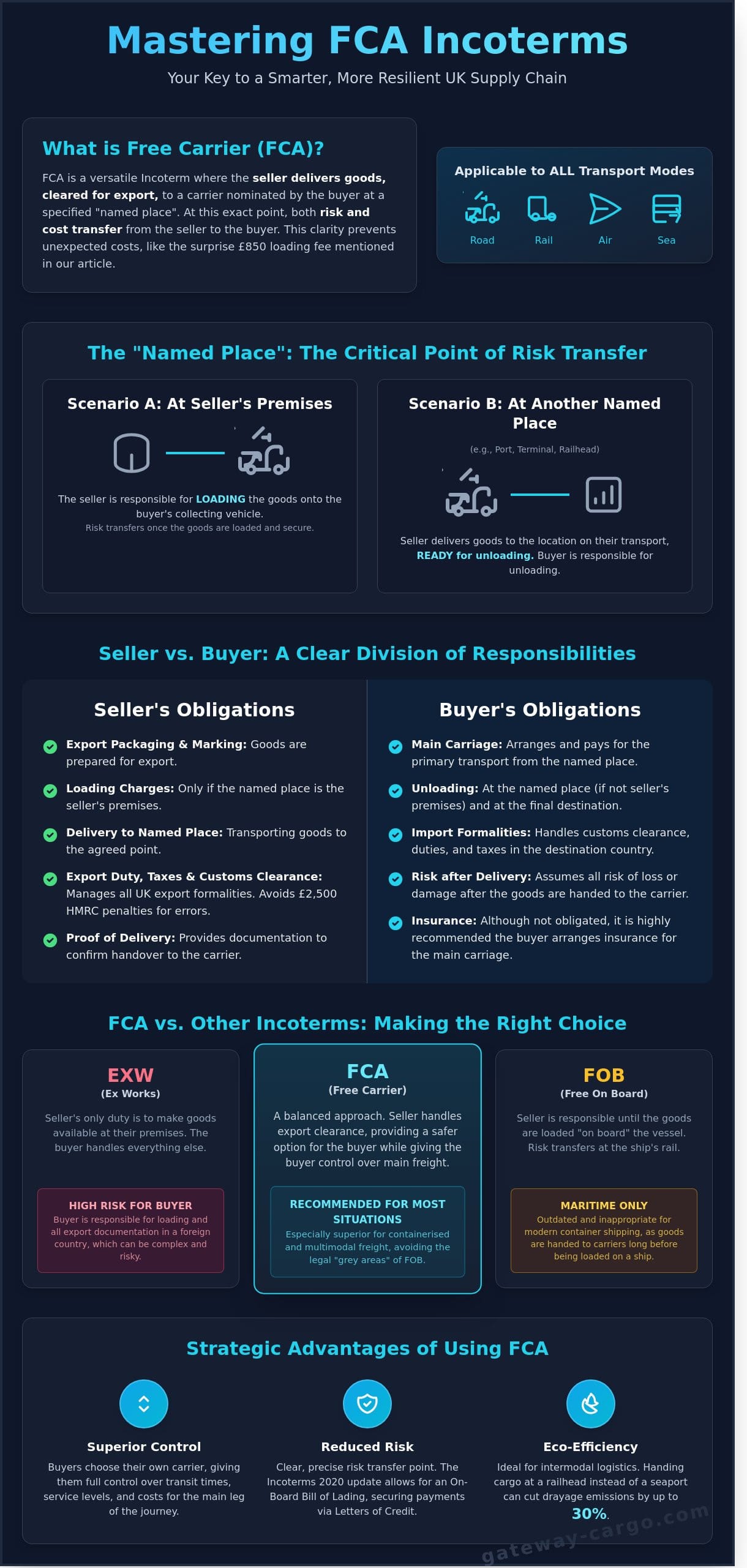
Free Carrier (FCA) is a versatile trade term that applies to any mode of transport, whether you’re moving goods by road, rail, air, or sea. Understanding the fca incoterms meaning is essential for UK exporters and importers looking to optimise their supply chain efficiency. Under this rule, the seller fulfills their obligation when they deliver the goods to a carrier or another person nominated by the buyer at the seller’s premises or another specified named place. This flexibility makes FCA a cornerstone of modern international shipping services, as it clearly defines the moment risk transfers from seller to buyer.
The “named place” serves as the critical pivot point in the contract of sale. If the named place is the seller’s premises, the seller is responsible for loading the goods onto the buyer’s vehicle. If the delivery occurs at any other location, the seller is deemed to have delivered the goods once they reach the destination on their own transport, ready for unloading by the carrier. Precision in defining this location prevents disputes regarding terminal handling charges or unexpected storage fees at UK ports like Felixstowe or Southampton.
The Evolution of Free Carrier in Global Logistics
The transition from the 2010 standards to the current 2020 Incoterms rules introduced a significant change to FCA. It now allows the buyer and seller to agree that the buyer will instruct its carrier to issue an on-board bill of lading to the seller after loading. This adjustment solved a long-standing issue for businesses using letters of credit, where banks required proof of loading before releasing funds. This technical refinement is one reason why the fca incoterms meaning has become so relevant for high-value industries. Specifically, the pharmaceutical and electronics sectors, which handled over £70 billion in UK exports in 2024, favour FCA for its clear risk boundaries during rapid transit cycles.
Why FCA is the Go-To for Multimodal Transport
FCA is the superior alternative to maritime-only terms like FOB (Free on Board) or CIF (Cost, Insurance, and Freight) when goods are containerised. While FOB requires the seller to place goods on a vessel, FCA allows for delivery at an inland container terminal or a warehouse. This capability is vital for businesses utilising intermodal logistics to reduce their carbon footprints. By handing over cargo at a rail railhead rather than a distant seaport, shippers can cut drayage emissions by up to 30%. Because FCA handles transitions between road, rail, and air seamlessly, it eliminates the legal “grey areas” that often occur when maritime terms are incorrectly applied to land-based or air freight movements.
Decoding Seller and Buyer Responsibilities Under FCA
The fca incoterms meaning centres on a clear division of costs and risks at the point where goods are handed to a carrier. In this arrangement, the seller’s primary obligation is to deliver the goods, cleared for export, to a carrier or another person nominated by the buyer at a named place. This “named place” is the pivot point of the entire transaction. If the delivery occurs at the seller’s premises, the seller is responsible for loading the goods onto the buyer’s collecting vehicle. However, if the delivery takes place at a different location, such as a freight terminal or port, the seller is only responsible for transporting the goods to that site; the buyer must then handle the unloading.
The seller must provide the buyer with proof of delivery at their own expense. This is usually a transport document or an electronic equivalent that confirms the carrier has taken possession of the cargo. Once this transfer occurs, the buyer’s duties begin. The buyer arranges and pays for the main carriage, giving them full control over the transit times and the choice of logistics providers.
The Seller’s Export Obligations and Documentation
Under FCA, the seller manages all export formalities. This includes obtaining necessary export licences and completing customs declarations required by UK authorities. It’s a critical step; as of 2024, HMRC can issue penalties of up to £2,500 for significant errors in export documentation. The seller also plays a vital role in the ‘On-Board Bill of Lading’ provision introduced in the Incoterms 2020 update. This allows the buyer to instruct their carrier to issue a bill of lading with an “on-board” notation to the seller. This mechanism is essential for sellers who need to satisfy the requirements of a Letter of Credit to secure payment from a bank.
The Buyer’s Risk and Carriage Control
Risk transfers from the seller to the buyer the moment the goods are delivered to the carrier at the agreed location. This shift means the buyer bears any subsequent loss or damage during the main transit. By controlling the carriage, the buyer can optimise freight spend and select routes that align with their specific inventory needs. According to the U.S. International Trade Administration
The Named Place: Why Delivery Points Matter for Risk Transfer
In the fca incoterms meaning, the “named place” represents more than just a geographic coordinate. It’s the precise moment where the legal and financial responsibility for the cargo shifts from the seller to the buyer. Misunderstanding this point often leads to disputes over Terminal Handling Charges (THCs) or damage during the loading process. UK businesses must define this location with absolute clarity to avoid unforeseen costs that can erode profit margins.
Delivery at the Seller’s Premises
When the contract specifies the seller’s warehouse or factory as the delivery point, the seller’s obligations are at their highest. They’re responsible for loading the goods onto the vehicle provided by the buyer. This scenario is particularly beneficial for buyers moving full truckloads (FTL) or full container loads (FCL), as it ensures the seller manages the initial labour and equipment costs. From an insurance perspective, the seller carries the risk until the goods are safely on the buyer’s transport. If a pallet is damaged by a forklift at a Birmingham distribution centre before it’s secured on the lorry, the seller must rectify the loss.
Delivery at a Transport Terminal or Port
If the named place is a port, airport, or consolidator’s hub, the rules change significantly. Under the official Incoterms® 2020 rules, the seller completes delivery when the goods arrive at the designated spot on their own vehicle, ready for unloading. The seller isn’t responsible for the physical offloading of the cargo. This “arriving means of transport” rule is a frequent source of friction at busy hubs like the Port of Felixstowe or Heathrow.
A common pitfall occurs when the buyer expects the seller to pay for the terminal’s offloading fees. In 2024, some UK importers faced unexpected terminal surcharges exceeding £250 per consignment because the contract didn’t specify who would cover the transition from the seller’s truck to the warehouse floor. To maintain a seamless supply chain, you must ensure your contract wording matches the physical reality of the terminal’s operations.
Coordinating these origin logistics requires a high level of precision. Engaging a professional freight forwarder allows you to bridge the gap between the seller’s dispatch team and the terminal’s receiving schedule. They act as the technical intermediary, ensuring that the fca incoterms meaning is applied correctly and that vehicles aren’t left idling, which can result in significant detention and demurrage penalties.
FCA vs FOB and EXW: Choosing the Right Rule for Your Supply Chain
Selecting the appropriate Incoterm is a commercial decision that dictates your liability and total landed cost. While many UK businesses default to EXW or FOB out of habit, these terms often create unnecessary friction in modern logistics. Understanding the fca incoterms meaning helps procurement teams shift risk to the party best equipped to manage it.
Why FCA is Replacing EXW for International Shippers
Ex Works (EXW) creates an “export clearance trap” for the buyer. Under EXW, the seller simply makes goods available at their premises. The buyer must then arrange export customs clearance in a country where they may not have a legal presence. This often leads to delays at the border and compliance failures. FCA (Free Carrier) provides a professional alternative where the seller, who is the local expert, handles the export formalities.
FCA gives you better control over the “first mile” of transport. It ensures the seller is responsible for loading the goods, which reduces your liability for damages during the initial transit phase. This transition to more robust terms is a recurring theme in supply chain news today, as businesses seek to eliminate the data silos created by EXW shipments.
FCA vs FOB: Clearing the Confusion for Containerised Cargo
FOB (Free On Board) is frequently misapplied to containerised shipments. Technically, FOB is designed for maritime and inland waterway transport where the seller delivers goods over the ship’s rail. In a modern container terminal, the seller hands over the cargo to the carrier at a gate or a CFS (Container Freight Station), not the ship’s side. This creates a “grey zone” where the seller has lost physical control but still carries the risk until the container is actually loaded onto the vessel.
FCA solves this by aligning the risk transfer with the point of delivery to the carrier. If you’re shipping by air, road, or rail, FOB is legally inappropriate. Using the correct fca incoterms meaning ensures your insurance coverage is valid from the moment the carrier takes possession.
- Use FCA: For all containerised ocean freight, air freight, and road haulage. It’s the safest default for 95% of modern trade.
- Use FOB: Only for bulk cargo, grain, or oil where goods are loaded directly into the ship’s hold.
- Avoid EXW: Unless you have a dedicated local agent in the origin country to manage export legalities and loading.
Transitioning from FOB to FCA in 2026 requires updating your purchase agreements and informing your freight forwarder. Most UK insurers now prefer FCA because it removes the ambiguity of the “ship’s rail” transfer point. If you want to refine your shipping strategy, our specialists can help you optimise your freight solutions for maximum compliance.
Optimising Your Global Logistics Strategy with FCA and Gateway Cargo
Gateway Cargo acts as the strategic architect for your 2026 supply chain operations. Gaining a deep understanding of the fca incoterms meaning is merely the first step toward efficiency. Applying this knowledge to reduce the total cost of ownership requires a partner who integrates bespoke freight solutions with real-time data. We focus on removing the friction points that typically inflate logistics budgets by 12% through inefficient handovers and lack of visibility.
Leveraging Specialised Freight Forwarding for FCA
Managing the ‘Named Place’ handoff is where many FCA agreements falter. Gateway Cargo eliminates these bottlenecks by synchronising the seller’s delivery with our carrier’s arrival. In 2024, terminal wait times at major UK hubs like Felixstowe averaged 2.4 hours; our precise scheduling aims to reduce this to near zero. Our integrated customs clearance services provide sellers with immediate proof of export, which is vital for VAT zero-rating compliance under HMRC regulations. Local knowledge of terminal operations ensures that your cargo moves through the port of entry without the 48-hour administrative lag often seen with non-specialised providers.
Integrating Sustainability and Innovation into Your Strategy
Choosing FCA empowers buyers to dictate the environmental impact of their transport. By selecting Gateway Cargo, you gain access to our “green corridor” initiatives, including EV vehicle transport for final-mile deliveries and carriers committed to low-sulphur fuels. This level of control is essential for companies aiming to meet the UK’s 2050 net-zero targets. Our AI-driven digital strategy uses predictive analytics to monitor terminal congestion in real-time. This technology allows us to reroute shipments 12 to 24 hours before a bottleneck occurs, ensuring your 2026 logistics plan remains resilient against global disruptions.
Our specialists are ready to help you refine your approach to the fca incoterms meaning and its practical application. Refine your 2026 logistics plan by consulting with our team to identify cost-saving opportunities in your current routes. Gateway Cargo remains committed to delivering seamless logistics for a smarter supply chain through innovation and deep industry expertise.
- Precision: Real-time AI tracking for every FCA shipment.
- Compliance: Expert handling of UK HMRC documentation and CDS entries.
- Sustainability: Access to EV fleets and carbon-offsetting transport options.
- Efficiency: Reduced terminal dwell times through proactive scheduling.
Contact our logistics specialists today to secure your supply chain’s future.
Future-Proofing Your 2026 Global Shipping Strategy
Success in international trade requires more than just moving cargo; it demands a precise understanding of the fca incoterms meaning to manage risk effectively. By 2026, UK exporters must navigate increasingly complex regulations, making the clear definition of delivery points and cost transfers vital for maintaining healthy margins. Transitioning from EXW or FOB to FCA offers greater flexibility for multimodal transport, especially as the UK government’s Single Trade Window initiative targets 2025 for full implementation to streamline border processes.
Gateway Cargo delivers the technical edge required for this evolving landscape. Our AI-driven digital strategy provides real-time cargo visibility, ensuring you’re never in the dark about your shipment’s status. We provide specialised expertise in UK customs clearance and international trade law, helping you avoid the penalties associated with incorrect documentation. Our commitment to the environment remains a priority, featuring proactive sustainability initiatives such as EV vehicle options for greener logistics chains. It’s time to transform your shipping department into a competitive advantage.
Optimise your supply chain with Gateway Cargo’s bespoke logistics solutions.
We look forward to helping you navigate the complexities of global trade with confidence and precision.
Frequently Asked Questions
Does FCA include export customs clearance?
The seller is responsible for all export customs clearance procedures and costs under FCA terms. This requirement includes obtaining specific export licences and completing the necessary HMRC declarations for goods leaving the United Kingdom. While the seller manages the export side, the buyer remains responsible for all import duties, taxes, and clearance formalities at the destination country.
Who pays for the main freight under FCA Incoterms?
The buyer is responsible for arranging and paying for the main international carriage from the named place of delivery. This structure gives the buyer full control over the shipping route, the selection of the carrier, and the negotiated freight rates. Understanding the fca incoterms meaning is essential for buyers who want to manage their own supply chain costs and logistics schedules effectively.
Is FCA suitable for ocean freight shipments?
FCA is the preferred term for containerised ocean freight where the seller delivers goods to a terminal rather than loading them directly onto a vessel. The International Chamber of Commerce recommends FCA over FOB for containers because the seller’s responsibility ends when the carrier receives the cargo. This removes the liability gaps that occur when containers sit in a port terminal before being lifted on board.
What is the difference between FCA and FOB for containerised goods?
The primary difference involves the specific point where risk and costs transfer from the seller to the buyer. In FCA, risk transfers when goods are delivered to the carrier at a named place, such as a container yard or terminal. In FOB, risk only transfers once the goods are physically loaded on board the ship. Using FCA avoids the “grey area” of risk that exists while cargo is staged at a port.
When does the risk transfer from seller to buyer in an FCA agreement?
Risk transfers at the exact moment the seller delivers the goods to the named carrier at the agreed location. If the delivery occurs at the seller’s own premises, risk transfers once the goods are loaded onto the buyer’s vehicle. If delivery happens at any other location, risk transfers when the goods are placed at the carrier’s disposal on the seller’s vehicle, ready for unloading.
Can a freight forwarder be the named ‘carrier’ in an FCA contract?
A freight forwarder can be the named carrier in an FCA agreement if they’re contracted to perform or procure the carriage. The Incoterms 2020 rules allow for any person or firm to act as the carrier as long as they undertake the performance of the transport. Logistics specialists often act in this capacity, providing the seller with a bill of lading or transport document as proof of delivery.
Does the seller have to load the goods under FCA?
The seller’s obligation to load depends entirely on the named place of delivery specified in the contract. If the named place is the seller’s premises, they’re responsible for loading the goods onto the buyer’s arriving vehicle. However, if delivery occurs at a warehouse or terminal, the seller isn’t responsible for unloading their vehicle; the buyer or their carrier must handle the transfer of goods.
Is FCA better than EXW for international trade?
FCA is generally better than EXW because it ensures the seller handles the export declaration, which is a legal requirement they’re better equipped to meet. In 2023, many UK businesses transitioned from EXW to FCA to simplify VAT compliance and ensure they receive proper proof of export. A clear understanding of the fca incoterms meaning helps companies avoid the legal complexities of having a foreign buyer manage domestic export filings.