
Supply Chain Optimisation Strategies 2026: Navigating the Complexity Explosion
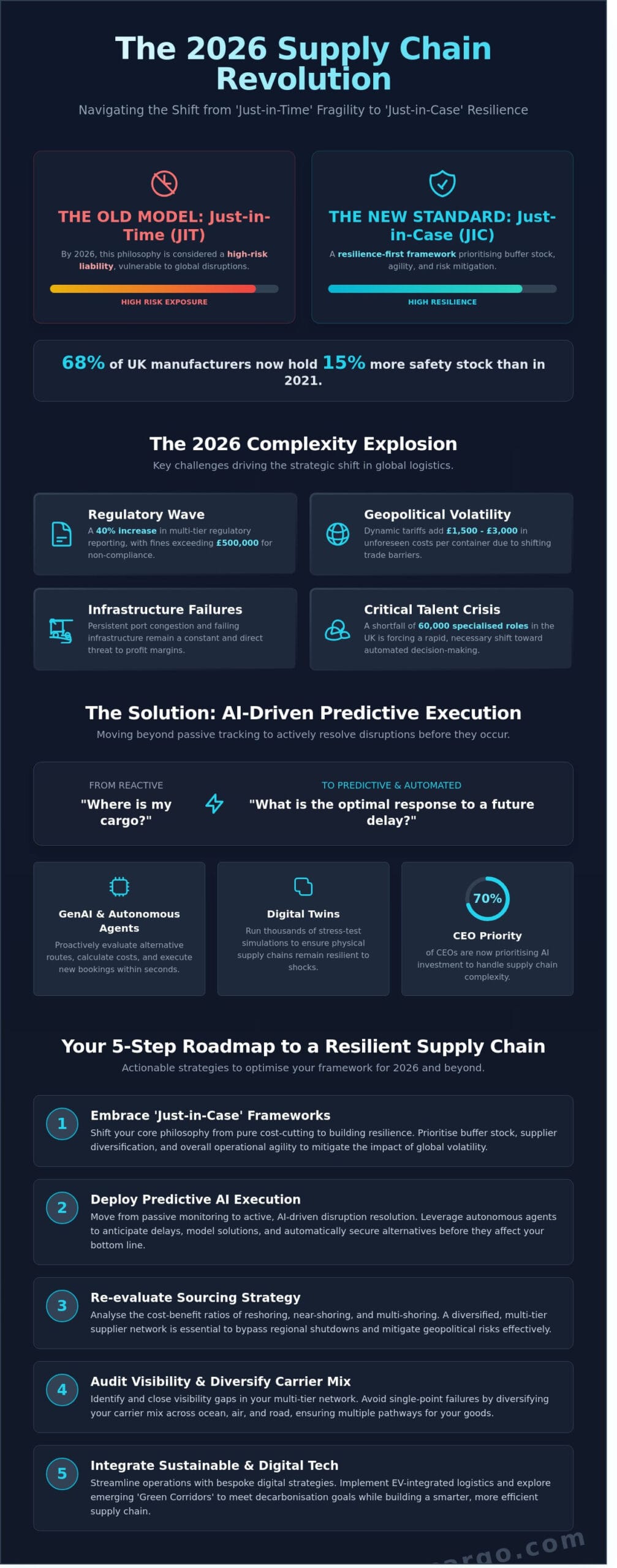
By 2026, the traditional “just-in-time” model will be considered a high-risk liability for UK businesses facing a 40% increase in multi-tier regulatory reporting requirements. You’re likely already feeling the strain of unpredictable tariff shifts and the mounting pressure to decarbonise your fleet without eroding your bottom line. It’s a difficult balance to maintain when port congestion and infrastructure failures remain persistent threats to your margins. Staying ahead requires more than just reactive adjustments; it demands a fundamental shift in how you manage global flow.
In this article, you’ll discover the most effective, AI-driven, and sustainable supply chain optimization strategies 2026 provides to help you build a resilient “just-in-case” inventory model that protects your profitability. We’ll provide a clear roadmap for integrating EV logistics and AI-powered forecasting to ensure your operations remain seamless amidst global complexity. You’ll learn how to navigate multi-tier traceability and mitigate geopolitical risks while lowering your overall logistics costs. By adopting these smarter solutions, your organisation can transform logistics from a cost centre into a strategic advantage.
Key Takeaways
- Understand why the ‘Just-in-Time’ philosophy is being replaced by resilience-first frameworks to mitigate the impact of global geopolitical volatility.
- Explore the shift from simple cargo visibility to AI-driven predictive execution, allowing you to resolve disruptions before they occur.
- Evaluate the cost-benefit ratios of reshoring versus near-shoring and the emerging role of ‘Green Corridors’ in sustainable logistics.
- Implement five actionable supply chain optimization strategies 2026 to audit visibility gaps and diversify your carrier mix across ocean, air, and road.
- Discover how bespoke digital strategies and EV-integrated logistics can streamline your operations for a smarter, more efficient supply chain.
The 2026 Logistics Landscape: Surviving the Complexity Explosion
By January 2026, the traditional “Just-in-Time” (JIT) model has effectively collapsed as the primary supply chain philosophy. Global disruptions, ranging from climate-driven canal restrictions to sudden port closures, have forced a pivot toward “Just-in-Case” resilience. Implementing effective supply chain optimization strategies 2026 requires moving beyond simple cost-cutting to prioritise buffer stock and agility. A recent industry survey indicated that 68% of UK manufacturers now hold 15% more safety stock than they did in 2021 to mitigate unpredictable lead times.
Geopolitical tensions have created a permanent state of tariff volatility. Trade barriers can now shift within a single 24-hour news cycle, making traditional ocean freight contracts difficult to maintain. Businesses are struggling with regulatory unalignment, where UK, EU, and Asian trade standards often conflict, creating a “compliance tax” on every shipment. Success in this environment depends on a foundational understanding of supply chain optimization to ensure resources are allocated where they offer the highest protection against risk.
The logistics sector also faces a critical talent crisis. The UK currently faces a shortfall of approximately 60,000 specialised roles across the supply chain. This labour gap is forcing a rapid shift toward automated decision-making. Logistics specialists are deploying AI-driven systems to handle routine routing and inventory replenishment, which allows human teams to focus on managing high-level exceptions. This transition is no longer a luxury; it’s a survival mechanism for firms aiming to maintain a supply chain optimization strategies 2026 framework.
Geopolitical Volatility and Route Diversification
Rethinking trade lanes is essential to avoid high-risk zones. Many UK firms are moving from single-source models to multi-tier supplier networks to bypass regional port shutdowns. Dynamic tariffs have increased the economic impact on traditional ocean freight, sometimes adding £1,500 to £3,000 in unforeseen costs per container. Diversifying routes ensures that a single geopolitical event won’t paralyse your entire distribution network.
The Regulatory Wave: Traceability and Compliance
Modern trade requires multi-tier traceability and rigorous proof of origin. Regulators now demand defensible data to prove environmental and ethical compliance; failure to provide this can result in market access fines exceeding £500,000 for large enterprises. Integrating customs clearance early in the planning stage prevents costly delays. Gateway Cargo provides the bespoke solutions needed to manage these complex data requirements, ensuring your goods move across borders without friction.
AI-Driven Predictive Execution: Beyond Simple Visibility
By 2026, supply chain optimization strategies 2026 will move beyond the passive monitoring of assets. Standard track-and-trace capabilities no longer provide a competitive edge in a volatile global market. Leading firms are now adopting AI-driven predictive execution, which uses Generative AI (GenAI) to anticipate and resolve disruptions before they impact the bottom line. This represents a fundamental shift in logistics management. Instead of asking “where is my cargo?”, supply chain directors now ask “what should I do when my cargo is delayed by the storm forecast for Tuesday?”.
The integration of autonomous AI agents is transforming how businesses manage air and ocean freight. These agents don’t just alert a manager to a problem; they actively evaluate alternative routes, calculate the cost-benefit of switching from ocean to air, and execute new bookings within seconds. Key trends impacting supply chains suggest that 70% of CEOs are now prioritising AI investment to handle this level of complexity. Digital Twins play a vital role here, allowing companies to run thousands of stress-test simulations for 2026. These virtual models test how a UK distribution network would cope with a 15% spike in fuel costs or a sudden port closure, ensuring the physical supply chain remains resilient.
GenAI and Autonomous Decision-Making
GenAI is now a primary tool for increasing operational efficiency. By 2026, these systems will routinely optimise load factors, reducing empty miles by an average of 15% across road freight networks. This isn’t just about cost; it’s about meeting strict UK carbon reporting requirements. Automation also tackles the administrative bottlenecks that cause port hold-ups. AI-driven systems now process shipping documentation with 99.8% accuracy, preventing the paperwork errors that previously cost businesses thousands in daily demurrage fees. To succeed, you must focus on upskilling your team. Your logistics specialists must transition from manual data entry to overseeing these AI-driven digital strategies.
Predicting Disruptions with Real-Time Data
Predictive analytics thrives on data variety. Modern logistics centres now integrate live weather patterns, cyber-threat intelligence, and infrastructure health data into a single operational view. This proactive stance can reduce the financial impact of “black swan” events by up to 25%. When a cyber-attack hits a major European port, predictive systems immediately identify affected containers and trigger contingency plans. For the most effective supply chain optimization strategies 2026, planners must leverage supply chain news today to make tactical adjustments. Relying on historical data is a risk few can afford. Real-time intelligence ensures that a £500,000 shipment of time-sensitive goods arrives on schedule, regardless of external volatility.
Physical Strategy Shifts: Reshoring, Multi-shoring, and Green Corridors
By 2026, the traditional model of chasing the lowest labour costs has been superseded by a focus on proximity and reliability. While reshoring to the UK offers maximum control, it often carries a 15% to 20% premium in operational costs compared to offshore alternatives. Consequently, near-shoring has emerged as the most balanced of the supply chain optimization strategies 2026. By moving production to regions like Eastern Europe or North Africa, UK firms reduce lead times from six weeks to less than seven days, providing a buffer against the volatility of long-haul maritime routes.
Intermodal transport has become the primary mechanism for bypassing chronic congestion at major coastal hubs like Felixstowe and Southampton. By shifting containers directly from vessel to rail, businesses avoid the bottlenecks of the UK’s overstretched road network. This strategy isn’t just about speed; it’s a structural necessity for maintaining flow. Meanwhile, Green Corridors, specific trade routes between major ports that support zero-emission shipping, are no longer experimental. These routes allow cargo owners to secure preferential berthing and reduced port fees, rewarding those who invest in decarbonised logistics early.
The Rise of Near-shoring and Regional Hubs
In 2026, the value of speed to market outweighs the savings of distant manufacturing. UK businesses are increasingly establishing regional distribution centres to house inventory closer to the final consumer. This shift has triggered a 12% increase in demand for rail freight, as companies seek more efficient ways to move bulk goods from European hubs into the UK heartlands. Shorter supply chains don’t just mitigate risk; they allow for a more responsive inventory model that reduces the capital tied up in “just-in-case” stock.
Sustainability as a Cost-Saving Strategy
Sustainability has transitioned from a compliance burden to a genuine driver of efficiency. The adoption of electric heavy goods vehicles (eHGVs) for “last-mile” and “middle-mile” deliveries is now a standard component of supply chain optimization strategies 2026. These vehicles offer lower long-term maintenance costs and exempt businesses from escalating urban congestion charges. Optimising freight transport through circular logistics models, where packaging is reused and return legs are always utilised, has reduced empty-running incidents by 18% across the industry. By aligning with carbon-neutral freight standards, companies aren’t just meeting 2026 environmental regulations; they’re insulating their bottom line against future carbon taxes and fuel price volatility.
5 Steps to Optimise Your Supply Chain Framework
Building a resilient network requires moving beyond reactive fixes. To implement successful supply chain optimization strategies 2026, you must transition toward a proactive, data-led model that anticipates disruption before it impacts your bottom line. This five-step framework provides the structure needed to manage increasing global volatility.
Step 1: The Logistics Stress Test
Modern resilience starts with identifying single points of failure. You can’t rely on a single port or a solitary supplier for critical components. Recent data suggests that 18% of UK manufacturers experienced significant delays in 2024 due to narrow sourcing strategies. Your audit must extend beyond tier-one partners to uncover hidden risks in your deeper supply base. Additionally, mapping your carbon footprint is now a regulatory necessity. With the UK’s commitment to Net Zero by 2050, identifying high-emission links helps you avoid future carbon taxes and ensures compliance with evolving green corridors.
Step 2: Embracing Intermodal Flexibility
Rigid transport plans are a liability. Successful operators now maintain the ability to switch between modes, such as moving from air freight to sea-air solutions when ocean lanes are congested. Selecting a strategic freight forwarder is essential for this multi-modal agility. They provide the infrastructure to pivot your cargo based on real-time port data. You should also look for flexible warehousing contracts. Instead of long-term fixed leases, 2026 demands scalable space that expands or contracts based on seasonal peaks and market shifts.
Paper-based processes are the primary cause of border bottlenecks. By digitising your documentation, you align with the UK’s Customs Declaration Service (CDS). This ensures that commercial invoices, packing lists, and certificates of origin move faster than the physical goods. Automated filing reduces the risk of human error, which currently accounts for 30% of customs delays at major UK hubs.
Step 4: Automate with AI Agents
Routine logistics tasks no longer require manual intervention. AI agents can now handle carrier bookings, track shipments, and manage basic warehouse inventory levels. This isn’t just about speed; it’s about accuracy. Automating these workflows frees your specialists to focus on high-level problem solving and relationship management.
Step 5: Iterate with Real-Time Statistics
Static reports are obsolete. Your supply chain optimization strategies 2026 must rely on live performance dashboards. Monitor key metrics like container dwell times and last-mile delivery success rates daily. If a specific route consistently underperforms by more than 5%, use that data to trigger an immediate carrier review. Continuous iteration ensures your framework stays lean as market conditions shift.
Ready to modernise your operations? Contact Gateway Cargo today to build a smarter, more resilient supply chain.
Gateway Cargo: Bespoke Solutions for a Smarter Supply Chain
Gateway Cargo bridges the gap between digital intelligence and physical execution. As businesses refine their supply chain optimization strategies 2026, we provide the infrastructure to turn data into movement. Our AI-driven digital strategy isn’t a standalone tool; it’s the core of our freight forwarding operation. We don’t just move cargo. We provide bespoke logistics solutions that address specific industry pain points, from high-tech manufacturing to retail distribution. Our specialists integrate directly into your workflow, acting as an extension of your internal team to ensure every decision aligns with your commercial objectives.
Seamless Integration of Technology and Freight
Visibility is the foundation of modern logistics. Our platform delivers real-time tracking and predictive alerts for all shipments, allowing you to anticipate disruptions before they impact your bottom line. Managing complex customs and regulatory requirements remains a primary challenge for UK exporters. We handle HMRC compliance and international documentation with precision, reducing the risk of border delays. Our scalable warehousing and distribution networks across global centres provide the flexibility needed to manage seasonal surges or shifting market demands. We provide:
- Predictive Analytics: Using historical data to forecast transit times with 98% accuracy.
- Regulatory Expertise: In-house customs specialists to navigate post-Brexit trade complexities.
- Global Reach: Access to strategic hubs that facilitate faster last-mile delivery.
Leading the Way in Green Logistics
Reducing Scope 3 emissions is a regulatory and ethical priority. According to the UK Government’s Transport Decarbonisation Plan, the freight sector must transition rapidly to net-zero. We support this by offering sustainable shipping options and investing in electric and alternative fuel fleets. Our commitment to green corridors ensures your goods move through low-emission routes. By the end of 2025, we’ve planned to increase our EV fleet capacity by 40% to support urban distribution. This proactive approach helps you meet carbon reporting requirements while maintaining operational efficiency. Our specialists work to ensure your supply chain optimization strategies 2026 are as sustainable as they are profitable.
Gateway Cargo delivers an intelligent, carbon-conscious logistics framework that transforms complex global trade into a competitive advantage for 2026.
Securing Your Competitive Edge in the 2026 Logistics Landscape
The complexity explosion predicted for 2026 requires a fundamental shift from reactive to predictive logistics. Success depends on integrating AI-driven digital strategies and adopting sustainable practices like green corridors to meet the UK’s net-zero targets. Industry data indicates that businesses failing to digitise by 2025 risk a 15% increase in operational overheads. Implementing robust supply chain optimization strategies 2026 ensures your framework remains resilient against global volatility. You’ll need a partner that combines advanced technology with physical assets to navigate these shifts. Gateway Cargo provides the infrastructure required for this transition. Our specialised EV vehicle fleet supports your green shipping initiatives while our global network of logistics specialists manages every detail. We don’t just move cargo; we provide the intelligence to stay ahead of the curve. Our AI-driven digital strategy offers the predictive logistics you need to turn data into a competitive advantage. It’s time to transform your operations into a leaner, greener, and more responsive network.
Optimise your supply chain with Gateway Cargo’s bespoke solutions
Prepare your business today for the challenges of tomorrow.
Frequently Asked Questions
What are the biggest supply chain risks in 2026?
The primary risks include escalating geopolitical volatility and extreme weather events. By 2026, the UK’s Border Target Operating Model will have introduced mandatory digital certifications for 100% of imports. These regulatory shifts, combined with a projected 15% increase in global shipping volatility, mean businesses must prioritise agility. We help you mitigate these risks through real-time data and diversified sourcing.
How can AI improve my supply chain optimisation strategies?
AI improves supply chain optimization strategies 2026 by shifting from reactive to predictive planning. Machine learning models now achieve 95% accuracy in demand forecasting, which reduces excess inventory by up to 20%. Our specialists use AI-driven digital strategies to identify bottlenecks before they occur. This allows your team to adjust routes or stock levels dynamically, ensuring a smarter supply chain that saves time and money.
Is reshoring always better than offshoring for cost reduction?
Reshoring isn’t always cheaper, but it reduces hidden costs like the £5,000 per container volatility seen in long-haul ocean freight. While offshoring offers lower labour rates, reshoring to the UK or nearshoring to Europe cuts lead times by 60%. This agility reduces the capital tied up in transit. You should evaluate the total landed cost, including carbon taxes and inventory holding fees, to determine the best fit.
How do I ensure compliance with new 2026 traceability regulations?
You ensure compliance by implementing Digital Product Passports (DPP) that track raw materials from origin to end-user. The UK government’s 2026 roadmap requires detailed reporting on carbon footprints for 100% of electronic and textile imports. Our bespoke freight solutions integrate these data points into your shipping documentation. This automation prevents delays at customs and ensures you meet the strict standards of the UK’s Green Claims Code.
Can sustainable logistics actually lower my overall shipping costs?
Sustainable logistics lower costs by maximising fuel efficiency and reducing waste. Switching to EV vehicles for last-mile delivery in London’s Ultra Low Emission Zone saves operators approximately £12.50 per day in charges. Optimising load factors can also reduce the number of required trips by 15%. These green corridors don’t just protect the environment; they streamline your operations and improve your bottom line through reduced resource consumption.
What is the difference between visibility and predictive execution in logistics?
Visibility tells you where your cargo is located in real-time. Predictive execution uses that data to automatically reroute shipments when a delay is detected. If a vessel is delayed by 48 hours at the Port of Felixstowe, a predictive system immediately books alternative road freight. It’s the difference between knowing there’s a problem and solving it before it impacts your customer. This proactive approach is essential for a smarter supply chain.
How does intermodal transport help during port congestion?
Intermodal transport allows you to switch between sea, rail, and road to bypass specific bottlenecks. When the Port of Southampton faces 24-hour berthing delays, we can divert cargo to smaller regional ports and use rail freight for the final leg. This flexibility reduces reliance on a single infrastructure point. It’s a proven strategy that can cut port-related dwell times by 30% during peak periods of congestion.
What role does a freight forwarder play in supply chain optimisation?
A freight forwarder acts as a strategic partner to implement your supply chain optimization strategies 2026. We manage the complexity of customs clearance, intermodal logistics, and carrier negotiations. Our specialists work as part of your team to design bespoke freight solutions that align with your business goals. By leveraging our global network and industry insights, you gain the stability needed to navigate a volatile global market.