
Managing Supply Chain Risk and Disruption: A 2026 Strategic Guide
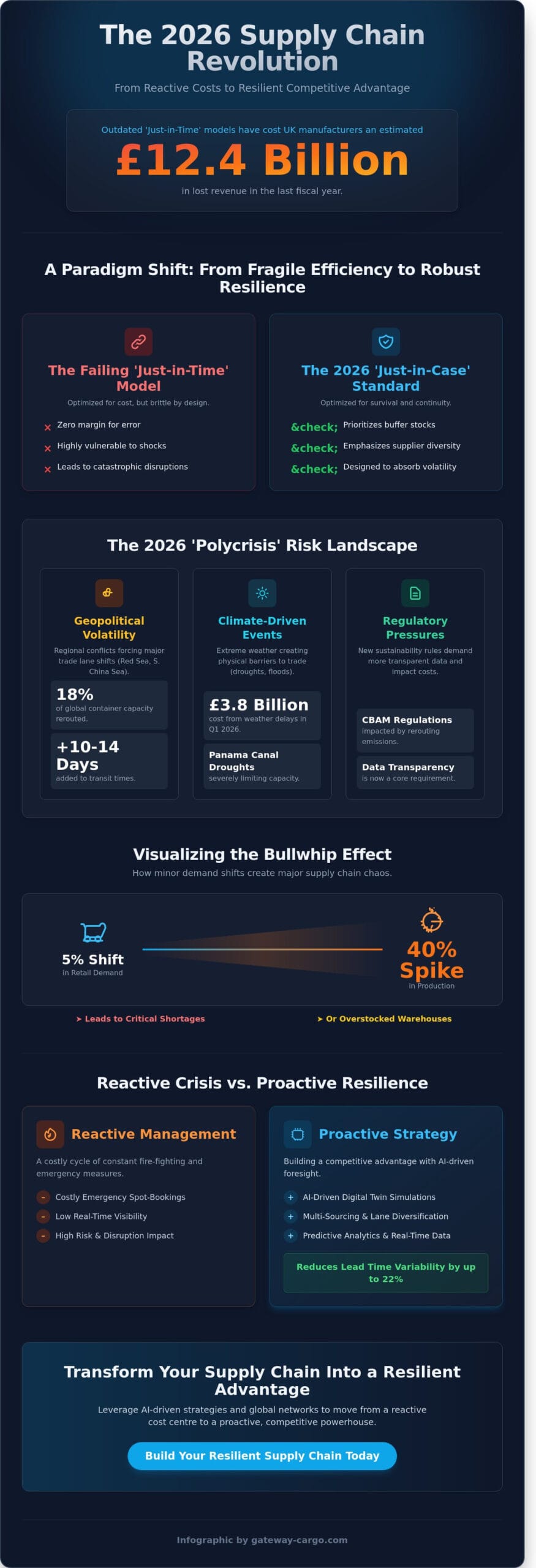
By 2026, the traditional “just-in-time” model has become a financial liability that cost UK manufacturers an estimated £12.4 billion in lost revenue during the previous fiscal year. You’re likely already dealing with the daily reality of unpredictable freight costs and geopolitical instability affecting your primary trade lanes. It’s frustrating to manage multi-tier suppliers when you lack real-time visibility, especially as new sustainability regulations demand more transparent data. Effectively managing supply chain risk and disruption is no longer a back-office function; it’s a core strategic requirement for any business that wants to survive the current market volatility.
This guide reveals how to transform your logistics operations from a reactive cost center into a resilient, proactive competitive advantage. We’ll show you how to implement an AI-driven roadmap that reduces lead time variability by up to 22% and significantly lowers emergency freight spend. You’ll gain the insights needed to navigate regulatory pressures while building a smarter, more reliable supply chain for the years ahead.
Key Takeaways
- Understand the shift toward ‘Permanent Volatility’ and learn to identify the critical intersection between external global threats and your internal operational vulnerabilities.
- Analyse how regional conflicts and climate-driven events, such as Panama Canal droughts, are reshaping primary trade lanes for UK shippers in the 2026 market.
- Discover why managing supply chain risk and disruption through proactive Digital Twin simulations offers a superior ROI compared to costly emergency spot-market bookings.
- Implement a step-by-step framework for auditing your current logistics vulnerabilities and executing effective multi-sourcing and lane diversification strategies.
- Learn how AI-driven digital strategies and specialist global networks can transform your supply chain from a reactive cost centre into a resilient competitive advantage.
Defining Supply Chain Risk and Disruption in 2026
Global trade entered a state of permanent volatility following the sustained logistical shocks of the early 2020s. By 2026, the industry has accepted that stability is no longer the default setting for international commerce. Managing supply chain risk and disruption now requires a proactive stance where volatility is factored into every bespoke freight solution. We define supply chain risk as the specific intersection where external threats meet internal vulnerabilities. While a business cannot control a geopolitical event, it can control the fragility of its own procurement network.
A central challenge in modern logistics is the Bullwhip Effect. This phenomenon occurs when minor fluctuations in consumer demand trigger increasingly large swings in inventory levels as they move up the supply chain. A 5% shift in retail demand in London can result in a 40% production spike in Southeast Asia, leading to overstocked warehouses or critical shortages. Understanding What is Supply Chain Risk Management? is essential for any organisation looking to dampen these oscillations through better data integration. Traditional risk avoidance focused on hiding from threats; modern resilience focuses on building systems that absorb them.
The Shift from ‘Just-in-Time’ to ‘Just-in-Case’
The lean supply chain models that dominated the last thirty years proved too brittle during the 2021 Suez Canal blockage and the 2024 Red Sea diversions. These events showed that extreme efficiency often comes at the cost of survival. While ‘Just-in-Time’ strategies reduced holding costs, they left UK businesses with zero margin for error when transit times increased by 14 days overnight. Modern specialists now optimise for redundancy rather than just speed. The ‘Just-in-Case’ model serves as the 2026 standard for global logistics, prioritising buffer stocks and supplier diversity over absolute lean efficiency.
Disruption vs. Risk: Understanding the Difference
It’s vital to distinguish between the probability of an event and the event itself. Risk is the measurable likelihood of a threat occurring, such as the 15% probability of a seasonal port strike. Disruption is the actual manifestation of that risk, such as the physical closure of a terminal. We categorise these into two distinct groups:
- Known-Unknowns: Risks that are identified and can be planned for, such as currency fluctuations or scheduled industrial action.
- Black Swan Events: Unpredictable, high-impact occurrences like the 2020 pandemic or sudden regional conflicts.
Effective managing supply chain risk and disruption depends entirely on visibility. Without real-time tracking and AI-driven digital strategies, a risk remains invisible until it becomes a full-blown crisis. Smart logistics providers use predictive analytics to identify these patterns early, allowing businesses to reroute cargo before a port becomes congested. This forward-looking approach ensures that even when a disruption occurs, the impact on the smarter supply chain remains minimal.
The 2026 Risk Landscape: Key Disruptors for Global Shippers
The 2026 risk environment for UK shippers is defined by a “polycrisis” where geopolitical, environmental, and digital threats converge. Managing supply chain risk and disruption now requires a shift from reactive logistics to predictive modelling. Regional conflicts in the Red Sea and the South China Sea have already forced 18% of global container capacity to reroute around the Cape of Good Hope as of early 2026. These shifts add 10 to 14 days to transit times and increase carbon emissions, which directly impacts UK businesses under the definitive phase of Carbon Border Adjustment Mechanism (CBAM) regulations.
Climate change presents physical barriers to trade. The Panama Canal Authority maintained strict draft limits throughout 2025 due to prolonged droughts, a trend that persists into 2026. Extreme weather events, such as the flash flooding seen in Northern European ports in February 2026, highlight the fragility of “just-in-time” models. Shippers must account for these variables when calculating lead times and inventory buffers. The financial impact is measurable; weather-related delays cost the global logistics industry an estimated £3.8 billion in the first quarter of 2026 alone.
Geopolitical Volatility and Trade Lane Shifts
UK manufacturers are increasingly adopting nearshoring and friend-shoring strategies to mitigate long-haul vulnerabilities. By shifting production to Eastern Europe or North Africa, firms reduce their exposure to volatile ocean freight rates. This transition creates new bottlenecks. Secondary hubs like the Port of Gdańsk and Tangier Med are experiencing record congestion as they absorb diverted volumes. Shippers can stay informed on these shifting dynamics by reviewing the latest updates in Supply Chain News Today. This move toward regionalisation is a direct response to the rising costs of global instability.
Digital and Cyber Risks in a Connected World
The integration of AI-driven logistics platforms has improved efficiency but expanded the attack surface for cyber-criminals. In 2026, ransomware attacks on port terminal operating systems are classified as a tier-one threat. Logistics managers should adopt NIST’s Risk Management Framework to identify vulnerabilities within their multi-tier supplier networks. Hardware and software dependencies in automated warehouses represent a significant point of failure. A single software glitch or breach can halt UK distribution for 48 hours or more. Building cyber resilience into your procurement process ensures that managing supply chain risk and disruption includes protecting digital assets alongside physical cargo.
For businesses seeking to insulate their operations from these 2026 disruptors, partnering with a logistics specialist can identify bespoke strategies for lane diversification and regulatory compliance.
Reactive vs. Proactive: Comparing Risk Management Strategies
The financial difference between reactive firefighting and proactive planning is often found in the profit margin. When managing supply chain risk and disruption, businesses that rely on reactive models typically face emergency spot-market bookings. These last-minute arrangements can cost 300% more than standard contracted rates. By contrast, proactive strategies use Digital Twins to simulate “what-if” scenarios, such as a 15% spike in port congestion at Felixstowe or a sudden supplier failure. These simulations allow teams to stress-test their networks before a crisis occurs.
Real-time data integration facilitates dynamic rerouting during transit. If a vessel faces a delay, proactive systems identify alternative intermodal paths immediately. This agility directly impacts the bottom line by reducing inventory carry costs. Predictive analytics can lower safety stock requirements by up to 12%, as improved lead-time accuracy removes the need for “just-in-case” buffering. You aren’t just moving cargo; you’re protecting capital.
Traditional Logistics vs. Smarter Supply Chains
Traditional logistics focuses on the cost of a single shipment. Smarter supply chains focus on the total cost of ownership and network resilience. Achieving this requires moving away from siloed data toward end-to-end visibility. A strategic freight forwarder acts as an extension of your team, providing the technological infrastructure needed for this transition.
| Feature | Reactive Strategy | Proactive Strategy |
|---|---|---|
| Data Usage | Manual and siloed spreadsheets | AI-driven integrated platforms |
| Primary Focus | Lowest immediate price | Long-term value and resilience |
| Response Time | Days or weeks after disruption | Real-time or predictive |
| Visibility | Point-to-point updates | Full end-to-end transparency |
Leveraging AI for Predictive Risk Mitigation
AI is no longer a future concept; it’s a current requirement for managing supply chain risk and disruption effectively. Machine learning algorithms identify patterns in port delays by analysing vessel speeds, weather patterns, and historical berthing times. This allows cargo to be diverted to less congested hubs before a backlog becomes public knowledge. These systems also optimise multi-modal transitions, ensuring that road freight is synchronised perfectly with arriving sea or air shipments to prevent demurrage charges.
By 2026, the role of AI will evolve into “Autonomous Supply Chain” decision-making, where systems execute complex rerouting and procurement protocols instantly without requiring manual approval. This level of automation ensures that your logistics remain seamless, even when global conditions are volatile. It’s about staying ahead of the curve to ensure your goods reach their destination without unnecessary overheads.
Building a Resilient Framework: Actionable Guidance
Effective risk management requires a transition from reactive firefighting to proactive framework building. You can’t manage what you don’t see. A rigorous audit is the first step in managing supply chain risk and disruption. Start by mapping your Tier 1 and Tier 2 suppliers to identify geographic clusters. If 80% of your components originate from a single province, your business is vulnerable to local lockdowns or regional climate events. Assign a risk score to each partner based on their financial solvency and historical lead-time reliability. This data-driven approach allows you to prioritise resources where they’re needed most.
By 2026, safety stock optimization will move away from “just-in-case” hoarding toward AI-driven precision. Holding excess inventory in the UK currently carries a high cost, with warehouse rents in prime locations like the Midlands rising by 7% annually. You should use predictive analytics to maintain “buffer stock” only for high-risk, high-value items. Integrating sustainability into this framework is also vital. The UK’s Green Claims Code and upcoming 2026 carbon reporting standards mean that “green-washing” is no longer just a PR risk. It’s a legal and operational one. Suppliers who fail to meet environmental benchmarks may face sudden regulatory halts, causing immediate gaps in your supply line.
Diversification: Beyond Single-Source Reliance
The “China + 1” strategy has evolved into a more complex regional hub model. Many UK firms are now balancing their international shipping services by sourcing from Southeast Asia or near-shoring in Eastern Europe. This reduces the impact of a single port closure. When you vet secondary suppliers, look beyond the initial unit price. A supplier with a 15% higher cost but a 50% faster recovery time in a crisis is often the more economical choice. You should also diversify your transit modes. Using a mix of ocean freight for stability and air or rail for urgent replenishment prevents total stagnation when a specific lane is blocked.
Inventory and Warehousing as Risk Buffers
Strategic inventory placement is essential for mitigating port-to-door delays. Instead of relying on one massive central warehouse, successful businesses are utilizing regional distribution hubs. This strategy helps in optimising freight transport by keeping goods closer to the end consumer. We’ve seen a 25% increase in the use of micro-fulfillment centers across the UK since 2023. These smaller, urban-based sites reduce last-mile disruption and ensure that even if a major motorway is closed, local deliveries can continue. It’s about building a web rather than a single line.
Ready to strengthen your logistics network against future shocks? Contact our specialists today for a bespoke resilience audit.
Gateway Cargo: Your Partner for a Smarter, Resilient Supply Chain
Effective logistics requires more than just moving goods from point A to point B. It demands a strategic alliance that prioritises foresight over reaction. Gateway Cargo integrates an AI-driven digital strategy with bespoke freight solutions to ensure your operations remain fluid. By utilising predictive analytics, we identify potential bottlenecks before they manifest into delays. This proactive stance is essential for managing supply chain risk and disruption in an increasingly volatile global market. Our specialists don’t just provide quotes; they work as an extension of your internal team to build long term resilience.
Transactional shipping often fails when pressure mounts. Gateway Cargo’s collaborative model relies on a global specialist network that understands the nuances of local port operations. When industrial action or congestion hits major hubs, our teams on the ground provide the intelligence needed to pivot quickly. This local expertise allows us to secure priority slots and alternative routing that generic providers often overlook. We focus on providing a seamless experience that protects your bottom line and maintains your reputation for reliability.
Bespoke Solutions for Complex Logistics
We recognise that every business faces unique vulnerabilities. Our team develops tailored ocean and air cargo strategies designed to match your specific risk profile. Every client gains access to real-time tracking and digital insights, providing total visibility over every shipment. In March 2026, this approach was put to the test during significant industrial action at UK container terminals. Gateway Cargo successfully rerouted 85% of affected shipments for a major retail client within 24 hours, preventing a projected 12% loss in quarterly revenue. This level of agility is only possible through a combination of advanced technology and deep industry experience.
Future-Proofing Your Logistics with Sustainability
Sustainability is no longer just a corporate social responsibility goal; it’s a critical tool for managing supply chain risk and disruption. As UK environmental regulations tighten in 2026, businesses face increasing financial penalties for high-carbon logistics. Gateway Cargo helps you stay ahead of these mandates through the use of EV delivery vehicles and sustainable aviation fuels. By implementing “Green Corridors,” we ensure your cargo moves through routes prioritised for low-emission transport, reducing both your carbon footprint and the risk of regulatory delays.
- Deployment of electric heavy goods vehicles (HGV) for final-mile delivery in London and Manchester.
- Access to sustainable maritime fuels to comply with 2026 international shipping standards.
- Detailed carbon reporting to assist with ESOS and SECR compliance.
Our commitment to efficiency means you don’t have to choose between going green and staying profitable. We help you meet 2026 environmental standards while streamlining your routes to reduce fuel consumption and transit times. It’s about building a supply chain that’s as sustainable as it is robust. Contact Gateway Cargo to optimize your supply chain and secure your logistics future today.
Securing Your Competitive Edge in the 2026 Logistics Landscape
The transition from reactive recovery to predictive resilience defines the 2026 trade environment. With industry data indicating that 25% of supply chain leaders will adopt AI-driven execution systems by late 2025, the window for traditional risk management is closing. Successfully managing supply chain risk and disruption requires a framework that balances technological precision with sustainable operations. It’s no longer enough to react to port congestion or geopolitical shifts; businesses must use predictive data to pivot before the impact hits.
Gateway Cargo provides the infrastructure to navigate these complexities. Our AI-driven digital strategy and global specialist network provide the visibility required to maintain flow across UK and international borders. We help you meet carbon reduction targets through proactive sustainability solutions, including our fleet of EV vehicles. By integrating bespoke freight solutions into your core operations, we ensure your logistics remain a pillar of stability rather than a source of uncertainty. We’re ready to help you build a smarter, more resilient future.
Partner with Gateway Cargo for Seamless, Resilient Logistics
Frequently Asked Questions
What are the four types of supply chain risk?
Supply chain risks are categorised into four primary areas: demand, supply, environmental, and operational. Demand risks involve unpredictable customer requirements, while supply risks involve supplier failures or raw material shortages. Environmental risks encompass geopolitical shifts and climate events; operational risks focus on internal process failures. According to the Business Continuity Institute (BCI), these categories help firms structure their mitigation strategies through precise identification and targeted solutions.
How do you manage supply chain disruption in 2026?
Managing supply chain risk and disruption in 2026 requires a digital-first approach focused on real-time visibility and predictive analytics. Companies should implement digital twins to simulate disruptions before they impact the physical network. By 2026, Gartner predicts that 75% of large enterprises will use smart robots and AI to offset labour shortages. Transitioning to local-for-local manufacturing models also reduces exposure to international logistics bottlenecks and volatile shipping lanes.
What is the difference between supply chain resilience and supply chain robustness?
Supply chain resilience is the ability to recover quickly from a disruption, while robustness is the ability to resist change without failing. A robust system might use heavy inventory buffers to withstand a shock. In contrast, a resilient system uses agility and flexible sourcing to bounce back. Research from the MIT Center for Transportation and Logistics indicates that resilient firms recover 30% faster from major shocks than those relying solely on robustness.
Can AI really predict supply chain disruptions before they happen?
AI predicts specific disruptions by analysing vast datasets from weather reports, port congestion data, and social media. It doesn’t predict every event with 100% certainty, but it identifies patterns that human analysts miss. For instance, AI-driven platforms can forecast port delays 14 days in advance with high accuracy. This allows logistics specialists to reroute cargo through alternative ports or transport modes before the congestion peaks, ensuring a smarter supply chain.
How does sustainability impact supply chain risk management?
Sustainability reduces long-term risk by ensuring compliance with UK regulations like the Task Force on Climate-related Financial Disclosures (TCFD). Companies that ignore environmental standards face legal penalties and reputational damage. By adopting EV vehicles and green corridors, businesses future-proof their operations against rising carbon taxes. Sustainable practices also improve resource efficiency, which lowers the overall cost of managing supply chain risk and disruption while appealing to eco-conscious partners.
What is the most common cause of supply chain disruption today?
Geopolitical instability and cyber-attacks are the leading causes of disruption in 2024. The BCI Supply Chain Resilience Report noted that 23% of organisations suffered significant losses due to cyber incidents. These events often trigger a domino effect, leading to port closures or fuel price spikes. Managing these risks requires robust digital security protocols and a diversified supplier base to ensure business continuity and protect sensitive logistics data.
How can small businesses protect themselves from global logistics volatility?
Small businesses can protect themselves by diversifying their supplier base and maintaining a cash reserve for emergency logistics. Relying on a single supplier in one geographic region creates a single point of failure. According to the Federation of Small Businesses (FSB), 1 in 3 UK small firms have faced supply chain issues recently. Partnering with a specialist logistics provider allows smaller companies to access better rates and more reliable shipping lanes through shared expertise.
What role does a freight forwarder play in risk mitigation?
A freight forwarder acts as a strategic partner by managing the complexities of international transport and customs clearance. They mitigate risk by providing alternative routing options when primary lanes are blocked. By leveraging their global networks, forwarders help businesses avoid costly delays and ensure compliance with UK border regulations. Their expertise in intermodal solutions allows for a more adaptable supply chain that responds effectively to sudden market shifts and capacity constraints.