
Real-Time Cargo Tracking Solutions: A Strategic Guide for 2026 Supply Chains
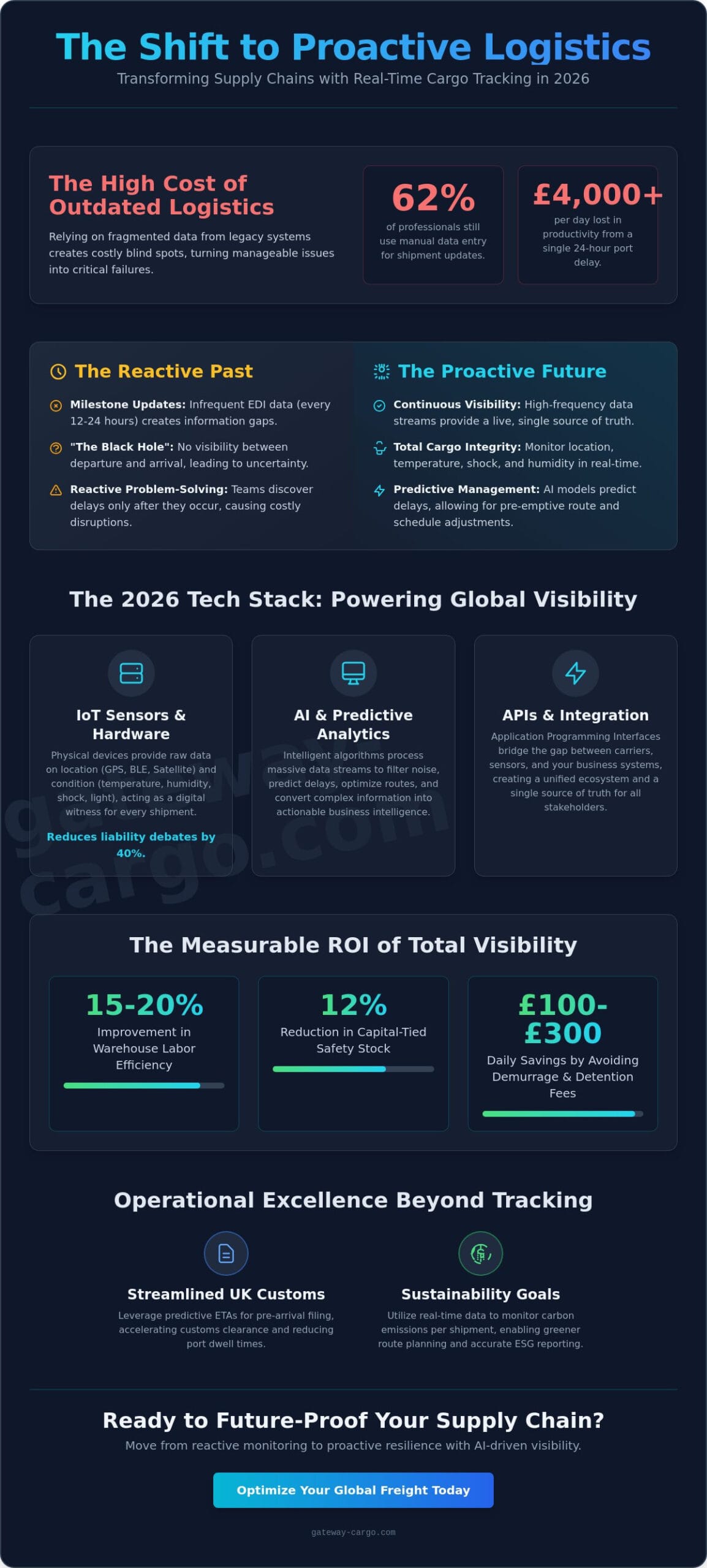
Did you know that 62% of supply chain professionals still rely on manual data entry for shipment updates, even though a 24-hour delay at a major hub like Felixstowe can cost a UK firm over £4,000 per day in lost productivity? You’ve likely experienced the frustration of unpredictable port congestion and inaccurate ETAs that lead to expensive warehouse bottlenecks. It’s clear that relying on fragmented data from different air, sea, and road carriers no longer meets the demands of a modern market.
This guide explores how advanced real-time cargo tracking solutions transform your logistics from a reactive process into a proactive competitive advantage. You’ll learn how to replace manual spreadsheets with automated reporting and bridge the gap between tracking and customs clearance. We’ll preview the strategic shifts necessary for 2026, focusing on how integrated data empowers your team to manage delays before they impact your bottom line. By the end of this article, you’ll have a clear roadmap for optimising your global freight operations with precision and confidence.
Key Takeaways
- Move beyond basic milestone updates to a continuous visibility ecosystem that integrates IoT hardware and data analytics for a smarter supply chain.
- Discover how the 2026 tech stack utilises APIs and satellite sensors to power robust real-time cargo tracking solutions across global freight networks.
- Shift from reactive monitoring to proactive resilience by using AI models to predict delays and optimise routes amidst geopolitical and environmental shifts.
- Streamline UK customs clearance through pre-arrival filing and meet corporate sustainability goals with real-time carbon emission monitoring per shipment.
- Leverage bespoke dashboards and the Insights portal to transform raw tracking data into actionable business intelligence tailored to your specific industry requirements.
Beyond the Map: The Strategic Value of Real-Time Cargo Tracking
Real-time cargo tracking solutions in 2026 represent more than just dots on a digital globe. This ecosystem integrates robust hardware sensors, cloud-based software, and predictive data analytics to provide a single source of truth for every shipment. By utilising Real-time locating systems (RTLS), businesses can capture granular data points ranging from precise GPS coordinates to internal container temperatures and shock alerts. This shift marks a transition from reactive logistics to proactive supply chain orchestration. It’s about moving from the basic question of “where is it?” to the strategic understanding of “when will it arrive, and what is its condition?”
Why Milestone Tracking is Obsolete in 2026
Legacy freight forwarding often suffered from the “black hole” problem. You knew when a ship left Shanghai and when it arrived in Felixstowe, but the weeks between remained a mystery. In 2026, simple “vessel departed” notifications don’t meet the needs of modern lean manufacturing. Production lines require sub-hour precision to manage just-in-time components effectively. Legacy EDI systems, which often update only every 12 to 24 hours, cannot compete with high-frequency data streams. These modern streams provide constant updates, eliminating the uncertainty that leads to costly production halts or missed retail windows.
The ROI of Total Supply Chain Visibility
The financial benefits of real-time cargo tracking solutions are measurable and immediate. Total visibility allows logistics teams to significantly reduce demurrage and detention fees. These penalties can cost UK importers £100 to £300 per container every day if they aren’t managed correctly. By predicting delays before they happen, companies can re-route shipments or adjust haulage schedules. This data improves warehouse labour efficiency by 15% to 20% because teams aren’t waiting for “no-show” deliveries.
Integrating these data streams requires a modern freight forwarder capable of translating raw sensor data into actionable insights. Higher inventory turnover and reduced safety stock levels—often by as much as 12%—directly improve cash flow and reduce capital tied up in storage. Beyond the balance sheet, transparency builds a psychological bridge with the end-customer. Sharing live data creates a sense of reliability and trust that static email updates cannot match. It transforms the supply chain from a back-office function into a powerful competitive advantage.
The 2026 Tech Stack: How IoT, AI, and APIs Power Global Visibility
Modern real-time cargo tracking solutions rely on a multi-layered architecture that bridges the gap between physical assets and digital intelligence. At the base, the physical layer utilises GPS for outdoor positioning, Bluetooth Low Energy (BLE) for warehouse-level precision, and satellite IoT for remote maritime routes where cellular coverage fails. This hardware generates massive volumes of raw data. AI then processes these streams, filtering out “noise” such as GPS drift or redundant pings to establish a single source of truth. Implementing AI-driven cargo visibility allows logistics teams to move from reactive troubleshooting to predictive management. Cybersecurity remains a critical pillar, as UK firms faced a 15% increase in supply chain cyber-attacks in 2024. Protecting this interconnected web requires end-to-end encryption and robust authentication protocols to ensure shipment data remains confidential.
IoT Sensors and Condition Monitoring
Visibility in 2026 extends far beyond simple coordinates. Advanced sensor suites now monitor temperature, humidity, shock, and light exposure to detect unauthorised container openings. High-value goods, particularly pharmaceuticals and electronics, require these specialised sensors to maintain compliance with UK MHRA standards or to prevent insurance disputes. A single shock sensor can identify the exact moment a crate was mishandled, reducing liability debates by 40%. In 2026, IoT sensors serve as the definitive digital witness for cargo integrity by adhering to the unified 5G-RedCap (Reduced Capability) standard for low-power, high-reliability data transmission.
API Integration: The Glue of Intermodal Logistics
Data fragmentation often hinders global trade, but APIs (Application Programming Interfaces) solve this by connecting disparate systems. These tools facilitate seamless data hand-offs between air cargo providers and road hauliers. This “plug-and-play” connectivity allows businesses to sync tracking data directly with ERP systems like SAP or Oracle, eliminating manual entry. Standardised APIs help overcome the historical silos within international shipping services, ensuring that a shipment’s status is updated across the entire network in under 200 milliseconds. If you’re looking to optimise your supply chain architecture, selecting a partner with open API capabilities is essential for long-term scalability. This technical cohesion ensures that every stakeholder, from the warehouse manager to the end customer, views the same real-time data simultaneously.
Predictive vs. Reactive Tracking: Turning Data into Resilience
Traditional logistics often faces the criticism that knowing where a container is doesn’t actually stop it from being late. This is true for reactive systems that merely report historical data. Modern real-time cargo tracking solutions have moved beyond this limitation by integrating predictive analytics. Instead of simply confirming a delay has occurred, these systems use AI models to evaluate variables like satellite weather patterns, port productivity rates, and geopolitical shifts. By processing thousands of data points, the software identifies a potential bottleneck five days before the vessel reaches the terminal.
Static delivery dates are a significant risk to your business operations. Relying on a fixed ETA leads to missed warehouse labour slots and disappointed end-customers. Dynamic ETA technology replaces these guesses with live, rolling updates. In 2025, industry data indicated that companies using dynamic ETAs reduced their “failed first delivery” rates by 18%. This foresight allows logistics managers to adjust schedules before a delay impacts the bottom line.
A recent case study highlights this shift in strategy. During a period of intense port congestion at major UK hubs, a high-volume shipper utilised predictive data to identify a 72-hour backlog before their vessel arrived. By accessing this intelligence early, they diverted the cargo to a less crowded secondary port, saving approximately £12,000 in potential demurrage fees and maintaining their retail distribution timeline.
Anticipating Disruptions Before They Occur
Effective logistics management relies on “Exception Management.” This strategy ensures your team doesn’t waste time monitoring the 95% of shipments moving on schedule. Instead, the focus stays entirely on the 5% of “exceptions” that require intervention. Real-time cargo tracking solutions trigger automated alerts only when a deviation is detected. This precision allows for advanced tactics like “slow steaming.” If the AI predicts a port berth won’t be ready for three days, the vessel can reduce speed to save fuel costs without missing the actual window of opportunity. Our logistics specialists then interpret these AI alerts to provide bespoke advice on the best course of action.
Dynamic Routing and Intermodal Flexibility
Resilience requires the ability to change direction mid-transit. If predictive data suggests a rail strike or a major road closure will stall your freight transport, you can pivot to alternative modes. This might mean switching from ocean to air freight at a transshipment hub if a delay escalates beyond an acceptable threshold. Optimising the final mile is equally critical; using real-time traffic data ensures delivery vehicles avoid local gridlock. While AI provides the data, the human-in-the-loop remains vital for complex decisions. Our experts combine technological speed with professional judgement to ensure your supply chain remains fluid regardless of external volatility.
Operational Excellence: Integrating Tracking with Customs and Sustainability
Operational excellence in 2026 requires a unified data layer where physical movement and regulatory compliance converge. Modern real-time cargo tracking solutions have evolved beyond mere location updates; they now serve as the primary engine for administrative efficiency. By synchronising live transit data with customs platforms, businesses can eliminate the traditional bottlenecks that occur at port boundaries and international borders.
Visibility as a Tool for Customs Compliance
Precise tracking data enables ‘pre-arrival’ filing, allowing HMRC to process documentation before a vessel even berths. This proactive approach reduces the likelihood of physical inspections by 15% for high-volume UK shippers. Automated alerts notify customs brokers the moment a vessel enters UK territorial waters, ensuring that clearance paperwork is prioritised and ready for immediate release. Maintaining this level of data accuracy is a fundamental requirement for achieving ‘Trusted Trader’ status. This status streamlines cross-border trade and reduces the administrative burden on internal logistics teams.
Tracking the Carbon Footprint of Every Shipment
The 2026 supply chain is measured by its environmental impact as much as its speed. Real-time cargo tracking solutions allow for the calculation of exact CO2 emissions based on actual distance travelled and specific vessel fuel consumption; this replaces the outdated reliance on industry averages. UK businesses must now align with the EU CSRD and similar local mandates that require granular reporting on Scope 3 emissions. Gateway Cargo supports these 2026 sustainability targets by integrating EV vehicle tracking and ‘green corridors’ into a single visibility portal. This ensures that ESG reporting is backed by verifiable, real-time data rather than retrospective estimates.
Efficiency is further enhanced through the integration of digital documentation. Linking e-BL (electronic Bill of Lading) and e-AWB (electronic Air Waybill) directly to the tracking portal creates a single source of truth for every stakeholder in the chain. It removes the risk of lost paper documents and accelerates the handover process at intermodal hubs. When documentation is digitised and tied to a live GPS signal, the entire supply chain becomes more resilient and responsive to disruptions.
Logistics leaders are using these insights to refine their routes and reduce wasted mileage. Gateway Cargo provides the technical infrastructure to turn these data points into actionable strategy. Our specialists help you bridge the gap between complex customs requirements and your sustainability goals.
Optimise your logistics strategy today: Explore our bespoke freight solutions
Gateway Cargo: AI-Driven Visibility for Seamless Global Logistics
Gateway Cargo approaches logistics through a lens of precision and technological integration. Our real-time cargo tracking solutions aren’t just off-the-shelf software; they’re engineered to provide a smarter supply chain. We recognize that raw data is useless without context. That’s why our “Insights” portal transforms complex telemetry into actionable business intelligence. It allows you to forecast potential delays and adjust inventory levels before a bottleneck impacts your bottom line. We’ve moved beyond the basic question of where a container is located. We focus on how that location affects your landing costs and customer commitments.
Technology is only as effective as the experts who manage it. While AI drives our digital strategy, our logistics specialists work as a dedicated extension of your team. They monitor exceptions 24/7. If a vessel is diverted or a UK port faces a sudden 48-hour disruption, our specialists intervene immediately. They don’t just report the problem; they execute the solution. This human element ensures that your freight stays moving even when global conditions become unpredictable.
Bespoke Solutions for Complex Supply Chains
A “one size fits all” tracking app fails when applied to specialized industries. In the Healthcare sector, a two-degree temperature fluctuation can ruin a shipment of pharmaceuticals. In Automotive logistics, a delayed component can halt a Just-in-Time production line. We build custom dashboards tailored to these specific requirements. By integrating warehousing and distribution data into your global tracking view, we eliminate the blind spots that usually occur during the final mile. You get end-to-end intermodal visibility through a single, reliable partner. This unified approach reduces administrative overhead and improves data accuracy across your entire network.
Ready to See the Future of Your Freight?
The transition from reactive to proactive logistics is the defining challenge for 2026 supply chains. Relying on historical data isn’t enough to remain competitive in the UK market. You need a digital ecosystem that anticipates change. Gateway Cargo provides the tools and the expertise to make this shift seamless. We invite you to explore our platform and see how AI-driven insights can transform your operations. Our team is ready to demonstrate how we can optimise your specific routes and cargo types. Contact Gateway Cargo for a bespoke tracking consultation and take the first step toward a more resilient, smarter supply chain today.
Securing Your Competitive Edge in the 2026 Global Supply Chain
The transition from reactive monitoring to predictive intelligence defines the next era of logistics. By 2026, industry reports from Gartner indicate that 75% of supply chain organisations will rely on advanced visibility tools to navigate complex trade lanes. Adopting real-time cargo tracking solutions isn’t just about knowing a container’s location. It’s about leveraging IoT and AI to anticipate disruptions before they impact your bottom line. Integrating these systems with customs clearance and the UK’s Border Target Operating Model creates a more resilient operational framework.
Gateway Cargo provides the expertise needed to navigate these technological shifts. Our AI-driven digital strategy and bespoke freight solutions ensure your goods move efficiently across borders. We prioritise a proactive sustainability integration, helping you align with the UK’s net-zero targets while maintaining peak operational efficiency. You don’t have to manage these complexities alone. Our specialists work as part of your team to turn logistics data into a strategic advantage.
Request a Demo of Our AI-Driven Tracking Solutions
Let’s build a smarter, more transparent supply chain together.
Frequently Asked Questions
What is the difference between GPS and AIS tracking for ocean freight?
GPS provides the exact location of the cargo unit using satellite signals, while AIS tracks the vessel’s position through VHF radio or satellite transponders. GPS is essential for real-time cargo tracking solutions because it monitors the container even after it leaves the ship. AIS only tells you where the boat is. Most UK port operators now require AIS for safety, but cargo owners rely on GPS for door-to-door visibility.
Can real-time tracking help reduce my insurance premiums?
Implementing real-time tracking can reduce insurance premiums by up to 15% according to recent industry reports. Insurers favour companies that mitigate risk through proactive monitoring. If cargo is stolen or damaged, real-time data provides an immediate audit trail. This transparency helps claims adjusters settle disputes 40% faster than traditional methods. It’s a strategic move for UK businesses looking to lower their total cost of risk in 2026.
How accurate are AI-generated ETAs compared to carrier schedules?
AI-generated ETAs are approximately 25% more accurate than standard carrier schedules. Carrier timelines are often static and don’t account for port congestion at Felixstowe or Southampton. AI models analyse 10 years of historical data, current weather patterns, and real-time vessel speeds to predict delays. This allows logistics managers to adjust their downstream operations three to five days before a delay actually occurs, ensuring a smarter supply chain.
Does real-time tracking work for LCL (Less than Container Load) shipments?
Real-time tracking is fully functional for LCL shipments through the use of IoT sensor tags placed directly on the pallet or crate. While carrier tracking might only show the container’s progress, individual sensors provide visibility throughout the consolidation and deconsolidation process. In 2024, 65% of UK freight forwarders adopted these small-form sensors. They ensure you don’t lose sight of your goods when they’re grouped with other shipments.
What happens to tracking data when cargo moves between different transport modes?
Tracking data is synchronised through cloud-based platforms using APIs to ensure a continuous visibility chain during transport mode changes. When cargo moves from a vessel to a UK rail link, the system handovers the data stream without a gap. This eliminates the “black hole” effect often seen at major hubs like the London Gateway. Modern software integrates these disparate signals into a single dashboard for seamless monitoring across intermodal routes.
Is it possible to track the internal temperature of my cargo in real-time?
You can track internal temperatures in real-time using smart reefer containers or independent IoT data loggers. These devices transmit temperature, humidity, and light exposure every 15 minutes via cellular or satellite networks. If the temperature deviates by more than 2 degrees Celsius from the set point, the system triggers an automated alert. This technology is vital for the 30% of UK food imports that require strict cold chain compliance.
How does real-time tracking integrate with my existing ERP system?
Real-time cargo tracking solutions integrate with existing ERP systems like SAP, Oracle, or Microsoft Dynamics via RESTful APIs. This connection allows your procurement and warehouse teams to see live shipment statuses directly within their familiar workspace. Data synchronisation typically happens in less than 60 seconds. Automating this flow removes the need for manual data entry and reduces human error by an estimated 90% across the supply chain.
What are the costs associated with implementing high-level cargo visibility?
Implementing high-level visibility typically involves a subscription fee ranging from £20 to £75 per shipment depending on the sensor requirements. Hardware costs for reusable IoT trackers have dropped by 30% since 2022, making them more accessible for mid-sized UK enterprises. While there’s an initial setup cost for API integration, the return on investment is often realised within 12 months through reduced demurrage fees and improved inventory management.